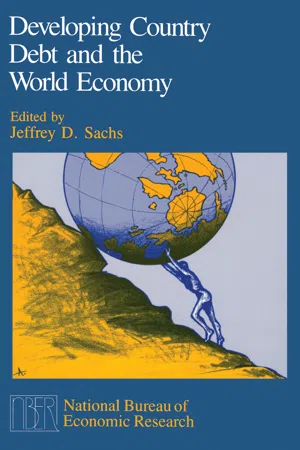
For dozens of developing countries, the financial upheavals of the 1980s have set back economic development by a decade or more. Poverty in those countries have intensified as they struggle under the burden of an enormous external debt. In 1988, more than six years after the onset of the crisis, almost all the debtor countries were still unable to borrow in the international capital markets on normal terms. Moreover, the world financial system has been disrupted by the prospect of widespread defaults on those debts. Because of the urgency of the present crisis, and because similar crises have recurred intermittently for at least 175 years, it is important to understand the fundamental features of the international macroeconomy and global financial markets that have contributed to this repeated instability.
Developing Country Debt and the World Economy contains nontechnical versions of papers prepared under the auspices of the project on developing country debt, sponsored by the National Bureau of Economic Research. The project focuses on the middle-income developing countries, particularly those in Latin America and East Asia, although many lessons of the study should apply as well to other, poorer debtor countries. The contributors analyze the crisis from two perspectives, that of the international financial system as a whole and that of individual debtor countries.
Studies of eight countries—Argentina, Bolivia, Brazil, Indonesia, Mexico, the Philippines, South Korea, and Turkey—explore the question of why some countries succumbed to serious financial crises while other did not. Each study was prepared by a team of two authors—a U.S.-based research and an economist from the country under study. An additional eight papers approach the problem of developing country debt from a global or "systemic" perspective. The topics they cover include the history of international sovereign lending and previous debt crises, the political factors that contribute to poor economic policies in many debtor nations, the role of commercial banks and the International Monetary Fund during the current crisis, the links between debt in developing countries and economic policies in the industrialized nations, and possible new approaches to the global management of the crisis.
Developing Country Debt and the World Economy contains nontechnical versions of papers prepared under the auspices of the project on developing country debt, sponsored by the National Bureau of Economic Research. The project focuses on the middle-income developing countries, particularly those in Latin America and East Asia, although many lessons of the study should apply as well to other, poorer debtor countries. The contributors analyze the crisis from two perspectives, that of the international financial system as a whole and that of individual debtor countries.
Studies of eight countries—Argentina, Bolivia, Brazil, Indonesia, Mexico, the Philippines, South Korea, and Turkey—explore the question of why some countries succumbed to serious financial crises while other did not. Each study was prepared by a team of two authors—a U.S.-based research and an economist from the country under study. An additional eight papers approach the problem of developing country debt from a global or "systemic" perspective. The topics they cover include the history of international sovereign lending and previous debt crises, the political factors that contribute to poor economic policies in many debtor nations, the role of commercial banks and the International Monetary Fund during the current crisis, the links between debt in developing countries and economic policies in the industrialized nations, and possible new approaches to the global management of the crisis.