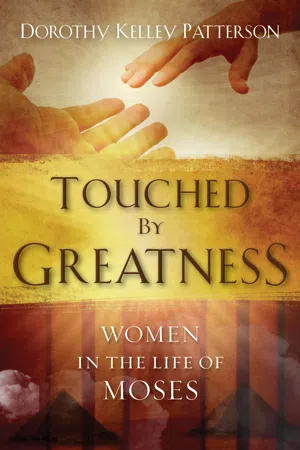
- English
- ePUB (mobile friendly)
- Available on iOS & Android
eBook - ePub
Information
Publisher
Christian Focus PublicationeBook ISBN
9781845509835
Year
2011
MOSES: A DIFFICULT MAN
As a towering personality in the history of Israel, Moses was born with neither a birth announcement nor the accompaniment of supernatural phenomena. Both Samson in the Old Testament and John the Baptist in the New Testament were distinguished by these criteria—Samson’s parents (Manoah and his wife) received the word of his birth from the Angel of the LORD (Judg. 13:3, 10-11, 21, 24), and John’s birth was announced to his father Zacharias (Luke 1:13) and to Mary, the relative of his mother Elizabeth (Luke 1:36). Both mothers of these prominent men in biblical history were declared barren, making their respective births an amazing blessing (Judg. 1:2; Luke 1:7). However, the birth of Moses and his rise to leadership were executed in the midst of ordinary lives and in the course of daily activities. Moses remains an enigma on the pages of history.
Although the descendant of unknown desert nomads and the son of enslaved Israelites, this uncommon man Moses, through the providence of God, was reared as a prince in Egypt. Having led his people out of Egypt, on one hand, and then into the wilderness on the other, this commoner prince could be loved and hated, embraced and rejected, admired and despised almost simultaneously! It all depended on who was living and who was dying, who was winning and who was losing.
A Hebrew born in Egypt while the Hebrews were in captivity, probably at the beginning of Egypt’s eighteenth dynasty (about 1525 BC), Moses was brought up in the Egyptian royal household as the adopted son of the pharaoh’s daughter, possibly the famous Hatchepsut. As the daughter of Thutmose I, Hatchepsut assumed the power of the pharaoh after the death of her brother/husband Thutmose II. She acted officially as regent but functioned as the ruler during the years her stepson Thutmose III was too young to assert himself enough to outrule her.
Although some would question the possibility of anyone with Hebrew ethnicity being allowed to grow up in Pharaoh’s household, Thutmose III (1457–1425 BC) definitely brought in the princes of western Asian kings who were subject to Egypt. He wanted them to be trained in Egyptian ways before they replaced national rulers, who would die and leave open thrones. The same practice could have been in place in earlier dynasties.1
The most natural reading of the text indicates that the name “Moses” was assigned by Pharaoh’s daughter. Names were important in the ancient world. Often the name suggested a character trait the parents envisioned for their child to pursue. Our first granddaughter was named “Abigail,” meaning “the joy of the Father” (see 1 Sam. 25). It is our prayer that as she is now our joy from the heavenly Father so she will be to those who cross her path for all her life!
On the other hand, some parents may assign a name meaning the exact opposite of what they want their child to be. Such must have been the case with “Nabal,” meaning “fool.” Unfortunately, he lived the life of a fool, which caused his own destruction (1 Sam. 25:25).
Sometimes parents used popular names expressing their faith by joining the divine name with a noun or verb, such as “Daniel,” meaning “God is my Judge,” or “John,” meaning “YAHWEH [the personal name of God in Hebrew] has been gracious.” Also the name of the child’s father might be attached to his name to remind the child of his godly ancestral heritage, as in “Simon bar-Jonah,” meaning “Simon, son of Jonah,” or to distinguish among children with the same names, such as “James and John [very common names even in the time of the first century], sons of Zebedee.”
Often circumstances surrounding the child’s birth or some other event in his life influenced the choice of a name. Hannah named her son “Samuel” (literally “heard by God”) because she asked the LORD for a son. Perhaps the name of Moses fits this category?
Although the name is associated with a Semitic root, meaning “bring” or “take out” or “remove,” many scholars consider the name to be Egyptian in origin. In that case, Egyptologists define its meaning as merely “boy” or “son.” The root is common in Egyptian names, such as Ahmose, Amasis, Thutmose, etc. Some suggest that the daughter of Pharaoh, who rescued the Hebrew infant from the Nile, chose the name for its Hebrew meaning; but presumably, given her own heritage, she was working from Egyptian meanings, even though she could have had some familiarity with the Hebrew language. In any case, the Bible states that she named the child Moses because she “drew him out of the water” (Exod. 2:10). This latter phrase of explanation could have merely been the inspired words passing through the author to the biblical text.
In the spiritual realm, although Moses came from the womb of a woman with faith in the God of Israel, he spent the years of his childhood among people who believed in a multitude of deities. The Egyptians worshiped gods of all shapes and forms, including the person of the pharaoh, who considered himself divine. Yet from the context of Egyptian polytheism, Moses emerged with allegiance to Hebrew monotheism, and he proclaimed his own faith commitment to the God of Israel alone. He was born into the home of a Hebrew slave; he spent his childhood and young adult years in the royal palace of Egypt; then he reclaimed his humble beginnings to identify himself with his enslaved people; finally he went down in history as the formidable leader of one of the greatest nations of antiquity—a nation that remains a power even until this modern era.
Moses began his work as a proactive seeker of justice at an early age. When he left the sheltered environment of the palace to explore the land of Egypt, he not only learned that the Israelites had been subjected to slavery in order to build garrison cities and monuments for Pharaoh, but he also observed that they had been mistreated and oppressed. This oppression probably began with the Hyksos, Egyptian pharaohs who, because of their Semitic origin, may have considered the Israelites to be their bitter enemies.
As the Hebrews rapidly increased in number, their work load was also expanded to increase their oppression and to discourage any rebellion. Moses’ exile was forced because he, with righteous indignation, interfered in a labor dispute, killing an Egyptian guard who was abusing a Hebrew worker. There is no indication that Moses intended to kill the man; rather, that seems to be the tragic outcome of the confrontation. And thus the career of “the great liberator” began as he fled to the wilderness of Midian (about 1485 BC; see Acts 7:23).
Although Moses was not aware of any witnesses to the incident, other than the man he rescued, he knew the possibility that talk among the slaves would eventually put him at risk. He would be forever identified with the Hebrews of his ancestry rather than the Egyptians of his adoptive household. That would make his interference on behalf of a Hebrew man a revolutionary and treasonous act. Pharaoh did indeed put him under an edict of death. This edict of the current ruler was just as deadly as the first one issued by the pharaoh who was on the throne during Moses’ infancy. He fled for his life.
Moses appeared to be a reluctant leader. He expressed humble inadequacy for the task; when approaching his people, he claimed ignorance of what to say about God; he questioned his own credibility; he maintained his lack of eloquence to speak or any charisma to move people; he confessed his own lack of self-confidence. Yet Moses showed himself from the beginning to be a man of courage and resourcefulness. He had no tinge of cowardice. The bravado and machismo that has often characterized men had been hammered into genuine courage through the “fear of the LORD” that beat within the breast of Moses. Temporal and passing boldness had been refined into permanent and abiding faith.
In expressing his reluctance to lead the Hebrews, Moses, even though he was under sentence of death in Egypt, never used his own safety as a reason for refusing to lead the people of Israel out of the land. Moses is recognized by the Hebrew people as their greatest leader, most notable prophet, and the most powerful personality in their history until the present day. The faith of Moses became the telescope by which his people could bring YAHEWH God into human focus.
When plagued by rebellion, complaints, and ridicule, Moses did on occasion lose his temper, and he did experience depression and discouragement. He may have allowed his ministry duties to shortchange his family responsibilities. The text does not allude to his investment of time or attention to his wife and children and even notes lengthy periods of separation from them. This seeming neglect must have exacted a painful cost for him and for them as well. There is no evidence of loving intimacy between Moses and his wife nor any hint of tender interaction between him as a father with his children. While one dare not make dogmatic conclusions from an argument of silence, a careful reading of what is recorded in Scripture does not give positive words about Moses as husband and father. Perhaps this could serve as a warning to modern Christian leaders to set a public example of investing in their wives and children as part of their respective ministries.
The ultimate tragedy for this man, however, is that after all he endured in the forty-year trek through the wilderness, he was denied entry to the Promised Land. Disobedience is costly, even for great men. Nevertheless, the evaluation of this man, including the strength he portrayed through the providences of God, becomes more meaningful against the backdrop of his weaknesses.
When Moses returned from his exile in the wilderness of Midian to confront Pharaoh and demand the release of his people, he used different strategies to achieve his goal. He began with talking and negotiating, while continuing to stand up for what was right, refusing to back down on the assignment God had given him. However, when the talking and standing proved inadequate, he was willing to push forward whatever the cost! God used Moses to lead the people of Israel out of Egypt to freedom (about 1445 BC; see Acts 7:30).
As with any other powerful leader, the life of Moses intersected with hundreds of other lives. As with any public figure, the lives of those he touched were not always close enough to see or touch. Nevertheless, these lives were permanently changed by his presence, regardless of how they might have felt about him personally.
Through his birth family Moses’ ancestry for both father and mother came through Levi, whose lineage became the priestly line, beginning with Aaron his brother (Exod. 6:16-20). Moses became a prince of Egypt via his adoption by a member of Pharaoh’s household. Yet above and beyond his heritage by birth and adoption, Moses was set apart by God as a prophet. Throughout the generations, the Hebrew people have continued to honor him as their great deliverer.
This book about the women in Moses’ life is based first and foremost on the facts recorded in the biblical narrative, partly on the normal course of events that would have accompanied the career of a man like Moses, and with some of my own perceptions of the feelings of these women who shared his life. The latter study on Egyptian women is much more subjective than the former but provides an insightful way to take a more personal look at the life of a very private man. Actually very few credible historical sources offer much insight into the lives of Egyptian women. In those cases where information is available, the women chronicled are from the privileged class. These tidbits from their lives are found chiseled into monuments or embedded in myths and stories. The women are identified as daughters, wives, and mothers of kings, officials, and priests.
One of the most interesting observations for a woman who looks closely at the man Moses is the fact that many of the key players in his life are women. Humanly speaking, those women must have helped to determine the events of his life. Many of the women acted courageously and defied tyranny and oppression in so doing. They were wise and resourceful in handling tough and seemingly impossible situations. Some women, a few of whom were nameless, took remarkable personal risks in order to safeguard the life of Moses when, as a baby, he must have been a typically winsome Hebrew infant.
A mother defied the orders of Pharaoh, as did the midwives who attended her during the delivery of her son. A young but precocious sister stood by in a hostile environment and dared to speak to a member of the royal family. She was a partner in a daring conspiracy that would indeed save the condemned baby boy. The daughter of Pharaoh saved a condemned child against her father’s orders, engaged a slave woman to serve as his “wet nurse,” and then reared the condemned child as a prince of Egypt.
Humanly speaking, without these women, there would have been no liberator for the Jews. Yet even with all that these gifted women had to offer, Moses would not have survived to lead his people without the overarching providence of God and His intervention again and again. Moses began his life under tumultuous conditions. He was born into slavery; immediately threatened by death; irrevocably torn from his birth family when he was weaned from the breast of his mother; he was adopted into Pharaoh’s household and thus reared in the stronghold of the enemy. Then he was bereft of his adoptive family through a self-imposed exile. However, in moving through these adversities, God was ever present and working. Even while alone and removed from the family ties of birth and childhood, Moses was anointed by God for his mission, and God called him to the leadership of the Israelites.
Midwives, not male family members or men in the community, are mentioned in the Bible as those who dared to protect the infant Hebrew boys and let them live rather than to obey Pharaoh’s edict of death. Moses’ mother Jochebed, not his father, is cited as being determined to hide him rather than passively to allow him to be murdered. She kept him hidden during the first three months of his life, and she devised and executed the plan for his rescue (Exod. 2:2-3). Again, Miriam, the sister of Moses, and not his brother Aaron (who as a toddler at the time was not really a candidate for such a clandestine operation) risked her life to watch over her baby brother. She then boldly stepped forward to offer assistance to the royal princess who found the baby (Exod. 2:4, 7-8). It was a daughter, and not a son, of Pharaoh who found the infant and had enough compassion to risk the anger of Pharaoh by rescuing him (Exod. 2:5). Even Moses’ wife Zipporah intervened in a divine confrontation caused by her husband’s disobedience and saved his life (Exod. 4:24-26).
These women identified with Moses, especially those who were part of his household, and must have quickly learned that they were living with a difficult man. Moses moved from his position as a prince of Egypt, living within the household of Pharaoh, to become the leader of the Hebrews; but the women associated with him, with the exception of his adoptive mother, were not royalty! Each of these women, even the daughter of Pharaoh, found herself cast in Moses’ shadow at some point in history; yet none was singled out by Moses for words of praise and honor.
Moses was stubborn and bold; but the most prominent women in his life were certainly not passive. He was disobedient to higher powers (i.e., Pharaoh). The women in his life were not always submissive to the authorities in their lives. In fact, one could identify the key women in Moses’ life as “wild women” in a sense, for some of them did radical things, exposing themselves to danger. Yet there were those times in his life when Moses himself was more passive than proactive. He was a visionary leader; the women around him were creative and resourceful. Ultimately, Moses, as well as the women in his life, was humbled before the Creator God.
In this volume, you will have opportunity to consider what the Bible and extra-biblical sources have to say about these women who touched the life of Moses. Obviously the chapter lengths will vary according to the nature of the role each woman played in the life of Moses and the amount of information historical sources record about the woman. However, each woman is important in her own right and has a role to play in the life of Moses and within her own era of history. Each woman in some sense provides a legacy to be passed throughout the generations. The lives of these women are being viewed and, to a certain extent, evaluated by another woman. Perhaps the reader’s question is this: What goes into the making of a heroine? More important to this study is the question: What equips a woman, regardless of her giftedness or station in life, to be used mightily of God?
1 James K. Hoffmeier, Israel In Egypt: The Evidence for the Authenticity of the Exodus Tradition (New York: Oxford University Press, 1996), 142.
JOCHEBED:
THE MOTHER
WHO BORE HIM
Jochebed, whose name means “honor of God” or “God is glory,” was a classic Hebrew woman of faith who believed God would prevail whatever the odds. Thus she was willing to wait for His deliverance. She had clothed her faith in courage and modeled it through her works.
By faith Moses, when he was born, was hidden three months by his parents, because they saw he was a beautiful child; and they were not afraid of the king’s command (Heb. 11:23).
However, Jochebed was also a model mother who was committed to her part in protecting her child in the womb and bringing him into the world even under the sentence of death. But then, she was also willing to part with him and entrust his rearing to a stranger in order to ensure the saving of his life. She had faith in God’s faithfulness and believed God would save her child, but she made herself available to help!
Jochebed did not appear to be depressed or despondent about the seemingly impossible task before her. After caring for and hiding the child at home for three months, she determined to entrust the safety, and even the life, of her child to God rather than continue to depend upon her own strategies for concealing the child. She faced impossible and fateful circumstances, which appeared to bring only suffering and death, but she determined to beat them. Someone has said that “mothers begin saying good-bye to their children from the moment they are born.” And that was more true of Jochebed than it is for most of us. Yet she demonstrated superbly how maternal love for a child sometimes demands letting go of the child for the good of both.
Mothers face such dilemmas even today. My darling niece Sarah was released by her young, unmarried birth mother, who realized that she was not prepared for the responsibilities of motherhood. Just as a teenaged girl walked through the painful process of releasing a child, my sister Eileen was in the throes of sorrow because of irrevocable barrenness. God brought representatives of the birth mother and the adoptive mother together so that the sorrow of the mother releasing her child was mingled with the joy of the mother who would receive and nurture that precious life. The emptiness of infertility was hallowed by the joy of sacrificial unselfishness.
Whatever the dangers, Jochebed was committed to protecting her baby for the long haul. How many women have loved their babies enough to be willing to part with the baby after birth in order to give the baby life! Jochebed was willing to do what had become the best thing to do for that time! Such a sacrifice may be more difficult for a mother than putting her own life on the line to ensure her baby’s safety through pregnancy and delivery. Certainly, pregnancy and childbirth have always had dangers for women. Death during childbirth was quite common in all pre-modern societies, a fact evidenced from burial sites subsequently uncovered by archaeologists.
Nothing about Jochebed appeared until she was thrust into an untenable situation. As a young wife and mother, she gave birth to her third child. Jochebed saw her child’s potential and responded by doing what was necessary to assure the child’s opportunity to realize his potential. Vision is as important as the courage to take action on that vision. She described this son as “beautiful” (the same Hebrew word tov translated elsewhere as “good”), taken to mean that he was a fine, handsome child (Exod. 2:2). Actually this observation is a reminder of the creation account found in Genesis, in which the phrase “God saw that...
Table of contents
- Reviews
- Title
- Indicia
- Dedication
- Contents
- Preface
- 1. Moses
- 2. Jochebed
- 3. Puah And Shiphrah
- 4. Miriam
- 5. Pharaoh's Daughter
- 6. Zipporah
- 7. Grieving Mothers
- 8. Reluctant Travelers
- 9. The Ethiopian
- Conclusion
- Other Titles
- Feminine Threads
- Christian Focus
Trusted by 375,005 students
Access to over 1.5 million titles for a fair monthly price.
Study more efficiently using our study tools.