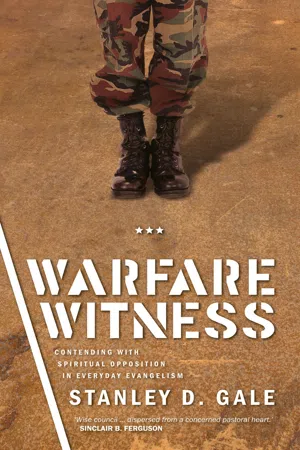
eBook - ePub
Warfare Witness
Contending with Spiritual opposition in everyday evangelism
- English
- ePUB (mobile friendly)
- Available on iOS & Android
eBook - ePub
Information
Publisher
Christian Focus PublicationeBook ISBN
9781845508128
Year
2005I
ENLISTMENT
1
Commissioned for Service
Twenty-five. That was the magic number. American presence in Vietnam was in its final days. President Johnson had issued an order to bring the troops home. The deployed troops were thinning. As a result the military draft was not as comprehensive as it had been. When the time came for me to enter the draft, each date of birth was assigned a number and a lottery was held to determine which numbers would be conscripted into military service in an unstable world situation. The cut off that year was twenty-five. My number was 193.
Since that time, America’s standing army has been all volunteer. Young people today must still register for selective service, but there is no draft as there had been from 1948 to 1973. People now enter the military as a matter of personal choice.
Nonetheless, in America and around the world there remains a draft, a required participation in military service. The ranks of these soldiers cut across national borders, across political boundaries, across ethnic and racial lines. God describes these military personnel as citizens of heaven, forming a holy nation, subjects of a kingdom, and soldiers of the cross. If you have confessed Jesus Christ as your Lord, then you have been conscripted into his service. Your term of service is the term of your life in the world as his disciple.
COMMISSIONED
Where do we find our papers to report for service in Christ’s army? Perhaps our most direct orders, carrying the official seal of our Lord, are contained in what is often called ‘the Great Commission.’ After his successful mission of salvation, Jesus spoke to his followers:
Then the eleven disciples went to Galilee, to the mountain where Jesus had told them to go. When they saw him, they worshiped him; but some doubted. Then Jesus came to them and said, ‘All authority in heaven and on earth has been given to me. Therefore go and make disciples of all nations, baptizing them in the name of the Father and of the Son and of the Holy Spirit, and teaching them to obey everything I have commanded you. And surely I am with you always, to the very end of the age.’
Matt. 28: 16–20 9
On the basis of newly received authority,10 Jesus Christ, the risen Lord, turns to those who have aligned themselves with him and gives them a parting command, marching orders for those who count themselves his disciples.
Such commissions are not new for God’s servants. Jeremiah, the prophet of the Lord around the time of the fall of Jerusalem in 586 BC, received a commission from the Lord.
The word of the LORD came to me, saying,
‘Before I formed you in the womb I knew you,
before you were born I set you apart;
I appointed you as a prophet to the nations.’
‘Ah, Sovereign Lord,’ I said, ‘I do not know how to speak; I am only a child.’ But the LORD said to me,
‘Do not say, ‘I am only a child.’ You must go to everyone I send you to and say whatever I command you. Do not be afraid of them, for I am with you and will rescue you,’ declares the LORD.
Then the LORD reached out his hand and touched my mouth and said to me,
‘Now, I have put my words in your mouth. See, today I appoint you over nations and kingdoms to uproot and tear down, to destroy and overthrow, to build and to plant.’
Jeremiah 1:4-10
Our commission as ambassadors of Christ follows much the same pattern. God comes to give Jeremiah a mission; Christ came to the disciples in Galilee. Jeremiah protests; some doubted Jesus. God asserts his authority; ‘All authority in heaven and earth has been given to Me,’ Jesus said. God commands Jeremiah to go to the nations; ‘Go and make disciples of all nations.’ God promises his presence and power for the duration of Jeremiah’s mission; ‘I am with you always, to the very end of the age.’
We stand in the prophetic line, proclaiming the message of God with which we have been entrusted. Not that we are vehicles of new revelation, but we are ambassadors of Christ, carrying his message, under his auspices and with his authority. We are called to venture out into an inhospitable, even hostile environment. Our Lord assures us of his presence. He also reminds us that he will use our message to achieve his purposes in the lives of those to whom we carry that word.
Every one who has come to know and follow Jesus Christ is given the responsibility to ‘make disciples of all nations.’ The line dividing Christ’s corps is not nation, but salvation. Peter describes us as a ‘holy nation.’ Paul says our ‘citizenship is in heaven.’ We belong to God, having been purchased for him by the blood of his Son. Our job is to go with the comprehensive, redemptive authority of our Lord to reach the entire world with the good news of his victory and deliverance.
God gives us a picture of the end result of Christ’s goal through us. He shows us a people from diverse backgrounds, believing Jew and Gentile alike, gathered around the throne of him who reigns, raising one voice:
And they sang a new song:
‘You are worthy to take the scroll
and to open its seals,
because you were slain, and with your blood
you purchased men for God
from every tribe and language
and people and nation.
You have made them to be a kingdom
and priests to serve our God,
and they will reign on the earth.’
Rev. 5:9-10
We are now to be engaged in that work, seeking worshippers of God in Spirit and truth, who give him glory both in this life and the life to come. God is at work through us forming the heavenly chorus of his kingdom. In its richest expression, evangelism is gathering worshipers for the heavenly chorus, where God’s people will sing the new song of life and hope in Christ with hearts tuned by his Spirit.
The command of Matthew 28 is aptly named a ‘commission.’ Our Lord is giving his disciples marching orders. He has conferred upon each of us who bear his name the authority and responsibility to carry the message of life, liberty, and the pursuit of true happiness to those still held hostage in the bonds of sin. The task given to us by Jesus is nothing less than a search and rescue mission. Our mission is not search and recovery that gathers dead bodies to bury. We deal in life, looking to bring from death to life.
I don’t intend to rehash the responsibility of the church to evangelize. That’s not news to most of us. The mandate to witness to others fits in the category of knowing we need to eat healthier or to pray more. We know it, but how seriously do we go about it? I don’t want to rehash our responsibility to bear witness to Christ, but to recast that mission in a military model. Seeing Christ’s command as a military commission is not only warranted by Scripture, it also provides a framework that captures the nature of the mission and cultivates what is necessary to carry it out.
A MILITARY MODEL
Your approach to something makes all the difference in the world in how you carry it out. Right now my children and their friends are entering a new phase of life. They’re graduating from college and entering the work force, or at least working at it. They are moving from being recipients of parental support to being co-laborers in society.
That transition is rough. It requires a whole different attitude, a new approach to life. It’s now that the umbilical chord is ultimately severed. With their newfound status comes newly gained responsibility to lead productive lives. It’s one thing to enter a business establishment as a carefree consumer. It’s quite another to be employed at the business as a conscientious worker. Loyalties, use of time, frame of mind all change.
How much more true is that of disciples of Jesus Christ? His lordship over us stretches beyond forty hours a week and stretches us in our priorities and goals. As his followers, we need to see ourselves in the light of this relationship and to conduct our lives in its redemptive reality. God’s work of redemption radically changes us, giving us meaning, purpose, and identity in communion with him.
God presents the work of redemption in decidedly militaristic terms, in the work of Christ to bring it about, of the church to carry it out, and of individual Christians to live it out. We’ll touch on each of these aspects here, although the entire book draws from Scripture to give shape to this model that frames our new lives in Jesus Christ.
Christ’s Mission. Christ’s work of salvation is painted in military terms, from anticipation to accomplishment to application. God’s promise of a Savior, on the heels of the fall in Genesis 3, is couched in terms of combat: ‘And I will put enmity between you and the woman, and between your offspring and hers; he will crush your head, and you will strike his heel’ (Gen. 3: 15). This seed of the woman would ‘crush’ the head of the serpent. That’s warfare talk. Two combatants are identified, one would inflict harm, the other would defeat.
As we look ahead to the fulfillment of this promise in the fullness of time, we see Jesus Christ, the seed of the woman, coming into this world for battle.11 He came to destroy the one who holds the power of death—the devil. He was incarnate to destroy the devil’s work. His ministry was full of encounters and conflict with enemy opposition. The culmination of his saving work is displayed in the Book of Revelation in terms of warfare, conquest and banishment.
And I saw an angel coming down out of heaven, having the key to the Abyss and holding in his hand a great chain. He seized the dragon, that ancient serpent, who is the devil, or Satan, and bound him for a thousand years.
When the thousand years are over, Satan will be released from his prison and will go out to deceive the nations in the four corners of the earth—Gog and Magog—to gather them for battle. In number they are like the sand on the seashore. They marched across the breadth of the earth and surrounded the camp of God’s people, the city he loves. But fire came down from heaven and devoured them. And the devil, who deceived them, was thrown into the lake of burning sulfur, where the beast and the false prophet had been thrown. They will be tormented day and night for ever and ever.
Rev. 20: 1–2, 7–10
Jesus came to wage war. His redemptive work is portrayed in military terms. The picture of the consummation of that work given to us in Revelation carries the image to its cosmic conclusion.
In all this we see the Lord Jesus not fighting for personal victory, but for the redemptive rescue of those held in the grip of sin’s power and condemnation.
When you were dead in your sins and in the uncircumcision of your sinful nature, God made you alive with Christ. He forgave us all our sins, having canceled the written code, with its regulations, that was against us and that stood opposed to us; he took it away, nailing it to the cross. And having disarmed the powers and authorities, he made a public spectacle of them, triumphing over them by the cross.
Colossians 2:13-15
Our salvation is the result of military intervention by our Lord. He subdued us to himself. He leads us in triumphal procession, captives of his grace, in the bonds of his love. When he says that he came to seek and to save those who are lost, he is referring to a military mission of mercy and meekness as the promised Messiah of God.
The Church’s Mission. Not only is the work of Christ cast in military terms, the church and its work are as well. We lay siege to the gates of hell. Jesus says that he will build his church. That building is set against the backdrop of spiritual opposition that seeks to overcome. The church operates in enemy territory and contends with enemy opposition. The mission of the church is decidedly militaristic.
Bob Hope recently died at the ripe age of 100. Not only was he renowned the world over as a comedian, he was noted for his many trips overseas to entertain the troops. He logged many hours and many miles to lift the spirits of the men and women on the field of battle, both by his presence and his humor. Bob Hope no doubt did wonders for morale. But as important and noble as that was, his work was mainly entertainment and not military. He provided a welcome diversion from the struggle, but his efforts were divergent from the military operation.
Morale of the troops is important. It helps to motivate us for the mission, not by serving as a diversion from the work, but by showcasing the grace that makes us part of it. While morale is important, it is not the mission. The church is not the USO,12 with a mission of hospitality and recreation. The church is the army on a mission of kingdom advancement. Not only do we need the proper model for service, we need to remember our role in it.
The church in this world is to be seen, and to understand itself, as the church militant, marching out to war. We are the church triumphant in that we fight in victory, not for victory. We are to savor now that triumph by Christ over sin, death, and the grave; yet the church triumphant looks to the church in heaven, removed from the field of battle in this world, in glory, at rest, fully and eternally enjoying the victory of our Lord.
Nowadays, we are an invading church as well as an inviting church. The covenant community of the Old Testament stood as a light to the nations. The true and living God was present there, dwelling with his people in mercy and grace. The temple attested to the presence and prominence of this God. It also spoke to the character of the nation itself as it followed his holy laws, both attracting the attention of the surrounding idolatrous nations, and serving as a welcoming beacon of light to the hope of salvation.
The new covenant community is still an inviting church and in much the same way. But to our mode of inviting, God has added the mandate of invading. The ‘go’ of our Lord’s Great Commission is the go of invasion. It is not the ‘go’ of a casual stroll or pointless wandering, but the go of military mission. We go to the nations not as tourists or as terrorists, but as ambassadors of life and hope. The church is not merely situated in the world; it is stationed here at the placement of our King with his orders in hand.
To ‘make disciples of all nations’ is a military mandate that casts the church in a military mode that sets the stage for a military offensive to rescue. Also in our Lord’s commission is a note of recruitment. Those enslaved to Christ are enfolded in the covenant community, the church, and so enlisted for the military service of the cross. When Jesus says in Matthew 28 that disciples are to be baptized in the name of the triune God, he is pointing to the building of the church—growth in the active forces of his army. Baptism is the sign of initiation into God’s covenant community, expressing alliance with the true God and agreement with his covenant promises. This means that taking vows of membership in Christ’s church carries the weight of being sworn in to his service.
The Christian’s Identity. Every local church has been established by her Lord as an outpost of his kingdom, the congregation his army, the members his soldiers. Paul calls those laboring with him for the sake of the gospel ‘fellow soldiers’ (Phil. 2: 25; Philem. 2). He urges Timothy to be a ‘good soldier of Christ Jesus’ (2 Tim. 2: 3). Soldiers are identified through military paraphernalia.
When we are drafted into Christ’s army we are issued a uniform. It’s rather strange at first. The typical uniform for a soldier on a field of battle is some sort of camouflage that blends in with the terrain. It would not be the brightest of ideas to wear a florescent orange uniform in combat. That would be like setting yourself up as a target for the enemy’s attention. However, our uniform is strange in that it runs counter to conventional wisdom. Our battle garb is white. If we were deployed in the Siberian winter wilderness that might be fine. We’d blend in like a polar bear in a snowstorm. But we are deployed in the darkness. Our uniform is the robe of Christ’s righteousness. Not only does that uniform make us stand out, it is designed to make us stand out. It carries the designer label of God’s wisdom. Our conspicuousness is actually part of our combat.
Our work is described as ‘waging war.’ Just as our uniform is issued at God’s design, so are the tools for the task. We are outfitted with weapons suitable for the nature of the combat we are called to undertake. Our tactics reflect military strategy, conducted in the wisdom of God. We stand on the truth against the assault of error. We pray against the opposition we face in mission. The model prayer of our Lord in Matthew 6 instructs us to pray ‘Your kingdom come,’ reminding us of our ultimate allegiance, our Lord’s militaristic means of its growth and our role in it as soldiers of the cross. Everything about us and our service is couched in militaristic terms.
RETURN TO ACTIVE DUTY
My brother-in-law is a colonel in the US Army. I should say, ‘was’ a colonel. He retired a few years ago and now receives his pension. When he was on active duty his life was consumed with the military. He was stationed at various bases throughout the world. Orders from his commanders directed his steps and dictated his address. He had people under him; people over him. Certain privileges and responsibilities belonged to him when he was on active duty.
But when he retired and entered civilian life, things changed dramatically. He became his own boss. He decided how he would spend his time and invest his life. The structure and demands no longer dictated his steps. While his military training no doubt stayed with him, shaping his outlook and way of doing things, all that became optional, dispensable.
Many in the church have fallen into the same mentality. With the downplaying of the military model given by our Lord for the work of the church and the role of believers, we have lost the edge of active duty. Evangelism and involvement have been reduced to options and confined to periodic participation in programs.
A major part of the indifference and malaise lies in the loss of the military framework resident in the church’s identity and the consequent distancing of the work of evangelism from the orders of our King. Evangelism has to be reclaimed from the list of offerings in the church’s assortment of programs for its members to choose or not. It has to be retrieved from the pastor’s desk where it has been dumped or from the mass evangelist where it has been outsourced. The mission given to his church by her Lord has to be recast as a commission in more than name only and reinstated as the marching orders for his spiritual army, of which every disciple is a soldier. Can you imagine an army at war ignoring the air raid sirens because they don’t want to tear themselves away from the latest episode of M*A*S*H, entertained by war instead of engaged in it? What would it be like fo...
Table of contents
- Reviews
- Title
- Indicia
- Contents
- About the Author
- Dedication
- Acknowledgements
- Foreword
- Preface
- Introduction
- Part I - Enlistment
- 1. Commissioned for Service
- 2. This Present, Evil Age
- 3. Kingdom Conflict
- 4. Unmasking the Enemy
- Part II - Equipment
- 5. Plundering Christ's Spoils
- 6. Spiritual Weapons
- 7. The Weapon of Prayer
- 8. Wielding Spiritual Weapons
- Part III - Engagement
- 9. The Theatre of Operations
- 10. Rules of Engagement
- 11. Flying the Colors of the Cross
- 12. Battle Ready
- Epilogue
- Author's Note
- Christian Focus
Trusted by 375,005 students
Access to over 1.5 million titles for a fair monthly price.
Study more efficiently using our study tools.