eBook - ePub
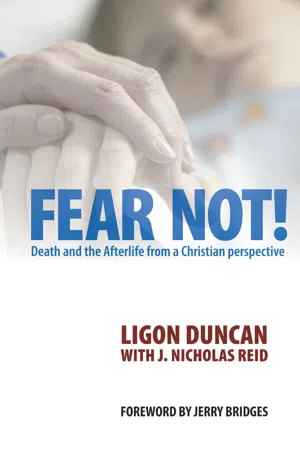
Fear Not!
Death and the Afterlife from a Christian Perspective
- English
- ePUB (mobile friendly)
- Available on iOS & Android
eBook - ePub
Information
Publisher
Christian Focus PublicationeBook ISBN
9781845506667
Year
2010CHAPTER ONE
What Is Death?
Resolved, to think much, on all occasions of my own dying, and of the common circumstances which attend death.
Jonathan Edwards
Dying to Know
In the wake of certain reading material in the public domain right now, Christians have become increasingly curious about the Bible's answers to various questions relating to death and the afterlife. But it is not just bizarre literature that raises questions about death. Many of the questions raised to me about death over the years have been profoundly personal, specific, and born out of an experience in one's own life and family. Whether death is expected, or considered tragic by all human standards, it raises questions.
The politicians wrote that in this world the only things that are certain are death and taxes. This statement has an element of truth to it. Death is most assuredly a reality for all of us. Every single one of us will deal – if we have not already dealt – with death personally in our own family and in the circle of our closest friends. Likewise, all of us, unless the Lord comes soon, will personally face death. That is why we are looking so intently at death, because death profoundly affects each one of us at the very core of who we are.
Dead Wrong
It should be of no surprise that our world today is confused about death. Many different views about death exist due to the multiple religious beliefs and worldviews in our society. If you believe that there is no God, and that this world evolved from a primitive protein in the explosion of some primary particle, then death is literally meaningless. If you have reduced life to just one sequence of cause and effect, one inexorable chain of events, then after death comes nothing. If you allow that sort of thinking to control the way you approach life and death, then you will approach both fundamentally differently than someone who engages life and death with a biblically informed, Christian worldview.
We do not have to go to non-Christian people, however, to find misunderstandings about death. When we are among our friends and family in the hour of death, we will see many different practical yet confused approaches to death. Some people try to deal with death by denial, pretending that it is just not there.
Several years ago I was able to serve a family during a tragic loss. The sudden death of their family member had taken their breath away. During the course of the family conversation, there was serious discussion among them as to whether they would tell the children in the family that this person had died. I had to spend a lot of time explaining to them the importance of being honest with the children, even as they sought to break the news with sensitivity and care.
Among the bereaved, such a tendency to hide death stems from an attempt to deal with its reality by denial. “We're going to protect the children from death by pretending it's just not here.” In the end, such a lapse in judgment exacerbates the problem. The family member that they have just lost is suddenly around no longer, and the child has no clue why. “What happened?” the child might ask. “Was he snatched up into the air? Did I do something wrong to make him not be around me anymore? Doesn't he still love me?” Such uncertainty actually strikes far more terror in the heart of a child than the reality of death, and yet many people have a tendency to deal with it by denial. But such escapism is not a twenty-first century phenomenon; it has been around for a long time.
Louis XV of France demanded that his advisors not use the word “death” around him. But no matter how hard he tried to pretend as if death was not a reality; he still died. Despite our denial, the graveyards still fill up. The Bible does not encourage us to deal with death by denial or escapism, but neither does it encourage us to cultivate a stoic attitude towards death.
Very often friends will attempt to comfort you in the hour of death by making diminishing remarks about your loss by finding something positive to say. This is yet another way human beings try to cope with death. Overwhelmed by the emotions associated with death, people sometimes come up with little platitudes to put on a happy face. But we see a glimpse of the goodness of God in that the Bible does not deal with death by denial or pretending like it is no big deal; instead, His Word prepares us by facing the problem of death head on.
All Sin Is Deadly
The Bible paradoxically faces death with utter realism and complete hope in God. We, therefore, must cultivate a biblical way of thinking about death and the last things if we are going to engage them with the right perspective. If we are going to cultivate a Christian perspective about death, then we must begin by trying to understand death itself.
Before death existed in the human world, God was already talking with Adam about it. In Genesis 2:17, the Lord says:
“But of the tree of the knowledge of good and evil you shall not eat, for in the day that you eat of it you shall surely die.”
Death makes its debut in the Bible as a judgment for sin. Sin brings with it, the Apostle Paul will say, its wages, “For the wages of sin is death” (Rom. 6:23a). Before death existed in the human world, God had already explained to Adam: “Adam, rebel, sin against Me, and the consequence, the penalty will be death.” At the very outset, the Bible asks us to look at death in judicial terms. Death is not simply the natural end to life; it is God's judgment of sin.
Forrest Gump, that great theologian and philosopher of our age, has popularized a saying that was around long before Winston Groom penned it, “Dyin’ is just a part of livin’.” Well, I think we all know the point that is being made here, but this saying is not at all a good representation of the biblical view of death. Dying was not part of God's project for Adam living in the garden. Dying was threatened only in the instance of Adam's sin. Sin brought the reality of death into the world. Death, the separation of the body and the soul, is the fruit of sin and the consequence of God's judgment. This, we are told, is the result of Adam's sin:
“By the sweat of your face you shall eat bread, till you return to the ground, for out of it you were taken; for you are dust and to dust you shall return.” (Gen. 3:19)
In fulfillment of the warning given to Adam in Genesis 2:17, God pronounces a curse after he rebels, which results in Adam and Eve being driven out of the Garden of Eden.
Sin brings about separation, and there are two separations that occur in Genesis 3. First of all, Adam and Eve are separated from God (Gen. 3:23). Adam and Eve can no longer stay in the garden. But what does this judgment mean? Adam and Eve being driven out of the garden is a picture of the loss of life.
Genesis 3:8 says: “And they heard the sound of the LORD God walking in the garden in the cool of the day…” How many of you have ever heard the sound of God walking in the garden? Me neither! The only people in the history of this world who knew what it sounds like for God to walk in the garden with them decided to listen to a serpent, rather than to love God. We lost that privilege at the Fall.
God walking in the garden in Genesis 3 is a picture of the life, communion, fellowship, and enjoyment of the living God that had been given to Adam and Eve. But in Genesis 3:24, Adam and Eve are driven out of the garden as a consequence of their sin. Separation has occurred, and in being separated from God, they are separated from life – life as it was intended to be. God intended us to enjoy life, but man forfeited all true life, all true joy, all true peace by sinning against God.
That is why Jesus says, “I came to give life, and that abundantly.” The biblical concept of life is not having an abundance of things in this world; instead, abundant life is communing and fellowshipping with the living God. By sinning against God, Adam and Eve lost the privilege of abundant life for the whole world, but Jesus Christ came into this world in order to regain that privilege for a multitude of men and women, boys and girls, a multitude that no man can number, from every tribe, tongue, people, and nation. What Adam lost, Jesus lived and died and rose from the dead to give. Death must be contemplated in terms of the just judgment of God on sin.
Secondly, sin caused a separation in us. The separation of the body and soul is a sign of the physical separation from God that is brought about by physical death – a separation that will be deepened after death for those who leave this world without Christ.
The Bible – from beginning to end – views death as “the last enemy”; not because this life is the thing that we treasure above everything else, but because our supreme treasure – above all other things – is God, and death is the judgment that comes against those who have rebelled against God and lost the right to life and communion with Him. The Christian view of death is radically different from an unbeliever's view of it because the Christian desires more than anything to have communion with God. One old saint put it this way:
As a believer's life is very different from an unbeliever's life, so also a believer's death is very different from an unbeliever's death. The unbeliever prefers Heaven over Hell; the believer prefers Heaven over this earth. The unbeliever prefers Heaven only over Hell because he cannot imagine anything more blessed than this life. The believer prefers Heaven over earth, because the believer cannot imagine anything more blessed than life with God.
The believer and unbeliever look at death dramatically differently, because death is not the end for the believer. The thing that the believer longs for more than anything else is communion with the living God, but death is the visible picture of the just judgment of God against all those who have fallen into sin – sinners have no right to enjoy communion with the living God. So death and the dissolution of the body and spirit is a picture of spiritual separation from God.
The Paradox of Death
There is something very strange about the way the Bible speaks about death. It pictures death as an enemy, and yet still speaks of death in comforting terms to believers.
All the way back in Genesis 49, Israel could describe his death as being “gathered to his people.” In 2 Kings 22:20, God said to Hezekiah that he was going to be “gathered to” his “grave in peace.” In Psalm 116:15, we're told that death is precious – “precious in the sight of the LORD is the death of his saints.” In Luke 16:22, Jesus refers to death as being “carried by the angels to Abraham's side.” In Luke 23:43, He can speak to a thief on the cross in terms of being with Him, “Today you will be with me in Paradise.” In John 14:2, Jesus can describe the death of His disciples in terms of going to the many mansions, which He has prepared for them. In 2 Corinthians 5:8, we are told that death is like being “at home with the Lord.” In Philippians 1:21, death is called “gain.” In Philippians 1:23, death is called “far better.” And in 1 Thessalonians 4:13, the believer's death is described as those who have fallen asleep. What beautiful pictures of death!
On the one hand, death is the last enemy. Believers, too, are sinners, and so unless the Lord comes soon, we will all taste death. The Christian views death as an enemy; it is not a natural part of life. Death is actually the way things were never intended to be. Death is a judgment of God against sin. Death is the most unnatural thing in this world. But on the other hand, death has become for the believer an entrance into glory.
The Transformation of Death
But how was death transformed? How is the believer not only able to view death as the last enemy, but also as his entrance into glory? The fifth of seven benedictions that John the apostle pronounces in the Book of Revelation, says:
Blessed and holy is the one who shares in the first resurrection! Over such the second death has no power, but they will be priests of God and of Christ, and they will reign with him for a thousand years. (Rev. 20:6)
Death was transformed for the believer when God sent His Son into this world and placed Him on the cross. Jesus Christ experienced the second death on behalf of His people – second death is biblical shorthand for the eternal judgment and punishment that awaits those who have not trusted in the Lord Jesus Christ. After the believer experiences the first death, he does not taste the second death. For the Christian, death is no longer a precursor to the final judgment and separation of God; instead, death is now transformed to the portal into the presence of God.
When Adam and Eve were kicked out o...
Table of contents
- Cover Page
- Title Page
- Copyright
- Dedication
- Contents
- Foreword by Jerry Bridges
- Introduction by J. Nicholas Reid
- 1. What Is Death?
- 2. What Happens After Death?
- 3. What Happens When Christ Returns?
- 4. The Final Judgment
- 5. What is Heaven?
- Endnotes
Trusted by 375,005 students
Access to over 1.5 million titles for a fair monthly price.
Study more efficiently using our study tools.