eBook - ePub
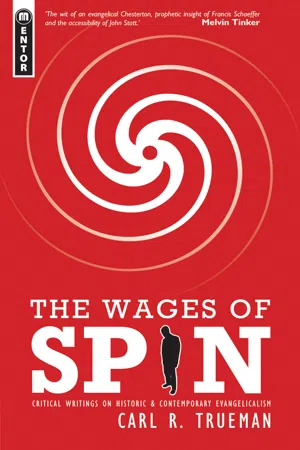
The Wages of Spin
Critical Writings on Historical and Contemporary Evangelicalism
- English
- ePUB (mobile friendly)
- Available on iOS & Android
eBook - ePub
Information
Publisher
Christian Focus PublicationeBook ISBN
9781845509484
Year
2011PART ONE
EVANGELICAL ESSAYS
ONE
RECKONING WITH THE PAST IN AN ANTI-HISTORICAL AGE
As I prepared this article I was reminded of the very first issue of the English journal, The Evangelical Quarterly, which was issued in January 1929 as part of a concerted attempt to articulate the historic Christian faith in times that were not particularly well suited to such an endeavour. On the back cover of that issue is a series of names of those who had agreed to write articles for the journal. Among the names are those of Professors Ridderbos and Schilder of Kampen. The presence of their names on that list speaks volumes about the consistent ecumenical desire of Reformed theologians throughout the ages to propagate their faith in an intelligent and articulate manner; about their desire to combat heresy while at the same time engaging in well-mannered dialogue with those with whom they disagree.1 It would indeed have been very opportune for this article if the programmatic statement about the Reformed faith which that journal’s first issue contained had been written by a Dutchman – and from my personal perspective, had I been editor I would certainly have arranged it thus – but, as a matter of fact, that honour was accorded to an American, Caspar Wistar Hodge. In an essay of twenty pages or so, Hodge expounded the basic principles of the Reformed faith in a context which showed both his knowledge of its historic origins and emphases and the looming crises which it faced. Indeed, his remarks on the rising Swiss star, Karl Barth, offer us insights into early orthodox responses to the new theology. More than that, they remind us that 1929 was a transition point in the history of Reformed theology, a time when great change was about to sweep over the Reformed world. In the closing paragraph, Hodge makes the following comment:
Doubtless this Reformed Faith is suffering a decline in the theological world today. What has been termed ‘Reformed spring-time in Germany’ we cannot regard as the legitimate daughter of the classic Reformed Faith. In Scotland the names of William Cunningham and Thomas Crawford no longer exert the influence we wish they did. In America the influence of Charles Hodge, Robert Breckinridge, James Thornwell, Robert Dabney, William G.T. Shedd, and Benjamin Warfield, seems largely to have vanished.
This list reads almost as a metaphorical obituary for Reformed theology, being as it is a litany of dead Reformed theologians, with Warfield – the most recently deceased – having been dead at that point for eight years. If Hodge had had a less Anglo-American focus he might also have added the names of Kuyper and Bavinck, who died in 1920 and 1921 respectively. The times they were indeed a-changing and, in retrospect, we can see that 1929, witnessing as it did the reorganisation of Princeton Theological Seminary and the end of classical confessionalism at that institution, was an historic turning-point for Reformed theology.
I shall return to Hodge’s article later on. What I wish to do in this article is to argue that once again confessional Reformed theology, along with its close relatives of confessional Lutheranism and conservative evangelicalism, stands at a crucial crossroads in its history; and that the opening years of the twenty-first century present the orthodox Christian world in general with a series of serious challenges to its theology and its ecclesiastical identity. I want to make the case that the only hope for such orthodox theology, and for the churches which give visible expression to such theology, lies in the ability – or rather the willingness – of those of us who claim the name Christian to be what we always should be. That is, exponents of a counter-cultural movement which finds its norms and its purpose not in an assimilation to the wider culture but in a recovery of its own distinctiveness.
Anti-Historical Tendencies
The aspect of modern life which I wish to highlight as presenting one of the most significant threats to the Reformed faith is that of the tendency of the modern world to be anti-historical. By this, I mean the aversion of modern men and women to tradition and history as a source of wisdom and even authority. In a world where the very language that is used reflects the deep-seated suspicion of all things old and an adulation of most things new, this is hardly a contentious claim. It is, however, one that has massive significance for the church and for theology.
Before engaging in closer analysis of this problem, we must first acknowledge that it is too easy for those who spend their lives studying ideas and concepts to overestimate the role of self-conscious intellectuals in creating this anti-historical atmosphere. When students, in the rarefied atmosphere of university libraries, read of anti-historical tendencies many instinctively reach for their textbooks of anti-historical philosophies and the primers of deconstructive method. Yet to do so is to expose themselves to the error of seeing the problem of the importance of history merely as a crisis in intellectual method and philosophy. It is certainly to be seen as such in certain contexts. But as so often happens in the history of ideas, a problem that appears to manifest itself as primarily philosophical and intellectual can have roots which lie deep in the wider cultural milieu.
We must be aware that we live in a world where, for most people, designer labels, credit cards and the Pill are of far more immediate and decisive significance than the prison notebooks of Antonio Gramsci or the musings of Michel Foucault. In other words, to understand the world in which we live, we must not only engage in intellectual genealogy in order to establish the philosophical roots of the modern world but we must also broaden our analysis to engage with the wider sociology of knowledge. Thus what follows will not be confined solely to the history of ideas as traditionally conceived but will also look at the broader picture of society.
The intellectual roots of the modern anti-historical tendency can be found in the Enlightenment of the seventeenth and eighteenth centuries. Whether one looks at the continental or the Anglo-American tradition, it is quite clear that the rhetoric of the new and the novel quickly becomes associated with the improved and the better. While the last thing a theologian in the sixteenth century or before wished to be accused of was novelty or innovation, in the Enlightenment era an iconoclastic view of history and tradition was seen as part and parcel of the freeing of humankind from bondage and darkness. Thus, Voltaire, Kant and company were happy to understand themselves as taking part in an ‘enlightenment’ and surround their work with the language of liberty, while dismissing their predecessors as scholastic, obscurantist, and inhabiting the dark ages. This intellectual tendency toward the exaltation of the new at the expense of the old was massively reinforced with the advent of the Industrial Revolution. At this time new modes of production, urbanisation, and the rise to dominance of the middle classes led to the fundamental reshaping of society and its values. In an apocalyptic passage in The Communist Manifesto, Karl Marx, writing in the heat of the Industrial Revolution, describes the changes he sees around him:
The bourgeoisie cannot exist without constantly revolutionizing the instruments of production, and thereby the relations of production, and with them the whole relations of society.… All fixed, fast-frozen relations, with their train of ancient and venerable prejudices and opinions, are swept away, all new ones become antiquated before they can ossify. All that is solid melts into air, all that is holy is profaned, and man is at last compelled to face with sober senses his real conditions of life, and his relations with his kind.2
Thus the preference of the Enlightenment for the new and the novel at the level of ideas found its social counterpart in the changes driven by the Industrial Revolution, and its concrete expression in the changed economic and social relations in society. All of this militated against the older, classical notion that history and tradition were important sources of positive wisdom.
Looking around today it is quite clear that these anti-historical tendencies have reached something of a climax in the Western societies of the present time. The advanced consumerism of the West promotes novelty as an absolute virtue. Marx would no doubt have seen this as the result of capitalism’s need to be constantly creating new products and new markets for itself. One may hesitate to go all the way with the Marxist analysis of the situation in purely material terms but one cannot deny some truth to such an argument. It is, after all, crucial that we do not wear yesterday’s fashions, sport yesterday’s labels, or listen to yesterday’s music lest we be labelled, not so much ‘reactionary’ as ‘square’ or ‘out of touch’. And who says that this is the case? The people whose financial security depends upon the sale of more and more of their products. In addition, the cult of youth is evident in everything from the domination on television of adverts aimed at young people to the plethora of available anti-ageing products. The underlying ideology would seem to be clear: the young, the fresh, the new is good; the old, the aged, the traditional is bad.
This anti-historical commitment of modern consumerist society finds its ideological counterpart in some of the strands of that amorphous group of philosophies which go under the over-used name of postmodernism. Ever since Marx, Freud, and Nietzsche, secular thinking has been aware of the specious nature of claims to objectivity in all realms, including the historical. Even within a modernist framework the need for a hermeneutic of suspicion in the study of history comes across clearly in the work of a traditional Marxist historian such as Eric Hobsbawm. In the introduction to The Invention of Tradition (a collection of essays on the creation and applications of various traditions), along with accompanying spurious historical pedigrees, Hobsbawm notes three overlapping uses of types of tradition since the Industrial Revolution. Some traditions establish or symbolise the social cohesion of certain groups; some establish or legitimise institutions or certain power relations; and some inculcate value systems, patterns of behaviour, and social conventions in the interest of socialisation and social stability.3 What underlies each of these three types is the manipulation – or even ‘creation’ – of history and historical narrative for some ulterior political purpose, either of social control or of legitimation.
What is a useful critical tool in the hands of a traditional Marxist becomes an utterly destructive and self-defeating weapon in the hands of those thinkers who have pushed the hermeneutic of suspicion to its logical conclusions. In the world of postmodern history, the point is neither to reconstruct the past, as in the work of tradition positivist historians, nor to construct it as in the work of traditional Marxists, but rather to deconstruct it. It is to lay bare the hidden agendas which underlie all historical narratives and to ask the key question again and again, who owns history?4 For the ownership of any given historical narrative is intimately linked to the question of who wields power in the present. Hence, the last two decades have seen a ferocious reaction against the traditional narrative of history that focused on Europe and on white heterosexual males. This has been reinforced by a consequent growth in histories from other perspectives, for example those of women, blacks and gays. Perhaps the most famous and articulate exponent of this rejection of traditional history was the late French intellectual, Michel Foucault. As Richard Evans summarises the position of Foucault on history:
History [for Foucault] was a fiction of narrative order imposed on the irreducible chaos of events in the interests of the exercise of power. And if one version of the past was more widely accepted than others, this was not because it was nearer the truth, or conformed more closely to ‘the evidence’, but because its exponents had more power within the historical profession, or within society in general, than its critics.5
For such as Foucault, therefore, histories do not offer explanations of how we come to be where we are in the traditional sense of the word; rather they offer bids for power, attempts to legitimise particular institutions or attitudes in the present. Thus, historical narratives, along with other attempts to provide all-embracing explanations of reality or to make truth-claims, must be unmasked and exposed as the bids for power that they really are. As the Enlightenment downgraded history and tradition by stigmatising them with the language of obscurantism and reaction, and as consumerism has made space for history only as a marketing opportunity in the shape of theme parks and nostalgia shops, so much recent philosophy has labelled history as yet another surreptitious attempt to exert power under the guise of objective truth. Taken together, the voracious appetite for novelty and innovation that marks advanced consumerist societies, and the inveterate cynicism of the modern world, whether expressed in popular political apathy or sophisticated postmodern theories, have proved to be a potent anti-historical, anti-traditional combination.
The Impact on the Church
This article is not intended as a sketch map of contemporary society. The purpose is to address the very serious question of where and how orthodox Christian theology, as classically conceived, can speak to this day and this generation and why, therefore, time should be spent studying it at the start of the third millennium. Before a positive agenda can be offered, however, some time needs to be spent assessing the impact of the various anti-historical trends, noted above, on the Christian church. If society at large is losing its sense of history, and if the academy is launching a full-frontal assault upon the very possibility of history, how is this affecting the church?
I want to suggest that anti-historical trends of the pragmatic, consumer society of the West have elicited two differing but equally inadequate and, ultimately, anti-historical, responses from the church in the West. First, part of the church has itself enthusiastically embraced these tendencies and has abandoned its self-conscious position within a historical tradition, leaving itself somewhat rootless. Second, part of the church has attempted to grasp the significance of history once again by seeking traditions to enrich its spirituality, but has done this in a manner which is historically fallacious and ultimately a symptom of precisely the same consumerism which has shaped the first response.
To take the first point, the evidence of a collapse in historical rootedness is evident for all to see. We can start by looking at the liturgical practices of the church. By ‘liturgical practice’ I do not mean specific formal liturgies such as the Book of Common Prayer. Rather I use the term to refer to the broader linguistic and ritualistic shape of Christian worship: the kind of songs that are sung, prayers that are prayed, and sermons that are preached. When looked at in these broad terms, the last twenty or thirty years have seen a veritable transformation of Christian practice, with many churches abandoning traditional hymnody and worship service structures in favour of songs that are more contemporary and service styles that are more conducive to modern sensibilities. More often than not, these changes are implemented with more than a passing reference to the need to attract young people to church – a most legitimate aim but also perhaps a significant modification of the emphases contained in the Great Commission where the category of age receives no specific mention. It is also interesting that a clear connection is being made between attracting youth and breaking decisively with the past in key areas. The ideology of consumerism, with its emphasis on novelty, youth markets etc., clearly lies just below the surface.
To use language that is familiar to a consumer society, no one should make the mistake of seeing the move to contemporary praise songs and service styles as simply a straightforward, value-neutral repackaging or rebranding of a traditional product. After all, at a basic level, language and worship forms offer significant lines of continuity with the past, a past which inevitably shapes our identity in the present. This is seen quite clearly in the Bible’s own teaching, whereby the Passover is instituted as a means of commemorating God’s mighty act of salvation of ancient Israel. The ceremony was to be repeated annually as a reminder to the Israelites both of what God had done in the past and, consequently, who they were in the present. The historical connection is underlined by the reference in Exodus 12:26-27, where God instructs the Israelites what to say when their children question them about why the Passover is celebrated. The same is true in the Christian church: connection with the past is vital. Of course, the Bible and the sacraments provide us with the basic, vital historical connection to God’s saving action in Christ; but there is also a wealth of theological and church tradition which, while not authoritative in the way that Scripture is, is yet extremely useful for maintaining the knowledge of who Christians are, through relating them to the past; and one important avenue for this is the church’s current liturgical practices. The language and the practices of the Christian community, tried and tested over the centuries, while not in themselves absolutely sacrosanct, should not be casually abandoned or lightly cast to one side. They are an important element in the identity of the church; and to break decisively with them on the purely pragmatic grounds of enhanced marketablity risks the displacement of the church’s historic identity.
Of course, Protestantism has always had the potential of providing fertile soil for a theology and a church culture which disparages tradition. The notion of scriptural authority as articulated by the Reformers and by subsequent Reformed and Lutheran thinkers inevitably subordinated church tradition to the Bible. It created a situation where tradition could, where necessary, be abandoned. They regarded the Bible as the sole source of revelation and that inevitably meant Protestants were far more critical and selective in their approach to the church’s dogmatic tradition than was typically the case in medieval Catholicism. Nevertheless the Reformers and the subsequent tradition never intended this notion of scriptural authority to act as the means for a wholesale rejection of the church’s theological traditions in themselves; they saw it simply as a critical tool by which those traditions could be continuously critiqued and reformed.
While there were groups within the sixteenth and seventeenth centuries who argued for just such a rejection of all tradition on the basis of a radical biblicism, it is most significant that these groups were not part of the magisterial Reformation and were repudiated by...
Table of contents
- Testimonials
- Title
- Indicia
- Contents
- Dedication
- Introduction
- Part One: Evangelical Essays
- Part Two: Short, Sharp Shocks
- Postscript
- More Books from Christian Focus
- Christian Focus
Trusted by 375,005 students
Access to over 1.5 million titles for a fair monthly price.
Study more efficiently using our study tools.