- English
- ePUB (mobile friendly)
- Available on iOS & Android
eBook - ePub
Information
Publisher
Christian Focus PublicationeBook ISBN
9781781915677
Year
20151
If God is Triune, Do Christians Believe in Three Gods?
I can’t recall who said it, but I believe it: ‘Try to explain the Trinity and you’ll lose your mind. Deny the Trinity and you’ll lose your soul!’ Well, I believe the second half of that statement. Whereas trying to understand the doctrine of the Trinity is certainly taxing and often frustrating, don’t let the prospect of insanity keep you away. I hope that by reading this chapter you will actually experience a measure of enlightenment that fuels the deep delight that comes from knowing God better. But I will admit that the concept of the one God as a Trinity of co-equal, yet distinct, persons is perhaps the most intellectually taxing and baffling doctrine in Scripture.
There is a world of difference between saying, on the one hand, that the concept of God as triune transcends reason and that, on the other hand, it is contrary to it. I freely concede that the best and most enlightened minds in the Christian world reach a point in their exploration of the Trinity where they simply throw up their hands, not so much in frustration but in awe and wonder and worship at so glorious and majestic aGod! Well, there may be a measure of frustration in that no one wants to admit that some things simply exceed our capacity to fathom. There are questions raised in this chapter that I cannot answer. The reason isn’t because they are inherently and eternally unanswerable but because we are finite and cannot grasp the infinite. There are human limitations beyond which we cannot go in this life and we must be content to affirm in faith what we will only fully understand in the age to come. In fact, I shouldn’t say that we will ‘fully’ understand the Godhead even then, for God is infinite and we will never exhaust the depths of His being or the way in which He exists as both One and Three.
But the inevitable shortcomings of our knowledge of God in the present should not hinder us from diligently and humbly exploring His triune character as best we can. God loves to be studied, but not in a detached way as a high school sophomore would dissect alifeless frog. Our aim should be to press in deeply to the character of God, on our knees, in worship and breathless adoration, prayerfully crying out for insight into the revelation He has made of Himself in Scripture.
So let’s start by taking note of what is probably the most famous definition of the doctrine of the Trinity, given to us by St. Augustine (4th-5th century a.d.):
‘There are the Father, the Son, and the Holy Spirit, and each is God, and at the same time all are one God; and each of them is a full substance, and at the same time all are one substance. The Father is neither the Son nor the Holy Spirit; the Son is neither the Father nor the Holy Spirit; the Holy Spirit is neither the Father nor the Son. But the Father is the Father uniquely; the Son is the Son uniquely; and the Holy Spirit is the Holy Spirit uniquely. All three have the same eternity, the same immutability, the same majesty, and the same power.’1
Insights from Church History
Throughout the course of church history, people have asserted that this concept of God is incoherent and logically contradictory. The doctrine of the Trinity, they argue, is irrational, hardly worthy of intelligent belief. As a result, certain heretical concepts of the Godhead have emerged, the two most notable of which are variants of what was known as Monarchianism (also known as Sabellianism after one of their leaders, Sabellius, who lived in the early third century). In accordance with their name (monarchy = single principle), the monarchians stressed divine unity to the exclusion of any personal distinctions in the Godhead. Monarchians opted for one of two explanations concerning the Son and Holy Spirit.
Dynamic Monarchianism (don’t you just love these ten-dollar theological terms!) was first advocated by Theodotus, a learned Byzantine leather merchant. This view conceives of Jesus prior to His baptism as merely human (the natural born son of Joseph and Mary). As a reward for His exceptional moral virtue, Jesus was adopted as God’s Son and empowered by the Spirit through which He subsequently performed His miracles. Jesus was divine not because of any equality in essence with the Father but by virtue of a received power (dunamis). His ‘divinity’, therefore, is functional or ethical, not ontological. In other words, they spoke of Jesus as god not because of His nature or being but only because of what He did or accomplished through the power of God given to Him. This view, also called Adoptionism, did not flourish as well as did its sister view.2
Modalistic Monarchianism believed in both the unity of the Godhead and the deity of Christ. The only viable way to maintain both, so they argued, was to identify the Son (and the Spirit) with the Father. There is only one God who, depending on the circumstances, need, and work in which He is engaged, will variously manifest Himself either as Father or Son or Spirit. These names do not identify eternally distinct persons in the Godhead but were simply different functional expressions for the same God. Jesus is one of several modes or phases or roles whereby the one God reveals Himself. Thus ‘Father, Son and Spirit are distinctions that apply to God in relation to us. The modalists could affirm the economic trinity (a threefoldness in God in relation to the world) but not the ontological or essential trinity (a threefoldness in the inner being of God).’3
Perhaps an illustration might help us understand modalism. My full name is Charles Samuel Storms, II. Let’s drop the ‘II’ for a moment and look at how this sheds light on this particular heresy. When I was quite young and on the school playground during recess, my friends would call me ‘Storms.’ When we would return to the classroom, my teachers would often call me ‘Charles’ because that is my first name. But when Iwent home my family called me ‘Sam’ (I’ve always gone by my middle name). So, when I ‘played the part’ of a friend to one of my classmates, Iwent by the name ‘Storms.’ When I‘played the part’ of a student in school, I went by the name ‘Charles.’ And when I ‘played the part’ of a family member, I went by the name ‘Sam.’ But Iwas at all times still only one person. These names did not differentiate among three distinct persons but simply described one person fulfilling three distinct roles in life.
You may think that’s a great way of illustrating what we mean when we speak of God as triune, but Iassure you it is not! In fact, it’s heresy. God is not one person who goes by three names depending on the part or role He’s playing. God is one divine being who exists eternally as three co-equal persons, Father, Son, and Holy Spirit. But is this actually what the Bible says? Let’s look and see.
Uniting the Three
Does the doctrine of Trinitarianism demand that the Christian perform some sort of special spiritual arithmetic? After all, how can 1 + 1 + 1 = 1? To answer this, we must begin by giving full weight to three lines of evidence in the Bible.
Monotheism – That there is but one God is an assertion at the very heart of the Judeo-Christian tradition. ‘Hear, O Israel: The Lord our God, the Lord is one’ (Deut. 6:4). The apostle Paul is unequivocal in his monotheism: ‘we know that an “idol has no real existence”, and that “there is no God but one”’ (1 Cor. 8:4b; see also 8:5-6). Again, he insists that ‘there is one God, and there is one mediator between God and men, the man Christ Jesus’ (1 Tim. 2:5; see also Exod. 3:13-15; 15:11; 20:2-3; Isaiah 43:10; 44:6; 45:5-6; 45:14,18,21-22; 46:9; Zech. 14:9; John 17:3; James 2:19; Rom. 3:30). In summary, there is but one and one God only.
The Deity of Father, Son, and Holy Spirit – ‘Houston, we have a problem.’ There is only one God. But the Father is God. So also is the Son; likewise, the Holy Spirit. How can three be God and yet God be one? There is no escaping the fact that the biblical authors assert both truths. Clearly the Godhead is not an undifferentiated solitary oneness, but a oneness that subsists in multiplicity. The Bible speaks often of the deity of the Father, but no less so of the deity of the Son and the deity of the Spirit. I don’t have space in this book to set forth a biblical case for the divine status of Father, Son, and Spirit. I will simply assume this to be true and proceed to determine how we can affirm this without becoming polytheists (people who believe in multiple gods).
Triunity – Alongside the biblical testimony that (1) God is one and that (2) three are God is the multitude of texts which in some fashion (3) unite the three who are God, hence our term triunity. Let’s look at just a few of these important biblical passages.
In the Great Commission, Jesus commands His followers to make disciples and to baptize them ‘in the name of the Father and of the Son and of the Holy Spirit’ (Matt. 28:19). Jesus does not say to baptize them ‘in the names’ (plural), as if there were three Gods, but ‘in the name’ (singular). Neither does He say ‘in the name (singular) of the Father, Son, and Holy Spirit,’ as if there were one being passing Himself off under a threefold name. Rather, the definite article (‘the’) is repeated before each: the Father, and the Son, and the Holy Spirit. Thus, while Jesus distinguishes the three, with equal care He unites them under one name.
Two other texts, among many I could cite, which unite the Father, Son, and Holy Spirit and declare that they are each equally deserving of worship, adoration, love, and obedience, and that each is equally and actively involved in the work of the others, include:
‘The grace of the Lord Jesus Christ and the love of God and the fellowship of the Holy Spirit be with you all.’ (2 Cor. 13:14)
‘There is one body and one Spirit – just as you were called to the one hope that belongs to your call – one Lord, one faith, one baptism, one God and Father of all, who is over all and through all and in all.’ (Eph. 4:4-6)
On several occasions the Father, Son, and Holy Spirit are mentioned together in united activity or purpose relating to the life and ministry of Jesus: at His conception (Luke 1:35), baptism (Matt. 3:16-17; John 1:33-34), miracles (Matt. 12:28), and ascension (Luke 24:49). Likewise, the Three are also portrayed as united in the work of revelation and redemption: Acts 2:38-39; Romans 14:17-18; 15:16, 30; 2 Corinthians 1:21-22; Galatians 4:6; Ephesians 2:18-22; 3:14-19; Colossians 1:6-8; 2 Thessalonians 2:13-14; Titus 3:4-6; Hebrews 10:29; 1 Peter 1:2; 1 John 4:2,13-14; Jude 20-21; Revelation 1:4-5.
None of these three lines of evidence can be dismissed nor any one elevated above another. We must embrace them all. But how can they be reconciled?4
Unity of Essence, Trinity of Personhood
There are only three possible ways to respond to the biblical evidence cited above. The first alternative is to stress the unity of the one God to the exclusion of the full and co-equal deity of Father, Son, and Holy Spirit. This is the doctrine of Monarchianism described earlier. It exists today in two somewhat differing forms. Most expressions of Unitarianism, a theologically liberal perspective that denies the deity of Jesus and the Spirit, are Monarchian in nature. The United Pentecostal Church (also known as Oneness Pentecostalism) is a conservative perspective that argues for the deity of Jesus. Indeed, Jesus ‘only’ is God. Or again, there is only one person in the Godhead and His name is Jesus. The ‘Father’and ‘Spirit’ are only different names appropriate for different manifestations of the one God, Jesus.5
The second alternative is to stress the distinctiveness of the Father, Son, and Spirit to such a degree that the result is Tritheism, a form of Polytheism. The only link among the three is that they share a common purpose or will. Stress is placed on the personhood of each, the essence of which is autonomy and independent self-consciousness. Few embrace this view.
The third and, I believe, only legitimate alternative is to accept without hesitation or alteration both the oneness of God and the full deity of Father, Son, and Spirit. This is done by saying that the way in which God is one is different from the way in which God is three. God is one in essence and three in person. Historic Trinitarianism does not assert that God is one and three in the same sense. That would indeed be contradictory and unworthy of Christian belief. Rather, that in respect to which God is one is essence (or substance), and that in respect to which God is three is person. In affirming triunity in God we are saying that God is one in a sense different from the sense in which He is three. We may thus speak about Father, Son, and Spirit both in terms of what is common to all (the divine essence) and what is proper or unique to each (person).
Therefore, the Father is the same God as the Son and Spirit but not the same person. The Son is the same God as the Father and Spirit but not the same person. The Spirit is the same God as the Father and Son but not the same person. Or again, relative to deity, Father, Son, and Spirit are the same. Relative to person, they are distinct. And be it noted that divine ‘threeness’ is not merely a matter of our perception of God. We don’t simply experience God as triune. He is triune, independently of how we or the angels or any being might think of Him or encounter Him. Threeness belongs to the eternal essence of God no less than divine oneness.
Thus whereas all three persons are God, none of the three has its own essence separate from or independent of the other two. Rather, each person shares equally the numerically one divine substance or essence. Numerically speaking there is only one divine essence and each of the three divine persons coinhere in that one nature. There is, therefore, no ontological subordination within the Godhead. The Father, Son, and Spirit are coequally God in terms of the divine essence. Each person is as fully God as the other. From this, and as a corrective to modalism, John Feinberg concludes that:
‘the three persons (hypostaseis / prosopa) coinhering in the one divine nature (ousia) exist simultaneously with one another as distinct subsistences or persons. This means that the divine essence is not at one time entirely manifest as the Father (but not in or as the Son or Spirit), and then at another moment manifest exclusively as the Son, and yet again at another time solely as the Spirit. Rather, all three persons ... exist simultaneously.’6
Thus, the Trinitarian relationships as conceived in the Western church may be summarized as follows:
- The Father begets the Son and is He from whom the Holy Spirit proceeds. But, the Father is neither begotten nor does He proceed.
- The Son is begotten and is He from whom the Holy Spirit proceeds. But, He neither begets nor proceeds.
- The Holy Spirit proceeds from both Father and Son. But, He neither begets nor is He one from whom any proceed.
Another way of expressing the same thought:
- The Father is not God from God. The Father is God from whom God exists.
- The Son is God from God. The Son is God from whom God exists.
- The Spirit is God from God. The Spirit is not God from whom God exists.
In conclusion, what I’m saying, then, is that there is a sense in which God is one (essence) and a sense in which God is three (person). The one God exists eternally in three distinct but not independent persons: Father, Son, and Holy Spirit. So the answer to our question is No, Christians who affirm the Trinity do not believe in three gods. The doctrine of the Trinity, therefore, is neither logically contradictory nor inconsistent with Scripture. Although we likely will never fully comprehend the nature of triunity in God, let us worship Him in awe and reverence.
Recommended Reading
Alister E. McGrath, Understanding the Trinity (Grand Rapids: Zondervan, 1990).
Michael Reeves, Delighting in the Trinity: An Introduction to the Christian Faith (Downers Grove: IVP Academic, 2012).
Fred Sanders, The Deep Things of God: How the Trinity Changes Everything (Wheaton: Crossway Books, 2010).
Bruce A. Ware, Father, Son, & Holy Spirit: Relationships, Roles, & Relevance (Wheaton: Crossway Books, 2005).
1 Augustine, On Christian Doctrine, transl. By D. W. Robertson, Jr. (Indianapolis: Bobbs-Merrill, 1958), p. 10.
2 The most influential spokesman for this view was Paul of Samosata, Metropolitan of Antioch in Syria, who was finally condemned at a synod of Antioch in 268.
3 Donald Bloesch, God the Almighty: Power, Wisdom, Holiness, Love (Downers Grove: IVP, 1995), p. 172. The Monarchians were also called Patripassians by their opponents, because they taught that the Father (Latin, pater) suffered (Latin, passus) as the Son.
4 Although the concept of the Trinity is not explicit in the OT, there are texts in the OT that may allude to the idea of plurality in the Godhead. (1) The standard word for God is elohim (plural). (2) Often a plural ...
Table of contents
- Testimonials
- Title
- Indicia
- Table of Contents
- Introduction
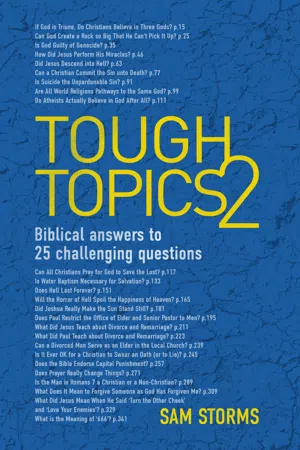
- 1. If God is Triune, Do Christians Believe in Three Gods?
- 2. Can God Create a Rock so Big That He Can’t Pick It Up?
- 3. Is God Guilty of Genocide?
- 4. How Did Jesus Perform His Miracles?
- 5. Did Jesus Descend into Hell?
- 6. Can a Christian Commit the Sin unto Death?
- 7. Is Suicide the Unpardonable Sin?
- 8. Are All World Religions Pathways to the Same God?
- 9. Do Atheists Actually Believe in God After All?
- 10. Can All Christians Pray for God to Save the Lost?
- 11. Is Water Baptism Necessary for Salvation?
- 12. Does Hell Last Forever?
- 13. Will the Horror of Hell Spoil the Happiness of Heaven?
- 14. Did Joshua Really Make the Sun Stand Still?
- 15. Does Paul Restrict the Office of Elder and Senior Pastor to Men?
- 16. What Did Jesus Teach about Divorce and Remarriage?
- 17. What Did Paul Teach about Divorce and Remarriage?
- 18. Can a Divorced Man Serve as an Elder in the Local Church?
- 19. Is It Ever OK for a Christian to Swear an Oath (or to Lie)?
- 20. Does the Bible Endorse Capital Punishment?
- 21. Does Prayer Really Change Things?
- 22. Is the Man in Romans 7 a Christian or a Non-Christian?
- 23. What Does It Mean to Forgive Someone as God Has Forgiven Me?
- 24. What Did Jesus Mean When He Said ‘Turn the Other Cheek’ and ‘Love Your Enemies’?
- 25. What is the Meaning of ‘666’?
- Subject Index
- Scripture Index
- Christian Focus
Trusted by 375,005 students
Access to over 1.5 million titles for a fair monthly price.
Study more efficiently using our study tools.