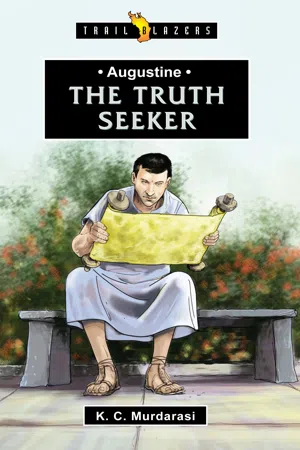
- English
- ePUB (mobile friendly)
- Available on iOS & Android
eBook - ePub
Information
Publisher
Christian Focus PublicationeBook ISBN
9781781913628
Year
2014A Brush with Death
Augustine swirled water around his clay cup, listening to the gentle sloshing noise. He swirled it harder, making some of the glistening water splash over the side of the cup and fall onto his bare knees and dusty feet. Is this what the sea is like? he wondered, closing his eyes as he tried to imagine a cup of water big enough to separate Africa, where he lived, from Italy, the center of the Roman Empire. It must be scary to cross it! Augustine had never seen the sea, but he was curious about it. The countryside around his villa was covered with olive groves and fir trees and fields of wheat as far as the eye could see. He knew that somewhere, far away to the north, lay the Mediterranean Sea –“Our Sea” as Romans called it because the Roman Empire stretched the whole way around the edge. Augustine had never been further than Thagaste, the town where he lived.
It wasn’t just the sea Augustine was curious about. He was interested in plants and birds and animals. In his spare time he liked to wander the countryside with his friends, chasing lizards and birds, and sometimes watching the birds catch the lizards. He had just begun flicking at the water with his fingers, imagining tiny ships tossed about in his stormy cup, when a slave came into the courtyard to call him.
“Master Augustine, it’s time to go to school.”
“No-o!” groaned Augustine. For a wild moment he thought about running away and hiding in the olive groves until school had finished, but he knew it was no use. His father, Patrick, would find out and beat him, and then he would get sent back to school and the teacher would beat him. Plus, his mother, Monica, would give him one of her disappointed looks, and that was almost worse than a beating. Augustine loved his mother, and he wanted to make her proud of him, but even for her he couldn’t pretend to enjoy school. The slave said again,“Master Augustine!”
Sighing, Augustine got up to follow her, pouring his little sea onto the dusty soil of the courtyard as he went.
Monica was a Christian, and even though her husband Patrick was a pagan, he had allowed his wife to bring up Augustine and his brother and sisters as Christians. Augustine said his prayers as his mother had taught him, and every time he prayed he asked God not to let him be beaten at school any more, but it never seemed to work. He would forget his lesson or spell something wrongly, and the teacher would cane him. It happened most of all in Greek classes. Augustine hated Greek! It was bad enough having to learn how to read and write in Latin, his own language, but reading and writing in Greek was impossible! Augustine would have been happy to make sacrifices to his father’s gods, too, if he thought it would help—to mighty Saturn and the Heavenly Goddess—but he knew that they were just stories, not real gods. Even Patrick, who was supposed to believe in them, wasn’t especially careful about remembering to sacrifice to them.
Augustine tried to look casual as he walked from his family villa into the town of Thagaste. The school was in an old building near the small forum, or central square. The classroom walls were covered in crumbling plaster and scribbles on the walls from generations of boys. The teacher was already talking so Augustine slipped in quietly and sat down next to one of his friends. That was one good thing about school—he had made a lot of friends.
“What is the lesson about?” he asked in a whisper.
“Dido and Aeneas, from Virgil’s Aeneid,” replied the other boy. Augustine smiled. This was the only bit of his lessons that he actually liked, the stories from ancient legends. Already he knew bits of the poem the Aeneid by heart and would recite the poetry to himself to enjoy its rhythm. The story of Dido was so sad that it made him want to cry, but it was a nice feeling too. The teacher was telling them about each word in the passage, explaining what type of word it was and why Virgil had chosen it, but Augustine was hardly listening to that. He was thinking about poor Dido left alone in Africa while Aeneas, who was sort of her husband, sailed away to Italy because his destiny awaited him there. It seemed far too short a time before the teacher closed the book and said,
“We will resume Virgil tomorrow. Just now, we will move on to the study of Greek.” Augustine put his head in his hands and groaned quietly.
* * *
“Augustine! Augustine, why are you still in bed? You must get up and go to school,” called Monica from the corridor outside her son’s bedroom. She knew that he hated his Greek lessons, but he was getting on so well with Latin literature and speeches that for many months now he had not begged her to take him out of school, as he used to do. She was surprised that he was still in his bedroom when it was time to go into Thagaste. She pushed back the curtain to the bedroom.
“Augustine?” He was still in bed. Even in the dim light Monica could see that something was wrong. The bedroom was warm but Augustine was shivering. Quickly, she pushed back the shutters from the window. In the daylight she could see that her son was very pale and his forehead was covered in sweat. She brushed back the hair from his forehead.
“Augustine? What’s the matter?”
“Mother? Don’t feel well. Cold.”
Monica ran to the door. “Paula! Send out for the doctor!” she called to her slave. “Augustine is very sick.”
The doctor came within an hour, but he did not bring good news.
“This is a very serious fever,” he told Monica and Patrick. “I have seen it before. His temperature will reach a peak in a day or two. Then, one of two things will happen. Either the fever will break and he will get well, although he will still feel weak for a while. Or the fever will not break, and the illness will kill him. I must warn you, this is the more likely outcome. You should summon a priest.”
Monica turned to Patrick, buried her head in his shoulder and wept for a few moments. Then she took a deep breath and pulled herself together.
“Thank you for your advice, Doctor. Our steward will see to your payment. I will go immediately to Father Crispus and ask him to come.” She hurried away, leaving Patrick to see the doctor out, and returned half an hour later with Father Crispus, the local Christian priest. Crispus was a simple man, without much education, and whose Greek was no better than Augustine’s, but he was kind and he did his best to teach the people of Thagaste about Jesus and the Bible. Now he spent the afternoon with Augustine, talking to him about Heaven and Hell and the sayings of Jesus. Augustine was very sick but he managed to confess his sins and declare his faith in Jesus through chattering teeth. The priest prayed over the boy, and turned to leave.
“B-baptized. I want to b-be b-baptized!” shivered Augustine. He looked from his mother to the priest. The two adults looked at each other, but Augustine couldn’t tell what they were thinking.
“I’ll talk to Father Crispus about it,” said Monica, and they left the bedroom. Outside, Monica and the priest talked in hushed voices.
“Do you think it’s a good idea, Father?”
“Yes, I think so. I realize that the boy doesn’t have much understanding of the faith, but you wouldn’t want him to die unbaptized, would you?”
“Of course not!” Monica replied. “But, what if he lives?” The priest nodded sympathetically. He knew why Monica was hesitating. Many people believed that sins committed after baptism were more serious than those committed before baptism. If Augustine lived, he would surely commit some sins in the future – perhaps God would not forgive them? 1 Crispus was no expert and he was not sure if Monica’s belief was right. To check, though, would mean asking the bishop, who was out of town. Even if he sent him a letter the reply might not come for several days or weeks. Augustine did not have that long.
“I tell you what, we’ll leave it for the time being. If Augustine gets worse and you think he won’t make it, send someone to call me at any hour of the day or night. I will come immediately.”
“Thank you, Father,” said Monica, dabbing her eyes.
Augustine’s fever got worse all evening. More than once Monica nearly sent for the priest, but then her son would seem to be more peaceful again and she hesitated. Finally, in the early hours of the morning, she was sure the end had come. Augustine had stopped moaning and shivering. Now he was convulsing, his legs and arms jerking around horribly. His breath came and went with a strange wheezing sound.
“Paula!” Monica screamed. “Send Marcus to get Father Crispus!” She sat holding her son by the shoulders for what felt like hours but was only a few minutes, until eventually he stopped thrashing about and started breathing normally. Monica’s scream had woken Patrick, who came into his son’s bedroom.
“Is he ...?” Patrick couldn’t finish the question, and Monica did not know how to answer him. They stared at their son for long minutes until, at last, his eyes flickered open.
“Mother? Father? Can I have some water?” Monica held a cup to Augustine’s lips as he drank, and supported his head. His neck felt much cooler than before.
“Augustine, how do you feel?” she asked.
“I feel a little better,” he replied. Then he smiled, turned over, and fell asleep. Monica slipped her arms around her husband and sobbed with relief.
“I think he’s going to be alright! He’s going to live, Patrick.”
“Good, that’s good. No need for any more tears, then,” he chided her gently. They stood together for a long time, hugging and listening to their son’s regular breathing, and they had forgotten all about sending for Father Crispus until there was a commotion from downstairs. Steps hurried up the stairs. Monica and Patrick slipped out into the corridor.
“Father Crispus, I’m so sorry! I thought Augustine was dying but now the fever has broken. I think he will be fine,” Monica explained.
Father Crispus smiled broadly.
“That’s a great relief! You don’t have to apologize.”
When Augustine awoke the next morning, weak but healthy, baptism was the last thing on his mind. Instead he only wanted to eat and eat and eat. Monica was just glad that her son was still alive, and Father Crispus never did write to the bishop, so the idea of Augustus’ baptism was quietly forgotten.
1 This is a mistaken belief. Forgiveness of sins is a result of the work of Christ on the Cross not the good works of believers. When God forgives sinners he forgives their past sins and future sins.
Bad Company
Augustine recovered almost perfectly from his brush with death. The only reminder was a slight weakness in his lungs when he over-exerted himself. He continued to make progress at school. Although he still could not get the hang of Greek, his skill in Latin improved until he was the star pupil in Thagaste. He knew long passages of literature off by heart and was getting better and better at writing essays and making beautiful speeches. When he reached the age of fourteen, Patrick and Monica decided that it was time to send their son to the nearby town of Madaura to continue his studies.
Augustine was delighted. Madaura was only a few miles from Thagaste, but too far to travel home every day so he boarded in the larger town. This gave him much more freedom than he had ever had, without his watchful mother keeping an eye on him, or his brother Navigius telling tales on him if he did anything wrong. In Madaura, as long as he didn’t do anything bad enough for the teachers to care about, he could live as he pleased. Augustine and his new friends visited the circus, where on festival days there were fights between bears and lions and hunting dogs, or gladiator battles. They slipped into the theatre and watched the new comic plays, repeating the dirty jokes to each other all the way home. In the evenings after lessons they played endless games, gambling food or possessions to make it more exciting. Augustine didn’t have much luck at these games. He soon lost his small stash of possessions, and had to watch from the sidelines as the other boys played. If there was one thing Augustine hated, it was being left out. He visited his home in Thagaste regularly, and every time he returned to Madaura, just before he left the villa he would sneak into the cellar to steal some food, or wine, or olive oil, so that he could trade it in Madaura and join in the gambling again.
The best thing about Madaura was that there were no Greek lessons. Instead, Latin literature and rhetoric—the art of public speaking—made up the whole of the curriculum. The teachers at Augustine’s new school liked to take their students on tours of the forum, pointing out the impressive statues of the gods and linking them to the passages of literature they were studying. They were not Christians, and spoke of the stories of the gods and heroes as if they were true, almost the way Father Crispus talked about the acts of Jesus. Augustine didn’t really care. True or not, these ancient stories gave him the chance to show his skill at writing and speaking; he was able to work up so much emotion when he spoke that anyone hearing him could almost believe that, not only were they true, they had happened to him!
After Augustine had been at Madaura almost a year, there was an important speaking competition. This was the highlight of the school year and only the best students were invited to take part, while all the other boys were given the day off to listen to the speeches. Augustine, although he was one of the youngest students, was told that he would be taking part. The subject was “The Wrath of Juno”. All of the competitors had to read the goddess Juno’s angry speech from the first book of the Aeneid, put it into their own words, and recite it in front of the whole school.
Augustine stood trembling at the side of the stage, listening to the applause for the speech before his. What if no one applauded his speech? But he knew he had done his best, so taking a deep breath, he walked into the center of the stage and began:
“Why? Why, oh fates? Why am I so powerless that I cannot prevent this puny mortal, this mere man, this lump of flesh from crushing all my plans?” Caught up in the emotion of the speech, Augustine raged and shouted, drove his fingers through his hair in frustration and even let a few tears fall down his cheeks. When he had finished, there was silence. Still panting from the effort, Augustine looked at his audience. Why weren’t they clapping? Didn’t they like it? A moment later he was nearly blown backwards by the noise as the whole audience, students and teachers alike, rose to their feet, clapping, cheering and whistling. Augustine could see that he was not the only one who had been crying – many people in the audience also had tears running down their cheeks. Giddy with fluttery excitement, Augustine went to take his seat to listen to the rest of the speeches, although he hardly heard them.
It seemed like no time at all until the leader of the school walked on to the stage to announce the winner.
“Aurelius Augustine of Thagaste!” he cried. Augustine walked to the center of the stage with trembling legs, hardly able to believe it as the leader placed a wreath of leaves on his head. He was the youngest boy in the competition! Some of his competitors were seventeen or eighteen. His friends of his own age couldn’t wait to congratulate him when they returned to their bedrooms at the end of the day.
“That was brilliant, Augustine! I’ve never heard anything like it!”
“How do you do it? It’s incredible! You have a gift.”
“You’ll go far, Augustine! You’ll probably end up working for the Roman Emperor himself, one day!”
Augustine fell asleep that night feeling that it had been the happiest day of his life. He felt special, as if he was going to achieve great things. He drifted off daydreaming about giving a speech to the Emperor, with the whole palace clapping and cheering. The following week, however, when he returned to his family’s villa...
Table of contents
- Title
- Indicia
- Contents
- 1. A Brush with Death
- 2. Bad Company
- 3. Love, but no Marriage
- 4. Looking for Wisdom
- 5. Divided Loyalties
- 6. Running Away
- 7. Keep on Running
- 8. Making the Leap
- 9. A New Life
- 10. A New Path
- 11. Trouble at Home, Trouble Abroad
- 12. The Last Push
- 13. The End
- Augustine Timeline
- Thinking Further Topics
- Notes on Names
- Quotes and Paraphrases from Augustine’s Writings
- Main Sources
- Quotes and Paraphrases from the Bible
- Christian Focus
Trusted by 375,005 students
Access to over 1.5 million titles for a fair monthly price.
Study more efficiently using our study tools.