- English
- ePUB (mobile friendly)
- Available on iOS & Android
eBook - ePub
Information
Publisher
Christian Focus PublicationeBook ISBN
9781845509545
Year
2008PART I:
OUR FELLOWSHIP WITH GOD
1 Our Relationship
with God: The Hub
How succinct is the writing of the Holy Spirit!
‘Complete in Him,’ (Col. 2:10, AV).
In three short words He sums up the basis of all true fellowship – that is, the relationship of being united to Him.
And Who is the ‘him’? None other than God Almighty, revealed to us in all His fullness by the Lord Jesus Christ, the Word made flesh and dwelling among us. Paul wrote, ‘For in him [Christ] dwelleth all the fullness of the Godhead bodily. And ye are complete in him…’ (Col. 2:9-10, AV).
And if we are ‘complete in him’, it does not take a vast training in logic to deduce that we are incomplete out of Him. How many of us have known the feeling of incompleteness at one time or another – maybe a sense of failure, or of insecurity, or of sheer inadequacy for the task that lies ahead of us?
As ambassadors for Christ, commissioned by God to preach the Word of Reconciliation, how many of us have known the acute sense of failure when, having preached clearly and with deep conviction of the power of the indwelling of the Holy Spirit of God to keep us from sin and to give us victory in both our private and public lives, we have failed Him miserably, perhaps by an outburst of uncontrolled anger over some petty, almost insignificant event?
Have we not all known moments of insecurity, despite having professed our total faith in God to provide for our every need at every level? When at the end there is no money available to meet an urgent bill (yet we’re certain that the acquisition was God-prompted in the fulfilment of His purpose), have we not then known a moment of bewilderment, fear, or doubt, or questioned our guidance?
As a missionary in a foreign land, I have known inadequacy and frustration. Imagine having the diagnosis of a patient’s illness, but being unable to treat him because of not having the needed drug in the pharmacy, and having no means to acquire it within the next six months! How frustrating to be ready to put the roof on a new building, perhaps a ward for the hospital, only to find that the nails that were eventually delivered last week were the wrong kind for corrugated sheeting! How frustrating to have made a 200-mile journey over the mountain range of Central Africa to pick up much needed supplies, only to find they were impounded by Customs and could not be released without a particular sheet of paper that might take up to a year to obtain!
Doubtless all of us could add endless examples from whatever our particular walk of life – the frustration of the housewife who has cooked the evening meal and the family do not return on time and the soufflé is spoilt; the frustration of a school teacher who has prepared everything for the scheduled inspection, only to be told at the last minute that the government officials are not coming for another month; the frustration of a busy executive who has flown across the Atlantic to an important conference, only to find that the telegram announcing its cancellation had arrived one hour after he had left his homeland!
In each instance, and in numerous other similar instances, there is nothing wrong with the sense of frustration, but when one reacts to it with impatience, annoyance, or by blaming the other party, or in some such manner demonstrating a real lack of peace and of acceptance of the difficulties of working in an imperfect world, or in a developing country, then one realises one’s ‘incompleteness’. Had I been ‘complete in him’, I would have maintained His serenity and used the situation to prove His all-sufficient grace.
Some of us feel incomplete because we have never yet come to the Lord Jesus Christ on His terms. I make no apology for so-called ‘old-fashioned’ vocabulary when I say that the only acceptable way to come to Christ is as a sinner who needs saving, and who knows he/she cannot save him/herself.
From 1939 to 1944, during World War II, as a boarding schoolgirl in North Wales I had occasion to travel across the city of London six times every year, on my way to and from my home in Kent; and I had seen the bombing, the devastation, the horrific scenes after the crashing to earth of the dreaded doodle-bugs, causing destruction and death on all sides. And I had concluded that, if there were a God, He was irrelevant. He could not cope. He could not stop this slaughter, this futile cruelty of man against man, this barbarous savagery that a hunger for power caused as one nation sought to take over another.
Yet, at the same time as my mind reasoned ‘There is no God,’ my heart was crying out in hunger to know that very God whose existence I denied. I needed an all-powerful God, on whom I could depend and from whom I could seek answers to the many problems and questions that crowded in on all sides as the war progressed.
In 1944 I went up to university. It was still wartime. I was hungry for friendship, lonely and strangely frightened in the brave new world of university life. All the security of the rigid props of a girls’ boarding school had suddenly been taken away and there was nothing to replace them. Along with many others, I was questioning everything, and there seemed to be no one to give any answers. In fact, there seemed to be no answers. What was the point of living? What was the purpose of it all?
I kept up a bluff exterior, probably appearing to others as self-reliant, competent, self-assured and able to cope with all I met. But inside I was chewed up with shyness, inexplicable fears and an almost desperate sense of inadequacy. How I longed to escape from it all! Only pride (plus, perhaps fear of my father’s rejection) kept me from running away – or even from ending the seeming uselessness of living, at all.
At that point, a Christian second-year student invited me to accompany her the following Sunday evening to a special Freshers’ Sermon to be given in a large church in the centre of town. I accepted – not with any desire to go to church, but out of courtesy, plus probably the sheer need to be with someone instead of endlessly being on my own. After the evening meal we cycled down-town and, like hundreds of others, padlocked our bicycles to the iron railings surrounding the church. Holy Trinity was packed with students, and filled with an indefinable sense of belonging and of quiet expectancy – and I felt an outsider. The text, ‘For there is one God and one mediator between God and men, the man Christ Jesus’ (1 Tim. 2:5), is all I remember of the service. I was too self-conscious to be able to concentrate on the preacher or his message.
At the close, we left the building and walked across to collect our bicycles. And I burst out laughing! The girl who had taken me swung round to see what had amused me, and quick as lightning she said, ‘Helen, that is just what your life is like!’
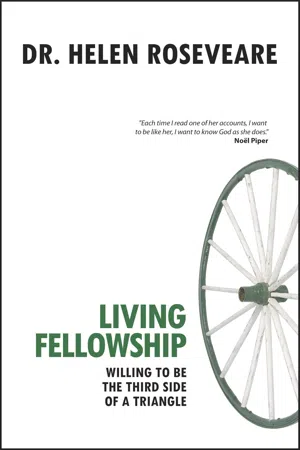
Next to my old, second-hand, sit-up-and-beg Raleigh bicycle, with its chipped black paint, there had been a beautiful new, modern, brightly coloured, well-equipped bicycle, padlocked to the railings with a very expensive padlock. It had gone. A thief had come during the service. Unable to break through the expensive padlock, had taken out the hub of the front wheel and gone with the beautiful bicycle, leaving only the tangled mass of spokes in the abandoned rim – still duly padlocked to the railings with its obviously expensive padlock. It did look ludicrous – though I doubt if the owner thought so when he came to collect it!
I did not register my companion’s remark at the time, nor would I then have been able to understand what she meant – but in the ensuing months, it kept coming back to me, even in my sleep. The sight of that tragic wheel, with no hub and no bicycle, and the words: ‘That is just what your life is like!’
Yet, in a strange way, it was true, heart-achingly true. My life was in a mess, and the mess grew daily more tangled. I had no real friends, though many offered me friendship, but I hadn’t learnt to give of myself or to trust others. I was scared. Lectures presented material beyond my understanding, and I didn’t know to whom to turn for help. Tutorials became a nightmare, with the dread of being asked questions that I could not answer, and therefore of being made to look a fool in front of others. I was not relating to anyone else: I was alone, and I didn’t know where I was going. The world seemed very large and very menacing. There seemed no meaning or purpose. Why live? Why not finish it off?
And I kept seeing visions of those tangled spokes… and no hub… and the uselessness of a bicycle without a hub in the centre of the wheel.
What was missing from my life? Why could I barely function as a rational human being? Who could help me to find the answers to life’s questions that were becoming so poignantly pressing?
Members of our College Christian Union were only waiting for the right moment to move in and help. They offered me friendship and companionship. Their kindness lasted and did not evaporate, as I had feared it would. They didn’t push themselves at me but always seemed to be around when I needed help. I began going to their meetings, listening in to the Bible studies and the prayer meetings, amazed at the quiet happiness and sense of security that pervaded the group.
So I began to learn of the great Creator God, who loved and cared and understood; who sent His only Son to be born into this world as the Babe at Bethlehem in order that He might die in the place of sinful men. Born to die! That was a fantastic thought, yet it all made sense as they showed me these truths from the Scriptures. God cares so much, even for me, that He was willing to die instead of me – amazing grace!
At last this lovely Saviour won my heart, and I asked His forgiveness for all my pride and stubbornness, resistance and rebellion over the past years. His peace flooded my whole being, and suddenly I understood that comment, as we had looked at a bicycle wheel without a hub: ‘That’s just what your life is like!’ The Lord Jesus Christ, by the ministry of the Holy Spirit, came into my life, as a Hub into a tangled wheel… and He sorted me out, and made sense and order to reign where before there had only been fear and disorder.
Some twenty-five years later, very early one morning, I met an African at the roadside in Uganda. After the usual courtesies, he asked me (in Swahili) if I was ‘a sent-one’. Taken aback by the bluntness of his question, I thought quickly that that was the real meaning of the word ‘missionary’, so I replied that I was a sent-one, yes, but my usefulness as such depended on the Person by whom I was sent and the mission for which I was sent.
‘Are you a sent-one by a great God to tell me about something called Jesus?’ the man asked.
He was an illiterate herdsman, looking after his family’s cattle. Awed at his question, and with a keen sense of privilege and of destiny, I sat beside him at the roadside in the early morning sunshine, and with the help of a book of coloured pages I explained to him the basic truths of the Gospel.
Yes, there is a great God, who created all the wonderful and beautiful world around us, and also men and women in that world, that we might love, serve and worship Him. But over the years we men have chosen to love, serve and worship ourselves, rather than God. And what a mess we have made of God’s world as a result. The great God has written a book (holding my Bible in my hand) in which He calls that mess sin. And He, the Creator, has judged that the wages of sin, our just deserts that each one of us has earned by our own free choice, is death, that is to say, spiritual death – to live eternally separated from Him who would have been our friend and counsellor.
Turning from the black page, that represented our sin, to the red page, I shared with my herdsman friend that wonderful story of the birth of the Baby at Bethlehem, when the great God became one of us men. He was born as a man in order that He might die for us – to take our wages – so that we might live. Using local African illustrations to help him enter into the wonder of that amazing story, I watched, fascinated, as light slowly dawned in his eyes, as he grasped at least the basic fact that the Creator so loved His creatures, despite all we had done to forfeit that love, that He was willing to die for us.
Turning from the red page, that represented the shed blood of our Saviour, to the following white pages, I sought to explain our need to confess our sins individually and to ask Him for His forgiveness, that our hearts might be cleansed and made ‘white as snow’. I was praying earnestly that God would give him understanding that that death on the Cross of Calvary two thousand years ago was sufficient to pay for all his (and my) personal guilt. It was awesome to watch that humble man open up to the Saviour, and to realise that he had passed from death to life, becoming a child of God and receiving the gift of eternal life.
We sat and talked together for nearly two hours. Then I got up to go back to the car and continue my journey homewards. As we approached the road another African, on his way to the local market, was cycling towards us with a huge head of bananas strapped to his carrier. As we watched him he suddenly swerved, and we saw the hub of the front wheel disengaging itself! He crashed to the ground, bananas in every direction. We rushed to his rescue as he picked himself up and looked ruefully at his broken bicycle.
It was all I could do not to laugh out loud! But together we did what we could to help put the bicycle back together again, to gather up the scattered bananas, and to wave the lad off on his journey. Turning to my herdsman friend, I told him of my encounter, all those years before, with a bicycle wheel without a hub, and of how that had been used by God to bring me to a knowledge of my need of a Saviour. We laughed together as we recollected the look on the lad’s face as he crashed to the ground, before we helped him on his way, and as we realised how totally helpless a bicycle wheel is without a hub. Yes, indeed, a human life without Christ as its Saviour is like a wheel without a hub: incomplete and therefore useless and quite unable to function in the way for which it was created.
With the hub in place, the wheel is complete and able to function correctly. With Christ in our heart as our Lord and Saviour, we are complete, ‘complete in Him’, and so able to function as God intended we should.
A few years ago, seeking to offer friendship to a lonely, sad lady at a Christian holiday centre, I became increasingly conscious of her total lack of assurance of salvation. To my question: ‘Dear, if you were to die shortly, do you know that you would go to heaven?’ her evasive reply was a hesitant: ‘I hope so.’ To a more blunt question, ‘Do you know that your sins have been forgiven?’ she only queries: ‘Can one ever be sure of that?’
So I had the joy and privilege of sharing with her the story of my herdsman friend, using the same ‘wordless book’ to explain the way of salvation, but now employing illustrations from our western culture rather than African ones, to make it clear to her.
There was an obvious growing desire to believe what I told her, but yet there was also a reluctant hesitancy.
‘That is all right for an African,’ she started to say and then faltered into silence. I understood what was troubling her, though she was afraid to put it into words, not wanting to appear offensive. That I had gone as a missionary to what used to be popularly called ‘Black Africa’ to tell a ‘native’ that he needed to be saved, was acceptable – but that she, a well-educated white lady, should need to come to God by the same route – that was revolutionary to her!
‘Let me share another experience with you,’ I said gently. ‘Not long ago, I was coming home from shopping in our local city. I bought a railway ticket and went down to wait for my train on the appropriate platform. It was raining and I put up my umbrella. Another lady followed me down the slope, but she had no umbrella. I invited her to share mine and, as we stood together, an absolute cloud-burst occurred. I knew she would not go away from me in a hurry, and prayed quickly for some way to start a conversation with her.
‘On the other side of the tracks there was a large poster for a brand of cigarettes. “That makes me annoyed,” I said, pointing across the line. She looked at me, possibly a little belligerently. “Well,” I said, “that makes young folk want to smoke; smoking causes lung cancer; lung cancer causes death.”
‘To my consternation, she broke down and began to cry. A train drew in to the platform. I assisted her in, sat beside her and asked her if I could help her in any way.
‘“I have just come from the hospital,” she said, “where I had gone for a medical check-up, and t...
Table of contents
- Testimonial
- Title
- Indicia
- Contents
- Preface
- Prologue
- PART I: Our Fellowship with God
- PART II: Our Fellowship with Others
- PART III: God’s Invitation to Share in the Fellowship of His Sufferings
- Epilogue
- About the Author
- More Books from Christian Focus
- Christian Focus
Trusted by 375,005 students
Access to over 1.5 million titles for a fair monthly price.
Study more efficiently using our study tools.