eBook - ePub
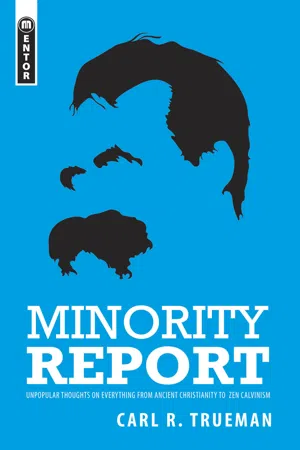
Minority Report
Unpopular Thoughts on Everything from Ancient Christianity to Zen Calvinism
- English
- ePUB (mobile friendly)
- Available on iOS & Android
eBook - ePub
Minority Report
Unpopular Thoughts on Everything from Ancient Christianity to Zen Calvinism
Information
Publisher
Christian Focus PublicationeBook ISBN
9781781913994
Year
20081.1
Rage, Rage Against
The Dying Of The Light 1
Introduction
Having been unable to find a suitable quotation from Bob Dylan as a title for my inaugural lecture, I have chosen instead a line from a famous poem by his partial namesake, Dylan Thomas. The whole stanza reads as follows:
Do not go gentle into that good night,
Old age should burn and rave at close of day;
Rage, rage against the dying of the light.
My reason for choosing as my opening shot Dylan Thomas’s rant against the passive resignation of old age in the face of death is simply this: today, both old age and church history are generally regarded as irrelevant. In a culture obsessed with youth and driven by consumption, old age is something of an embarrassment. It is an unproductive, unmarketable concept; and, in a church which so often apes the larger culture, church history is usually regarded as having little or nothing of use to say. My purpose, therefore, is to cast a critical eye on this assumption, and to indicate that Westminster Seminary church historians are not simply going to acquiesce in the consensus concerning their irrelevance, but that they fully intend to rage, rage against the dying of the historical light. 2
A variety of factors contribute to the anti-historical thrust of the modern age, as I have argued elsewhere. 3 Suffice it to say today, however, that I believe that in a society dominated by ideologies of novelty and innovation—ideologies driven by the agendas of science, of capital, and of consumerism—the past will always be cast in terms which put it at a disadvantage in relation to present and future. In fact, it is vitally necessary in such societies for the past to be inferior; this is one important means of validating the present and justifying the future. Dare one say it, in America, a nation built on notions of an expanding frontier and of manifest destiny, a nation whose self-actualization is always seen as being just over the next horizon, such present-future orientation is particularly strong. But it is not just in America that such a viewpoint exerts its grip; it is a Western phenomenon as a whole, with even our language indicating this underlying value scheme: innovative, original, ground-breaking have, on the whole, positive connotations; traditional, conservative, old-fashioned have, on the contrary, negative ones. Within such a cultural framework, can history really serve any function other than that of a traveling freak show which parades the grotesques, the monsters, and the mediocrities of the past in order to allow the modern world to feel good about itself and its future?
A further problem for history as a discipline is the cluster of philosophies which are bracketed together under the general term postmodernism. Postmodernism has allegedly rendered implausible the whole idea of grand narratives and of the accessibility of truth in any traditional way. In a world of no grand narratives, of course, there can be no history in any referential sense, only various incommensurable narratives by which historians express their own values and tastes. Writing history is thus swallowed up in the politics of the present. Postmoderns tells us that because of this radically relativizing insight we therefore live an age of epochal change, where everything once certain is now exposed as negotiable and volatile, and that a fundamental cultural paradigm shift has occurred. 4
As a historian, of course, I am never impressed by claims about epochal events and paradigm shifts. I am too well aware that every age has made claims to being epochal; the great Bob Dylan may well have sung, “Oh my name it is nothin’, my age it means less,” but nobody has ever really believed such sentiments about themselves and their own time. On the contrary, human beings have consistently and continuously engaged in the creative struggle to transform culture and to leave their mark on the world around them. This surely indicates something about the amazing and awesome human drive to make a difference, to make my name and my age the decisive one. Is the postmodern turn of epochal significance? Only time will really tell, but if I were a betting man, I would wager heavily against it being so.
At a more sophisticated level, my skepticism about post-modernism is rooted in my attraction to the arguments of critical theorists like Frederic Jameson, Perry Anderson, and Terry Eagleton. 5 They argue that postmodernism, with all of its vibrantly creative, chaotic, challenging, and exciting insights, is actually the cultural logic of late capitalism, to use Jameson’s phrase. I myself prefer to speak of the cultural logic of advanced consumerism so as to avoid the prescriptive political and eschatological implications of Jameson’s Marxism, but his basic point is, I believe, sound. To defend this thesis would take too much time today, so a single quotation from Karl Marx himself will have to suffice. In the Communist Manifesto Marx describes with unnerving foresight the epistemological and ethical anarchy which modernity, extended to its very limits, globalized and universalized, will bring with it:
The bourgeoisie has stripped of its halo every occupation hitherto honoured and looked up to with reverent awe… Constant revolutionizing of production, uninterrupted dis-turbance of all social conditions, everlasting uncertainty and agitation distinguish the bourgeois epoch from all earlier ones. All fixed, fast-frozen relations, with their train of ancient and venerable prejudices and opinions, are swept away, all new-formed ones become antiquated before they can ossify. All that is solid melts into air, all that is holy is profaned, and man is at last compelled to face with sober senses, his real conditions of life, and his relations with his kind. 6
All that is holy is profaned: pardon the pun, but full marks to Marx for here predicting precisely the kind of anarchic world which would produce both the highly sophisticated philosophical hedonism of Michel Foucault and the crass redneck shenanigans of the Jerry Springer Show.
If, of course, postmodernism, with all of its disdain for history in any traditional sense, is the ideology of advanced consumerism, then it can just as easily be described as the quintessential ideology of modern America; indeed, in modern America, and in the West which follows America’s social and economic lead, it is surely interesting to note that just about anything can be believed, however absurd, and any moral precedent can be overturned, however well-established, provided that such action can be successfully marketed as enhancing the American consumerist dream. Whether it is the nature of human sexuality, the definition of marriage, or access to abortion and euthanasia, American public morality is increasingly that of the marketplace, and moral truth is that which the cultural market forces permit, or, in some cases, demand. Think, for example, of the recent emergence of phenomena such as gay tourism and gay television channels. Would these things happen if they did not present opportunities for moneymaking? And can one overestimate how these things themselves then feed into and reinforce the social normalization of homosexuality as a lifestyle choice (and I use the word choice precisely to make the point about the connection with the consumer mentality). 7
This is where my narrative today connects to evangelicalism. If postmodernism was always destined to be the cultural logic of modern America, with its consumer driven economy and cultural mores, then it was arguably inevitable that it was also destined to be the ideology of evangelicalism, which, with its individualism, its pragmatism, and its functional disdain for history, is Americanized religion par excellence. 8
Now, there has been much hoo-hah over recent years about how the church in general, and evangelicalism in particular, must embrace many aspects of the (nebulous) cultural conditions called postmodernism. 9 In part, this is built upon a historiography which I shall presently call into serious question. First, however, I want to draw attention to the fact that the proponents of postmodern or post-conservative evangelicalism generally consider themselves to be saying something new. They are calling, as they see it, for a fundamental recasting or revisioning of evangelical theology in postmodern, anti-Enlightenment categories. At this point, I want to begin to demonstrate the value of history as a critical discipline by applying to postmodern evangelicalism the principle articulated so well by Quentin Skinner, the Cambridge historian and philosopher: when reading an historical text, Skinner points out, one must not simply ask what the writer of the text is saying; one must also, and more importantly, ask what the writer of the text is doing. 10
Now, when one approaches the major texts of postmodern evangelicalism and asks what they are saying, the answer is exciting: they claim they are opening up radical new directions for theology; but when one approaches the same texts and asks what they are doing, the answer is somewhat more prosaic. Far from pointing to new ways of doing theology, these texts are on the whole appropriating an admittedly new idiom, that of postmodernism, in order to accomplish a very traditional and time-honored task: they are articulating a doctrinally minimal, anti-metaphysical “mere Christianity.” Like pouting teenagers in pre-torn designer jeans and Che Guevara tee-shirts, they look angry and radical but are really as culturally conformist and conservative as a tall latte from Starbucks.
Any historian worth his salt can see that this “mere Christianity” agenda has a well-established pedigree in Christendom. At the time of the Reformation, Erasmus, writing against Luther, used a combination of Renaissance skepticism, intellectual elitism, and contemporary Catholic teaching on church authority to argue for a Christianity which was essentially practical in orientation and minimally doctrinal in content. 11 In seventeenth-century England, Richard Baxter adopted a linguistic philosophy suggestively akin to that of his contemporary Thomas Hobbes in order to undercut the traditional metaphysical basis of Christian orthodoxy and offer a minimal account of the doctrines of the faith. 12 In the early nineteenth century, Friedrich Schleiermacher responded to Kant’s critical philosophy by fusing pietism, Romanticism, and a post-Kantian anti-metaphysical bent to reconstruct Christian doctrines as statements about religious psychology, not transcendent theological truths. And evangelicalism, from its roots in revivalism and pietism, through its development in the pragmatic, anti-speculative culture of America, to its current existence as a more-or-less amorphous, transdenominational coalition, has historically embodied in its very essence an antipathy to precise and comprehensive doctrinal statements. 13 To make the point of immediate relevance in a Westminster context, it was this kind of evangelical position, and not really true liberalism in the technical sense, against which Machen was fighting at Princeton prior to 1929. Therefore, it would seem at least arguable from the perspective of history that the evangelical appropriation of certain aspects of postmodernism is not really a radical break with the past. It might simply be a co-opting of the latest cultural idiom to give trendy and plausible expression to a well-established and traditional ideal of “mere Christianity.” 14
Let me interject a clarification at this point lest I be mis-interpreted as saying that mere Christianity is something wrong in itself, a matter to be despised. That is emphatically not what I am saying at all. Salvation does not depend upon the individual’s possession of an elaborate doctrinal system or a profound grasp of intricate and complex theology. Yet this is not my point. What I am claiming is that mere Christianity, a Christianity which lacks this doctrinal elaboration, is an insufficient basis either for building a church or for guaranteeing the long-term stability of the tradition of the church, i.e. the transmission from generation to generation and from place to place of the faith once for all delivered to the saints. What is disturbing is that the advocates of postmodern mere Christianity are not debating how much one must believe to be saved; they are actually proposing a manifesto for the life of the church as a whole, a somewhat more comprehensive and ambitious project. It is the validity of this that I question.
To return to my main point: eclectic, simplistic, and popularized appropriation of Wittgensteinian linguistics and uncritical engagement with pop culture finds fertile soil in a movement committed not so much to the real implications of Wittgenstein’s philosophy of language as to the defusing of the problems faced by a transdenominational movement seeking a place at that oft-mentioned but somewhat nebulous “table.” Evangelicalism is, after all, based not upon comprehensive dogmatic formulation but upon a loose collection of elective affinities, only some of which are doctrinal. 15 I would argue, therefore, that seen in this light, the long-term contribution of postmodernism to evangelicalism will ultimately be seen to be more of form than of substance; ho-hum, the singer changes yet again, but, in the words of Led Zeppelin, the song remains the same. This is surely why evangelical expressions of postmodernism are often so tame and uncritical compared to their counterparts in the secular academy, and why they are rarely taken seriously by those outside of the evangelical subculture. In my admittedly limited experience it does not really seem to be the case that postmodern evangelicals want to engage with the truly radical philosophical implications of the various postmodern philosophies; it is rather that evangelicals are drawn to the idiom of postmodernism because it facilitates a hip, trendy, and culturally plausible in-house defense of the classic, established evangelical notion of a mere Christianity. 16
Further, evangelical postmodernism often fails to subject postmodernism itself to any radical critique. Instead, it seems to assume its basic validity as a given and therefore, by implication, as ideologically neutral. Postmodernism’s allegedly overwhelming cultural dominance does not, of course, in any way prove its validity; yet one must search hard for any serious post-conservative evangelical discussion of the possibility, articulated so well by Jameson, Anderson, and Eagleton among others, that postmodernism might itself be a highly ideological modernism extended to its absolute limits. The reason for this critical lacuna? To quote Bob Dylan again, you never ask questions with God on your side; and to the extent that postmodernism is the all-embracing, omnipresent, godlike cultural system which imperiously castrates and internalizes all opposition, and to the extent that mere Christianity is the evangelicals’ God-given ideal, there is no need to ask the really critical questions. 17 Postmodern evangelicalism, like much of postmodernism, presents itself to the world with all the smug self-importance of a radical revolution. Yet this is an illusion, because the end result at which it aims is as old as the hills, as exclusively doctrinaire as it can be, and as traditional and conservative as it comes: an old-hat, mere Christianity, articulated in a contemporary cultural idiom which actually renders it utterly powerless to challenge the dominant culture and yet impervious to criticism. 18
The Problem of Reformed Orthodoxy
This brings me to the issue of Reformed Orthodoxy. 19 The postmodern evangelical literature has little time for Reformed Orthodoxy, typically characterizing it as an example of how Enlightenment rationalism infected and perverted Christian theology. 20 Yet I would suggest that the real problem which postmodern evangelicalism has with Reformed Orthodoxy is not so much that it is a form of rationalism. That claim can be, and has been, easily debunked time and time again. 21 The claim’s persistence as received truth therefore indicates that something else, other than the actual evidence, is keeping it alive. Let me therefore indulge in a moment of speculation: the problem, I suspect, is rather that Reformed Orthodoxy is, well, orthodox, that it offers a fairly detailed and extensive account of the Christian faith which stands in clear opposition to the traditional mere Christianity which evangelicals have co-opted the idiom of postmodernism to help them express. Therefore, those postmodern evangelicals who criticize orthodox responses to their positions as being too preoccupied with epistemology are, I think, quite correct: the postmodern evangelical project is not primarily an epistemological one; it is rather one of aesthetic preference, bound up with matters of taste; I speculate, but perhaps postmodern evangelicals simply find distasteful extensive and detailed doctrinal statements which aspire to universal validity; and their epistemology is on the whole simply instrumental to validating such a preference. Indeed, it is arguable that taste is the key to truth these days, a fulfillment of what Friedrich Nietzsche (a much-neglected prophet of postmodernism) anticipated in Also Sprach Zarathustra: “And do you tell me, friends, that there is no dispute over taste and tasting? But all life is dispute over taste and tasting!” 22
Given Westminster’s commitment to upholding the Westminster Standards, it is inevitable that the church historians on faculty must justify their existence by fulfilling their role in this larger institutional task. On one level we can do this by doing what I have tried to sketch out in the first section of this lecture: by placing the latest cultural trends in the context of history and thus exposing as premature and uncritical all the hype and the hoo-hah that so often surrounds such. A world, and a church, which is hooked on novelty like some cultural equivalent of crack cocaine needs the cold, cynical eye of the historian to stand as a prophetic witness against it. And make no mistake, when it comes to my approach to trendy evangelical claims to epoch-making insights, beneath the cold, cynical exterior of this particular historian beats a heart of stone.
The other level at which we must fulfill our task as Westminster historians is by exposing the incorrect histor-iography on the basis of which the postmodern evangelical pundits so often dismiss Reformed Orthodoxy as a necessary prelude to asserting their own theological claims. It is to this that we now turn our attention.
The typical picture of Reformed Orthodoxy offered by the popular postmodern evangelical market is that which we find, for example, in a recent volume which offers an analysis of the tradition based upon a very selective examination of the writings of Charles Hodge. The picture that emerges from this slender reading of Hodge is first read back into Turretin and then extrapolated as if normative for the whole of the confessional Reformed tradition. At the same time, an understanding of scholasticism as an essentially rationalist and deductive method is thrown into the mix. Thus a particular picture of Reformed Orthodoxy is transmitted to the pulpits and the bookshops which inform the literate wing of evangelicalism, a picture which is as depressing and pejorative as it is historically inaccurate. 23
First, the authors of such works have failed to engage either with the range and complexity of the seventeenth-century sources of Reformed Orthodoxy, or with the problem of historical development, or with the relevant secondary scholarship in the field. Had they done so, they would have realized that, for example, their definition of scholasticism as essentially rationalist is historically untenable. Albert the Great, Thomas Aquinas, John Duns Scotus, William of Occam, Jacob Arminius, Francisco Suarez, John Owen, Johannes Cocceius, Thomas Barlow, Francis Turretin: all were scholastics, yet represent a diverse and, in some cases, mutually exclusive range of epistemologies, philosophies, and theologies. Scholastic method does not demand a particular doctrinal or philosophical position; it is simply a basic way of arranging, investigating, and describing objects of study, which was developed in the schools (hence it is scholastic), and which demands no single philosophical or theological conviction. 24
Further, the highly contentious assumption that the nineteenth-century Charles Hodge is typical of the Reformed tradition should set the alarm bells ringing. To take those areas in which Hodge is most often used in such literature as being representative of the tradition as a whole, those of epistemology and revelation, it is arguable that these are the very issues where he deviates most significantly from the seventeenth-century confessional tradition. Most telling in this regard is Hodge’s failure to pick up on and develop the distinction between archetypal theology (generally, God’s infinite knowledge of himself) and ectypal theology (that knowledge of God which is revealed in finite forms to finite creatures), a point on which I myself erred in a discussion of Hodge some years ago. 25 This distinction was formally developed by Francis Junius in the late sixteenth century but it has roots in the voluntarism of late medieva...
Table of contents
- Title
- Indicia
- Contents
- Dedication
- Introduction
- PART ONE
- PART TWO
- Postscript: Sherlock Holmes and the Curious Case of the Missing Book
- Christian Focus Publications
Trusted by 375,005 students
Access to over 1.5 million titles for a fair monthly price.
Study more efficiently using our study tools.