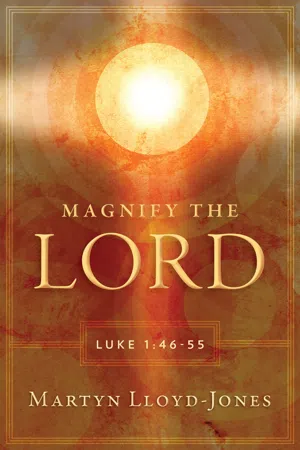
- English
- ePUB (mobile friendly)
- Available on iOS & Android
eBook - ePub
Information
Publisher
Christian Focus PublicationeBook ISBN
9781781910030
Year
2011

MAGNIFYING
GOD
‘And Marysaid, My soul doth magnify the Lord, And my spirit hath rejoiced in God my Saviour. For he hath regarded the low estate of his handmaiden: for, behold, from henceforth all generations shall call me blessed. For he that is mighty hath done to me great things; and holy is his name. And his mercy is on them that fear him from generation to generation. He hath shewed strength with his arm; he hath scattered the proud in the imagination of their hearts. He hath put down the mighty from their seats, and exalted them of low degree. He hath filled the hungry with good things; and the rich he hath sent empty away. He hath holpen his servant Israel, in remembrance of his mercy; As he spake to our fathers, to Abraham, and to his seed for ever’ (Luke 1:46-55).
This statement, this bursting forth of Mary into worship and praise and adoration, which we call ‘The Magnificat’, is something which is worthy of our most careful consideration. There is, perhaps, no better way of approaching the season of Christmas than to do so in terms of a consideration of this particular passage. Indeed, I think we can say that there is no better test of our understanding of the meaning of the Incarnation, everything we think of and celebrate during these days, than our reaction to this song of Mary; because, as I want to try to show you, here, in this short compass, in a very extraordinary manner, she brings us face to face with some of the many central matters in connection with our salvation.
Stages
There are many things which are of great interest with which we cannot stay; I merely note them in passing. It is very interesting, for instance, to notice the stages through which Mary herself passed in connection with this momentous event which was to take place. When, first of all, the archangel Gabriel went to her and made his announcement, Mary was incredulous; she was sceptical, she stumbled. The thing, of course, was so staggering, so unusual, so amazing that she could not receive it, and she made her protestation. Indeed, she virtually suggested to the angel that what he was saying was quite impossible. But the angel reminded her that ‘with God nothing shall be impossible’, that she must not think in those terms and in those categories. She must realise that here she was in a different realm: that he was no ordinary human emissary, nor the bearer of a message from any earthly or human power, but that he was the messenger of God.
Then, as a result of that, Mary moved on to this second stage in which she said: ‘Behold the handmaid of the Lord, be it unto me according to thy word.’ This is a most interesting process, so typical and characteristic of the way in which the gospel tends to come to all of us. At first it seems impossible. But then we feel rebuked for that and we say: ‘Well, I don’t understand it, but I will submit.’ That is what Mary did. She still did not understand. ‘All right’, she seems to say: ‘I hear what you have said to me, and I know that what you say is right concerning God, and that with God nothing is impossible. I therefore leave myself in God’s hands, still not understanding, but ready to wait and to listen and to follow.’ A most important step.
But then she went and visited her cousin Elisabeth, and, as the result of what happened to Elisabeth, and especially as the result of what Elisabeth said to her, Mary burst forth into this great song, this great hymn of praise. Elisabeth had turned to Mary and said: ‘Blessed art thou among women, and blessed is the fruit of thy womb. And whence is this to me, that the mother of my Lord should come to me? For, lo, as soon as the voice of thy salutation sounded in mine ears, the babe leaped in my womb for joy. And blessed is she that believed: for there shall be a performance of those things which were told her from the Lord’ (Luke 1:42-45).
And then we see that God used those very words of Elisabeth to confirm to Mary the announcement that had already been made by the archangel. They brought her to her real understanding, because the moment Elisabeth said that to her, we are told that Mary said: ‘My soul doth magnify the Lord, And my spirit hath rejoiced in God my Saviour.’ And she poured forth her heart in this extraordinary praise and adoration of God, and it is to this that I want to call your attention.
Characteristics
So let us look at some of the characteristics of these words uttered by Mary.
Depth
First, let us notice the depth of feeling with which she spoke, which is conveyed in these words. She said: ‘My soul doth magnify the Lord, And my spirit hath rejoiced in God my Saviour.’ Now she drew a distinction between her soul and her spirit. This is a very interesting theological point. Again, we must not stay with this and we must not build too much upon it, but, at any rate, I think we are reminded here and elsewhere in Scripture that whether the soul and spirit are essentially one or not, there is a distinction between them. The soul in general refers to the rational powers. When the expression soul is used in this way in contra-distinction to spirit, it is meant to refer to the intellect, to the feelings, to the way in which we correspond with one another and have fellowship and relationship with one another. The soul is essentially the rational part of man.
Then the spirit represents the perception. There is a difference between ability and understanding. There is a difference between knowledge and perception. The spirit is a higher faculty, a higher aspect of this possession which we all have. It includes the capacity for worship. The soul, in other words, is that which links us to all that is round and about us: to man and to animals; to history and to the world and all we can see. That is the soul. But if you want to argue that there are only two parts in man and not three, you must say, nevertheless, that there is this compartment, as it were, of the soul which enables one to appreciate the unseen and the spiritual, the spirit: everything that is greatest and uppermost in man.
So, Mary uses the two expressions, ‘My soul’ and ‘my spirit’, by which she means that she is moved in the very depth and centre of her being. She is not merely pleased in a general sense and on the surface. It is not merely something of general interest to her. She has a realisation of something that, she says, has touched her in the very centre and the most vital part of her personality. That is why all this is so important: that is the effect of the good news of salvation upon the soul. This is the effect to which it has always led when people have really understood what it is all about.
In other words, it is like the passage in Ephesians 5:19; there is all the difference between mere ‘singing’ and ‘making melody’ in our hearts. The heart includes this same thing: the soul and spirit, the very centre of man’s whole personality. And it is here that this response to the gospel really comes forth. That is where it has its origin. So we find Mary obviously stirred to the very depths of her soul, and the result is that she speaks with a sense of dignity and of greatness, as she is aware of something profound. You cannot read through what she said without sensing her feeling of awe and of wonder, of worship and of amazement. ‘This’, she seems to be saying, ‘is the most amazing thing I have ever known. I am beyond and beside myself. My soul and my spirit.’
There, then, is the first thing that emerges and the first thing, therefore, by which we test ourselves. You have but to read the New Testament to see that all the men and women who truly have understood the gospel have said something similar; even the Psalmist, looking forward to it, says: ‘Bless the LORD, O my soul: and all that is within me, bless his holy name’ (Ps. 103:1).
I could quote hymns to you; I could quote statements to you from the saints throughout the centuries. They are all saying the same thing and, of course, it must be true. If we really understand what happened when the Son of God left the courts of heaven and came into the world in this way and manner, if we grasp something of its eternal significance, of its profundity, its amazing character, how can it fail to move us, especially in our souls and in our spirits?
And here we are again reminded of how this Christmas season can be so abused even in the church, with men and women talking about themselves and about one another. No, no! It is not just a feeling of goodwill and of friendliness and of happiness; it is something, if we really get hold of it, that moves us in the soul and in the spirit.
Manifestation
Then, secondly, look for a moment at the mani-festation of this feeling. Two words stand out. The first is the element of adoration: ‘My soul doth magnify the Lord’. Now this is an extraordinary expression. It means to make great and to make glorious. ‘But,’ says someone, ‘what a foolish term. How can one magnify God? How can a human being, a creature, one who is but a Creator-created being, how can such a one magnify, make great, multiply, as it were, the Lord God Almighty?’ Of course, in an ultimate sense, it cannot be done, and Mary realises that, as all the psalmists who used the term realised it. And yet there is a sense in which it is very true because while we cannot do anything as such to God in his greatness and in his majesty, we can help other people to see it. We can, as it were, act as a kind of lens that makes him greater in the eyes and in the esteem and in the sight of people.
And that is what Mary was trying to express. It is as if she were saying: ‘How can I make known what I have seen of the greatness and of the glory of God? I want everybody to know this: I want everybody to see it. “My soul doth magnify the Lord”. I am clutching at every word that I can get hold of in order to express something of his greatness and his glory.’
It is, then, a very profound way of giving expression to this depth of desire that God might be known and might be seen, that what he is might be shown in a large way and painted on an enormous canvas, that the whole world may see it and look at it and bow before him in adoration and in praise. ‘My soul doth magnify the Lord...’
>So what about us? I am simply taking these words and holding them before you in order that we may examine ourselves in the light of them. Do our souls magnify the Lord? Is this our innermost desire? The Psalmist has expressed it: ‘O magnify the LORD with me’ (Ps. 34:3). ‘Let us do it together,’ he says, ‘let everybody join in. Let us make his name great. Let us hold it before the nations and the peoples.’
The other word is rejoice. ‘My soul doth magnify the Lord, And my spirit hath rejoiced in God my Saviour.’ Now the word ‘rejoice’ is not quite good enough; it is not quite strong enough. The word really means to exult in him or to make your boasting of him. This is the thing in which I exult. The world is always exulting in various things and men make their proud boast of themselves. But: ‘O,’ says Mary, ‘my spirit exults in God. Here is the theme of my rejoicing – in God my Saviour.’
Significance
Cause
Thirdly, let us go on to see the full significance of this. What is the cause of this feeling within her? And here we come to what I want to emphasise particularly. Why is Mary magnifying the Lord? Why does her spirit exult in God her Saviour? And she really supplies us with the answer. It is not primarily because of what has happened to her. She does mention that: it comes in, but that is merely an incident in her hymn of praise. So what is the cause of her adoration, of her praise? It is because God himself is who and what he is, and because of what he is doing with respect to the world. Mary’s eye, in other words, is not upon herself. You see how certain parts of the Church have so abused and made an utter travesty of this. Mary is full of humility. She refers to herself as what she is – ‘the low estate of thine handmaiden’. There is nothing here about the ‘mother of God’ and about ‘the queen of heaven’. Mary is not thinking about herself. Mary has seen something that makes her forget herself; and this is the ultimate test of a true understanding of what happened when God in the fulness of the times ‘sent forth his Son, made of a woman, made under the law’ (Gal. 4:4). Mary is rejoicing not so much in the fact that she is to be given this great privilege, she has been reminded by Elisabeth of what that is and of how people are going to call her blessed, and she repeats that: ‘from henceforth all generations shall call me blessed’. But that is not the thing that really moves her. It is what God is doing: this historic event, this climactic action of God himself. She is humbled and grateful at the thought of the fact that she is to be given a part and a place in this, but it is the thing itself that moves her and makes her sing and worship. She is filled with a sense of amazement, of worship, adoration and utter astonishment. She sees the inner meaning of the action. She has a glimpse and a glimmering of understanding of the whole purpose of salvation, what God is doing in bringing forth his Son into the world, even out of her womb.
Now that is the secret of this song. And it is also the secret of the whole Christian position. What is it that leads to worship and to praise, to exultation, to adoration? And the answer is that it is always the understanding. The only singing that is of any value in the sight of God is that which is based upon the understanding, the understanding of the truth. That is why we must take this occasion to remind ourselves, therefore, that we must never go for the emotions directly. We must never go for the will directly. The emotions and the will are the result of something seen by the understanding.
That is what Elisabeth shows. She was filled with the Holy Spirit, we are told, and she spoke forth with understanding – enlightenment of the Spirit. And exactly the same thing is true here of Mary. And what Mary sees is not that she is to be made great because she has this privilege, but the greatness of the God who is acting and the greatness of the action which he is taking.
Expression
So, fourthly, let us follow her in the expression of her feeling. What does she say? The main thing here, of course, is that Mary is telling us certain things about God as he is. She is adoring God for being what he is, and this is the very essence of Christian worship and of Christian praise. Alas, in our weakness and frailty, we are so concerned about the benefits that we forget the giver. But here is adoration and worship at its very best. There are two dangers which confront us: there is the danger to which I have already referred – the monstrosity of the false teaching and the exaggeration of the Roman Catholic Church. But let us be careful also that in a violent reaction against that we do not underestimate what Mary saw and what she expressed in the Magnificat. Let us keep to the balance of the Scriptures and not be governed by prejudices.
And here, Mary is expressing the very heart and soul of Christian praise and worship and adoration. God himself. First and foremost, his greatness and his glory: ‘My soul doth magnify the Lord’ (emphasis added). There is nothing above that; we will never rise above that; to magnif...
Table of contents
- Title
- Indicia
- Contents
- Foreword
- 1. Magnifying God
- 2. The Wisdom of God
- 3. The Faithfulness of God
- 4. The Christian's Experience
- Christian Focus
Trusted by 375,005 students
Access to over 1.5 million titles for a fair monthly price.
Study more efficiently using our study tools.