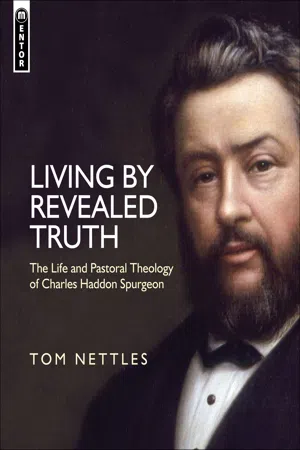
eBook - ePub
Living by Revealed Truth
The Life and Pastoral Theology of Charles Haddon Spurgeon
- English
- ePUB (mobile friendly)
- Available on iOS & Android
eBook - ePub
Information
Publisher
Christian Focus PublicationeBook ISBN
9781781912737
Year
20131
Birth to New Birth
Once I, like Mazeppa, bound on the wild horse of my lust, bound hand and foot, incapable of resistance, was galloping on with hell’s wolves behind me, howling for my body and soul, as their just and lawful prey. There came a mighty hand which stopped that wild horse, cut my bands, set me down, and brought me into liberty. Is there power, sir? Aye, there is power; and he who has felt it must acknowledge it. There was a time when I lived in the strong old castle of my sins, and rested on my works. There came a trumpeter to the door, and bade me open it. I with anger chid him from the porch, and said he ne’er should enter. There came a goodly personage, with loving countenance; his hands were marked with scars, where nails were driven, and his feet had nail-prints too; he lifted up his cross, using it as a hammer; at the first blow the gate of my prejudice shook; at the second it trembled more, at the third down it fell, and in he came; and he said, “Arise, and stand upon thy feet, for I have loved thee with an everlasting love.” A thing of power! Ah! It is a thing of power. I have felt it here, in this heart; I have the witness of the Spirit within, and know it is a thing of might because it has conquered me; it has bowed me down. 1
Charles Haddon Spurgeon engaged the last half of the nineteenth century with the power of his personal experience of grace and the unshakeable convictions that the Bible was revealed, that Christ came, and that the Holy Spirit was sent to make sure that all of the Father’s elect would have such an experience. If Spurgeon could not bend the rationalists, the latitudinarians, the modern-thought men, the purveyors of manners and virtue, and the Anglo-Catholics to his will in this matter, then he certainly would not conform a single degree toward them—and he would keep as many from their clutches as he could possibly reach. If he saw a human need that could be met and in so doing serve the cause of this gospel, he would meet it. If he saw a ministry needed to promote the clear proclamation and wide dissemination of this gospel, he would start it—and maintain it. If he could not keep his denomination resolutely faithful to the power of these truths, then he would die trying.
Spurgeon’s Childhood
Born in the Essex village of Kelvedon on June 19, 1834, his parents were John and Eliza Jarvis Spurgeon. He was the first of seventeen children, only eight of whom survived infancy. Spurgeon’s father would die at ninety-one years of age in 1902, having survived his eldest son by ten years. Spurgeon’s family moved to Colchester before he was one year old. “Grace does not run in the blood,” Spurgeon wrote in 1884 during his fiftieth year, “but it often runs side by side with it.” He considered it a high honor to be descended from one that feared the Lord and particularly one from non-conformist stock. 2
Such religious gumption, if not genetic, was certainly environmental, for the Spurgeons had first come to England from Holland near the close of the sixteenth century, refusing to submit their consciences to Philip II, the husband of Bloody Mary and king of Spain, who had sent the bloody Duke of Alva to force the sturdy Hollanders into the church of Rome. A subsequent ancestor, Job Spurgeon, suffered as a Puritan in England during the reign of Charles II, being imprisoned for the sake of conscience. He refused to be released on the promise of good behavior, that is to cease his non-conformity, and suffered as a sick man through an extreme winter. 3 When Spurgeon characterized his father in his seventies, he could have described these ancient forebears: “There is a strong fixedness of belief in our father’s mind, and it would take an eternity of modern arguing to reason him out of his confidence.” 4 He was not one to truckle with the inventions of the hour.
Spurgeon was named after two uncles, one maternal and one paternal, Charles Jarvis and Haddon Spurgeon. Four months after the parents moved to Colchester, his grandparents took him to live in Stambourne, in the country between Halstead and Haverhill. His grandfather had been pastor of the Independent congregation there since 1810, was a virtual oracle in the village, and stood in good graces with even the minister of the established church, James Hopkins. Spurgeon noted, “They preached the same gospel, and, without surrendering their principles, were great friends.” 5 The tension that existed between Church and Chapel in many places in England was not a prominent factor in Stambourne. 6 The young Spurgeon remembered the “very brown” sugar along with the sugared bread and butter for Monday snack in fellowship with his grandfather, the Rev. Hopkins, and a resident who attended both church and chapel on any given Lord’s Day. 7
Spurgeon also recalled a great number of details about the house and its impressions on him, including its picture of David and Goliath, its plastered windows so darkened to avoid a window tax, and its rocking horse “on which even a member of Parliament might have retained his seat.” The foxhunt fascinated him for its pageantry, its speed, and its mystery. Both hymn-memorizing and rat-killing earned him money, the latter more than the former, but Spurgeon knew, as did his hearers, “which employment has been the more permanently profitable.” Every event, every item, every conversation, every relationship, every errand resulted eventually in spiritual and doctrinal lessons to Spurgeon. He learned to notice small but astounding elements of nature and marveled in the fascinating wonders all around him. The apple in a bottle, the sparrows in the plaster wall just beside his bed, the kneading trough with a cabinet containing a pastry for “the child,” the mangle used by many others in the town, all made pleasant memories for Spurgeon. He liked “all this rural life,” 8 and many of the spiritual and theological lessons he shared through his ministry came out of the way in which he developed analogies between nature and doctrinal truth.
Spurgeon loved to tell stories of the rural life of his grandfather and how God provided for them in, humanly speaking, straitened circumstances. In days prior to Spurgeon’s sojourn with him, his main living came from the working of a farm. He had a cow that provided milk for his many children. One day the cow got the staggers and died, leaving them destitute of much of their sustenance. “God has the power to give us fifty cows if he so pleases,” John told his distraught wife. On that day, the committee administering a fund for poor ministers met in London, and after distributing all the money to those that had requested it, they were left with £5. None knew him personally, but one knew of him and his integrity and his struggles and suggested that the £5 be sent to the Independent minister down in Stambourne in Essex. Another said that £5 would not do, and added another five; so two others did the same. The next morning, the Spurgeons received £20 in the post from the Lord in recompense for the departed cow. When he opened the note, and saw the money, he said to his wife, “Now, can’t you trust God about an old cow?” 9
The immediate dependence that rural village people had on the health of a cow, the balance of sun and rain, the sharpness of a plough, and daily health and pain, all produced a habit of proverbializing and a deep awareness of providence. Spurgeon’s John Ploughman and some other pseudonymous characters arose from a combination of characters he met in rural Stambourne, not least of which was his beloved grandfather, and a farmer given to proverbial sayings called Will Richardson. Sometimes the young man would walk with Richardson when he was plowing. Richardson was well known for his “cramp” sayings which often would be repeated around the town, particularly his evaluation of a young preacher given to the novice himself, “Ah, young man, you have a good many stiles to get over before you get into Preaching Road.” 10
The love Spurgeon had for the common man, the confidence he had in good common sense, and the commitment he had for honest and long labor emerged from his observations of rural life and the work required to keep life merely above failure. In reviewing a book entitled Plodding On; or, the Jog-trot to Fame and Fortune by Henry Curwen, Spurgeon commended the book as likely to excite laudable ambition in youth by the narrative of victories of genius. All of the persons were plodders and all succeeded in life. “Working men will here see how they may climb if they will,” Spurgeon remarked. With a bit of wise and sad observation in the background, he continued, “If the quart pot and an unwise marriage do not chain them to the lowest round of the ladder, they may mount if they will banish self-indulgence, and put forth their energies.” Since the idea of successful plodders had been introduced, Spurgeon decided to add to the review his own concept of genius. “It would be a gross error,” he urged, “if it were imagined that men of genius do not work. To our mind, genius generally means that a man has a tendency and an aptitude for double toil in a certain direction, and hence he prospers in it.” The genius for hard work was the only genius he believed in. A man that sought to succeed on supposed genius apart from diligent application had no place in Spurgeon’s esteem.
His reminiscences of Stambourne came from a collection of them throughout early childhood and adolescence. He relished visits to his grandparents, especially on holidays, even after going back to Colchester to live at home. His father remarked about these times:
It has been said that Charles was brought up by his grandfather and grandmother. The fact is, that my father and mother came to see us when Charles was a baby of fourteen months old. They took him to stay with them, and he remained with them until he was between four and five years of age. Then he came home to stay with us at Colchester. ... Afterwards he often went to spend his holidays with his grandparents, who were very fond of him. ... He was always reading books—never digging in the garden or keeping pigeons, like other boys. It was always books and books. If his mother wanted to take him for a ride she would be sure to find him in my study poring over a book. 11
Breathing Puritan Air
Particularly beneficial to Spurgeon during these visits to Stambourne were the numerous opportunities for immediate and positive doctrinal impressions. Discussions at his grandfather’s house, as well as among his father’s friends, made Spurgeon pay close attention to the nature of theological argument. “I can bear witness that children can understand the Scriptures,” Spurgeon insisted, “for I am sure that when but a child I could have discussed many a knotty point of controversial theology, having heard both sides of the question freely stated among my father’s circle of friends.” 12 In addition, the love for books noted by John Spurgeon reflected an innate intellectual curiosity that Charles Spurgeon maintained all his days, but which was startled to life in his grandfather’s room of books. One of the rooms behind a plastered window housed a true book lover’s gold mine. Spurgeon met the martyrs of the English reformation and “Old Bonner,” the bishop of London responsible under Bloody Mary for the burning of more than 200 of his parishioners. He also made a lifelong acquaintance with Bunyan and his Pilgrim which he read more than a hundred times throughout his life. Most memorably and reverentially did Spurgeon regard the “great masters of Scriptural theology, with whom no moderns are worthy to be named in the same day.” He loved even the look of a genuine Puritan book with its margins, notes, type, and especially the “sheepskins and goatskins” in which they were forced to wander.
These volumes were left over from the very day of the Puritans and had been the possession of Henry Havers, a Puritan who left the parish church in 1662 when conscience would not permit him to comply with the Act of Uniformity. Three straight pastors by the same name, a grandson and then his nephew followed, served the church for its first eighty-six years. After the original Henry Havers vacated as rector of the parish, he continued to encourage the parishioners and teach them in other venues. The legislation of the Conventicle Act and the Five Mile Act brought renewed waves of persecution on his itinerant flock for ten years. Havers himself was once pursued by the authorities, hid himself in the kiln of a malt-house and eluded his pursuers when a spider wove a web over the door to the kiln, leading them to believe that he could not possibly be in there or he would have broken the web.
A long-time member of the congregation composed some loving lines of poetry about the three Havers and included the following verses about the ejected Puritan.
Havers the first was rector here,
His Zeal for God was warm;
The living not to him so dear
That he would e’er conform.
He left his church and living too,
To keep his conscience clear;
His great concern was good to do,
And much good did he here.
He was far from being a Jude,
He was a star of light;
Yea one of the first magnitude,
And always shined bright.
Yea, he was like unto the sun
In a bright summer day;
Bright he begun and bright went on,
And bright he went away.
The books that so enthralled Spurgeon were a gift to Havers from Thomas Green to be used by him and those that should follow him in the gospel ministry in that place. 13 The man that served as pastor of the congregation from 1776 to 1810, immediately prior to James Spurgeon (1810-64), was Benjamin Beddow, and he was grandfather to the man who aided Charles Spurgeon in the production of Memories of Stambourne. 14
Spurgeon’s commitment to exposition from early to late in his ministry showed the tenacity of his mental and spiritual attachment to this literary legacy and of his continued preference for it over the developing critical approach to scriptural scholarship and commentary. Preaching on “Faith” from Hebrews 11 in December 1856, Spurgeon set forth the outline using the divisions of the subject suggested to him by the Puritans. “The old writers, who are, by far, the most sensible—for you will notice that the books that were written about 200 years ago by the old Puritans have more sense in one line than there is in a page of our new books—and more in a page than there is in a whole volume of our modern divinity!” The subject he then divided into knowledge, assent. and affiance, “or the laying hold of the knowledge to which we give assent and making it our own by trusting in it.” 15 Less meat and more pits became common fare from the modern handling of the text in Spurgeon’s opinion. Twenty-seven years did not dampen his enthusiasm for the Puritans, for in 1883 he still protested, “If Puritanic preaching filled the pulpits, it would soon fill the pews.” He asked for more “old-fashioned divines like Boston and the Erskines.” 16 He found little in the theological productions of modern times to recommend to his students but was delighted when the Nichols Series of Puritans commentaries appeared. Though the modern critical approach encouraged some advances in understanding, the value of the Puritans was insuperable. “The Puritan age was one of great erudition, unwearied application, deep-felt experience, and unbounded veneration for the authority of the Divine Word.” More breadth may come from the moderns, but not more depth. With the Puritans “we shall have both breadth and depth, and our theology, however, much extended, will still be the deep, deep sea.” 17
When examining a book on prayer in 1882, Spurgeon noted its thorough thinness and its “tameness of propriety as compared with the force and piquancy of the Puritans.” 18 He did not want a book to “squeeze soft” but something “solid, substantial, and real.” Modern theology was like whipped cream or the soufflé of the confectioner, very pretty but hardly anything at all. “In a cubic inch of Charnock, or Owen,” he remarked in 1885, “there is enough matter to cover acres of the new school of writing.” 19 George Rogers, the first tutor at the Pastors’ College, speaking at the 1883 Conference, reflected Spurgeon’s heart when he noted, “It is another distinguishing peculiarity of our College, and which accounts in a great measure for its spiritual results, that it adheres to the Puritanic in distinction from the Germanic theology.” 20
As for Spurgeon, he could quote from the Puritans at will, illustrate a point from a variety of Puritan auth...
Table of contents
- Testimonials
- Title
- Indicia
- Contents
- Preface
- Introduction
- 1 Birth to New Birth
- 2 Made for Gospel Ministry
- 3 The Metropolitan Tabernacle
- 4 Preaching the Whole Counsel
- 5 Theological Method and Content
- 6 Spurgeon’s Message of Christ’s Atoning Sacrifice
- 7 The Challenge of Church Life and the Governance of Worship
- 8 The Gospel is Evangelism
- 9 Use of Evangelists
- 10 Theological Foundations for a Benevolent Ministry
- 11 Personal Theory and Preferences in the Production of Godly Literature
- 12 Literature about Right, Wrong, and Truth
- 13 Theology and Controversy
- 14 Destroyed or be Destroyed
- 15 The Downgrade Conflict
- 16 Spurgeon and Baptists in America
- 17 Sickness, Suffering, Depression
- 18 Conduct in the Face of Death
- Scripture Index
- Subject Index
- Also available from Christian Focus
- Christian Focus
Trusted by 375,005 students
Access to over 1.5 million titles for a fair monthly price.
Study more efficiently using our study tools.