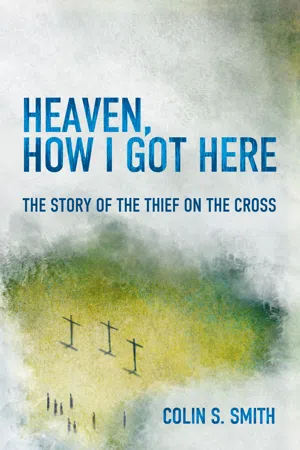
- English
- ePUB (mobile friendly)
- Available on iOS & Android
eBook - ePub
Information
Publisher
Christian Focus PublicationeBook ISBN
9781781915691
Year
20151
Breakfast
6.00 a.m.
Not many men open their eyes in the morn-ing knowing it is their last day on earth. ‘This is it. This is the day I die.’ Looking back, the entire day and how it ended still blows my mind.
I awoke in the cell where they were holding me pending execution or, to be more accurate, torture, humiliation and a long, slow descent into death on a cross. Only the Romans could have perpetuated such barbarity, and I hated them with every fiber of my being.
My story began in an ordinary home and is largely without surprise. My father made a modest living as a builder while my mother, who set the pace for our family, gave herself to setting her children on the right path.
Because we were Jewish, the synagogue was a regular part of our family life, as was the annual trip to the temple in Jerusalem. My mother, a woman of ridiculous faith, made sure that I was well schooled in the teachings of our fathers. ‘God is gracious and compassionate,’ she said, ‘slow to anger and abounding in love.’
She also taught us the Ten Commandments, and with them a long list of rules drawn from the Scriptures, the Rabbis and from her own fund of wisdom. Her world was simple: there was a right way to live and there was a wrong way. Live the right way and all will end well. Live the wrong way and you had better watch out. ‘God is watching you,’ she would say. ‘He sees everything, and He never forgets. He remembers the good and He remembers the evil. You always reap what you sow.’
Her favorite book in the Scriptures was the book of Proverbs. I can still hear her voice telling me that ‘The fear of the Lord is the beginning of wisdom.’ Then she would ask me, ‘Do you fear God?’ It never occurred to me that there was any other option. Like most children, I pretty much just accepted what my mother taught me about God—until my early teens, when I began to have questions about God and about authority in general.
A major turning point occurred for me at the age of thirteen, when I saw up close the injustice that was woven into the fabric of our national life. My father worked so hard to make ends meet for our family, but the intolerable taxes imposed on us by the occupying Roman army made even our modest lifestyle hard to sustain. That particular day, the tax collector knocked on the door with his latest unfounded demand. I remember the pained and powerless look on my father’s face. It was as if they had broken his back and crushed his spirit. Everyone knew that the system was riddled with corruption, but what can you do when the power of a brutal army stands behind the slimy little taxman?
Seeing my father look that way made me furious. What right did these imposters have to march into our land and demand our money? Since when did we owe them? The whole thing was an injustice, and even as a young man it made me mad. It simply wasn’t fair.
Our annual visit to the temple in Jerusalem had always been a highlight of family life. Think of a vacation with your extended family and you will get the idea. My first impression of the temple was of awe and wonder. The size of the building, the depth of the walls, the noise of the crowds and the relentless activity in the temple courts took my breath away.
But as the years passed, my questions began to grow. The priests offered a relentless diet of rules and morality. ‘Wisdom for life’, they called it. But what were they doing about the glaring injustice that was plain for all to see in the ever-present oppression of Rome? Nothing, as far as I could see.
Gradually I came to the conclusion that the temple, the priests and the whole moral structure were supremely irrelevant to the real issues of life for our people. Over time, the hatred I felt toward Rome showed up in a growing resentment toward the temple, its rules and its God. It seemed like the priests and religious professionals were just playing games while all the time they were ignoring the real issues that needed to be addressed in society.
I watched how people poured money into the temple treasury and thought about how that money could be used to fund the small bands of freedom fighters who were ready to risk their lives in standing up to the Roman occupation. But that didn’t happen. Instead, the money rolled into the temple coffers to be sunk into the endless maintenance of buildings and priests who, as far as I could see, had little to offer.
Rules! Morality! Where was this getting us? What could it all accomplish? Somewhere in these anxious and angry thoughts, a rebellion was born in my heart.
So you won’t be surprised when I tell you that the temple was the scene of my first theft, at the age of fifteen. I had been watching as people put their money into the treasury and had been surprised by the low level of security. It would be as easy, I figured, for me to take money out of the treasury as it was for them to put money in. If the priests weren’t going to put the money to good use, maybe I could.
As the thought settled, a decision emerged. My palms began to sweat as I watched and waited for the right moment. Then, with money in hand, I stepped toward the basin where the gifts were gathered, feigned the dropping of my coins, and in the same movement gathered a fistful of cash.
Walking away, I felt sure that a large hand would be laid on my shoulder and that I would be confronted. But it never happened. I had committed the perfect crime, and as much as I hated to admit it, it felt good.
My theft at the treasury planted the seed of a grander scheme for a nobler purpose. Somebody needed to do something bold, and that became my life’s ambition.
Each time I stole, it got easier for me. I had far bigger hauls and far less fear of consequences. Over time I became arrogant in my crimes and lazy in my efforts to hide them. After years of stealing, lying and taking advantage of others, the consequences of my lifestyle finally caught up with me. That large hand of the law I had eluded for so long landed on my shoulder, and led me to the cell where I began the last day of my life.
A loud thud reverberated on the cell door as a heartless guard stepped in with a mug and a plate in his hand. ‘Breakfast,’ he said, as he spat in my food. ‘Enjoy your last meal.’
The door closed and I sat alone, powerless, staring at the wall of my miserable cell. This was the end of the line for me, and it felt as if the Devil was on my shoulder. In front of me was a day of excruciating pain, and who knew what would lie beyond that?
Rage against Rome had energized my life, and now I was in the hands of the people I hated. I had dared to resist their power, and I knew that they would show me no mercy. They would make an example of me and use my pain to stop any brave souls who might consider following my example in their tracks.
As I considered the day that stretched in front of me, I determined to show no weakness. The Romans could break my body, but they would never break my spirit. I resolved to die in defiance.
2
Hatred
9.00 a.m.
The first time I saw a dead body I was seven years old. Our family was in Jerusalem for Passover week, and like a typical boy I wandered away from my parents. I ended up in an area known as Execution Row, where I saw soldiers and other people staring up at the bloodied, lifeless body of a man who had been crucified earlier that day. I could not take my eyes off the man. He was so close to me that I could reach up and touch his feet. It was unlike anything my seven-year-old imagination had dared to picture. I would have never dreamed that years later, I’d be facing the same fate.
Two others shared my ordeal the day I was crucified. One after the other, they nailed us to our crosses. I was not able to see the guards do their work on the first victim, but I watched closely as the second was pushed forward. A large beam of wood was placed on the ground and a moment later the victim, who had been poleaxed by a guard, was lying on it. One of the soldiers stamped on the man’s right forearm, pinning him to a second beam. Then they produced the nails.
An agonized scream cut through the morning air as the victim’s hand was pierced by the blunt spike. Four times I heard that awful shriek.
‘This is what happens to thieves,’ shouted one of the guards. His words seemed to be for the crowd rather than the victim, to whom he gave no regard.
Then it happened to me.
There are no words to describe the pain of crucifixion. All I can tell you is that hatred sustained me. Determined to show no weakness, I fixed my eyes on the guard with the hammer and loathed him. He looked at me for a brief moment, but seeing the intensity in my eyes, he turned away. I stared at him and steeled myself as he indulged his macabre act.
But worse was yet to come. After fixing my body to this instrument of torture, they lifted me up and dropped the beam into a roughly cut hole in the ground. The weight of my entire body sent searing pain through the wounds in my hands. My only relief was to press down with my legs, transferring the most intense pain to my feet.
I found that I could breathe when the weight was on my feet, so I developed a kind of rhythm in which I moved between hanging from my hands and pressing on my feet. Either way, the agony was unrelenting.
The first victim was clearly the object of unusual attention. His cross had been placed at the center, with the second victim and myself just a few feet away on either side.
I was completely absorbed with my own pain and had taken no notice of Him until I heard Him speak.
‘Father, forgive them,’ He said.
‘Forgive them!’ Who is this m...
Table of contents
- Testimonials
- Title
- Indicia
- Dedication
- Contents
- Quotation
- Introduction
- 1 Breakfast
- 2 Hatred
- 3 Faith
- 4 Hope
- 5 Love
- 6 Darkness
- 7 Agony
- 8 Triumph
- 9 Safety
- Postcript
- Christian Focus
Trusted by 375,005 students
Access to over 1.5 million titles for a fair monthly price.
Study more efficiently using our study tools.