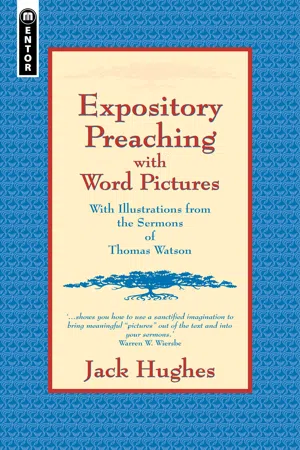
eBook - ePub
Expository Preaching With Word Pictures
With Illustrations from the Sermons of Thomas Watson
- English
- ePUB (mobile friendly)
- Available on iOS & Android
eBook - ePub
Expository Preaching With Word Pictures
With Illustrations from the Sermons of Thomas Watson
Information
Publisher
Christian Focus PublicationeBook ISBN
9781781913406
Year
20141
GENUINE OR COUNTERFEIT?
What is expository preaching?
A few years ago I was away on holiday and visited a church where I was told the pastor did ‘expository preaching’. Fresh paint, nice dark asphalt in the car park and lack of wear and tear on the furnishings told me it was a new church building. Several friendly people greeted me and one of them gave me a bulletin.
As I sat waiting for the service to begin, I anticipated a helpful expository sermon that would be good for my soul. On the bulletin was the title of the sermon, but since the outline was missing, I flipped over one of the bulletin inserts and composed my own outline. I opened my Bible to the sermon text and did a quick diagram of the passage. I found a main verb and several phrases modifying it in the text. Immediately, it was apparent that the sermon title did not fit the subject of the text. But I have been guilty of giving such strange titles to my sermons that not even Sherlock Holmes could deduce their meaning.
Then the pastor delivered the message. As a communicator, he rated highly. He had some great illustrations, funny stories and taught some important biblical concepts. But he first tortured, then murdered the text. It was exegetically gruesome. The blood of misinterpretation was splattered everywhere. He took one word from one of the grammatical sub-points and brutalized it by stretching it far beyond its contextual limits. His sermon had nothing to do with the meaning of the text. In fact, it was alien to the context. As he preached, I cringed at each of his fabricated points which he foisted upon the Scriptures. Yet, as is often the case, everything he said was true. He was not promoting false doctrine. He was preaching biblical truth – but from the wrong text! One thing was clear, he was not doing ‘expository preaching’.
A deep quagmire surrounds the definition of expository preaching. It has become stylish for preachers today to call themselves ‘expository preachers’. After all, who would want to be ‘just a Bible teacher’ when you could be an ‘expositor’ like famous preacher so-and-so? Quite a lot of pressure exists in conservative church circles for preachers to be ‘expository’.
But what does it mean to be an expository preacher? Does it mean preaching through a book by first reading a verse and then talking about whatever you want? Does it mean only preaching small portions of Scripture? Does it mean teaching verse by verse all the time? Does it mean never doing a topical sermon, a thematic sermon, or preaching a large section of narrative? Since this is a book on expository preaching, it is important to ascertain what expository preaching is before we develop the specific topic at hand.
Modern day expositors have defined expository preaching for us. Dr. Stephen Olford states:
A sermon is the proclamation of the Word of God only if the text of the Word is accurately expounded and preached. So, in the strictest sense of the term, authentic preaching is expository preaching. 1
Sidney Greidanus, when defining expository preaching, quotes Merrill Unger:
Expository preaching, as its name implies, is to expose, to lay open, the meaning of the preaching text in its contexts. Merrill Unger has provided a fine description of expository preaching: handling the text ‘in such a way that its real and essential meaning as it existed in the mind of the particular Biblical writer and as it exists in the light of the over-all context of Scripture is made plain and applied to the present-day needs of the hearers’. 2
Haddon Robinson has defined expository preaching in this way:
Expository preaching is the communication of a biblical concept, derived from and transmitted through a historical, grammatical, and literary study of a passage in its context, which the Holy Spirit first applies to the personality and experience of the preacher, then through him to his hearers. 3
John MacArthur, in discussing the issue of inerrancy and expository preaching, explains:
The only logical response to inerrant Scripture, then, is to preach it expositionally. By expositionally, I mean preaching in such a way that the meaning of the Bible passage is presented entirely and exactly as it was intended by God. Expository preaching is the proclamation of the truth of God as mediated through the preacher. 4
John R. W. Stott defines expository preaching saying:
It is my contention that all true Christian preaching is expository preaching. Of course if by an ‘expository’ sermon is meant a verse-by-verse explanation of a lengthy passage of Scripture, then indeed it is only one possible way of preaching, but this would be a misuse of the word. Properly speaking, ‘exposition’ has a much broader meaning. It refers to the content of the sermon (biblical truth) rather than its style (a running commentary). To expound Scripture is to bring out of the text what is there and expose it to view. The expositor pries open what appears to be closed, makes plain what is obscure, unravels what is knotted and unfolds what is tightly packed. The opposite of exposition is ‘imposition’, which is to impose on the text what is not there. But the ‘text’ in question could be a verse, or a sentence, or even a single word. It could equally be a paragraph, or a chapter, or a whole book. The size of the text is immaterial, so long as it is biblical. What matters is what we do with it. Whether it is long or short, our responsibility as expositors is to open it up in such a way that it speaks its message clearly, plainly, accurately, relevantly, without addition, subtraction or falsification. In expository preaching the biblical text is neither a conventional introduction to a sermon on a largely different theme, nor a convenient peg on which to hang a ragbag of miscellaneous thoughts, but a master which dictates and controls what is said. 5
All of these definitions of expository preaching are somewhat different. Yet, if all of them were put into the smelter and alloyed, a definition with certain attributes would result. The content of expository preaching is the word of God. The method of deriving the sermon is the application of the historical, grammatical method of interpretation and exegesis. The quality of the sermon is accuracy to the text of God’s word. The goal of expository preaching is to represent or expose to view or plainly reveal what God and the authors of Scripture meant by what they said, exactly and entirely. The practical purpose of expository preaching is to show how the text of Scripture is to be applied in the believer’s life. The expository sermon must also be personally applied by the preacher and delivered in the power of the Holy Spirit. The mode of delivery is public preaching or proclamation. Expository preaching is ‘Christian preaching’, ‘authentic preaching’ and ‘biblical preaching’.
I first learned what expository preaching was while attending The Master’s Seminary in southern California. 6
Before seminary, I thought expository preaching was a ‘style of sermon delivery’. I soon discovered that expository preaching is like an iceberg. The delivery of the sermon is the part of the iceberg that shows above the water, but more is hidden under the surface which is not seen in the pulpit. The unseen part is the necessary training that enables one to be an expository preacher. In order for a gifted man to become an expository preacher he must be taught or teach himself certain disciplines. Three specific disciplines come to mind. The knowledge and skill of these disciplines are the tools of the preacher’s trade.
First, expository preaching is the product of sound hermeneutics. When I say sound hermeneutics, I mean a system of hermeneutics which is objective, not subjective, which is inductive, not deductive. Many hermeneutical principles or rules are used for interpreting the Bible. These principles are like tools in a carpenter’s tool box. When a carpenter goes to work, he has a large assortment of tools. Some he uses on every job – like a tape measure, pencil and saw. These are like the principles of historical context, far context and near context which are used every time a text is studied. But some tools in the carpenter’s box are only used for specialized applications, such as the draw knife, plumb bob, or router. These might be compared to specialized hermeneutical principles used when studying certain types of biblical genre like parables or prophecy. For instance, some texts don’t mention any cultural customs; because of this a study of cultural customs is not applicable. So the ‘tool’ of cultural studies stays in the tool box until a cultural custom is encountered in another text. Without solid hermeneutical training the preacher is like a carpenter with only some of the tools needed to do carpentry. Some preachers are able and gifted preachers, but many do not have the tools to produce an expository sermon from every text they encounter.
Second, expository preaching is not only the possession of the right hermeneutical tools, it is the skilled application of those tools. This is exegesis, the application of hermeneutical principles. Exegesis is the process of extracting information from the text,as opposed to eisegesis, which is reading information into the text.Some carpenters are magnificent tool collectors but poor craftsmen. They have the equipment but not the gift of carpentry. They have a hard time figuring out when to use a specific tool. This is like a preacher who attends the finest seminaries in the world but is not gifted by the Holy Spirit to be a preacher. Therefore he struggles with the ‘art’ of expository preaching because he doesn’t know what tools to use when he approaches a specific text.
The man who has pulpit talent is able to soar once in a while; often he can run without growing weary; sometimes he can only plod along through sand or mud. But if there is in the pulpit any shivering mortal who never soars, or even runs, who must plod along like an ox hitched to the plough, he should ask himself whether or not he has found the task for which God girded him. 7
The expository preacher must not only have the tools, he must also have the gifts and the abilities to apply the tools skillfully. The study of hermeneutics is more of an exact science but the application of hermeneutics, i.e., exegesis, is more of an art.
Thirdly and finally, the Bible expositor is an exposer of the meaning of the text he preaches. At an exhibition, different companies or people display or expose their products. The carpenter takes wood and builds furniture with it. He skillfully applies his tools until he has something to display in the front window of his carpentry shop: that is exposition. Biblical exposition is displaying the truths of Scripture within their various biblical, historical and literary contexts. It is to accurately display God’s truth to the masses in an under-standable and practical way. It is to ‘show them’ what God meant to say from the text of Scripture being exposed. It is not merely teaching Bible facts or proclaiming sound doctrine. A preacher who teaches sound doctrine, but does it from the wrong text, is failing to be an expository preacher. As an expository preacher preaches the word, his congregation should be able to see from the text of Scripture where he derived the truths put forth in his sermon. By example, the expository preacher teaches a congregation how to study their Bibles. Every sermon is an example of ‘handling accurately the word of truth’ (2 Tim. 2:15).
Many preachers who think they are expository preachers are not because they: (1) do not have the proper hermeneutical training to produce an expository sermon; (2) do not have the giftedness needed to be an expository preacher; or (3) do not expose the meaning of the text within its various contexts in an understandable way. The true expository preacher is able to show his people from the text of Scripture what God and the authors of Scripture meant, so that people understand what the biblical text means. The revival under the leadership of Ezra and Nehemiah started when ‘they read from the book, from the law of God, translating to give the sense so that they understood the reading’ (Neh. 8:8). Exposition fails if it does not impart the understanding of the text of Scripture.
I believe that expository preaching is biblical preaching. The reason I believe this is that preachers are commanded to ‘preach the word’ (2 Tim. 4:2). They are commanded to be ‘approved to God’ by ‘handling accurately the word of truth’ (2 Tim. 2:15). Any sermon which fails to communicate the word of God accurately from its biblical contexts has failed; the preacher has sinned grievously. By reading one’s thoughts into the text, by preaching biblical truth but from the wrong text, by mishandling the text, by using the text for what one wants it to say, or by hammering away on the anvil of one’s own pet peeve, preachers sin. It is a direct violation of the word of God.
Poor preaching teaches people faulty hermeneutics. They are looking at the text and seeing one thing, but they are hearing something else from the pulpit. This usually takes them to one of two tragic conclusions.
In the first place, it frustrates them because they conclude they are not smart enough or educated enough to get from the text of Scripture the truths they are hearing from the pulpit. They think to themselves, ‘I guess you have to go to seminary and learn Hebrew and Greek to understand what the Bible says’. Instead of motivating them to study their Bibles, poor preaching makes them want to give it up all together.
A second and equally frightening outcome of failing to preach the word accurately is that it teaches by example a faulty system of hermeneutics. It leads people to conclude that they can come to a text, ignore the context, ignore the theme, ignore the grammar and syntax and make it say whatever they want. This leads to false doctrine which gives birth to carnality. We need to remember that teachers will incur a stricter judgment (Jas. 3:1). It is hard to swim with a millstone around your neck (Matt. 18:6).
This leaves the preacher with only one way of study (sound hermeneutics in exegesis), one body of truth (the Bible), and one method of delivery (expository preaching). The style of sermon delivery is not necessarily defined by expository preaching. Bible expositors have many different preaching styles. The common denominator is that they all apply sound hermeneutics and expose to view what God meant in the Scriptures. Expository preaching is not necessarily verse-by-verse exposition through a book. It does not mean that you cannot have a topical expository sermon. Expository preaching can be done in many ways, but in every way that it can be done it contains the three non-negotiable elements: sound hermeneutics manifested in exegesis, a biblical focus and exposing biblical truth from its scriptural context. Expository preaching is a verbal conveyor belt that digs gold from the Scriptures and transports the nuggets of God’s word to the hearts and minds of people. How to deliver the gold most effectively is the field of homiletics.
Homiletics, like hermeneutics and exegesis, is both a science and an art. The various communication or homiletic techniques are more of a science, but the application of those techniques is an art. Examples of homiletic techniques are eye contact, gesture, voice tone, pace of speech, pause, rhetorical questions, illustration, and a host of other practices that can help make one a better communicator. Preachers must ever strive to be excellent communicators of the word of God. Homiletics has as its goal the effective delivery of biblical truth. Because preaching is the highest profession on the face of the earth, we must practice good homiletics.
God has raised up many great Bible expositors in the course of history. These men were mighty weapons in the hands of God to deliver the ‘foolishness of the message preached to save those who believe’ and to ‘equip the saints for the work of service’ (1 Cor. 1:21; Eph. 4:12). Thomas Watson, an English Puritan, was an exceptional case in point. Of the many great preachers of his day Watson rises to the top like cream. His sermons, preserved in written form, teach us by example how we might better preach from the word. The next chapter introduces one of the greatest preachers of the seventeenth century, Thomas Watson.
St. Paul’s preaching was not with enticing words of wisdom but
in the demonstration of the Spirit and power (1 Cor. 2:4).
Plainness is ever best in beating down sin. When a wound festers,
it is fitter to lance it than to embroider it with silk or lay vermilion
upon it (Thomas Watson).
2
WHO IS THOMAS WATSON?
In recent years, there has been increasing interest in the Puritans. The fluffy, spiritual junk food which fills the shelves of most Christian bookshops is leaving many Christians malnourished. People are craving the meat of the word and are finding it in the rich and nourishing writings of the Puritans. The Puritan preachers produced deeply spiritual and eminently practical works based on the solid exposition of the Scriptures. They are being used by God to motivate modern readers to pursue greater excellence in their walk with the Lord. While some Puritan writings are like those of the Apostle Paul, ‘in which are some things hard to understand’ (2 Pet. 3:16), many wrote with simple and profound clarity. Their works are well within the grasp of most readers, which is remarkable, considering they lived over three hundred years ago! Thomas Watson is one such individual. He is hailed as the most readable, understandable and lucid of all the Puritans. 8 His sermons, preserved in written form, are spiritual treasures rich in sound doctrine. He skilfully wielded the sword of the Spirit to excise cancerous sins from even the most pious believer’s soul. All his known works have been reprinted and gladly received by those who love the spiritual depth of the Puritan Divines. It is my hope that as preachers, we will not just read and admire men like Thomas Watson, but learn from their example. Watson, like Abel, though he is dead, still speaks (Heb. 11:4).
Thomas Watson’s early life is somewhat of an enigma. Virtually nothing is known of the date and place of his birth, his parents, or the circumstances of his conversion. One person aptly described him as a Puritan Melchizedek since he is ‘without father, mother, or genealogy’. 9 The earliest information we have concerning Watson is from Kennet’s ‘Register and Chronicle’ that lists Watson among other Puritans as educated at Emmanuel College, Cambridge. 10
While at Emmanuel College, Watson earned a Bachelor of Arts degree in 1639 and his Masters in 1642. 11 Emmanuel College was an educational fountainhead of great Puritan ministers. It produced other notable individuals such as Thomas Brooks and Stephen Charnock. Many of them were Nonconformists who protested against the execution of Charles I and Cromwell’s treatment of King Charles II. 12 While at Emmanuel College, Watson had the reputation of being a very diligent student. 13 His intellect is apparent in his writings. Watson’s works expose a profound grasp of the English language, as well as a solid understanding of Hebrew, Greek and Latin. He quotes from the early church fathers as if they were the morning newspaper. His familiarity with the breadth of the scriptural canon is stunning. Cross-references from the entire biblical corpus are sprinkled throughout his sermons, revealing a deep understanding of many texts obscure to most modern day Bible students. A solid understanding of history, botany, medicine, physics, the classics, logic and various trades are revealed in his sermons. From the beginning of his ministry in London, he was recognized as a man of great learning. 14 Today he is revered as one of the great pastor-theologians of the Puritan era. 15
Watson’s ministry had a great impact. He was first called to the pastorate at St Stephen’s, Walbrook, in 1646. He continued to minister there until imprisoned in 1651 by the Cromwellian Army. He was confined to the Tower, along with several other dissenters, but was released and reinstated in 1652 after he petitioned for mercy and promised submission to the government.
His ministry at St Stephen’s, located in the heart of London, was profound. C. H. Spurgeon describes his ministry with ...
Table of contents
- Testimonials
- Title
- Indicia
- Dedication
- Contents
- Introduction
- 1. Genuine or Counterfeit?
- 2. Who is Thomas Watson?
- 3 .Model or Dead Puritan?
- 4. Hurdles to Leap Over and Giants to Slay
- 5. Hey! You Can’t Do That!
- 6. An Encyclopedia of Word Pictures
- 7. Do It Yourself Word Pictures
- 8. Burmese Tiger Traps
- Notes
- Appendix: A List of Watson’s Works
- The Art Gallery
- Select Bibliography
- Christian Focus Publications
Trusted by 375,005 students
Access to over 1.5 million titles for a fair monthly price.
Study more efficiently using our study tools.