eBook - ePub
Dealing With Depression
Trusting God through the Dark Times
- English
- ePUB (mobile friendly)
- Available on iOS & Android
eBook - ePub
Information
Publisher
Christian Focus PublicationeBook ISBN
9781845509972
Year
2015
1
Depression:
What is it?
The medical term depression refers to a range of mental health conditions with a common thread of persistent low mood. Depression is fast becoming one of the most common complaints people take to the doctor’s surgery. Currently depression is the third most common reason to consult a family doctor in the UK and it is estimated that approximately 15 per cent of people in the UK will have at least one episode of major depression in their life time – and that’s just those who are actually diagnosed by a doctor. [1] Many more will have milder episodes of depression. The World Health Organisation has predicted it will be ‘the most disabling condition of the twenty-first Century’ having a significant impact on the workplace as sufferers take time off, and on families of sufferers who bear a great deal of the strain. The economic costs are enormous, estimated at over £9 billion each year in England alone.[2] Although it often has physical causes and effects, it is primarily an illness of the mind, and its frequency has caused doctors to speak of it as ‘the common cold of the mind’. It is difficult to say whether it is more common now than it was in times gone by. Certainly people have always suffered with it, even if it went under different names such as ‘melancholy’. Perhaps it is more readily diagnosed now, or perhaps it is a consequence to be expected from living increasingly fast and stressful lives, in an increasingly broken and insecure society. Whilst its prevalence may lead to comparison with the common cold, that is about as far as the similarities between depression and the common cold go. Depression is a significant health problem and a long way from some sneezing and a runny nose, which for most of us is a relatively trivial affair.
FEELING DEPRESSED OR GOT ‘DEPRESSION’?
People often ask, ‘What’s the difference between depression and feeling unhappy?’ Clearly we all have times in our lives when we feel down for all kinds of reasons and we may even say we ‘feel depressed’. It is important to distinguish here between ‘feeling depressed’ and ‘having Depression’ with a capital D, as it were (by which we are speaking of those diagnosed by a doctor as having clinical depression).
It may help to imagine our emotions are on a spectrum ranging from ‘Definitely not depressed’ to ‘Definitely depressed’. We can all move up and down this spectrum at different times in our lives, even in the course of a day!
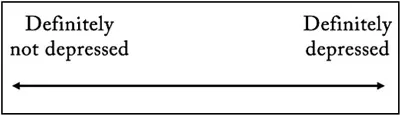
When trying to decide whether or not someone has depression a doctor will consider what symptoms they have and compare this to various criteria that have been developed by experts.[3] Often a doctor might encourage a patient to complete various questionnaire tools to help the doctor and patient to work together to decide whether or not the patient has clinical depression. It is almost as though there is a cut-off point along our spectrum between definitely not depressed and definitely depressed – a cut-off which marks the difference between feeling low and having clinical depression, and someone who meets the ‘expert criteria’ for depression will be on the ‘definitely depressed’ side of that cut-off.
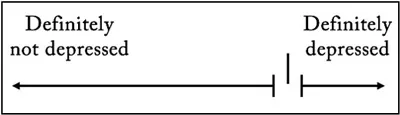
The cut-off is a bit of a simplification: it is possible to be very close to it, or to fluctuate backwards and forwards over it, and even within a diagnosis of depression there are varying degrees of severity; indeed someone with severe depression may well feel that their emotions are in a completely different league to anything they have experienced before.
What is helpful about seeing our emotions on a spectrum is that it shows that the depressed person is not in a whole separate category from the rest of us. It can be tempting when we hear that someone has depression, to see them as if they are in a box and to assume that they can’t or won’t get out of it. Realising they are just a bit further (or sometimes quite a lot further) down the emotional spectrum than the average person helps us to remember that they can also move back towards the healthy end of the spectrum given time and the right help. Just as we all move up and down a spectrum of physical health, going through times of good health and times of bad health, so it is with our emotional health, and recovery in most cases is not only possible, but normal.
Having said that, because depression is in one sense just a very severe form of feeling unhappy, it may be tempting to apply the usual kind of ‘pull yourself together!’ or ‘cheer up!’ advice to someone suffering with it. It is vital to understand that when a person gets that far towards the end of the spectrum there is no simple ‘snapping out’ of it. Just as when a person becomes severely physically ill, they can’t be expected to get better ‘just like that’ or without help, so it is with the person suffering with the illness of depression. Indeed this may be even more the case with depression than with a purely physical illness – because at least with a purely physical illness sufferers are able to think clearly about the situation whereas in times of depression it can be very difficult to get a clear perspective on the problem and to reason with oneself about the situation.
SIGNS AND SYMPTOMS OF DEPRESSION
We all have times of feeling low and unhappy, but when a person is suffering from depression these feelings are stronger and the times go on for longer than life’s normal ups and downs.
Symptoms that might clearly point to depression include feeling low or sad most of the day and losing interest in life.
Other things that may point to depression include:
- Anxiety or panic problems
- Loss of appetite or weight
- Difficulty thinking clearly – perhaps including poor concentration and difficulty making decisions
- Not coping with things that normally would be manageable
- Feeling tired all the time
- Sleep problems – ranging from not being able to get to sleep, to waking early in the morning, to sleeping too much
- Feeling worthless or guilty
- Recurrent thoughts of death and dying, possibly including thoughts about suicide
- Irritability or anger
- Feeling restless or agitated
- Crying easily
- Introspection
- Over-sensitivity or heightened paranoia
- Seeing everything through a negative filter
- Feeling hopeless about the future
- Avoiding being with other people
- Aches and pains that do not have another cause – for example headaches, muscle aches and bowel symptoms.
From a pastoral point of view, it may be helpful when trying to distinguish between depression and life’s normal ups and downs to consider whether the symptoms are preventing someone from functioning normally and how long they have had the symptoms for. It is very likely that someone with depression will find that their symptoms have been present for some time and that they interfere with everyday life.
TIME TO SEE A DOCTOR?
Many people suffering from mild depression won’t need to see a doctor – although a family doctor will always be happy to help people concerned that they might be depressed. It is not uncommon for people who have depression to be reluctant to seek medical help – for all sorts of reasons. For people who have initially tried to manage their depression without the help of a health professional, indications that it might be time to see a family doctor or a counsellor include:
- the symptoms being severe
- the symptoms having gone on for a long time
- not making much progress with approaches such as self-help and pastoral support
- thoughts of suicide
Another reason for encouraging someone who might have depression to see a doctor is that we should allow the diagnosis of depression to be made by a health professional – and avoid the temptation of making the diagnosis ourselves – an incorrect label of depression can be just as harmful as refusing to acknowledge a genuine problem with depression.
1 Clinical Knowledge Summaries. Depression. http://www.cks.nhs.uk/depression/background_information/prevalence [last accessed 1 March 2011].
2 Thomas CM and Morris S. Cost of Depression in England in 2000. British Journal of Psychiatry 2003;183:514-9.
3 e.g. ICD-10 (International Classification of Diseases) http://www.who.int/classifications/icd/en/ [last accessed 1 March 2011].
2
Why do people get depressed?
The medical causes of depression are not fully understood. Like many illnesses it seems that there are multiple inter-related factors that influence whether or not an individual will be vulnerable to depression. For many people there will be a combination of a background predisposition to developing the illness coupled with some precipitating factor(s) that finally tips a person into an episode of depression. Major depression is an illness and the person should not blame themselves, or be blamed by others, for suffering from it.
- Biology – it is widely accepted that an imbalance in various chemicals in the brain can cause depression. It also seems that some medical conditions such as strokes, Parkinson’s disease and thyroid problems may cause depression.
- Circumstances – someone’s circumstances both past and present may make them vulnerable to depression. For example traumatic life events such as bereavement, relationship breakdown or job loss may contribute to a person developing depression. Different people find different things difficult – so there are as many different situations that may make someone vulnerable to depression as there are people. Common situations that might make someone vulnerable to depression include being socially isolated, being ‘burnt out’, or being unhappy at work or at home.
DEPRESSION IN PARTICULAR SITUATIONS
• POSTNATAL DEPRESSION
Postnatal depression is a depression that follows the birth of a baby – it is surprisingly common, affecting as many as one in ten new mothers. It usually begins in the first month or so after the baby is born, but may come on several months later. Lots of factors may contribute to the depression, and sometimes it is hard to distinguish from the exhaustion of life with a small baby. On top of this mothers may feel guilty that they are not enjoying motherhood as much as they think they ...
Table of contents
- Reviews
- Title
- Indicia
- Contents
- Preface
- 1. Depression - what is it?
- 2. Why do people get depression?
- 3. Medical treatments for depression and a Christian perspective on them
- 4. Depression and the Christian
- 5. Trusting God in the darkness - Help from the Psalmists
- 6. Trusting God in the darkness - Using what God has provided
- 7. Helping the depressed
- Appendix 1: Struggles with Depression by Roger Carswell
- Appendix 2: Coping with my wife's depression - a husband's perspective
- Appendix 3: A Pastor's experience of helping someone with depression
- Helpful reading and Internet resources
- Other Titles
- Christian Focus
Trusted by 375,005 students
Access to over 1.5 million titles for a fair monthly price.
Study more efficiently using our study tools.