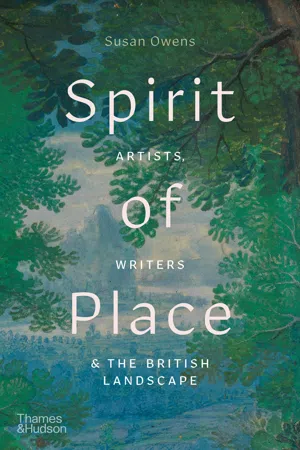
When we look at the landscape, what do we see? Do we experience the view over a valley or dappled sunlight on a path in the same way as those who were there before us? We have altered the countryside in innumerable ways over the last thousand years, and never more so than in the last hundred. How are these changes reflected in and affected by art and literature? English landscape painting is often said to be an 18th-century invention. But when we look for representations of the countryside in British art and literature, we find a story that begins with Old English poetry and treads a winding path up to the present day. Spirit of Place offers a panoramic view of the British landscape as seen through the eyes of writers and artists from Bede and the Gawain-poet to Gainsborough, Austen, Turner and Constable; from Paul Nash and Barbara Hepworth to Robert Macfarlane. Guided by these distinctive voices and imagery, and with a sharp eye for an anecdote, Susan Owens elucidates how the British landscape has been framed, reimagined and reshaped by generations. Each account, whether limned in a psalter, jotted down in a journal or constructed from sticks and stones, holds up a mirror to its maker and their world.
- English
- ePUB (mobile friendly)
- Available on iOS & Android
eBook - ePub
About this book
Trusted by 375,005 students
Access to over 1.5 million titles for a fair monthly price.
Study more efficiently using our study tools.
Information
Subtopic
British HistoryIndex
HistoryNOTES
Introduction
1Samuel Palmer to John Linnell, 21 December 1828, in The Letters of Samuel Palmer, ed. Raymond Lister, 2 vols (Oxford, 1974), I, p. 47. The phrase is from John Milton, ‘Il Penseroso’, line 135
2Daniel Defoe, A Tour Through the Whole Island of Great Britain, ed. P. N. Furbank and W. R. Owens (New Haven and London, 1991), p. 323
3Thomas Gray to Richard West, 16 November 1739, in Thomas Gray Archive <http://www.thomasgray.org/cgi-bin/display.cgi?text=tgal0084#ft> [accessed 16 February 2019]
4Ashmolean Museum, Oxford, WA1908.224
I Mystery
1Two Lives of Saint Cuthbert: A Life by an Anonymous Monk of Lindisfarne and Bede’s Prose Life, ed. and tr. Bertram Colgrave (Cambridge, 1940), p. 217
2William of Malmesbury, Gesta regum Anglorum; The History of the English Kings, ed. and tr. R. A. B. Mynors, R.M. Thomson and M. Winterbottom, 2 vols (Oxford, 1998), I, p. 51
3Quoted in A. W. Oxford, The Ruins of Fountains Abbey (Oxford, 1910), p. 165
4N. J. Higham, ‘Old light on the Dark Age landscape: the description of Britain in the De Excidio Britanniae of Gildas’, Journal of Historical Geography, 17 (1991), pp. 363–72 (364)
5Gildas, The Ruin of Britain and Other Works, ed. and tr. Michael Winterbottom (London and Chichester, 1978), p. 17
6Ibid., pp. 29, 52
7Bede, The Ecclesiastical History of the English People; The Greater Chronicle; Bede’s Letter to Egbert, ed. Judith McClure and Roger Collins, tr. Bertram Colgrave (1994; Oxford, 1999), pp. 9–10
8Gildas, Ruin of Britain, p. 17
9I am grateful to Benedict Gummer for this observation.
10Bruce Mitchell and Fred C. Robinson, A Guide to Old English (4th edn, rev., Oxford, 1986), p. 255
11Ibid., p. 256
12Ibid.
13See Leonard Neidorf (ed.), The Dating of Beowulf: A Reassessment (Cambridge, 2014)
14Anon., Beowulf, line 94
15Ibid., lines 1357–64. In Beowulf, ed. and tr. Michael Swanton (Manchester, 1978), p. 198, Swanton notes that this vision is likely to have a literary source: a description of a damp, chilly Christian Hell as related in the Visio Pauli or Apocalypse of Paul, part of the New Testament apocrypha.
16Beowulf, line 1366
17Ibid., lines 1368–72
18Ibid., lines 103–4 and 162
19Ibid., line 710
20Francis Pryor, The Making of the British Landscape: How we have Transformed the Land, from Prehistory to Today (London, 2011), p. 383
21Felix’s Life of Saint Guthlac, ed. and tr. Bertram Colgrave (Cambridge, 1956), pp. 87, 103
22Ibid., p. 93
23See Sarah Semple, ‘A Fear of the Past: the Place of the Prehistoric Burial Mound in the Ideology of Middle and Later Anglo-Saxon England’, World Archaeology, 30/1 (June 1998), pp. 109–126 (113)
24Mitchell and Robinson, Guide to Old English, pp. 249–50
25Sarah Semple also hypothesizes that ‘the woman is not a living exile, but dead’ in ‘A Fear of the Past’, p. 111
26Gerald of Wales, The Journey Through Wales and The Description of Wales, tr. Lewis Thorpe (London, 1978), p. 185
27Ibid., p. 108
28Ibid., pp. 194–5
29Ibid., p. 195
30Ibid., pp. 187–8
31See Alexandra Walsham, The Reformation of the Landscape: Religion, Identity, and Memory in Early Modern Britain and Ireland (Oxford, 2011), p. 9
32Gildas, Ruin of Britain, p. 17
33William A. Chaney, The Cult of Kingship in Anglo-Saxon England: the Transition from Paganism to Christianity (1970; 2nd edn., Manchester, 1999), pp. 188–9. See also Christina Hole, English Custom and Usage (1941; rev. ed. London, 1944), p. 4
34Caxton: The Descriptio...
Table of contents
- Cover
- Title Page
- About the Author
- Other Titles of Interest
- Contents
- Introduction
- I: Mystery
- II: Reflection
- III: Discovery
- IV: Imagination
- V: Sensation
- VI: Vision
- VII: Feeling
- VIII: Presence
- Epilogue
- Notes
- Further Reading
- Acknowledgments
- List of Illustrations
- Index
- Copyright
Frequently asked questions
Yes, you can cancel anytime from the Subscription tab in your account settings on the Perlego website. Your subscription will stay active until the end of your current billing period. Learn how to cancel your subscription
No, books cannot be downloaded as external files, such as PDFs, for use outside of Perlego. However, you can download books within the Perlego app for offline reading on mobile or tablet. Learn how to download books offline
Perlego offers two plans: Essential and Complete
- Essential is ideal for learners and professionals who enjoy exploring a wide range of subjects. Access the Essential Library with 800,000+ trusted titles and best-sellers across business, personal growth, and the humanities. Includes unlimited reading time and Standard Read Aloud voice.
- Complete: Perfect for advanced learners and researchers needing full, unrestricted access. Unlock 1.5M+ books across hundreds of subjects, including academic and specialized titles. The Complete Plan also includes advanced features like Premium Read Aloud and Research Assistant.
We are an online textbook subscription service, where you can get access to an entire online library for less than the price of a single book per month. With over 1.5 million books across 990+ topics, we’ve got you covered! Learn about our mission
Look out for the read-aloud symbol on your next book to see if you can listen to it. The read-aloud tool reads text aloud for you, highlighting the text as it is being read. You can pause it, speed it up and slow it down. Learn more about Read Aloud
Yes! You can use the Perlego app on both iOS and Android devices to read anytime, anywhere — even offline. Perfect for commutes or when you’re on the go.
Please note we cannot support devices running on iOS 13 and Android 7 or earlier. Learn more about using the app
Please note we cannot support devices running on iOS 13 and Android 7 or earlier. Learn more about using the app
Yes, you can access Spirit of Place by Susan Owens in PDF and/or ePUB format, as well as other popular books in History & British History. We have over 1.5 million books available in our catalogue for you to explore.