Women with 2020 Vision
eBook - ePub

Women with 2020 Vision

American Theologians on the Voice, Vote, and Vision of Women

  1. 280 pages
  2. English
  3. ePUB (mobile friendly)
  4. Available on iOS & Android
eBook - ePub

Women with 2020 Vision

American Theologians on the Voice, Vote, and Vision of Women

About this book

Women haven't always had the right to vote. From such diverse voices as John Stuart Mill and Cokie Roberts, the absolute right of both women and men to vote has been affirmed. And yet, resistance to women's suffrage even by women themselves has a long and painful history. In this exciting volume, thirteen theologians and religious leaders in America look back at the historic victory in 1920 when women in the United States won the right to vote. They then assess the current situation and speak into the future.

Women with 2020 Vision: American Theologians on the Voice, Vote, and Vision of Women commemorates the 100th anniversary of women in the United States obtaining the right to vote, a story that must be told and retold and reflected upon in light of the current sociopolitical-theological realities.

Frequently asked questions

Yes, you can cancel anytime from the Subscription tab in your account settings on the Perlego website. Your subscription will stay active until the end of your current billing period. Learn how to cancel your subscription.
No, books cannot be downloaded as external files, such as PDFs, for use outside of Perlego. However, you can download books within the Perlego app for offline reading on mobile or tablet. Learn more here.
Perlego offers two plans: Essential and Complete
  • Essential is ideal for learners and professionals who enjoy exploring a wide range of subjects. Access the Essential Library with 800,000+ trusted titles and best-sellers across business, personal growth, and the humanities. Includes unlimited reading time and Standard Read Aloud voice.
  • Complete: Perfect for advanced learners and researchers needing full, unrestricted access. Unlock 1.4M+ books across hundreds of subjects, including academic and specialized titles. The Complete Plan also includes advanced features like Premium Read Aloud and Research Assistant.
Both plans are available with monthly, semester, or annual billing cycles.
We are an online textbook subscription service, where you can get access to an entire online library for less than the price of a single book per month. With over 1 million books across 1000+ topics, we’ve got you covered! Learn more here.
Look out for the read-aloud symbol on your next book to see if you can listen to it. The read-aloud tool reads text aloud for you, highlighting the text as it is being read. You can pause it, speed it up and slow it down. Learn more here.
Yes! You can use the Perlego app on both iOS or Android devices to read anytime, anywhere — even offline. Perfect for commutes or when you’re on the go.
Please note we cannot support devices running on iOS 13 and Android 7 or earlier. Learn more about using the app.
Yes, you can access Women with 2020 Vision by Jeanne Stevenson-Moessner in PDF and/or ePUB format, as well as other popular books in Social Sciences & Women in History. We have over one million books available in our catalogue for you to explore.

Information

I

Past: Hindsight Is 2020

In Women with 2020 Vision, we first look back. In chapter 1, Jeanne Stevenson-Moessner reflects on three very different women of the nineteenth century: Sojourner Truth, Elizabeth Cady Stanton, and Harriet Beecher Stowe, who each had blindfolds lifted to see the diabolical bondage of women as well as the savagery of slavery. How did such diverse women work in collaboration for suffrage and in resistance to misapplied Christian ethics, which created slaves of custom, creed, and color? How did they navigate differences?
Chapter 2 explores the shadow side of the 1920 victory for women to vote: African American women were not beneficiaries of the victory as historic sexism, racism, and politics tried to separate them from the ballot box. Bishop Teresa Jefferson-Snorton traces not only the resistance to African American votes but the line of determined women who never lost sight of the vision of equality.
Using recent neuropsychological research, in chapter 3 Barbara McClure refutes the common distinctions between cognitive and emotional functions and shows the relevance of these findings for the suffrage movement. There was a common assumption at the time that women’s natural inferiority, reproductive function, passive nature, and inferior brains did not equip them to be rational selves. In a similar way, Euro-American cultural constructions were imposed on African American men, also seen as inferior and irrational, as the Fifteenth Amendment became a contentious issue. This chapter explores the roots of resistance in ancient philosophy and Christian theologies to movements for the full inclusion of women.
In chapter 4, Kimberly Detherage elaborates on the understanding that black people did not secure their right to vote until 1965 with the passage of the Voting Rights Act. In addition to the biblical account of Zelophehad’s daughters (Mahlah, Noah, Hoglah, Milkah, and Tirzah), who claimed their inheritance as women and as daughters, Detherage highlights other women, like Maria Stewart, Shirley Chisholm, and Stacey Abrams, who have continued the struggle to claim the inheritance of women of color. Their truth is self-evident: all men and all women are created equal.
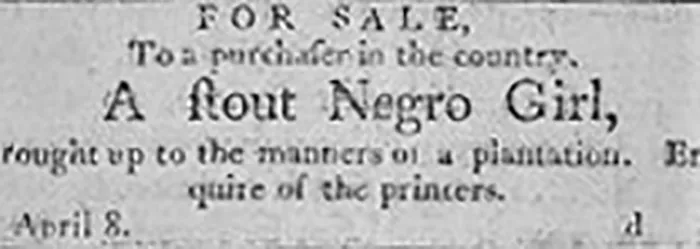
1799 Baltimore newspaper Federal Gazette and Baltimore Daily Advertiser with front page slave ad for ā€œa stout Negro Girl,ā€ brought up to the manners of a plantation. Enquire of the printers. April 8.

1

Blindfolds Removed: The Perspicacity of Sojourner Truth, Harriet Beecher Stowe, and Elizabeth Cady Stanton

Jeanne Stevenson-Moessner

A negative limit is a boundary or impasse that cannot be traversed. It is a line that in all truth and honesty we do not want to cross. This term is in common parlance among feminists. It is when we reach this negative limit in our experience that ā€œblindfolds are removed,ā€ sometimes gradually but more often dramatically or tragically. When I was a young single adult sitting in a crowded Memphis auditorium to hear a speaker my church had recommended, my negative limit was reached when the speaker, Bill Gothard, instructed us as follows: ā€œWives are to submit to their husbands—even if they are beaten to a bloody pulp—in the hope that their husband might be won to Christ.ā€[1] It was as if I ran into a brick wall or impasse and slowly had to rethink the nature of the God I was serving, the veracity of the Bible I loved, and the commitment to be a Christian. The abuse and misuse of the book of Ephesians, specifically Ephesians 5, by the speaker tore the blindfolds from my eyes.
Each of the three women highlighted in this chapter—Sojourner Truth, Harriet Beecher Stowe, and Elizabeth Cady Stanton—had blindfolds removed, which resulted in their commitment to and passion for the freedom of slaves and the vote for all people. The purpose of this chapter is to examine the intersection of the lives of these three extraordinary women, who each contributed in distinctive ways to the fight for equal vote, voice, and possibilities for women. My research is driven by the quest to see how they found commonalities amid the differences of their lives. This chapter is built on the assumption that all three women had their ā€œblindfolds removedā€ to see the savagery of the treatment of slaves and the diabolical bondage of women as well as the possibilities of the right to freedom and the right to enfranchisement, which includes the right to vote. Is there something in their common vision that would enlighten those of us today who continue the struggle against the exploitation of others? What was the connection among these three women? What were other commonalities that drew such dissimilar women together? How did they navigate differences?[2]
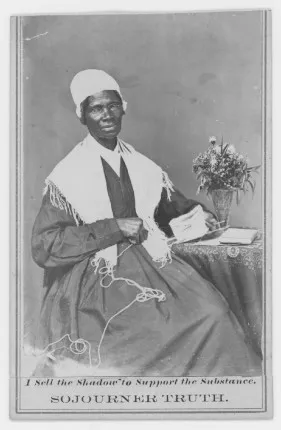
Original carte de visite (calling card) of Sojourner Truth (Brady’s National Photographic Portrait Galleries, NYC and Wash., DC), ca.1870s.
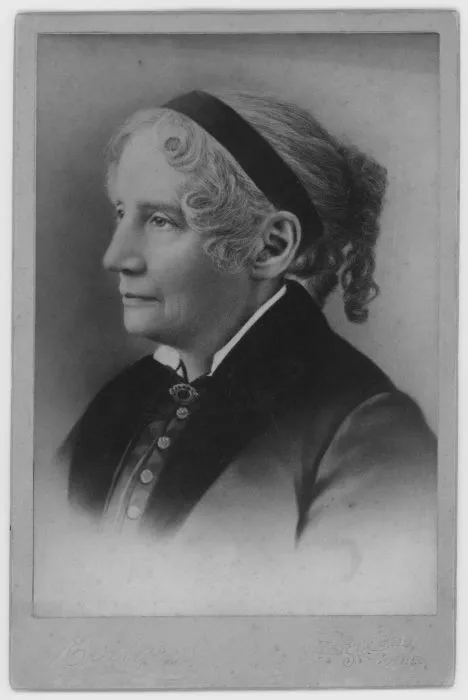
Original cabinet card, Harriet Beecher Stowe, printed by Rodgers.
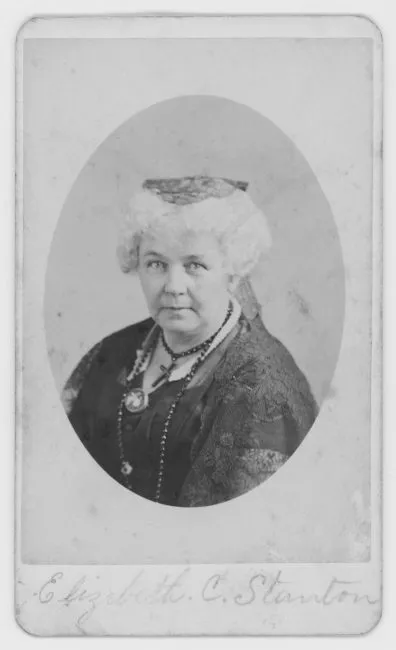
Original signed carte de visite, Elizabeth Cady Stanton, 1902.

Sojourner Truth

Sojourner Truth, née Isabella Baumfree, knew nothing but slavery as a child. She was an infant when her brother, age five, and her sister, three, were sold away from her parents, leaving them inconsolable. Among Isabella’s earliest memories was the new house of her master, Charles Ardinburgh, which he had built for a hotel. ā€œA cellar, under this hotel, was assigned to his slaves, as their sleeping apartment, —all the slaves he possessed, . . . sleeping . . . in the same room. She carries in her mind, to this day, a vivid picture of this dismal chamber,ā€ with loose boards on the floor over the uneven earth, which was often muddy, with splashing water and noxious vapors.[3] The slaves slept body to body across the damp floor, lying on a little straw and a blanket, as if they were horses. Servitude in degradation was the life she knew. In her Book ofLife, however, she comments on the dispelling of ā€œthe mists of ignoranceā€ and the removal of the shackles of body and spirit:
As the divine aurora of a broader culture dispelled the mists of ignorance, love, the most precious gift of God to mortals, permeated her soul, and her too-long-suppressed affections gushed from the sealed fountains as the waters of an obstructed river, to make new channels, bursts its embankments and rushes on its headlong course, powerful for weal or woe. Sojourner, robbed of her own offspring, adopted her race.[4]
I am suggesting that her blindfolds of bondage were removed to see ā€œthe divine auroraā€ of a broader culture after the mists of ignorance imposed on her by a lack of freedom began to evaporate over time. Her adoption of her race is seen in her tireless efforts to improve the sanitary conditions for the freed slaves who gathered in Washington. She assisted the National Freedman’s Relief Office, Freedman’s Village, Freedman’s Hospital, and orphanages for freed children to compensate for the lack of foresight by the US government. Who had thought ahead about how the freed slaves would exist, live, and support themselves when they left plantations, masters, and overseers? Sojourner Truth instigated a petition to both the House and Senate to address these issues, whereby the freed slaves could be given land that they so rightfully deserved in order to support themselves. After all, hadn’t their unpaid labor boosted the economy of the nation? This is an example of perspicacity, which, among other things, can be described as sagacity and sharp-sightedness.

Harriet Beecher Stowe

Harriet Beecher Stowe was raised as a minister’s daughter in a home and church where she heard her father, Lyman Beecher, deliver graphic sermons on the evil of slave trading.[5] Lyman Beecher came from a long line of ministers. Harriet’s pious mother died when she was four; thus, Harriet was not unfamiliar with hardship.[6] Her father was called to Lane Theological Seminary in Cincinnati in 1832, when Lane Seminary was a hotbed of abolition.[7] At the time the Beecher family moved there, Theodore Weld was a student and radical abolitionist at Lane. Harriet, like her sister Catharine, was more committed to education than the issue of slavery.[8]
In 1833, Harriet made a trip from Cincinnati to Kentucky with a teacher named Miss Dutton. It was there that Harriet came in contact with slaves of the South. In the biography written by Harriet’s son, Charles Edward Stowe commented that Miss Dutton realized later that scene after scene in Uncle Tom’s Cabin came from that visit to Kentucky.[9]
While in Cincinnati, Harriet witnessed proslavery mobs pull down houses of respectable and law-abiding blacks. She knew the office of Mr. J. G. Birney, editor of The Philanthropist, had been ransacked and demolished by those angered by his liberation of his slaves in Alabama. She had a desire to do something.[10] Meanwhile, her husband, Professor Stowe...
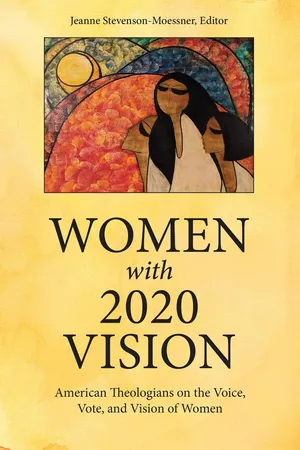
Table of contents

  1. Cover
  2. Title Page
  3. Copyright
  4. Dedication
  5. Table Of Contents
  6. Acknowledgments
  7. List of Contributors
  8. Prologue: Stones and Stories of Remembrance
  9. Past: Hindsight Is 2020
  10. Present: Clearly Seeing Where We Are
  11. Future: Envisioning What’s Next
  12. Epilogue: Women with 2020 Vision: A Summary of New ā€œSightingsā€
  13. Appendix A
  14. Appendix B
  15. Appendix C
  16. In Memoriam
  17. Name Index
  18. Subject Index