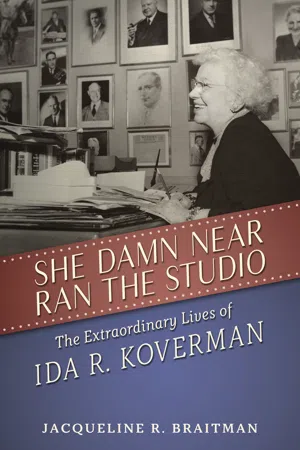
Best known as the woman who "ran MGM, " Ida R. Koverman (1876–1954) served as talent scout, mentor, executive secretary, and confidant to American movie mogul Louis B. Mayer for twenty-five years. She Damn Near Ran the Studio: The Extraordinary Lives of Ida R. Koverman is the first full account of Koverman's life and the true story of how she became a formidable politico and a creative powerhouse during Hollywood's Golden Era. For nearly a century, Koverman's legacy has largely rested on a mythical narrative while her more fascinating true-life story has remained an enduring mystery—until now. This story begins with Koverman's early years in Ohio and the sensational national scandal that forced her escape to New York where she created a new identity and became a leader among a community of women. Her second incarnation came in California where she established herself as a hardcore political operative challenging the state's progressive impulse. During the Roaring Twenties, she was a key architect of the Southland's conservative female-centric partisan network that refashioned the course of state and national politics and put Herbert Hoover in the White House. As "the political boss of Los Angeles County, " she was the premiere matchmaker in the courtship between Hollywood and national partisan politics, which, as Mayer's executive secretary, was epitomized by her third incarnation as "one of the most formidable women in Hollywood, " whose unparalleled power emanated from her unique perch inside the executive suite of Metro-Goldwyn-Mayer. Free to adapt her managerial skills and political know-how on behalf of the studio, she quickly drew upon her artistic sensibilities as a talent scout, expanding MGM's catalog of stars and her own influence on American popular culture. Recognized as "one of the invisible power centers in both MGM and the city of Los Angeles, " she nurtured the city's burgeoning performing arts by fostering music and musicians and the public financing of them. As the "lioness" of MGM royalty, Ida Koverman was not just a naturalized citizen of the Hollywood kingdom; at times during her long reign, she "damn near ran the studio."
eBook - ePub
She Damn Near Ran the Studio
The Extraordinary Lives of Ida R. Koverman
- 352 pages
- English
- ePUB (mobile friendly)
- Available on iOS & Android
eBook - ePub
About this book
Trusted by 375,005 students
Access to over 1.5 million titles for a fair monthly price.
Study more efficiently using our study tools.
Information
PART III
LIFE THREE—MOVIE STAR MAKER
CHAPTER 13
Friends in High Places
Ida Koverman was “proudly acquired by L.B. not only as a sign of class but as a means of moving up the Republican ladder to the lofty appointments for which he panted.”1
IDA KOVERMAN MIGHT NOT HAVE REALIZED KATHERINE PHILIPS EDSON was responsible for her loss as Republican national committeewoman in 1923, but Edson was well aware of Koverman’s alliance with Louis B. Mayer and her role in promoting his stature within the party, coincidentally paralleling her growing interest in the motion-picture industry. Kate Edson knew her tenure on the Industrial Welfare Commission was threatened after the 1930 election of California Governor James “Sunny” Rolph, who was “obligated to a group of political women in Los Angeles who supported him,” including Ida Koverman. Edson had already established a rapport with MGM’s Louis B. Mayer, but once he became vice chair of the state Republican Party, she knew it was unlikely he would “make the personal application” on her behalf for Rolph to retain her post. More IWC hearings were planned for the movie industry, which meant approaching Mayer was inappropriate. Nevertheless, in what can only be understood as Edson’s desperate fear for her financial survival, she reached out to Ida Koverman to rally support for her plight. Koverman explained to Edson the realpolitik of her predicament. Opposition to Edson came from the influential network of Republican Study Clubs because of Edson’s longtime, vocal support of Hiram Johnson. She reminded Edson “the Clubs” were known enclaves of Hoover loyalists.2 Koverman confirmed that the Club’s real mission was to serve one master, not the party, all along.
Edson had naively believed that Koverman was “big enough” to respect Edson’s loyalty to Johnson, while rationalizing that it was “smaller women” who narrowly viewed her as “a Johnson politician.” It remains doubtful that Ida Koverman thought Edson actually believed her when she told her “she would get busy with Mr. Mayer and other people in the industry and get an endorsement immediately,” and that she would rather visit with Hiram Johnson in Washington than anyone else because he was “by far the biggest man there.” Edson didn’t buy it, but optimistically told Johnson, “Whether she means it or is just being agreeable to me I do not know, but she has always seemed to me perfectly sincere.”3
Governor-Elect James Rolph announced on January 3, 1931, that Mrs. Mabel E. (Thornton) Kinney would replace Katherine Philips Edson at the end of her term in June. The press described Mabel Kinney as “active in women’s work in Southern California and was a preprimary campaign worker for the new Governor.”4 Mabel Kinney was also a close friend of Ida Koverman, and her selection to replace Edson reflected the ongoing ideological divide within the Republican Party. Rolph signaled a shift in policy affecting women workers within the motion-picture industry and everywhere else. During the final months of her eighteen-year stint on the IWC, Katherine Edson did her best to prepare Mabel Kinney to take over her role administering the commission, including its oversight of the motion picture industry. At the time, few, if any, knew then, or now, of Mabel Kinney’s close ties to Ida Koverman, which would affect public policy and personal piety.
Mabel Kinney’s appointment to the IWC crystallized the ideological schisms within American feminism that accelerated in 1923 with the introduction of the Equal Rights Amendment, which threatened hard-fought, gender-specific workforce regulations. Ida Koverman and Mabel Kinney supported the ERA like many organized professional women’s groups, who were beyond the reach of IWC oversight. One of the most vocal groups seeking to overturn gender-based social and labor legislation was the Business and Professional Women’s Association (BPW). Ida Koverman and Mabel Kinney were members, but Mabel Kinney was a prominent leader in the local branch.
Mabel E. Kinney and Ida Koverman shared political perspectives, a passion for music, similar religious beliefs, and their interest in motion pictures and the business of making them. Born Mabel E. Cohen in February 1886, Kinney came to California in 1910 and filled her life with music, piano, and song. But her interest in religion was historic. She joined with brother pastors Ernest and Fenwicke Holmes to establish their Venice Union Congregational Church, but soon after, the brothers embraced the tenets of New Thought and successfully converted their flock while they dabbled in local politics, initially in a campaign to ban prizefighting in Venice. Their new venture was the 1927 founding of the Church of Religious Science, later in 1954, renamed as the Science of Mind. Mabel Cohen married Thornton Kinney, a son of Abbott Kinney, the renowned entrepreneur and developer of the Venice community and its historic canals. Mabel Kinney soon became a leader in the local women’s club network and Religious Science community, and as the motion-picture business flourished, she chaired the Motion Picture Committee for the Women of the Golden West, and another for the Wilshire Women’s Club, and the Better Films committee for eight different local parent-teacher associations. She taught classes on “The Art of Previewing,” and for years she lectured, sometimes up to four times a day, seven days a week, about both films and faith.5
Koverman and Kinney’s public lives and private faiths often overlapped, as did their memberships in local and statewide women’s groups like the Hollywood Studio Club. Koverman was a member of the advisory committee of the motion-picture department of the California Federation of Women’s Clubs, and Mabel Kinney sat on the same committee of its Los Angeles branch.6 In February 1930, MGM producer, director, and overall nice guy Paul Bern talked to clubwomen about “Problems of the Motion Picture from the Producers Standpoint,” and when the CFWC sponsored a motion-picture luncheon, Louis B. Mayer was a featured speaker. Guests of honor included Mrs. Mayer, Ida Koverman, the mother of actress Myrna Loy, and journalist Alma Whitaker, and the toastmistress was Mabel Kinney, described as “the past district state chairman of motion pictures,” who currently sat on the Industrial Welfare Commission. The group was again featured together at an CFWC event held at the Ambassador Hotel.7
Viewing Ida Koverman and her circle of friends in high places provides a window into previously unexamined networks of conservative women in business and public office who aggressively sought to overturn the policies of their progressive counterparts. And it highlights unnoticed connections between Ida Koverman, Katherine Edson, Louis B. Mayer, and Mabel Kinney that illustrate how individuals representing conflicting social, cultural, and economic interests navigated through the layers of private advocacy, partisan politics, and public policy. Now that Louis B. Mayer was at the top of his game, with his political prowess and connections well established, during the next round of IWC hearings held near the end of Edson’s tenure, his testimony took on a more adversarial posture and at times even a threatening tone.
In November 1929, Katherine Philips Edson issued a report to put the public on notice that the problem of movie extras had yet to be solved. In an article,“Movie-Struck Girls Warned,” she outlined the problem of how “more than 10,000 ‘extras’ are pounding the pavements of Hollywood, jobless, penniless, hungry, the figures reveal.” There were already 11,000 signed up with the new Central Casting office, but only 133 men and 87 women were hired on movie sets for more than two days a week. On average, only 756 extras were employed per day. Edson broadcast these statistics in hopes of encouraging “would-be movie stars” to “consider all angles before embarking” on a venture to Hollywood.8
A few years later, during the last months of her IWC tenure, Louis B. Mayer explained that the movie business was “a creative thing,” and that great productions were possible “because we have had a liberal attitude to work under, and I am willing for the industry to do everything that is possible so that Mrs. Edson and the members of the Commission feel that we shall do the right thing.” He conceded that overtime was necessary, and “anybody working in the studios and is honest about it will realize that you don’t know what moment or hour something is going wrong, going to break you.” Nevertheless, standardization was rapidly coming, Mayer said, and it was much better than it had been a couple of years ago.9
But then Mayer’s tone became more threatening. He said that while he wasn’t opposed to overtime, there could come a point “where there will be no script girls, but script boys, and the regulation ceases.” Mayer reasoned that “if the cost becomes prohibitive … if the industry found it to its advantage in having men because of discriminatory rules and regulations—if you say no overtime for script girls—we love the girls, but what do you think we would do if that same rule applies to any other work that becomes oppressive,” And then, as he was prone to do, he applied the general principle to his personal experience. He said, “I am thankful none of my family has to be an extra because of the uncertainty of earning a living,” to which Edson pointed out that many girls had been afraid to ask for overtime pay due them because of their fear they would be laid off. Mayer said there needed to be a rule, and he would “love to see the studios operate from a humane standpoint,” but “boys do it right along fine. We had for a short time no girls, gave up the girls entirely and there was no yelling about overtime or fussing.” Edson asked how long that lasted, and Mayer had to acknowledge that it “drifted back” from “pressure all around.”
One month before Edson retired from the IWC, she described how the recommendations she was about to make were the result of the opposition of the Business and Professional Women because of their position that such legislation was “a handicap in obtaining higher paid employment in competition with men,” and Edson feared the BPW would injure current legislation designed to protect workers in manufacturing and other hourly waged jobs. Salaried workers were not included in existing regulations, but Edson had to reinforce that they would also be exempt from future codes because there appeared “no real need for including them.” Edson noted that the ideological divide between organized women’s groups was now affecting women in the motion-picture industry.
She said she believed that reasonable regulations would be “honestly supported by the industry,” and she praised Mayer’s influence in the industry for accepting “our regulations with so fine a spirit.” She could be threatening as well, though, adding that she had every reason to believe the regulations would be strictly adhered to, and if not, an order to include “all women” would be forthcoming. She said she would not seek this alternative, nor would she “care to be a party to it for fear either would result in the elimination of many high salaried women.” Nevertheless, she raised the possibility.
Soon after Katherine Edson’s departure from the IWC in July, she believed Mabel Kinney was purposefully thwarting IWC’s mandate. Kinney failed to publish announcements for public wage-board meetings and did not inform the public about cost-of-living updates; she eliminated investigators, and she ended payroll calls, making it nearly impossible for women to collect thousands of dollars in back pay. Edson understood there was “a complete breakdown of labor enforcement” because of Kinney’s leadership, and to her, “The gradual disintegration and degeneration of this work is worse than an actual repeal of the law—it could have at least died clean!”10
Then, another blow to Edson’s vision of the IWC came at the end of the year, when the mother of comedian Harold Lloyd, and a close friend of Ida Koverman, Mrs. Elizabeth Lloyd Smith, was appointed to the IWC. Harold Lloyd biographer Tom Dardis believes Mrs. Smith’s appointment was a reward for her work with the Columbian Society, a short-lived conservative group.11 The Lloyds’ familial relationship was a troubled one, but Ida Koverman provided a shoulder for Mrs. Smith, an apparently troubled person in her own right, who lived in the shadow of her famous son. Mrs. Smith’s genuine interest in labor relations remains unclear, but conservatives everywhere and the movie industry in particular now had two sympathetic seats on the IWC. Mrs. Smith would go on to spearhead radical anti-communist, pro-Nixon events during the Cold War era, but for now, the nexus of Ida Koverman, Mabel Kinney, and Mrs. Smith and the IWC provided an institutionalization of the conservative agenda Koverman and the BPW fostered and was allied with the motion-picture business.
The IWC never existed in a vacuum, and as a new presidential administration revolutionized labor relations on the federal level, Mabel Kinney found herself under attack, even requiring guards around the clock because of anonymous threats to her safety. She tried to balance her vision with new mandates of Franklin Roosevelt’s National Recovery Administration (NRA) of 1933. When the NRA drew on state level officials to form a committee to find ways to reduce the number of extras already listed through Central Casting, Mabel Kinney was among the members. The news sent shockwaves through the industry, inspiring one columnist to write that “an official mob ‘execution’ looms in Hollywood,” as “that great throng of hangers-on, people who live from hand to mouth and day to day waiting for extra work in films,” would be whittled down from 25,000 to a figure somewhere between 3,000 and 10,000. The whole process was a nightmare, and because of various complaints and complexities, the plan to reduce the number of extras registered in accordance with NRA guidelines was dropped in April 1935. In an otherwise excellent study of the IWC’s efforts to address the employment and oversupply of extras, Kerry Segrave mischaracterizes Mabel Kinney, in her association with the NRA, as someone who “had no film industry connection whatsoever, and no axes to grind.” Mabel Kinney clearly had connections to MGM and an ideological perspective opposed to New Deal principles. Leigh Ann Wheeler suggests that Kinney was appointed because she was “the Hays Office nominee,” and “not one suggested by organized women,” but Kinney was deeply embedded within California’s organized women’s groups.12 Will H. Hays, a longtime Republican heavyweight who appealed to progressives and conservatives became, in 1922, president of the Motion Picture Producers and Distributors of America (MPPDA). Hays and the MPPDA oversaw the industry’s efforts to address myriad problems, including extras. His name is mostly associated with the morals production codes of 1930, popularly known as the Hays Code, but it was Hays’s successor, Joseph I. Breen, who reigned for two decades rigidly enforcing the codes as the public’s censor, while holding unequalled power over the nation’s media empires and the cultural icons they fostered.
In spite of her connections to Ida Koverman and Louis B. Mayer, Mabel Kinney’s IWC did take one action against MGM during its production of the 1936 movie Riff Raff. She charged the studio with negligence when it failed to compensate women who lost work after being drenched during the filming of rainstorm scenes. Forty female extras were ultimately paid $15 for their work on location at Fish Harbor in San Pedro, California.13
The opposition continued to grow against Kinney, even from the state Business and Professional Women’s organization, which eventually found that “Mrs. Kinney had no comprehensive grasp of her work [and] that she was ‘just a political appointee.’” To others, it was clear that Kinney was instrumental in getting Elizabeth Lloyd Smith appointed because the movie interests wanted another body on the commission. According to the San Francisco Chapter of the National Lawyers Guild (NLG), “Mrs. Kinney does just what they [the moving picture companies] tell her.” California Assemblyman Gardiner Johnson believed Kinney maintained her position “with the full support of Louis B. Mayer and his famous secretary, Ida Koverman … because she would not enforce the eight-hour law against the motion picture industry.”14 The NLG incorrectly identified Kinney as a cousin to Ida Koverman, who also worked at MGM, but it made the connection that Kinney and Koverman, as the personal secretary to movie mogul Louis B. Mayer, helped to carry Venice for Rolph as part of “the local Mayer political machine.” Within three years, IWC hearings had stopped, and Kinney ordered investigators to soften the enforcement of IWC policies. California’s attorney general insisted that “Kinney did not have a broad conception of the work before her.” Others reported that she had taken steps to create a political machine of her own to bolster her standing with Governor Rolph. In October 1939, the Congress of Industrial Organizations called for Kinney’s resignation because of her “alleged assistance to employers in their attempts to sabotage the minimum wage law.” When the new Democratic governor Culbert Olson assumed office in 1939, he replaced Mabel Kinney with Mrs. Marguerite O. Clark, who quickly reversed Kinney’s rulings.15
Ida Koverman and Mabel Kinney were political and ideological opponents of Katherine Philips Edson. Their opposing worldviews about women and feminism shaped public policy and the lives of women wage earners. As the Great Depression dragged on, with the encouragement of New Deal policies, the motion-picture industry experienced violent battles over efforts to unionize the industry, which exploited fears about communist infiltration. One outcome of anti-union sentiment was Louis B. Mayer’s promotion of the establishment of the Academy of Motion Picture Arts and Sciences and its sponsorship of the annual Academy Awards. While Margaret Herrick is credited with naming the statuette “Oscar,” it’s worth noting that Ida Kover...
Table of contents
- Cover
- Title Page
- Copyright
- Dedication
- Contents
- Preface: “She Damn Near Ran the Studio!”
- Acknowledgments
- I. Life One—Trouble Maker: Scandal and Survival
- II. Life Two—Kingmaker and Matchmaker
- III. Life Three—Movie Star Maker
- Notes
- Bibliography
- About the Author
Frequently asked questions
Yes, you can cancel anytime from the Subscription tab in your account settings on the Perlego website. Your subscription will stay active until the end of your current billing period. Learn how to cancel your subscription
No, books cannot be downloaded as external files, such as PDFs, for use outside of Perlego. However, you can download books within the Perlego app for offline reading on mobile or tablet. Learn how to download books offline
Perlego offers two plans: Essential and Complete
- Essential is ideal for learners and professionals who enjoy exploring a wide range of subjects. Access the Essential Library with 800,000+ trusted titles and best-sellers across business, personal growth, and the humanities. Includes unlimited reading time and Standard Read Aloud voice.
- Complete: Perfect for advanced learners and researchers needing full, unrestricted access. Unlock 1.5M+ books across hundreds of subjects, including academic and specialized titles. The Complete Plan also includes advanced features like Premium Read Aloud and Research Assistant.
We are an online textbook subscription service, where you can get access to an entire online library for less than the price of a single book per month. With over 1.5 million books across 990+ topics, we’ve got you covered! Learn about our mission
Look out for the read-aloud symbol on your next book to see if you can listen to it. The read-aloud tool reads text aloud for you, highlighting the text as it is being read. You can pause it, speed it up and slow it down. Learn more about Read Aloud
Yes! You can use the Perlego app on both iOS and Android devices to read anytime, anywhere — even offline. Perfect for commutes or when you’re on the go.
Please note we cannot support devices running on iOS 13 and Android 7 or earlier. Learn more about using the app
Please note we cannot support devices running on iOS 13 and Android 7 or earlier. Learn more about using the app
Yes, you can access She Damn Near Ran the Studio by Jacqueline R. Braitman in PDF and/or ePUB format, as well as other popular books in Social Sciences & Film & Video. We have over 1.5 million books available in our catalogue for you to explore.