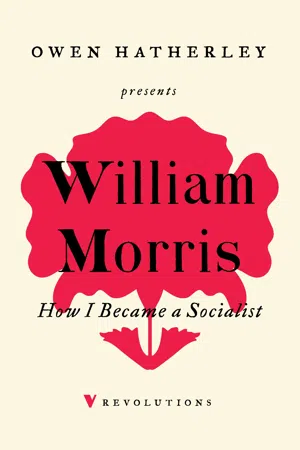
William Morris is famous as a designer, poet and artist, but his work as a political thinker and activist is less well known. This collection, the first of his political writings published for nearly 50 years, shows Morris as one of the most original and inspiring socialist intellectuals of his generation.
Covering essays and lectures ranging through the relation between art and politics, to his visions for a socialist society and his strident anti-imperialism, this is an essential volume which shows Morris as the engaged and committed socialist that he was.
- 224 pages
- English
- ePUB (mobile friendly)
- Available on iOS & Android
eBook - ePub
How I Became A Socialist
About this book
Trusted by 375,005 students
Access to over 1.5 million titles for a fair monthly price.
Study more efficiently using our study tools.
Information
1. ART UNDER PLUTOCRACY
You may well think I am not here to criticise any special school of art or artists, or to plead for any special style, or to give you any instructions, however general, as to the practice of the arts. Rather I want to take counsel with you as to what hindrances may lie in the way towards making art what it should be, a help and solace to the daily life of all men. Some of you here may think that the hindrances in the way are none, or few, and easy to be swept aside. You will say that there is on many sides much knowledge of the history of art, and plenty of taste for it, at least among the cultivated classes; that many men of talent, and some few of genius, practise it with no mean success; that within the last fifty years there has been something almost like a fresh renaissance of art, even in directions where such a change was least to be hoped for. All this is true as far as it goes; and I can well understand this state of things being a cause of gratulation amongst those who do not know what the scope of art really is, and how closely it is bound up with the general condition of society, and especially with the lives of those who live by manual labour and whom we call the working classes. For my part, I cannot help noting that under the apparent satisfaction with the progress of art of late years there lies in the minds of most thinking people a feeling of mere despair as to the prospects of art in the future; a despair which seems to me fully justified if we look at the present condition of art without considering the causes which have led to it, or the hopes which may exist for a change in those causes. For, without beating about the bush, let us consider what the real state of art is. And first I must ask you to extend the word art beyond those matters which are consciously works of art, to take in not only painting and sculpture, and architecture, but the shapes and colours of all household goods, nay, even the arrangement of the fields for tillage and pasture, the management of towns and of our highways of all kinds; in a word, to extend it to the aspect of all the externals of our life. For I must ask you to believe that every one of the things that goes to make up the surroundings among which we live must be either beautiful or ugly, either elevating or degrading to us, either a torment and burden to the maker of it to make, or a pleasure and a solace to him. How does it fare therefore with our external surroundings in these days? What kind of an account shall we be able to give to those who come after us of our dealings with the earth, which our forefathers handed down to us still beautiful, in spite of all the thousands of years of strife and carelessness and selfishness?
Surely this is no light question to ask ourselves; nor am I afraid that you will think it a mere rhetorical flourish if I say that it is a question that may well seem a solemn one when it is asked here in Oxford, amidst sights and memories which we older men at least regard with nothing short of love.1 He must be indeed a man of narrow incomplete mind who, amidst the buildings raised by the hopes of our forefathers, amidst the country which they made so lovely, would venture to say that the beauty of the earth was a matter of little moment. And yet, I say, how have we of these latter days treated the beauty of the earth, or that which we call art?
Perhaps I had best begin by stating what will scarcely be new to you, that art must be broadly divided into two kinds, of which we may call the first Intellectual, and the second Decorative art, using the words as mere forms of convenience. The first kind addresses itself wholly to our mental needs; the things made by it serve no other purpose but to feed the mind, and, as far as material needs go, might be done without altogether. The second, though so much of it as is art does also appeal to the mind, is always but a part of things which are intended primarily for the service of the body. I must further say that there have been nations and periods which lacked the purely Intellectual art but positively none which lacked the Decorative (or at least some pretence of it); and furthermore, that in all times when the arts were in a healthy condition there was an intimate connexion between the two kinds of art; a connexion so close, that in the times when art flourished most, the higher and lower kinds were divided by no hard and fast lines. The highest intellectual art was meant to please the eye, as the phrase goes, as well as to excite the emotions and train the intellect. It appealed to all men, and to all the faculties of a man. On the other hand, the humblest of the ornamental art shared in the meaning and emotion of the intellectual; one melted into the other by scarce perceptible gradations; in short, the best artist was a workman still, the humblest workman was an artist. This is not the case now, nor has been for two or three centuries in civilised countries. Intellectual art is separated from Decorative by the sharpest lines of demarcation, not only as to the kind of work produced under those names, but even in the social position of the producers; those who follow the Intellectual arts being all professional men or gentlemen by virtue of their calling, while those who follow the Decorative are workmen earning weekly wages, non-gentlemen in short.
Now, as I have already said, many men of talent and some few of genius are engaged at present in producing works of Intellectual art, paintings and sculpture chiefly. It is nowise my business here or elsewhere to criticise their works; but my subject compels me to say that those who follow the Intellectual arts must be divided into two sections, the first composed of men who would in any age of the world have held a high place in their craft; the second of men who hold their position of gentleman-artist either by the accident of their birth, or by their possessing industry, business habits, or such-like qualities, out of all proportion to their artistic gifts. The work which these latter produce seems to me of little value to the world, though there is a thriving market for it, and their position is neither dignified nor wholesome; yet they are mostly not to be blamed for it personally, since often they have gifts for art, though not great ones, and would probably not have succeeded in any other career. They are, in fact, good decorative workmen spoiled by a system which compels them to ambitious individualist effort, by cutting off from them any opportunity for co-operation with others of greater or less capacity for the production of popular art.
As to the first section of artists, who worthily fill their places and make the world wealthier by their work, it must be said of them that they are very few. These men have won their mastery over their craft by dint of incredible toil, pains, and anxiety, by qualities of mind and strength of will which are bound to produce something of value. Nevertheless they are injured also by the system which insists on individualism and forbids co-operation. For first, they are cut off from tradition, that wonderful, almost miraculous accumulation of the skill of ages, which men find themselves partakers in without effort on their part. The knowledge of the past and the sympathy with it which the artists of to-day have, they have acquired, on the contrary, by their own most strenuous individual effort; and as that tradition no longer exists to help them in their practice of the art, and they are heavily weighted in the race by having to learn everything from the beginning, each man for himself, so also, and that is worse, the lack of it deprives them of a sympathetic and appreciative audience. Apart from the artists themselves and a few persons who would be also artists but for want of opportunity and for insufficient gifts of hand and eye, there is in the public of to-day no real knowledge of art, and little love for it. Nothing, save at the best certain vague prepossessions, which are but the phantom of that tradition which once bound artist and public together. Therefore the artists are obliged to express themselves, as it were, in a language not understanded of the people.2 Nor is this their fault. If they were to try, as some think they should, to meet the public half-way and work in such a manner as to satisfy at any cost those vague prepossessions of men ignorant of art, they would be casting aside their special gifts, they would be traitors to the cause of art, which it is their duty and glory to serve. They have no choice save to do their own personal individual work unhelped by the present, stimulated by the past, but shamed by it, and even in a way hampered by it; they must stand apart as possessors of some sacred mystery which, whatever happens, they must at least do their best to guard. It is not to be doubted that both their own lives and their works are injured by this isolation. But the loss of the people; how are we to measure that? That they should have great men living and working amongst them, and be ignorant of the very existence of their work, and incapable of knowing what it means if they could see it!
In the times when art was abundant and healthy, all men were more or less artists; that is to say, the instinct for beauty which is inborn in every complete man had such force that the whole body of craftsmen habitually and without conscious effort made beautiful things, and the audience for the authors of intellectual art was nothing short of the whole people. And so they had each an assured hope of gaining that genuine praise and sympathy which all men who exercise their imagination in expression most certainly and naturally crave, and the lack of which does certainly injure them in some way; makes them shy, over-sensitive, and narrow, or else cynical and mocking, and in that case well-nigh useless. But in these days, I have said and repeat, the whole people is careless and ignorant of art; the inborn instinct for beauty is checked and thwarted at every turn; and the result on the less intellectual or decorative art is that as a spontaneous and popular expression of the instinct for beauty it does not exist at all. It is a matter of course that everything made by man’s hand is now obviously ugly, unless it is made beautiful by conscious effort; nor does it mend the matter that men have not lost the habit deduced from the times of art, of professing to ornament household goods and the like; for this sham ornament, which has no least intention of giving any one pleasure, is so base and foolish that the words upholstery and upholsterer have come to have a kind of secondary meaning indicative of the profound contempt which all sensible men have for such twaddle.
This, so far, is what Decorative art has come to, and I must break off a while here and ask you to consider what it once was, lest you think over-hastily that its degradation is a matter of little moment. Think, I beg you, to go no further back in history, of the stately and careful beauty of S. Sophia at Constantinople,3 of the golden twilight of S. Mark’s at Venice,4 of the sculptured cliffs of the great French cathedrals,5 of the quaint and familiar beauty of our own minsters; nay, go through Oxford streets and ponder on what is left us there unscathed by the fury of the thriving shop and the progressive college; or wander some day through some of the out-of-the-way villages and little towns that lie scattered about the country-side within twenty miles of Oxford; and you will surely see that the loss of decorative art is a grievous loss to the world.
Thus then in considering the state of art among us I have been driven to the conclusion that in its co-operative form it is extinct, and only exists in the conscious efforts of men of genius and talent, who themselves are injured, and thwarted, and deprived of due sympathy by the lack of co-operative art.
But furthermore, the repression of the instinct for beauty which has destroyed the Decorative and injured the Intellectual arts has not stopped there in the injury it has done us. I can myself sympathise with a feeling which I suppose is still not rare, a craving to escape sometimes to mere Nature, not only from ugliness and squalor, not only from a condition of superabundance of art, but even from a condition of art severe and well ordered, even, say, from such surroundings as the lovely simplicity of Periclean Athens.6 I can deeply sympathise with a weary man finding his account in interest in mere life and communion with external nature, the face of the country, the wind and weather, and the course of the day, and the lives of animals, wild and domestic; and man’s daily dealings with all this for his daily bread, and rest, and innocent beast-like pleasure. But the interest in the mere animal life of man has become impossible to be indulged in in its fulness by most civilised people. Yet civilisation, it seems to me, owes us some compensation for the loss of this romance, which now only hangs like a dream about the country life of busy lands. To keep the air pure and the rivers clean, to take some pains to keep the meadows and tillage as pleasant as reasonable use will allow them to be; to allow peaceable citizens freedom to wander where they will, so they do no hurt to garden or cornfield; nay, even to leave here and there some piece of waste or mountain sacredly free from fence or tillage as a memory of man’s ruder struggles with nature in his earlier days: is it too much to ask civilisation to be so far thoughtful of man’s pleasure and rest, and to help so far as this her children to whom she has most often set such heavy tasks of grinding labour? Surely not an unreasonable asking. But not a whit of it shall we get under the present system of society. That loss of the instinct for beauty which has involved us in the loss of popular art is also busy in depriving us of the only compensation possible for that loss, by surely and not slowly destroying the beauty of the very face of the earth. Not only are London and our other great commercial cities mere masses of sordidness, filth, and squalor, embroidered with patches of pompous and vulgar hideousness, no less revolting to the eye and the mind when one knows what it means: not only have whole counties of England, and the heavens that hang over them, disappeared beneath a crust of unutterable grime, but the disease, which, to a visitor coming from the times of art, reason, and order, would seem to be a love of dirt and ugliness for its own sake, spreads all over the country, and every little market-town seizes the opportunity to imitate, as far as it can, the majesty of the hell of London and Manchester. Need I speak to you of the wretched suburbs that sprawl all round our fairest and most ancient cities? Must I speak to you of the degradation that has so speedily befallen this city, still the most beautiful of them all; a city which, with its surroundings, would, if we had had a grain of common sense, have been treated like a most precious jewel, whose beauty was to be preserved at any cost?7 I say at any cost, for it was a possession which did not belong to us, but which we were trustees of for all posterity. I am old enough to know how we have treated that jewel; as if it were any common stone kicking about on the highway, good enough to throw at a dog. When I remember the contrast between the Oxford of to-day and the Oxford which I first saw thirty years ago, I wonder I can face the misery (there is no other word for it) of visiting it, even to have the honour of addressing you to-night. But furthermore, not only are the cities a disgrace to us, and the smaller towns a laughing-stock; not only are the dwellings of man grown inexpressibly base and ugly, but the very cowsheds and cart-stables, nay, the merest piece of necessary farm-engineering, are tarred with the same brush. Even if a tree is cut down or blown down, a worse one, if any, is planted in its stead, and, in short, our civilisation is passing like a blight, daily growing heavier and more poisonous, over the whole face of the country, so that every change is sure to be a change for the worse in its outward aspect. So then it comes to this, that not only are the minds of great artists narrowed and their sympathies frozen by their isolation, not only has co-operative art come to a standstill, but the very food on which both the greater and the lesser art subsists is being destroyed; the well of art is poisoned at its spring.
Now I do not wonder that those who think that these evils are from henceforth for ever necessary to the progress of civilisation should try to make the best of things, should shut their eyes to all they can, and praise the galvanised life of the art of the present day; but, for my part, I believe that they are not necessary to civilisation, but only accompaniments to one phase of it, which will change and pass into something else, like all prior phases have done. I believe also that the essential characteristic of the present state of society is that which has so ruined art, or the pleasure of life; and that this having died out, the inborn love of man for beauty and the desire for expressing it will no longer be repressed, and art will be free. At the same time I not only admit, but declare, and think it most important to declare, that so long as the system of competition in the production and exchange of the means of life goes on, the degradation of the arts will go on; and if that system is to last for ever, then art is doomed, and will surely die; that is to say, civilisation will die. I know it is at present the received opinion that the competitive or ‘Devil take the hindmost’ system is the last system of economy which the world will see; that it is perfection, and therefore finality has been reached in it; and it is doubtless a bold thing to fly in the face of this opinion, which I am told is held even by the most learned men. But though I am not learned, I have been taught that the patriarchal system died out into that of the citizen and chattel slave, which in its turn gave place to that of the feudal lord and the serf, which, passing through a modified form, in which the burgher, the guild-craftsman and his journeyman played their parts, was supplanted by the system of so-called free contract now existing.8 That all things since the beginning of the world have been tending to the development of this system I willingly admit, since it exists; that all the events of history have taken place for the purpose of making it eternal, the very evolution of those events forbids me to believe.
For I am ‘one of the people called Socialists’; therefore I am certain that evolution in the economical conditions of life will go on, whatever shadowy barriers may be drawn across its path by men whose apparent self-interest binds them, consciously or unconsciously, to the present, and who are therefore hopeless for the future. I hold that the condition of competition between man and man is bestial only, and that of association human; I think that the change from the undeveloped competition of the Middle Ages, trammelled as it was by the personal relations of feudality, and the attempts at association of the guild-craftsmen into the full-blown laissez-faire competition of the nineteenth century, is bringing to birth out of its own anarchy, and by the very means by which it seeks to perpetuate that anarchy, a spirit of association founded on that antagonism which has produced all former changes in the condition of men, and which will one day abolish all classes and take definite and practical form, and substitute association for competition in all that relates to the production and exchange of the means of life. I further believe that as that change will be beneficent in many ways, so especially will it give an opportunity for the new birth of art, which is now being crushed to death by the money-bags of competitive commerce.
My reason for this hope for art is founded on what I feel quite sure is a truth, and an important one, namely that all art, even the highest, is influenced by the conditions of labour of the mass of mankind, and that any pretensions which may be made for even the highest intellectual art to be independent of these general conditions are futile and vain; that is to say, that any art which professes to be founded on the special education or refinement of a limited body or class must of necessity be unreal and short-lived. ART IS MAN’S EXPRESSION OF HIS JOY IN LABOUR. If those are not Professor Ruskin’s words they embody at least his teaching on this subject.9 Nor has any truth more important ever been stated; for if pleasure in labour be generally possible, what a strange folly it must be for men to consent to labour without pleasure; and what a hideous injustice it must be for society to compel most men to labour without pleasure! For since all men not dishonest must labour, it becomes a question either of forcing them to lead unhappy lives or allowing them to live unhappily. Now the chief accusation I have to bring against the modern state of society is that it is founded on the art-lacking or unhappy labour of the greater part of men; and all that external degradation of the face of the country of which I have spoken is hateful to me not only because it is a cause of unhappiness to some few of us who still love art, but also and chiefly because it is a token of the unhappy life forced on the great mass of the population by the system of competitive commerce.
The pleasure which ought to go with the making of every piece of handicraft has for its basis the keen interest which every healthy man takes in healthy life, and is compounded, it seems to me, chiefly of three elements; variety, hope of creation, and the self-respect which comes of a sense of usefulness; to which must be added that mysterious bodily pleasure which goes with the deft exercise of the bodily powers. I do not think I need spend many words in trying to prove that these things, if they really and fully accompanied labour, would do much to make it pleasant. As to the pleasures of variety, any of you who have ever made anything, I don’t care what, will well remember the pleasure that went with the turning out of the first specimen. What would have become of that pleasure if you had been compelled to go on making it exactly the same for ever? As to the hope of creation, the hope of producing some worthy or even excellent work which without you, the craftsman, would not have existed at all, a thing which needs you and can have no substitute for you in the making of it – can we any of us fail to understand the pleasure of this? No less easy, surely, is it to...
Table of contents
- Cover Page
- Halftitle Page
- Title Page
- Copyright Page
- Contents
- Introduction: Back to the Red House – William Morris after Reform and Revolution
- Editor’s Introduction
- 1. Art under Plutocracy
- 2. The Housing of the Poor
- 3. How We Live and How We Might Live
- 4. Philanthropists
- 5. Ireland and Italy: A Warning
- 6. The Political Outlook
- 7. Whigs, Democrats, and Socialists
- 8. Words of Forecast for 1887
- 9. Facing the Worst of It
- 10. Why We Celebrate the Commune of Paris
- 11. The Policy of Abstention
- 12. The Society of the Future
- 13. Statement of Principles
- 14. Correspondence on Communism and Anarchism
- 15. A Report on the Progress and Condition of English Socialism
- 16. How I Became a Socialist
- 17. The Promise of May
- Notes
Frequently asked questions
Yes, you can cancel anytime from the Subscription tab in your account settings on the Perlego website. Your subscription will stay active until the end of your current billing period. Learn how to cancel your subscription
No, books cannot be downloaded as external files, such as PDFs, for use outside of Perlego. However, you can download books within the Perlego app for offline reading on mobile or tablet. Learn how to download books offline
Perlego offers two plans: Essential and Complete
- Essential is ideal for learners and professionals who enjoy exploring a wide range of subjects. Access the Essential Library with 800,000+ trusted titles and best-sellers across business, personal growth, and the humanities. Includes unlimited reading time and Standard Read Aloud voice.
- Complete: Perfect for advanced learners and researchers needing full, unrestricted access. Unlock 1.5M+ books across hundreds of subjects, including academic and specialized titles. The Complete Plan also includes advanced features like Premium Read Aloud and Research Assistant.
We are an online textbook subscription service, where you can get access to an entire online library for less than the price of a single book per month. With over 1.5 million books across 990+ topics, we’ve got you covered! Learn about our mission
Look out for the read-aloud symbol on your next book to see if you can listen to it. The read-aloud tool reads text aloud for you, highlighting the text as it is being read. You can pause it, speed it up and slow it down. Learn more about Read Aloud
Yes! You can use the Perlego app on both iOS and Android devices to read anytime, anywhere — even offline. Perfect for commutes or when you’re on the go.
Please note we cannot support devices running on iOS 13 and Android 7 or earlier. Learn more about using the app
Please note we cannot support devices running on iOS 13 and Android 7 or earlier. Learn more about using the app
Yes, you can access How I Became A Socialist by William Morris in PDF and/or ePUB format, as well as other popular books in Politics & International Relations & Political Economy. We have over 1.5 million books available in our catalogue for you to explore.