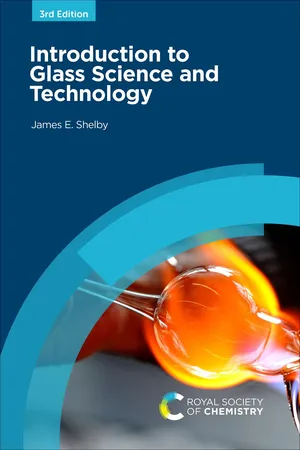
Presenting the fundamental topics in glass science and technology, this concise introduction includes glass formation, crystallization, and phase separation. Glass structure models, with emphasis on the oxygen balance method, are presented in detail. Several chapters discuss the viscosity, density, thermal expansion, and mechanical properties of glasses as well as their optical and magnetic behavior and the diffusion of ions, atoms, and molecules and their effect on electrical conductivity, chemical durability, and other related behavior. In addition to the effects of atomic structure on the properties of glasses, the effects of phase separation, crystallization, and water content, which are neglected in most texts, are discussed extensively. Glass technology is addressed in chapters dealing with the raw materials for producing glasses, batch calculations, and the melting and fining processes. The compositions, properties, and production of commercial glasses are also presented. A chapter is devoted to the use of thermal analysis in the study of glasses, including their crystallization behavior. This expanded, third edition, includes new chapters on doped vitreous silica and the, often overlooked, role of halides on glass formation and properties. In addition, solutions to all of the exercises at the ends of chapters are included for the first time in this edition.
This introductory text is ideal for undergraduates in materials science, ceramics, or inorganic chemistry. It will also be useful to the graduate student, engineer, or scientist seeking basic knowledge of the formation, properties, and production of glass in support of their work.
- 326 pages
- English
- ePUB (mobile friendly)
- Available on iOS & Android
eBook - ePub
Introduction to Glass Science and Technology
About this book
Information
Table of contents
- Cover
- Title
- Copyright
- Preface
- Acknowledgments
- Contents
- 1 Introduction
- 2 Principles of Glass Formation
- 3 Glass Melting
- 4 Immiscibility/Phase Separation
- 5 Structures of Glasses
- 6 Viscosity of Glass Forming Melts
- 7 Density and Thermal Expansion
- 8 Transport Properties
- 9 Mechanical Properties
- 10 Optical and Magnetic Properties
- 11 Water in Glasses and Melts
- 12 Thermal Analysis of Glasses
- 13 Glass Technology
- 14 Compositions and Properties of Commercial Glasses
- 15 Doped Vitreous Silica
- 16 Oxyhalide Glasses
- Bibliography
- Answers to Exercises Answers to Exercises
- Subject Index
Trusted by 375,005 students
Access to over 1.5 million titles for a fair monthly price.
Study more efficiently using our study tools.
Frequently asked questions
Yes, you can cancel anytime from the Subscription tab in your account settings on the Perlego website. Your subscription will stay active until the end of your current billing period. Learn how to cancel your subscription
No, books cannot be downloaded as external files, such as PDFs, for use outside of Perlego. However, you can download books within the Perlego app for offline reading on mobile or tablet. Learn how to download books offline
Perlego offers two plans: Essential and Complete
- Essential is ideal for learners and professionals who enjoy exploring a wide range of subjects. Access the Essential Library with 800,000+ trusted titles and best-sellers across business, personal growth, and the humanities. Includes unlimited reading time and Standard Read Aloud voice.
- Complete: Perfect for advanced learners and researchers needing full, unrestricted access. Unlock 1.5M+ books across hundreds of subjects, including academic and specialized titles. The Complete Plan also includes advanced features like Premium Read Aloud and Research Assistant.
We are an online textbook subscription service, where you can get access to an entire online library for less than the price of a single book per month. With over 1.5 million books across 990+ topics, we’ve got you covered! Learn about our mission
Look out for the read-aloud symbol on your next book to see if you can listen to it. The read-aloud tool reads text aloud for you, highlighting the text as it is being read. You can pause it, speed it up and slow it down. Learn more about Read Aloud
Yes! You can use the Perlego app on both iOS and Android devices to read anytime, anywhere — even offline. Perfect for commutes or when you’re on the go.
Please note we cannot support devices running on iOS 13 and Android 7 or earlier. Learn more about using the app
Please note we cannot support devices running on iOS 13 and Android 7 or earlier. Learn more about using the app
Yes, you can access Introduction to Glass Science and Technology by James E Shelby in PDF and/or ePUB format, as well as other popular books in Technology & Engineering & Industrial & Technical Chemistry. We have over 1.5 million books available in our catalogue for you to explore.