Winner of the International Gothic Association's Allan Lloyd Smith Prize 2022.
Shortlisted for the British Society of Literature and Science Book Prize 2020.
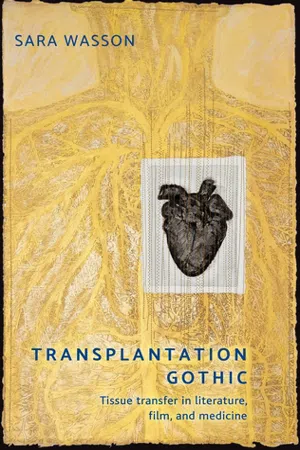
Transplantation Gothic is a shadow cultural history of transplantation, as mediated through medical writing, science fiction, life writing and visual arts in a Gothic mode, from the nineteenth-century to the present. The works explore the experience of donor/suppliers, recipients and practitioners, and simultaneously express transfer-related suffering and are complicit in its erasure. Examining texts from Europe, North America and India, the book resists exoticising predatorial tissue economies and considers fantasies of harvest as both product and symbol of structural ruination under neoliberal capitalism. In their efforts to articulate bioengineered hybridity, these works are not only anxious but speculative. The book will be of interest to academics and students researching Gothic studies, science fiction, critical medical humanities and cultural studies of transplantation.
- 217 pages
- English
- ePUB (mobile friendly)
- Available on iOS & Android
eBook - ePub
About this book
Trusted by 375,005 students
Access to over 1.5 million titles for a fair monthly price.
Study more efficiently using our study tools.
Information
1
Clinical necropoetics: medical and ethics writing of death and transplantation
In 1875, Francis Gerry Fairfield invoked period understandings of neurology to offer a striking view of the human nervous system. Experiments at the time indicated that white and grey nervous tissue have different functions, the former governing movement and sensation, and the latter involving higher thought. ‘[T]he physiologist thus finally encounters a gray nervous spectre that thinks and feels and longs, wills and determines and controls … a thin and filmy ghost … matter’s final Doppelgänger’.1 While the science of that passage is flawed, it foreshadows more recent medical thought in differentiating neurological functions and seeing consciousness wholly as a function of the body rather than the function of a separate spirit. Yet the language of this materialist vision is spectral: the subject is haunted by the material body, the ‘thin and filmy ghost’ of nerves themselves, ‘matter’s final Doppelgänger’.
A kind of materialist haunting can also be discerned within the medico-legal redefinitions of death that have accompanied the progress of the transplantation project. While haunting usually connotes disembodied spirits, here the term implies that bodies themselves can be recalcitrant and mysterious, not quite explained by a diagnostic label. This chapter explores affective and epistemological challenges posed by the novel diagnostic entities of ‘whole-brain death’, ‘brain-stem death’, and ‘controlled circulatory death’ as they developed in transfer milieux in the US and UK. As life-support technologies progressed, cardiopulmonary functions could be maintained despite catastrophic neurological damage. New states of being emerged, cyborg hybridities of machine and flesh dependent on machines for oxygen but still breathing, sweating, growing, sighing, and – sometimes – even weeping.2 My goal is not necessarily to challenge the validity of these criteria, or to question that these states indicate irreversible decline. Rather, I want to address how Gothic imagery, intertextualities, and narrative strategies are marshalled to variously express uncertainty or unease or, by contrast, to manage doubt and normalise. As described in my Introduction, Gothic can facilitate contradictory meanings, dis(re)membering to communicate troubling affects or to elide that very strangeness.
Reading the dead
Of necessity, a significant proportion of this interdisciplinary chapter will review the new deaths and their controversies, conventions of scientific communication, and theories of diagnosis. Diagnosis is historically and culturally specific, in that social factors shape how symptoms are understood; it is also always an enacted practice, an assemblage, as discussed in my Introduction, a network of human and nonhuman entities and forces tangible and intangible.3 Death diagnoses are enacted by assemblages of diverse elements – a body, cotton ear-buds, cardiac defibrillators, EEG machines, nurses, neurologists, anaesthesiologists, ventilators, thermometers, legal criteria for death, death certificate documentation, ice water poured into an ear. Each era has its own methods for enacting such diagnosis.
Thanatological uncertainty is hardly new, and has been especially prevalent at periods when new resuscitation technologies increased uncertainty about boundaries between life and death, notably 1740–1850 and the 1960s onwards. I will briefly review the eighteenth- and nineteenth-century context since it influenced the way these questions played out in the late twentieth century. In 1740, Leander Paget and Jacques-Bénigne Winslow wrote a short book in Latin, The Uncertainty of the Signs of Death. Expanded by others and translated into many languages, this text spawned a vast literature of thanatological doubt.4 By 1850 books and articles on the difficulty of diagnosing death ‘could be counted in the hundreds’.5 Societies were founded dedicated to resuscitation, especially of the drowned, such as England’s Humane Society founded in 1773. Considered as assemblage, early resuscitations drew on human and nonhuman actants including blankets, massage, and sal volatile. Electricity joined the paraphernalia of resurrection in 1774, and in 1803 Aldini used electricity to make a hanged man twitch, later to influence Mary Shelley’s Frankenstein (1818). By 1796 the London Society claimed over two thousand successful resuscitations.6 The Society’s work increased uncertainty over death’s finality, one of its Society’s founders arguing in 1780 that only bodily decay was a reliable indicator and some physicians contending that even that could be confused with gangrene.7 When the physician Charles Kite listed signs of death in 1788, he added that ‘these signs will not afford certain and unexceptionable criteria, by which we may distinguish between life and death’; likewise, Mathieu Orfila’s influential work on poison lists many signs of death but concludes that ‘no one of the signs, taken singly (except decided putrefaction) is sufficient to ascertain, positively, that an individual is dead’.8 By the end of the nineteenth century, physicians used a list of up to twenty possible signs of death.9 Checklists remain applicable in clinical diagnoses of death today, with some of the same challenges.
Fear of premature burial inspired creative measures such as escapable coffins and waiting mortuaries – ‘shelters of doubtful life’ – and as medical research and training make increasing use of dissection, fear also rose around unwitting vivisection.10 Uncertainties around death were exacerbated by popular awareness of other deathlike states, including those induced by trance, poison, or chloroform anaesthesia.11 Scientific innovations like the stethoscope and thermometer seemed to offer the possibility of simplifying death diagnosis, but instead added even further confusion by indicating that organs cease functioning at different times.12
At the same time as the corpse was brought under such scrutiny, death also became more hidden. Public-health reforms shifted to the margins of towns, and mourning conventions changed. There are risks in generalising about cultural attitudes towards death in particular eras, yet multiple commentators have identified a range in attitudes to death emerging at various moments from the late eighteenth century to the present, ranging from sentimentalising death in a cult of family through to seeing death in terms of prurience and taboo.13 Some critics have suggested that Gothic fiction offered ways to contemplate forms of mourning not socially acceptable at the time, as well as opportunities to muse over the corporeal mysteries of decay. With regard to the former, Dale Townshend speaks of early Gothic offering a socially acceptable expression of ‘negated grief’, mediated by descriptions of ‘macabre realities of corporeal decomposition and religious insecurity’, and Elisabeth Bronfen describes how, at times, art and literature could facilitate a kind of ‘death by proxy’, an imaginative engagement with this visceral and final experience.14 Carol Davison argues that Gothic writing offers a ‘necropoetics’, using ‘death-focused symbols and tropes such as spectrality and the concept of memento mori’ to express the complex relationship between the living and the dead, as well as the work of mourning.15 As the nineteenth century progressed, Gothic writing also increasingly imaginatively enacted the inquiry of professional medical discourse in deciphering death processes.16 By contrast with late eighteenth-century Gothic, nineteenth-century protagonists typically respond to the sight of a corpse less with horror than with either grief or quasi-scientific detachment: as Andrew Smith notes, in the late nineteenth century in particular, the dead body ‘either elicits empathy or invites forms of scientific understanding’, rather than terror or dread.17 In a range of ways, then, these fictions pose invitations to contemplate the affective and epistemological challenges posed by the dead.
Gothic fiction and scientific writing differ not only in formal characteristics but also in intended relationship to truth. Scientific writing is an ‘epistemic genre’, in Gianna Pomata’s phrase, driven by the goal of ‘knowledge-making’ (with the caveat that what counts as knowledge is historically variable).18 The nineteenth century saw professional pressure to move away from eighteenth-century sentimentality and Romantic language of emotional response, which had sometimes characterised elements of scientific writing previously.19 This distancing was informed not only by a need to meet the emerging epistemic virtue of objectivity but also by medicine’s claims on modernity, as Meegan Kennedy says, ‘defin[ing] itself in opposition not only to disciplinary others but to its own disciplinary ancestry’.20 However, traces of the sentimental or Romantic remained, particularly in contexts where physicians were emotionally moved.21 Nineteenth-century medical writing could invoke tenderness or fascinated horror, or emulate Gothic’s ‘interest in the supernatural and the unexplainable and its narrative aim of arousing suspense, horror, and astonishment’.22 Clinicians’ writing could also slide into emotional prose characteristic of Gothic fiction, such as James Bower Harrison’s description of fatal haemorrhage in his book The Medical Aspects of...
Table of contents
- Cover
- Half Title
- Title Page
- Copyright
- Dedication
- Contents
- List of figures
- Preface
- Acknowledgements
- Introduction • Bodies dis(re)membered: Gothic and the transplant imaginary
- 1 • Clinical necropoetics: medical and ethics writing of death and transplantation
- 2 • The bioemporium: corporate medical horror in late twentieth-century American transfer fiction
- 3 • Clinical labour and slow violence: transnational harvest horror and racial vulnerability at the turn of the millennium
- 4 • Possession? Uncanny assemblage and embodied scripts in tissue recipient horror
- 5 • Scalpel and metaphor: ‘machines of social death’ and state-sanctioned harvest in dystopian fiction
- Coda • Writing wounds
- Filmography
- Bibliography
- Index
Frequently asked questions
Yes, you can cancel anytime from the Subscription tab in your account settings on the Perlego website. Your subscription will stay active until the end of your current billing period. Learn how to cancel your subscription
No, books cannot be downloaded as external files, such as PDFs, for use outside of Perlego. However, you can download books within the Perlego app for offline reading on mobile or tablet. Learn how to download books offline
Perlego offers two plans: Essential and Complete
- Essential is ideal for learners and professionals who enjoy exploring a wide range of subjects. Access the Essential Library with 800,000+ trusted titles and best-sellers across business, personal growth, and the humanities. Includes unlimited reading time and Standard Read Aloud voice.
- Complete: Perfect for advanced learners and researchers needing full, unrestricted access. Unlock 1.5M+ books across hundreds of subjects, including academic and specialized titles. The Complete Plan also includes advanced features like Premium Read Aloud and Research Assistant.
We are an online textbook subscription service, where you can get access to an entire online library for less than the price of a single book per month. With over 1.5 million books across 990+ topics, we’ve got you covered! Learn about our mission
Look out for the read-aloud symbol on your next book to see if you can listen to it. The read-aloud tool reads text aloud for you, highlighting the text as it is being read. You can pause it, speed it up and slow it down. Learn more about Read Aloud
Yes! You can use the Perlego app on both iOS and Android devices to read anytime, anywhere — even offline. Perfect for commutes or when you’re on the go.
Please note we cannot support devices running on iOS 13 and Android 7 or earlier. Learn more about using the app
Please note we cannot support devices running on iOS 13 and Android 7 or earlier. Learn more about using the app
Yes, you can access Transplantation Gothic by Sara Wasson in PDF and/or ePUB format, as well as other popular books in Literature & Film & Video. We have over 1.5 million books available in our catalogue for you to explore.