eBook - ePub
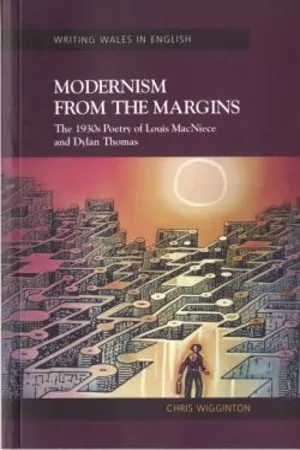
Modernism from the Margins
The 1930's Poetry of Louis MacNeice and Dylan Thomas
- 224 pages
- English
- ePUB (mobile friendly)
- Available on iOS & Android
eBook - ePub
Trusted by 375,005 students
Access to over 1.5 million titles for a fair monthly price.
Study more efficiently using our study tools.
Information
Topic
Littérature1
‘Poised on the edge of absence’: Louis MacNeice, Modernism and the 1930s
I doubt that the Auden Generation would, in the long run, have made substantively different decisions or expressed substantively different attitudes had events been otherwise. In retrospect at least, modernism appears to have been sliding toward a state of exhaustion and impasse. Jogged from the heights their elders held, defensively and with a kind of aesthetic bravado, the writers of the thirties, and particularly the decade’s ironists, found themselves more bewildered than heartened by their frequently superficial involvements: troubled by the detachments that, as they recognized, still afflicted them but uneasy in their demand for participation in a world whispering, beneath the shrill slogans and hopeful therapies, of disaster beyond the reach of politics and psychology and of disorder not to be stabilized by the symmetries of art. The chief paradox of the decade – the inevitable but unintended subversion of depth through a relentless attention to surface, undertaken in an attempt to change both self and world by rendering language transparent – this paradox marks the effective end of modernism and of the attitudes that made absolute irony possible.
Alan Wilde, Horizons of Assent: Modernism, Postmodernism and the Ironic Imagination1
Descending out of the grey
Clouds elephant trunk
Twitches away
Hat:
THAT
Was not what I expected,
A
Misdirected
Joke it seems to me;
‘What about a levitation?’ I had said,
Preening head for halo,
All alert, combed, sanctified,
I thank Thee, Lord, I am not like other men
WHEN
Descending out of the grey
Clouds elephant trunk … .
(and so ad nauseam)
Louis MacNeice, ‘Elephant Trunk’ 2
On 11 October 1925 the teenage Louis MacNeice delivered a paper entitled ‘The mailed fist of common-sense and how to avoid it’ to the Literary Society of his school. John Hilton remembers it as ‘an amazing conglomeration of dreams, fables, parables, allegories, theories … [and] … quotations’, and MacNeice offers excerpts from the paper in Modern Poetry:
Common Sense is like Jargon: it can only say a thing in one way. Sense is good in prose and Nonsense in poetry … [section break] … But you must not think that good things are only to be found in Xanadu or in past history. The dwellers in Xanadu never saw a van going down the street and piled with petrol tins in beautiful reds and yellows and greens … it is the narrowly scientific spirit, the common sense spirit, the reduction of everything to formulae, that is the fly in the ointment.3
During the course of the paper, MacNeice went on to criticize Romanticism generally, and Wordsworth’s poetry in particular, as ‘the stuff of personal dreams made sufficiently impersonal to be palatable to others than oneself’, and proclaimed that ‘The business of the poets is to produce rabbits out of apparent vacancy … They supply the missing pieces to our jigsaws. They delve into our brains and fish up the king of salmon from beneath the weeds of convention.’4 This seemingly adolescent anti-rationalism and anti-Romanticism was soon to manifest itself in the Modernist aestheticism of MacNeice’s first collection of poems, Blind Fireworks (1929). According to MacNeice, the collection was founded on ‘an esoteric mythology’, and was called Blind Fireworks because the poems therein ‘are artificial and yet random; go quickly through their antics against an important background, and fall and go out quickly’. Full of circular narratives, references to T. S. Eliot, Friedrich Nietzsche and Pythagoras, the collection expressed concerns with time, surface and sensory perception, through its imagery of clocks, marble, bells, ears and eyes.5
Perhaps unsurprisingly, given these origins, Blind Fireworks is often seen by MacNeice’s critics as an immature irrelevance, a necessary first step maybe, but certainly one in the wrong direction. On the rare occasions that it has been deemed worthy of even limited critical attention, Blind Fireworks is read as the sole example of the young MacNeice’s juvenile flirtation with Modernism. Edna Longley, for example, refers to the ‘hothouse solipsism’ and ‘uncontrolled flamboyance’ of the collection, Robyn Marsack to its ‘wistful sensuousness’ and ‘abdication of control over the words’, and Peter McDonald to the ‘somewhat cavalier manifestos of flux’ to be found in the early work generally.6 It is with no small measure of relief that all three critics move quickly on to what they regard as the anti-Modernist terra firma of MacNeice’s writing of the 1930s and after. Each also suggests that in MacNeice’s criticism of this period can be found confirmation of his rejection of Modernism.
Superficially, this case isn’t a difficult one to make. In his criticism MacNeice refuses the ‘closed circle of exalted moments’ which restricts Eliot and James Joyce, refers to Eliot’s poems as ‘studies from a corner’ and comments that ‘his [Eliot’s] world view is defeatist and he sees mankind through the eyes of a pedant’, remarks that are repeated more than once.7 Ezra Pound and Wyndham Lewis, too, attract adverse commentary. MacNeice announces, for example, that ‘Pound’s bits of history and culture are so diverse and so particular as to fail to arouse many echoes’, whilst ‘Wyndham Lewis is basically a pessimist, thinking of human beings as doomed animals or determinist machines’.8 However, apart from the fact that care needs to be taken in judging a writer’s poetry by his or her criticism – the criticism can often serve as a blind, cover or red herring with regard to the poetry (as in Eliot’s own notes to and comments on The Waste Land) – this is a one-sided assessment. Elsewhere, MacNeice writes approvingly that Eliot’s ‘verse was carefully fragmented to match the world as he perceived it’ and praises Eliot for incorporating into poetry for the first time ‘the contemporary world (and its implications of history)’, its ‘boredom and … glory’.9 In the same vein, he observes Eliotically that:
Pound takes the whole of history as stock for his soup and cuts backwards and forwards from one country or one century to another, adding plenty of the smell of cooking and the noise of the typewriter to make it clear that all these elements combine for him in a living and contemporary whole.10
MacNeice’s ventriloquizing of Eliot in order to endorse Pound is revealing of his complex, ambivalent critical attitude to Modernist aestheticism, and his critical work should not, therefore, be taken simply to endorse a rejection of Modernist practice in his poetry of the 1930s. Take, for example, a statement made in The Poetry of W. B. Yeats on the influence of Yeats and Eliot on his generation of poets:
We admired him [Yeats] too for his form. Eliot in 1921 had argued that, as the modern world is so complex, the poet must become ‘more allusive, more indirect, in order to force, to dislocate if necessary, language into his meaning.’ A Chaotic World, that is, could only be dealt with by the methods of The Waste Land. Yeats went back to an earlier tradition and suggested by his example, that, given a chaotic world, the poet is entitled, if he wishes, to eliminate some of the chaos, to select and systematise. Treatment of form and subject here went hand in hand; Yeats’s formalising activity began when he thought about the world; as he thought it into a regular pattern, he naturally cast his verse in regular patterns also.11
Here MacNeice does not dissociate the Modernist project of rendering in artistic terms the chaos of the modern world from that of the poetry that followed, but suggests, rather, that, in the 1930s, Yeats’s refurbishment of well-made form seemed more useful tactically than Eliot’s High Modernist aesthetic of fragmentation. Peter McDonald writes that, as distinct from MacNeice’s poetry of the 1920s, ‘much of his writing [of the 1930s] turns on the very issue of how far the self is able to marginalize the other into mere “context” and how far it is the context, the other, which gives meaning to the self’.12 I would agree. Whilst McDonald, though, takes this to mark a shift away from Modernist poetry after Blind Fireworks, I would see it, instead, as showing that MacNeice’s poetry of the 1930s continues in an utterly Modernist mode. Not only does it display a simultaneous distrust of and fascination with representing surface and perception, it also offers a complex engagement with other Modernist writers.
MODERNIST DIALOGUES
‘An Eclogue for Christmas’, for example, can be read as MacNeice’s dialogue with Yeats and Eliot in poetic form, and can allow for a slightly different reading of the relationships between MacNeice’s earliest work and that of the 1930s from the one given by Longley, McDonald et al. MacNeice notes that while he was at Marlborough he became obsessed by the Sitwells and wrote various poems indebted to their fascination with the ‘child-cult’, ‘fantasies’ and ‘Russian Ballet colouring’.13 These include the following poem, described by Jon Stallworthy as a ‘harlequin motley’:
The pleasure boats have paddled all the day, holiday;
Pay your penny, go away, come again on Saturday,
The boats will be repainted and their pennons will be gay,
The yellow fruit umbrellas in remote Kinsay
Will catch the yellow sun-rays …14
In ‘The mailed fist of common-sense and how to avoid it’ MacNeice also wrote approvingly of the ways in which ‘The Sitwells place things in new positions. By expressing something in terms of something quite different they succeed in describing what we had previously thought indescribable’; and in Modern Poetry he noted how ‘Their little jazz fantasies seemed to me extremely exciting. They were in tune with the “childlike” painting of Matisse and the sentimental harlequins of Picasso’s blue period.’15 By the 1930s, however, he seems to have become ‘jazz-weary’, as he puts it in ‘An Eclogue for Christmas’:
A. Jazz-weary of years of drums and Hawaiian guitar,
Pivoting on the parquet I seem to have moved far
From bombs and mud and gas, have stuttered on my feet
Clinched to the streamlined and butter-smooth trulls of the élite,
The lights irritating and gyrating and rotating in gauze –
Pomade-dazzle, a slick beauty of gewgaws –
I who was Harlequin in the childhood of the century,
Posed by Picasso beside an endless opaque sea,
Have seen myself sifted and splintered in broken facets,
Tentative pencillings, endless liabilities, no assets,
Abstractions scalpelled with a palette-knife
Without reference to this particular life.
And so it has gone on; I have not been allowed to be
Myself in flesh or face, but abstracting and dissecting me
They have made of me pure form, a symbol or a pastiche,
Stylised profile, anything but soul and flesh:
And that is why I turn this jaded music on
To forswear th...
Table of contents
- Cover
- Title Page
- Copyright Page
- Contents
- General Editor’s Preface
- Acknowledgements
- List of Abbreviations
- Introduction ‘Night-bound-doubles’: Louis MacNeice, Dylan Thomas and the 1930s
- 1 ‘Poised on the edge of absence’: Louis MacNeice, Modernism and the 1930s
- 2 ‘Our modern formula/of death to sense and dissolution’: Dylan Thomas, Modernism and surrealism in the 1930s
- 3 ‘The woven figure’: Louis MacNeice’s Ireland
- 4 ‘Here lie the beasts’: Dylan Thomas’s monsters, monstrous Dylan Thomas
- 5 ‘But one – meaning I’: Autumn Journal’s histories and voices
- 6 ‘Crying with hungry voices in our nest’: Wales and Dylan Thomas
- Conclusion ‘The judge-blown bedlam’: after the 1930s
- Notes
- Bibliography
Frequently asked questions
Yes, you can cancel anytime from the Subscription tab in your account settings on the Perlego website. Your subscription will stay active until the end of your current billing period. Learn how to cancel your subscription
No, books cannot be downloaded as external files, such as PDFs, for use outside of Perlego. However, you can download books within the Perlego app for offline reading on mobile or tablet. Learn how to download books offline
Perlego offers two plans: Essential and Complete
- Essential is ideal for learners and professionals who enjoy exploring a wide range of subjects. Access the Essential Library with 800,000+ trusted titles and best-sellers across business, personal growth, and the humanities. Includes unlimited reading time and Standard Read Aloud voice.
- Complete: Perfect for advanced learners and researchers needing full, unrestricted access. Unlock 1.5M+ books across hundreds of subjects, including academic and specialized titles. The Complete Plan also includes advanced features like Premium Read Aloud and Research Assistant.
We are an online textbook subscription service, where you can get access to an entire online library for less than the price of a single book per month. With over 1.5 million books across 990+ topics, we’ve got you covered! Learn about our mission
Look out for the read-aloud symbol on your next book to see if you can listen to it. The read-aloud tool reads text aloud for you, highlighting the text as it is being read. You can pause it, speed it up and slow it down. Learn more about Read Aloud
Yes! You can use the Perlego app on both iOS and Android devices to read anytime, anywhere — even offline. Perfect for commutes or when you’re on the go.
Please note we cannot support devices running on iOS 13 and Android 7 or earlier. Learn more about using the app
Please note we cannot support devices running on iOS 13 and Android 7 or earlier. Learn more about using the app
Yes, you can access Modernism from the Margins by Chris Wigginton in PDF and/or ePUB format, as well as other popular books in Littérature & Collections littéraires européennes. We have over 1.5 million books available in our catalogue for you to explore.