- 336 pages
- English
- ePUB (mobile friendly)
- Available on iOS & Android
eBook - ePub
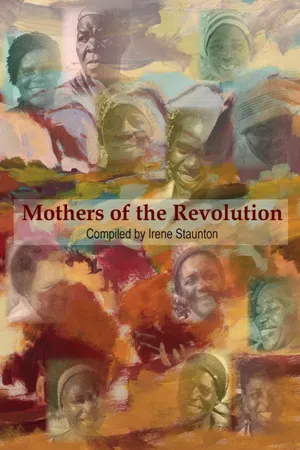
Mothers of the Revolution
About this book
Mothers of the Revolution is one of the most remarkable chronicles to emerge from the Zimbabwean liberation war (1967-1980). Here are first-hand accounts from rural women living in all parts of the country who stayed behind during the war; the women whose sons and daughters secretly left home to join the liberation armies and sometimes never returned; the women who single-handedly, not only had to keep their homes, but who fed the freedom fighters; women, who as the war intensified, were often caught in the crossfire.
Information
1
Seri Jeni
Madziwa, Mount Darwin
I was born in Guruve. I was the eldest of seven children but all of them except my brother died at birth or shortly afterwards. My mother also died when I was still a very small child and my grandmother, my father’s mother, looked after me. My father’s second wife, whom he had married after my mother’s death then died too. This meant that all the children – that is my mother’s children and my aunt’s1 children – went to live with my grandmother. It was very difficult for her to look after such a large family.
We were such a big family that we could not even ask our father to send us to school. I managed to go as far as Standard 1 by working in other people’s fields. Sometimes the teachers sympathised with me and even if I did not have enough money, they allowed me to attend school. Most times I was also late for classes, but the teachers did not punish me because they knew I had to prepare food for my three younger sisters and two brothers before I left for school. After class the teachers always let me go home earlier than the rest of the school children and they excused me from doing homework because I had to take care of my younger brothers and sisters.
Then I stopped going to school to give a chance to the younger ones. It was, after all, very difficult to go to school and, at the same time, think about and organise all the cooking for the rest of the family. When I had finished Standard 1, I was able to write my name and a letter, which was the important thing.
I then stayed at home for a long time before I met my husband. He had been working as a driver in the Chidavaenzi store in Guruve. After my marriage things seemed to change a bit for the better. My two younger sisters were by then old enough to look after the rest of the children. When they eventually married, they just left my brothers to cook for themselves because my grandmother was by then very old and depended on us.
After I had got married I moved to my husband’s home in Madziwa. He was still working as a driver but he had been transferred to Harare. About five months later he resigned and joined me at home.
During those years in Guruve there was plenty of politics. Those were the years when ZAPU started.2 Everyone, men and women were involved in the party. The police would come to arrest them. They would tie their hands together and their feet together and throw them into trucks. Then those who had not been arrested lay in the road to prevent the trucks from moving.
The police could do nothing but neither could they release those they had arrested. The police would plead with people to get up off the road and because the police usually came in large numbers, they managed to convince people to move away. If they refused and it was impossible for the car or the lorry to move, the police had to wait until people chose to leave the road. Obviously, they could not lie there forever. There always came a time when they gave in, saying, “Let them go and kill those people but we also want to go, and if it means being killed, then let them kill all of us,” and they would challenge the police to run them over. Seeing people being arrested and thrown into trucks was disturbing. Everyone was concerned, especially the children who had parents who were actively involved in politics.
I was worried. We children wondered why it was happening that old people were being arrested and thrown into trucks. We thought it was better for the old people to give in. But if ever the ZAPU people heard you say such a thing, they threatened to kill you.
I realised that people were not free and that is what they were trying to do, free themselves from colonialism. That is what the police were against and what they were arresting them for. People were trying to resist a bad type of government. People were arrested and put in Gonakudzingwa.3 They left their families with no one to look after them for many years. The arrested men would write from prison asking for assistance and then a few clothes were given to the family. When the wives went to visit their husbands they only went as far as the gate: that is where one spoke with one’s husband through a small window. The men did not have any privileges. They were not even allowed to hold their own baby, if the wife had a baby: they just had to look at each other in the presence of a policeman.
But this all happened before I married. My husband never joined ZAPU and, when we came here, it was quite different: there was no party in this area, Madziwa.
I came and stayed with my in-laws for a year. When it was time to plough the fields, we ploughed those belonging to my father-in-law, but when it was our turn to plough, they gave us an ox and a plough but did not help us. So, we had to plough alone, just the two of us, me and my husband. One of the cattle was difficult to control and once, when we were ploughing, we did not realise that my child was following us. By the time we turned to plough in the opposite direction, the child had lain down in the furrow. The cattle were moving ahead on their own, without anyone to lead them. I was behind them and my husband was holding the plough. Suddenly the cattle started with fright and left the furrow. I ran to control them and realised that my child was asleep in the furrow and that is what had frightened the cattle.
My husband stopped the cattle and we both sat down, with our child, considering how it had almost died. It was very distressing to realise that the child might have been killed by those cattle and all because we had no help. We always helped my in-laws but they were not willing to help us. We felt used and rejected. That was our main problem when we first came to live at Madziwa.
You see, we had only one ox and a plough. My husband’s relatives refused to work with him because they said he was poor. In the end we ploughed with another family for, as we say, ‘one thumb cannot squeeze a louse’. On another occasion, my in-laws took everything from us and we had nothing to use in the fields. We had to borrow from other friends and as a result, we ploughed very late and only harvested eleven bags of maize. I obtained six and my husband’s second wife harvested five.
After that, my husband found a job as a driver in Mount Darwin. That year he bought two oxen and three cows. Then life began to change for the better. From that time, we managed to plough as much as we wanted to and we managed to send our three children to school without any problem.
My husband’s relatives started coming to see us; they began to be friendly because we were no longer poor. Soon I realised that my husband had a lot of relatives. In the end things turned out well for us.
My first three children are the ones who suffered during those years, but it was really only for a short period. By the time I had the rest of my children, life was easy: I had no problems at all. We planted potatoes, maize and cotton and we made money. I was working in the fields while my husband was employed. After several years, and before the war, my husband left his job to concentrate on ploughing. He worked on the land with us for three years before we were moved into the Keep.
During that time, I heard that there was war in Mozambique but I did not know it would come to our country. I felt that this district should do some of the things that people in Guruve had been doing, but it was always very quiet here.
ZAPU was the first political party that came into this area. There were very few members and they did not come out into the open. They had small books [membership cards]. It was only after a police search, when those books were found, that you knew who the members were. The police were told by informers and then they went and searched the person’s whole house, throwing out everything as they looked for evidence. Even my home was searched once. If they discovered that you were a member of the party, they arrested you.
It was quite a long time after that, that the guerillas came. At the beginning, there were only a few at a time. It was only later that they came in full force. They even came to my house.
That was the first time I saw them. There were three boys and I prepared them a meal. In the evening, some other guerillas came and again I gave them food. The guerillas then called all my children together and told them that if they ever told anyone that I had given them food, it would be the end of us all. My children never talked about it to anyone; they were very disciplined.
The comrades talked to us a bit. They said that they were our children and that they were fighting for our country. They said they were not fighting for their own freedom, but for the freedom of everyone in the country. Then they said, “Please make us some food; we, your children, are very hungry,” and they left and went into the bush. I prepared the food and carried it into the bush. We did this for a number of days.
Because my husband had a car, the comrades used to send him to purchase whatever they wanted from Harare or Bindura. He bought clothes and food for them and he would deliver them to an agreed point. The soldiers did not know that my husband was involved; they did not have a clue, although once they did become suspicious and came to look for him at our home. They asked where he was and I said he had gone to Bindura. They did not believe me so they asked my neighbour, my sister-in-law, who confirmed my statement. I do not know what they had heard to make them so very suspicious.
Then the Smith government told us that we would be moved into the Keep. We were told to build our own huts within the protected village. Some people hesitated to do so because they were afraid to be the first to build their home there. The problem was that people who had not built their houses, had no time to do so, as we were all moved into the Keep before the stipulated date. You were supposed to move all your property into the area on one single day and the authorities said that if we did not do so, we would not be allowed to bring anything in afterwards. There had been a contact and that is why we were moved so suddenly. The authorities said that we had fed the guerillas and that was why they had the energy to fight.
My husband spent the day carrying maize into the Keep for other people, so at about four o’clock in the afternoon, he had still not begun to carry our own belongings. We started to mourn lest we had no food for the children. You see, my husband had a car and was being hired by others to carry their maize to the Keep. But at last, in the evening, he delivered our maize. We had nowhere to put it, so we just poured the cobs on the ground outside.
Once we were in the Keep, the children stopped going to school but, finally, a year later, they were allowed to attend school again. The school was outside the Keep but everyone, teachers, and school children, all stayed in the Keep. The grocery shops remained open.
It was after this that one of my children joined the struggle. What happened was that she woke up early in the morning and got ready the various things she used to sell. Then she changed into a denim dress, underneath which she wore a jersey and she put her brother’s baby on her back, saying that she was going to the township. She left the Keep and then gave her little brother the baby. She just said, “Bye-bye, we shall meet again some day.”
At the end of the day, as it grew dark, I asked my other children where she was. The little boy said she had told him that she was going to the shopping centre but that, as she left, she had said, “Bye-bye, we shall meet some day.” She never returned.
I did not sleep that night. I felt very worried and powerless. The following morning, I told my husband that our child had disappeared and he said that I should have told him before, so that he could have reported it. After a week some men arrived to say that their son wanted to marry my daughter. My husband was very annoyed because he thought that meant that they knew where my daughter was. He wanted to beat them but my brother-in-law stopped him.
After that the police regularly came to my house to ask about my daughter. They said that we were looking for a child who was long dead. They said that they had seen her go and that she had been killed immediately.
This was untrue. She went and fought in the war. It was a painful thing to think about. When a person was killed, the security forces hung the dead body on a chopper and every time this happened, I thought it could be my daughter. I had no happiness for thinking about my child. Each time I heard that comrades had been killed in such and a such place, I thought she could be one of them. I was very worried. She was my fourth-born child and she had been very interested in the war and had often gone to the base: many children did. They simply told the guards on the Keep gate that they were going to the township. It was three years before I heard about my daughter again.
We had lots of problems living in the Keep. Every time we returned from fetching water, the DAs4 stirred the pots to make sure there was nothing hidden inside. Each time we left the Keep the guards required us to jump up and down. One lady was forced to jump so hard that the cloth she was wearing fell off and, as she had nothing underneath it, she stood there naked.
My field was very near the Keep and once, when we were not allowed out of the Keep for three whole days, cattle entered the field and ate all my crops. I could see them doing so, but I could do nothing at all about it. Sometimes we spent days without water because we were not allowed out. Sometimes the cattle entered the Keep and ate the thatching from of the huts because they were so hungry.
Life was very difficult in the Keep because we were watched all the time. But in spite of this people did everything they could to help the comrades. My husband continued to buy things for them. Sometimes he filled a car tube with mealie-meal and other things. Then he fitted the tube into a tyre and put the tyre on the car so that one wheel was inflated not by air but by his purchases for the comrades. Then he drove outside. He went to an agreed point where he emptied the contents of the tube out for the comrades.
My husband always helped the comrades willingly. He often said that if the war had started when he had been younger, he would have gone to join them. So, he was glad of anything he could do to help them.
Nonetheless, I was very worried. My husband was fighting a war. My home was always being watched and the authorities said that we were for the guerillas. My husband never liked attending the meetings that were called in the Keep by the authorities. I had to force him to go because if he hadn’t, we would have had trouble. Actually, he was afraid that he might be forced to answer negatively to whatever was said by the authorities.
Usually when people went to the base, a few mujibas5 remained at the Keep to watch and listen to what happened in the Keep. If the authorities got to hear that we had all gone to the base, they would call the security forces to say that everyone in Keep Five had gone to the base. Soon afterwards, helicopters would fly above it. People would flee, some would fall into pools, and some would run so far away that they would only return the following day. The authorities always got their information from sell-outs but, fortunately, no one in our Keep was killed because of their activities. Still, at that time, you could never tel...
Table of contents
- Cover Page
- Title Page
- Copyright Page
- Contents
- Acknowledgements
- A note on place names
- Glossary
- Preface by Thoko Matshe
- Introduction by Irene Staunton
- 1 Seri Jeni
- 2 Sosana Marange
- 3 Elizabeth Ndebele
- 4 Flora Sibanda
- 5 Juliet Makande
- 6 Maudy Muzenda
- 7 Rhoda Khumalo
- 8 Thema Khumalo
- 9 Lois Mushore
- 10 Lisa Teya
- 11 Margaret Nkomo
- 12 Annah Madzorera
- 13 Meggi Zingani
- 14 Mary Gomendo
- 15 Margaret Viki
- 16 Tete Magugu
- 17 Agnes Ziyatsha
- 18 Feresai Mashayamombe
- 19 Elina Ndlovu
- 20 Daisy Thabede
- 21 Josephine Ndiweni
- 22 Cheche Maseko
- 23 Joanah Nkomo
- 24 Betty Ndlovu
- 25 Erica Ziumbwa
- 26 Daniah Girori
- 27 Elsi Chingindi
- 28 Helen Karemba
- 29 Ida Mtongana
- 30 Emmah Munemo
Trusted by 375,005 students
Access to over 1.5 million titles for a fair monthly price.
Study more efficiently using our study tools.
Frequently asked questions
Yes, you can cancel anytime from the Subscription tab in your account settings on the Perlego website. Your subscription will stay active until the end of your current billing period. Learn how to cancel your subscription
No, books cannot be downloaded as external files, such as PDFs, for use outside of Perlego. However, you can download books within the Perlego app for offline reading on mobile or tablet. Learn how to download books offline
Perlego offers two plans: Essential and Complete
- Essential is ideal for learners and professionals who enjoy exploring a wide range of subjects. Access the Essential Library with 800,000+ trusted titles and best-sellers across business, personal growth, and the humanities. Includes unlimited reading time and Standard Read Aloud voice.
- Complete: Perfect for advanced learners and researchers needing full, unrestricted access. Unlock 1.5M+ books across hundreds of subjects, including academic and specialized titles. The Complete Plan also includes advanced features like Premium Read Aloud and Research Assistant.
We are an online textbook subscription service, where you can get access to an entire online library for less than the price of a single book per month. With over 1.5 million books across 990+ topics, we’ve got you covered! Learn about our mission
Look out for the read-aloud symbol on your next book to see if you can listen to it. The read-aloud tool reads text aloud for you, highlighting the text as it is being read. You can pause it, speed it up and slow it down. Learn more about Read Aloud
Yes! You can use the Perlego app on both iOS and Android devices to read anytime, anywhere — even offline. Perfect for commutes or when you’re on the go.
Please note we cannot support devices running on iOS 13 and Android 7 or earlier. Learn more about using the app
Please note we cannot support devices running on iOS 13 and Android 7 or earlier. Learn more about using the app
Yes, you can access Mothers of the Revolution by Irene Staunton in PDF and/or ePUB format, as well as other popular books in History & African History. We have over 1.5 million books available in our catalogue for you to explore.