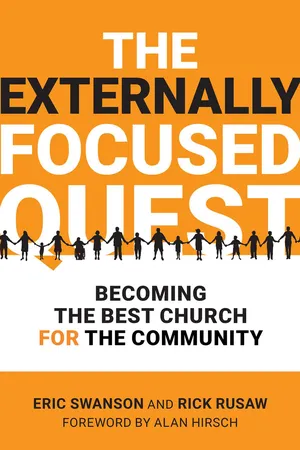
The Externally Focused Quest: Becoming the Best Church for the Community is designed for church leaders who want to transform their churches to become less internally focused and more oriented to the world around them. The book includes clear guidelines on the changes congregations must adopt to become truly outwardly focused. This book is not about getting all churches to have an annual day of community service as a tactic, but changing the core of who they are and how they see themselves as a part of their community. The Externally Focused Quest outlines ten changes needed for church leaders to transform their churches and presents a highly practical approach that shows leaders how to become more externally focused without having to give up programs that serve members. This book reveals what it takes to make the major shift from internal to external focus and how that affects church leadership.
eBook - ePub
The Externally Focused Quest
Becoming the Best Church for the Community
- 235 pages
- English
- ePUB (mobile friendly)
- Available on iOS & Android
eBook - ePub
About this book
Information
Topic
Theology & ReligionSubtopic
Christian Church9
Creativity: They Innovate, Not Replicate
The real acts of discovery consist not in finding new lands but in seeing with new eyes.
—Attributed to Marcel Proust
In 2009, Leadership Network, in partnership with the Hartford Institute for Religion Research, conducted a study to find out how large churches that describe themselves as “innovative” differ from other churches. The results were both revealing and enlightening. Highly innovative churches
- grow faster than other churches;
- have a higher rate of new believers than other churches;
- put more emphasis on personal Bible study and tithing than other churches;
- experience less conflict than other churches.
Ninety-one percent of the people attending highly innovative churches strongly agree that their church “has a clear mission and purpose” and see themselves as “a positive force for good in [their] community.” These innovative churches have more volunteers and are significantly more likely to invite friends and family to church. The author of the survey, Warren Bird, makes some insightful observations: “Churches that welcome innovation tend to embrace creativity, ingenuity, and divergent ways of thinking inside the box. They have a willingness to change their practice in order to improve performance. Their bent is to solve problems [in ways] that will generate better results—such as more and better disciples of Jesus Christ.”[1]
Warren’s insights are important. Churches don’t innovate simply to be novel, cute, or clever; they innovate to achieve their God-given mission.
Ideation, Creativity, Inspiration, Invention—and Innovation
We want first of all to clarify what innovation is not on the way to discovering what it is. Innovation is not the same as ideation, creativity, inspiration, or invention. To be certain, creativity, inspiration, and ideation are important to the innovative process, but innovation always pertains to the productive application of creativity. Tom Kelley of the global design company Ideo reminds us that “all good working definitions of innovation pair ideas with action, the spark with the fire.” Drilling down further, he quotes the 3M company’s definition of innovation: “new ideas—plus action or implementation—which result in an improvement, a gain, or a profit.”[2] Thomas Edison is said to have pointed out that “an idea is called an invention. Converting an idea into something that is useful to the customer and profitable for the company is called innovation.”[3] Elaine Dundon defines innovation as “the profitable implementation of strategic creativity.”[4] It is innovation that brings ideas to life.
Innovation deals with being not simply novel or different but “better.” And it is important to think about where we put our innovative energies and to not mistake innovation for uniqueness, creativity, or cleverness. Innovation needs to be tied to results that matter in regard to your mission. So, having a children’s area that looks like Disneyland may be creative, but it may not be innovative. Having candles in the back of the church may be creative but not necessarily innovative. Writing your own follow-up or discipleship materials may be creative but not necessarily innovative—if they do not change the outcomes compared to using materials that already exist. In areas that are not mission-critical, we can replicate what has been done. Creative and innovative energy should be reserved for the growth plates that are crucial to accomplishing your mission.
Results and Effort
Innovation always pertains to the relationship between inputs and outcomes—between effort and resources expended on the one hand, and the result or fruit of the outcome on the other. Look at the diagram in figure 9.1. Many churches are in the upper-left quadrant—they are getting results according to their effort. Their budgets, programs, and staff are accomplishing what they were intended to accomplish. In the lower-left quadrant are churches that spend much but accomplish little toward their mission. In the lower-right quadrant are churches that expend little and accomplish little. They are simply in survival mode.
To be honest, all of us would like to be in the upper-right quandrant: accomplishing more while using fewer resources and expending less effort to do so. To do so requires innovation. The upper right quadrant is where we find people like Gideon’s three hundred men and the boy with five loaves of bread and two fish.

Figure 9.1
The One Condition for Innovation
Anyone whose goals are bigger than their resources can be an innovator. If you are content with the status quo, there is no need to innovate. Innovation thrives under the conditions of scarcity or opportunity, but it never happens unless the leader has a goal. Genuine innovation occurs not because a person is trying to be original but because a person is attempting something difficult.
Let’s take a look at Moses in Deuteronomy 1. Deuteronomy is the record of three speeches given by Moses to prepare the Israelites to enter the promised land. In his first address, he said to the Israelites, “At that time I said to you, ‘You are too heavy a burden for me to carry alone. The Lord your God has increased your numbers so that today you are as many as the stars in the sky. May the Lord, the God of your fathers, increase you a thousand times and bless you as he has promised!’” (Deut 1:9–11).
You have just read about the heart of a leader. “You are way more than I can handle. I don’t think I can do this job one more day, but my prayer is that God would multiply you a thousand times more!” As burned-out as Moses was, he still wanted God to do a thousand times more. He didn’t shrink the size of his vision to the size of his capacity. Leaders have a way to hold two seemingly contrary things in their mind until they discover the solution. Moses didn’t succumb to “either-or” thinking. He wanted more time in his schedule and space in his life, and he wanted to see God multiply the Israelites by a thousand times. It is only when we want to accomplish something great and seemingly impossible that we are open to solutions and creativity from any source.
Do you remember what happened next (as recorded in the parallel passage in Exodus 18)? Moses’s father-in-law, Jethro, a pagan priest from a rival tribe, came up with the solution of appointing and training leaders who could take over the majority of the work. Leaders have the capacity to embrace “both-and” rather than “either-or” thinking. Think of what Moses wanted: he wanted space in his life and time in his schedule, and he wanted the community to multiply a thousand-fold. It was only by simultaneously holding on to both pieces of his desires that he was open to a creative solution. Solomon reminds us that “it is good to grasp the one and not let go of the other”—the genius of the both-and (Eccl 7:18). If Moses had given up on one idea or the other, he would not have seen the genius of Jethro’s solution. Creativity (new ideas) and innovation (the implementation of creativity) often come at the intersection of two contradictory ideas. If Moses had let go of either aspiration, he most likely would have told Jethro to take a hike—he could solve his own problems.
Google’s Astro Teller puts it this way:
Here is the surprising truth: It’s often easier to make something 10 times better than it is to make it 10 percent better. Yes . . . really. Because when you’re working to make things 10 percent better, you inevitably focus on the existing tools and assumptions, and on building on top of an existing solution that many people have already spent a lot of time thinking about. Such incremental progress is driven by extra effort, extra money, and extra resources. It’s tempting to feel improving things this way means we’re being good soldiers, with the grit and perseverance to continue where others may have failed—but most of the time we find ourselves stuck in the same old slog. But when you aim for a 10x gain, you lean instead on bravery and creativity—the kind that, literally and metaphorically, can put a man on the moon.[5]
Feeding the Fifty Thousand (Every Day)
A few summers ago, I (Eric) flew to southern California to be part of Serve Day, a one-day service project involving dozens of churches and more than five thousand volunteers. Serve Day was begun as a one-time initiative by Rock Harbor Church in Costa Mesa, California, as an alternative to worship because their usual meeting place had been double-booked one week. Serving on Sunday was an innovative alternative to Sunday service. But the event had multiplied over the years.
After Serve Day, my good friend Eric Marsh took me around to see some of the externally focused initiatives in the Long Beach area. One of the most amazing people I met was Arlene Mercer, founder of Food Finders in Long Beach (foodfinders.org). In 1989, Arlene became aware of all the hungry people in this community near Los Angeles. But what could she do by herself? She had no warehouse in which to store or distribute food. But what she did have was an innovative idea. What if she could connect the restaurants and grocery stores that threw out clean, edible food every day with agencies that fed hungry...
Table of contents
- Cover
- Title Page
- Copyright
- Dedication
- Table Of Contents
- Foreword
- Preface
- What Kind of Day Is Today?
- Focus: They Choose the Window Seat, Not the Aisle Seat
- Purpose: They Practice Weight Training, Not Bodybuilding
- Story: They Live in the Kingdom Story, Not a Church Story
- Missions: The Few Sending the Many, Not the Many Sending the Few
- Partnering: They Build Wells, Not Walls
- Systems: They Create Paradigms, Not Programs
- Evangelism: They Deploy Kingdom Laborers, Not Just Community Volunteers
- Creativity: They Innovate, Not Replicate
- Outcomes: It’s about the Game, Not the Pregame Talk
- Notes
Trusted by 375,005 students
Access to over 1.5 million titles for a fair monthly price.
Study more efficiently using our study tools.
Frequently asked questions
Yes, you can cancel anytime from the Subscription tab in your account settings on the Perlego website. Your subscription will stay active until the end of your current billing period. Learn how to cancel your subscription
No, books cannot be downloaded as external files, such as PDFs, for use outside of Perlego. However, you can download books within the Perlego app for offline reading on mobile or tablet. Learn how to download books offline
Perlego offers two plans: Essential and Complete
- Essential is ideal for learners and professionals who enjoy exploring a wide range of subjects. Access the Essential Library with 800,000+ trusted titles and best-sellers across business, personal growth, and the humanities. Includes unlimited reading time and Standard Read Aloud voice.
- Complete: Perfect for advanced learners and researchers needing full, unrestricted access. Unlock 1.5M+ books across hundreds of subjects, including academic and specialized titles. The Complete Plan also includes advanced features like Premium Read Aloud and Research Assistant.
We are an online textbook subscription service, where you can get access to an entire online library for less than the price of a single book per month. With over 1.5 million books across 990+ topics, we’ve got you covered! Learn about our mission
Look out for the read-aloud symbol on your next book to see if you can listen to it. The read-aloud tool reads text aloud for you, highlighting the text as it is being read. You can pause it, speed it up and slow it down. Learn more about Read Aloud
Yes! You can use the Perlego app on both iOS and Android devices to read anytime, anywhere — even offline. Perfect for commutes or when you’re on the go.
Please note we cannot support devices running on iOS 13 and Android 7 or earlier. Learn more about using the app
Please note we cannot support devices running on iOS 13 and Android 7 or earlier. Learn more about using the app
Yes, you can access The Externally Focused Quest by Eric Swanson,Rick Rusaw in PDF and/or ePUB format, as well as other popular books in Theology & Religion & Christian Church. We have over 1.5 million books available in our catalogue for you to explore.