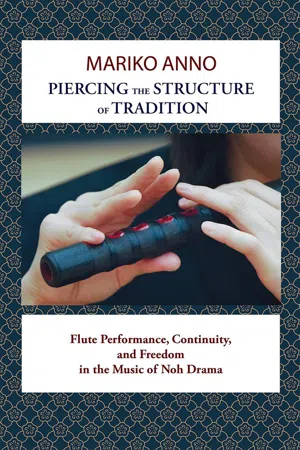
What does freedom sound like in the context of traditional Japanese theater? Where is the space for innovation, and where can this kind of innovation be located in the rigid instrumentation of the Noh drama? In Piercing the Structure of Tradition, Mariko Anno investigates flute performance as a space to explore the relationship between tradition and innovation. This first English-language monograph traces the characteristics of the Noh flute (nohkan), its music, and transmission methods and considers the instrument's potential for development in the modern world. Anno examines the musical structure and nohkan melodic patterns of five traditional Noh plays and assesses the degree to which Iss? School nohkan players maintain to this day the continuity of their musical traditions in three contemporary Noh plays influenced by Yeats. Her ethnographic approach draws on interviews with performers and case studies, as well as her personal reflection as a nohkan performer and disciple under the tutelage of Noh masters. She argues that traditions of musical style and usage remain influential in shaping contemporary Noh composition and performance practice, and the existing freedom within fixed patterns can be understood through a firm foundation in Noh tradition.
eBook - ePub
Piercing the Structure of Tradition
Flute Performance, Continuity, and Freedom in the Music of Noh Drama
- 366 pages
- English
- ePUB (mobile friendly)
- Available on iOS & Android
eBook - ePub
Piercing the Structure of Tradition
Flute Performance, Continuity, and Freedom in the Music of Noh Drama
About this book
Information
Publisher
Cornell East Asia SeriesYear
2020Print ISBN
9781939161970
9781939161079
eBook ISBN
9781501755804
Subtopic
Asian Literary CriticismChapter One
History and Construction of the Nohkan
The nohkan (literally, Noh pipe) 能管, also known as fue (flute) 笛, is a transverse flute made from a type of bamboo known as Pleioblastus simonii. Though traditionally played in the Noh theater, Kabuki, and some shrine festivals, the nohkan can now be seen on concert stages as part of both traditional and nontraditional ensembles. These nontraditional ensembles consist of Eastern and Western groups, including jazz groups and orchestras. Through these experiments and collaborations, this flute has been gaining international attention.
The nohkan is a unique instrument in both construction and sound. The nodo (throat) 喉, a thin bamboo tube placed between the mouth hole and first finger hole, disrupts the instrument’s natural acoustics. Therefore, it is unable to play a diatonic scale as heard in Western music and cannot play an octave.1 Its performance techniques include creating shakuhachi-like white noise by blowing into the mouth hole with excessive and forceful air,2 using percussive breath marks to indicate the beats, and playing melodic lines to color the text of the chanters.
Aside from its distinct, shrill sound and scales that include micro-tones and quarter tones, in its outward appearance the instrument has retained its original design: a large mouth hole and seven finger holes. In comparison, the modern flute started off in the fourteenth century as a simple, one-piece wooden tube closed at one end, with a blow hole and six finger holes, but its outward appearance changed with the addition of keys and new structural materials. In the eleventh century, the transverse flute made it to Europe by way of the Byzantine culture and was later used as a military instrument in the fourteenth century, along with drums and trumpets (Randel 2003, 320).
Today’s flute differs significantly from its original iteration. German watchmaker-flutist Theobald Boehm (1794–1881) worked in the nineteenth century to improve the flute’s design, which at that time featured no standard size and came in various tube lengths; the only restriction in terms of hole dimensions and placement was that the fingers must be able to reach and cover the holes. Similarly, the theater in which the flute was played differed (i.e., Noh drama versus Western opera), as did the subject matter of the play. This is in marked contrast to the nohkan in the types of music performed and its setting in Noh drama.
Many theories surround the history and construction of the nohkan in Japan. Nohkan players, makers, and researchers speculate endlessly about every aspect imaginable regarding this unusual instrument. Most research on the nohkan in Japan has focused on the origins of the instrument, using written records and iconography (i.e., paintings) from different eras that feature the nohkan to determine the context in which the instrument was played or how it was constructed during that period. Other research centers around the kaeshi (bamboo reversal) カエ シ method of construction (discussed later in this chapter), although this is not a typical method of nohkan construction. One of the few articles about the nohkan in English, written by Donald Berger in 1965, considers only the kaeshi method and neglects more frequently employed techniques. To remedy this paucity of information in English, I interviewed two nohkan makers and other nohkan specialists about the internal and external structure of the instrument.
The Nohkan in the Noh Ensemble
As stated in the introduction and outlined by Malm (2000, 134), the nohkan performs three roles in Noh: (1) it marks segments within a Noh; (2) it creates the onstage ambience by coloring the chant’s musical line with its melody or adds tone color or percussive qualities to music played by the ensemble; and (3) it plays the melody for dance music and instrumental music. These roles seem to have been in place since Zeami’s time, according to Takakuwa (2003). As is detailed in chapter 3, the nohkan plays specific patterns in certain shōdan (backbone[s] of Noh plays). For example, in an [Ageuta] shōdan, the nohkan plays the three patterns of Takane (literally, high sound/pitch) 高音, right after the first line of the utai (chant) is sung by the chorus, and before it is repeated; Naka no Takane (literally, medium-high sound/pitch) 中ノ高 音, for the second half of the utai; and Roku no Ge 六ノ下 or Kote 小手, near the end (Takakuwa 2003, 10; Yokomichi and Gamō 1978, 54). Yokomichi (1986, 109) further maintains that these melodic patterns should also follow the utai, which supports Malm’s second role for the nohkan. The nohkan should play the yuri (wavering) ユリ pattern when the utai sings hon-yuri (real wavering pattern) 本ユリ; when the utai sings at a high pitch, the nohkan should play Takane; when the utai moves from chū-on (middle pitch) to jō-on (high pitch) in the middle of the utai, the nohkan should play Naka no Takane. According to Yokomichi, the nohkan had these “standards” mentioned above, and it is thought that there were certain sections where the nohkan played in parallel with the utai (1986, 109). Takakuwa further supports this notion by explaining that not many nohkan players play in parallel with the utai; instead, they think about playing the prescribed melodic patterns that, in a way, are appropriate for the text (shishō) 詞章 of the chant (2003, 10).
Takakuwa cites Zeami’s Shūdōsho (Learning the way) 習道書,3 written in 1430, to demonstrate that the nohkan player played in between passages of text and during the utai (2003, 10). The Japanese version of Shūdōsho on how the nohkan (or flute) player should understand and assume his responsibilities4 and the story of how the nohkan master Meishō 名生 performed in a Noh can be found in Nose’s Zeami jūrokubushū hyōshaku, Ge (Annotated collection of Zeami’s sixteen treatises, volume 2; 1960, 262–272) 世阿弥十六部集評釋. However, the present book consults the English translation of the Shūdōsho by Rimer and Yamazaki (1984, 167–170), which states in the section “Various Matters Pertaining to the Flute Players”:
[The flute players] assume the extremely important task of establishing and maintaining the musical atmosphere of a particular performance, through all the stages of jo, ha, and kyū. Even before the performance by the actors begins, the players must perform quietly for a certain time in order to create for the audience an atmosphere appropriate for the beginning of the play. Then, when the dancing and the chanting commence, the players must align their music to the pitch of the voice of the shite and attempt to add emotional color to his vocal performance. (167)
The above excerpt supports the second function outlined by Malm: the flute player creates and maintains the ambience of the stage and is responsible for adjusting to the shite’s voice by coloring the singer’s melody. Continuing the passage quoted above, Zeami elaborates on vital principles the flute player must abide by:
With regard to this manner, there is one crucial principle to be kept in mind by the flute players. As the flute is the instrument that essentially leads the pitch during a performance, it is reasonable to assume that all the musical effects of the nō should be governed by this instrument. Although this fact is certainly true as far as it goes, in order to make an actual performance successful, still another consideration becomes paramount. The function of the flute as used in performances of nō must indeed be different from that when the instrument is played in a purely musical performance. This is because, in a performance of nō, the pitch of the chanter’s voice rises and falls slightly of its own accord from the level of pitch assigned. (Rimer and Yamazaki 1984, 167)
Here, the flute player must play differently in the dances or sections played by the instruments, which supports Malm’s third role of the nohkan. Furthermore, I argue that “all the musical effects of the nō” could include the section markers indicated in Malm’s first role of the nohkan. Because it is the sole melodic instrument in the ensemble, the nohkan is able to control certain musical functions within the ensemble; but in a musical ensemble it is the taiko (or the ōtsuzumi when the taiko is not present) that leads the ensemble (discussed further in chapter 3).
The latter part of the excerpt describes how the flute player adjusts according to the chanter’s pitches. An example of someone who was able to perform in this manner was the great nohkan player Meishō, whose skills the lay monk Sasaki Dōyo 佐々木道誉 praised: “It is not in itself a good thing to extend the length of a nō performance, but when I hear Meishō play, I lose all sense of time” (Rimer and Yamazaki 1984, 168). The story of Meishō takes place when he performs with the Yamato troupe, in which the father Kan’ami was performing the piece “Shōshō no Noh” (Noh of Major General) 少将の能 with his young son Zeami. The particular section noted in Shūdōsho occurs during the shōdan [Rongi], when the two are in dialogue with overlapping phrases (Takakuwa 2003, 10–11).
On one occasion, at a performance for a religious festival, during the time when a rongi section was being sung by the chief actor in the troupe and a child performer, the pitch of the music had been set in the rankei mode.5 However, as the child actor’s voice was not fully settled, his chant rose slightly toward the pitch of the banshiki mode. The pitch of the chant of the head of the troupe remained, of course, in the rankei mode. Thus, as their chanted dialogue continued, the pair were no longer in harmony with each other, and the performance began to lose its vigor. Meishō, while playing alone in the proper rankei mode, slowly adjusted himself to the pitch of the child actor and colored his playing in a manner appropriate to the banshiki mode, while still remaining at the pitch of the rankei mode so as to accompany the part of the older player. As a result, no discrepancy was heard in their performances, and the presentation was a success. (Rimer and Yamazaki 1984, 168–169)
This example, which can be found in Zeami’s Shūdōsho, in the section “The Great Flute Player Meishō,” clearly demonstrates how Meishō was able to align the pitch of the flute to the voice of the adult and the child, adding color to the vocal line, as indicated in Shūdōsho.6 Zeami’s Shūdōsho supports Malm’s claim of the three functions of the nohkan. Furthermore, it is evident that the role of the nohkan was most likely the same during Zeami’s time—that is, supporting and coloring the chant—and that the nohkan has most likely been part of the Noh music. Takakuwa states that, from the excerpt above, we can see Zeami referring to to...
Table of contents
- List of Illustrations
- List of Examples
- List of Tables
- Notes on Romanization and Notations
- Acknowledgments
- Introduction
- Chapter One History and Construction of the Nohkan
- Chapter Two The Nohkan and Oral Transmission: Transcription in Western Staff Notation
- Chapter Three The Role and Melodic Patterns of the Nohkan in Relation to Structural Principles
- Chapter Four The Nohkan’s Part in Atsumori as Planned, Prepared, and Performed
- Chapter Five The Continuity of Tradition Today: The Nohkan’s Part in Adaptations of W. B. Yeats’s At the Hawk’s Well
- Reflections and Directions
- Appendix A Teaching and Playing the Nohkan in the United States
- Appendix B Recordings of Issō Yukihiro on the Nohkan
- Appendix C Shōga and Transcription of the 〔Chū no Mai〕Hagakari: Kanze School Length, San-dan (Three Divisions)
- Appendix D Transcriptions of Shōdan from Atsumori
- Appendix E Yubitsuke (Fingerings) for the 〔Shidai〕 and the 〔Issei〕
- Appendix F Text for Yokomichi’s Taka no Izumi (1949)
- Appendix G Text for Yokomichi’s Taka no Izumi, Shu-gakari (2004)
- Appendix H Text for Yokomichi’s Takahime (1998)
- Appendix I Contemporary Noh Play Performances and Their Casts, by Location and Date
- Appendix J Kanze School Utaibon for Atsumori
- Appendix K Nohkan Pitches Used for Theoretical Transcriptions
- Glossary
- Bibliography
- Index
Trusted by 375,005 students
Access to over 1.5 million titles for a fair monthly price.
Study more efficiently using our study tools.
Frequently asked questions
Yes, you can cancel anytime from the Subscription tab in your account settings on the Perlego website. Your subscription will stay active until the end of your current billing period. Learn how to cancel your subscription
No, books cannot be downloaded as external files, such as PDFs, for use outside of Perlego. However, you can download books within the Perlego app for offline reading on mobile or tablet. Learn how to download books offline
Perlego offers two plans: Essential and Complete
- Essential is ideal for learners and professionals who enjoy exploring a wide range of subjects. Access the Essential Library with 800,000+ trusted titles and best-sellers across business, personal growth, and the humanities. Includes unlimited reading time and Standard Read Aloud voice.
- Complete: Perfect for advanced learners and researchers needing full, unrestricted access. Unlock 1.5M+ books across hundreds of subjects, including academic and specialized titles. The Complete Plan also includes advanced features like Premium Read Aloud and Research Assistant.
We are an online textbook subscription service, where you can get access to an entire online library for less than the price of a single book per month. With over 1.5 million books across 990+ topics, we’ve got you covered! Learn about our mission
Look out for the read-aloud symbol on your next book to see if you can listen to it. The read-aloud tool reads text aloud for you, highlighting the text as it is being read. You can pause it, speed it up and slow it down. Learn more about Read Aloud
Yes! You can use the Perlego app on both iOS and Android devices to read anytime, anywhere — even offline. Perfect for commutes or when you’re on the go.
Please note we cannot support devices running on iOS 13 and Android 7 or earlier. Learn more about using the app
Please note we cannot support devices running on iOS 13 and Android 7 or earlier. Learn more about using the app
Yes, you can access Piercing the Structure of Tradition by Mariko Anno in PDF and/or ePUB format, as well as other popular books in Media & Performing Arts & Asian Literary Criticism. We have over 1.5 million books available in our catalogue for you to explore.