Postharvest is an important element of getting fresh, high-quality fruit to the consumer and technological advances continue to outpace infrastructure. This book provides valuable, up-to-date information on postharvest handling of seven fruit and nut crops: almond, fig, peach, persimmon, pistachio, pomegranate and table grape. These crops are of particular importance in the Mediterranean region, but also to those countries that export and import these crops, where intensive economic resources are dedicated to developing information to understand and solve their postharvest problems.Written by a team of internationally-recognized postharvest experts, this manual collates and verifies essential, but often difficult to access, information on these important crops, that is pertinent to the world's agricultural economy and affects agricultural communities. The book: Covers relevant postharvest topics for each crop across harvesting, packing, shipping and retail postharvest phases.Has an emphasis on knowledge useful to solve current worldwide industry problems.Includes practical recommendations.Makes available for the first time in English information previously published in other languages.Includes up-to-date references and high-quality photos that make it an excellent resource for postharvest educators and students.This is a must-have manual for growers and commodity handlers, cold storage managers, transportation personnel, produce managers and retail handlers, researchers, or anyone in the food chain that packs, transports, stores and sells these fruits and nuts.
eBook - ePub
Manual on Postharvest Handling of Mediterranean Tree Fruits and Nuts
- 160 pages
- English
- ePUB (mobile friendly)
- Available on iOS & Android
eBook - ePub
Manual on Postharvest Handling of Mediterranean Tree Fruits and Nuts
About this book
Information
Topic
Sciences biologiquesSubtopic
Horticulture1 Almond
1University of California, Davis, California, USA
2Almond Board of California, Modesto, California, USA
3UC Cooperative Extension Butte County, Oroville, California, USA
*Corresponding author: [email protected]
Scientific Name, Origin and Current Areas of Production
Almonds belong to the genus Prunus, which includes all stone fruits, and belongs to the Rosaceae family. While other Prunus species, like peach or cherry, are grown for their fruits’ juicy flesh or mesocarp, almond is grown for its seeds and it is classified as a nut. The cultivated sweet almond is Prunus dulcis (Mill.) D.A. Webb, but the genus also includes many wild species. Although similar, Prunus amygdalus is a bitter almond. The cultivated almond tree grown today originated from wild species in the deserts and foothills of Central and South-west Asia. By selecting and cultivating the sweet kernel specimens, their use was widespread in the ancient world perhaps as early as 4000 BC. Almonds have been cultivated for over 4000 years and starting about 450 BC were cultivated around the Mediterranean coastline from Turkey to Tunisia. Almonds were first introduced to California with the founding of the Spanish California missions in the late 1700s, but the large commercial industry was built with local seedling selections from varieties brought to California from the Languedoc area of southern France in the 1850s (Kester and Ross, 1996). The mild wet winters and hot dry summers of California’s Mediterranean climate provided an environment in which almond trees could thrive in the Central Valley. California is the only US state that produces almonds commercially, producing the signature paper-shell variety ‘Nonpareil’, along with other soft-shell California types and a few hard-shell selections (Fig. 1.1). The soft-shell varieties are the basis of the California industry. Production under irrigated conditions in California accounts for 80% of the world crop.
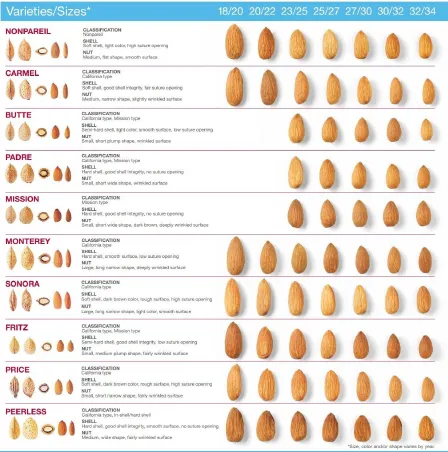
Fig. 1.1. Almond Cultivars. Figure courtesy of Dr. Sebastian Saa, Almond Board of California, Modesto, California, USA.
Fruit Physiological Characteristics
The almond fruit is a drupe characterized by an outer fibrous layer or hull equivalent to the flesh of the stone fruits. The almond’s hairy epidermis, or exocarp, the hull, is made of the pericarp and the mesocarp, and the shell or endocarp all derived from the ovary wall. The shell contains the seed or kernel, which is the primary commercial part of the fruit. Within the ovary, the ovules are enclosed by two layers called integuments, which eventually form the seedcoat, also called skin or pellicle. The ovule becomes the seed or kernel containing the embryo resulting from fertilization that will grow into the edible part of the future nut. Harvesting is usually carried out once the hull on all nuts is beginning to dehisce and the shell is exposed. The leathery hull is a by-product used mainly as feed for dairy cattle. The usual fruit weight in almond cultivars ranges from 8 g to 20 g. The expanded base of the flower or ovary will develop into the entire fruit. The shell ranges from very soft paper shells to very hard stony shells, and their morphology is variable between cultivars. The preference for each shell type depends on the growing conditions and the prevalent industry in the region. As for the fruit, the kernel or seed weight varies between cultivars, from 0.5 g to 1.5 g. The general trend in the industry is the preference for large kernels to improve yield and facilitate and cheapen the process of cracking and blanching. Almond flowers have a single carpel with two ovules, as in other stone fruits. The secondary ovule often degenerates, and a single kernel is produced. If the two ovules reach full development and are fertilized, double kernels are produced. The presence of double kernels is a cultivar trait. The edible kernel (primarily two cotyledons whose cells are filled with oil bodies and a small embryo) is surrounded by a shell and hull tissue. Almonds are relatively high in oil: 36–60% of kernel dry mass. Most of the fatty acids in almond oil are unsaturated, with the ratio of monounsaturated to polyunsaturated ranging from 2:1 to almost 5:1.
Ethylene production and sensitivity
Almonds produce very little ethylene and there are no documented responses to ethylene that might directly affect kernel quality (Kader, 1996).
Respiration rates
The low water content and/or water activity of properly stored kernels makes them relatively inert metabolically (King et al., 1983; King and Schade, 1986). Respiratory rates are very low.
Chilling sensitivity
Almonds are not sensitive to chilling during storage.
Quality Characteristics and Criteria
Currently over 85% of the California almond crop is sold as shelled products but developing export markets include substantial interest in in-shell product. Recently, there were over 300 million pounds of in-shell almonds shipped to India and China. In-shell almonds should have shells that are uniform, with a bright color, and be free of adhering hull material, debris, signs of insect damage or decay. The shell should be intact and free of damage caused by the hulling operation, insects, or fungi. Kernels should be fully formed rather than shriveled and larger sizes are preferred. The “skin” of the kernel (pellicle) should be unbroken (free of damage caused during shelling or by insects or pathogens) and of uniform light brown color. Double, split, or broken kernels are negative factors. A complete description of US Federal quality standards can be found at https://www.ams.usda.gov/grades-standards/almonds-shell-grades-and-standards (USDA Marketing Service, 2019). Almond flavor should display a combination of sweet and oily aroma and absence of stale or rancid flavors. Optimal kernel texture is from crisp to chewy. Kernels should have <5–6% moisture, but kernels with <4.0% moisture tend to be brittle and hard. Almonds are one of the highest dietary sources of vitamin E, magnesium, and manganese; as well as an important plant-based source of vital minerals like calcium and potassium. Among nuts, almonds are a good source of fiber, protein, copper, phosphorous, riboflavin, and niacin (USDA Agricultural Research Service, 2019; https://fdc.nal.usda.gov/fdc-app.html#/food-details/170567/nutrients). Almonds contain 40–60% fats by weight and less than 10% is water (Sathe et al., 2008). The two most abundant unsaturated fatty acids are oleic acid (18:1, 62–80%) and linoleic acid (18:2, 10–18%) in addition to a high concentration of “good” phenolics and tocopherols (~24 mg g-1).
Sensory attributes (texture, taste, and aroma) and chemical characteristics (fats, antioxidants, and sugars) have been described for in-shell, raw, roasted, and blanched nuts for a large group of almond genotypes at harvest and storage (Franklin et al., 2017, 2018; Franklin and Mitchell, 2019). The sensory profile including 16 attributes was measured by a trained panel as a sensory baseline to quantify sensory changes triggered by postharvest handling, drying, roasting, storage conditions, and other treatments. Most flavor attributes either increased or decreased with time; intensity of Clean Nutty aroma and Clean Nutty flavor associated with fresh almond (correlation value with respect to time (rT): −0.89 and −0.95, respectively) and Clean Roasted aroma and flavor (rT: −0.71 and −0.80, respectively) decreased with storage in both light roasted and dark roasted almonds (Franklin et al., 2018). Sensory attributes related to oxidative rancidity such as Cardboard/Painty/Solvent, Soapy, and total oxidized increased in intensity over time (Franklin et al., 2018), thus, total oxidized aroma and total oxidized flavor (rT: 0.91 and 0.95, respectively), as well as the oxidation-specific flavor attributes Cardboard (rT 0.86), Painty/Solvent (rT 0.96), and Soapy (rT 0.98). The mouthfeel attributes Pungent/Irritation/Burning (rT 0.94) and Astringent (rT 0.36) also increased over time, to a lesser extent. At the same time, consumer liking (acceptance, hedonic analysis) was determined using a large group of untrained consumers, thus, changes in consumer acceptance was related to specific chemical and sensory measurements allowing the creation of some market life prediction models (Cheely et al., 2018). A number of volatile predictors of consumer liking were identified, including 2,5-dimethylpyrazine and 2- and 3-methylbutanal, which were predictors of the desired “Clean Nutty” and “Clean Roasted” attributes. Additionally, a number of volatiles correlated with rancid flavor attributes were identified, which may be used to predict rancidity in roasted almonds (Franklin et al., 2018). Among them, hexanal, the most important predictor of total oxidized aroma, and heptanal and octanal were better predictors of average consumer liking and may be more reliable indicators of consumer perception of rancidity in roasted almonds.
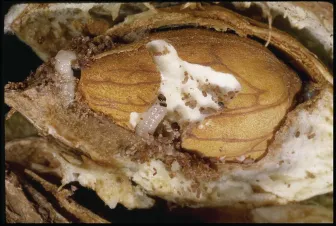
Fig. 1.2. Navel orangeworm (NOW) kernel damage. Photo courtesy of Dr. Carlos H. Crisosto.
Horticultural Maturity Indices
A primary incentive for rapid harvest of soft-shelled cultivars in California is to avoid costly navel orangeworm (NOW, Amyelois transitella) damage to almond kernels (Fig. 1.2). Beginning with a timely ‘Nonpareil’ harvest helps avoid early fall rains that delay harvest and decrease quality by increasing both worm damage and mold. The percentage of hull split correlates with nut removal by shaking, providing a field guide to acceptable maturity. The dry weight and drying rate of almond kernels during harvest have been characterized. When nuts on the tree reach 100% hull split, stick-tight hulls are minimized and nut removal by shaking is maximized. Keeping these parameters in mind, harvest operations are timed to optimize kernel quality. Almond maturation can be monitored externally by evaluating the extent of hull dehiscence. When the two halves of the hull are fully open to expose the shell, hulls readily separate and moisture content is low enough that nuts can be picked up from the orchard floor in a few days. Yield is maximized because the kernel’s dry weight is no longer increasing, and almond removal from the tree is close to 100%. Almond maturation on a given tree is not uniform; development tends to be most rapid on the south and south-western faces high in the tree canopy and slower in the lower interior. The California industry favors a timely (early) ‘Nonpareil’ harvest that helps avoid NOW egg-laying in split hulls. Thus, harvest is matched to the time when the last almond on the lower interior of a tree has begun to split. Nut removal is near maximum, as is kernel dry weight. Nuts harvested very early are greener, are not open to the shell in the lower interior tree canopy and will produce more sticktights (hulls shriveled around the in-shell nut). Since they are greener and have a higher water content these almonds must dry longer on the orchard floor for 1–2 weeks before being picked up and hulled (Connell et al., 1989, 1996).
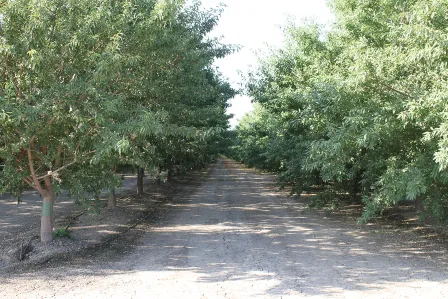
Fig. 1.3. General view of an almond orchard prepared for shaking. Photo courtesy of Dr. Carlos H. Crisosto.
Harvesting (Shaking and Picking) and Handling
Orchard floor preparation for harvesting
Almond harvest typically begins in early to mid-August and continues until late September for roughly 6–8 weeks depending on cultivars. Very few California almond orchards are cultivated. Those located in the Central Valley from Bakersfield to Chico are on flat land that facilitates irrigation and mechanical harvesting operations. Typically, preemergent strip weed control is used down the tree rows to control winter annual weeds. Orchard middles are mowed in the spring and sprays of approved translocated herbicides are used to control summer annual weeds followed by a final mowing. The orchard floor is smooth, firm, and free of weeds as harvest approaches (Fig. 1.3). All California almond orchards are irrigated: some with sprinklers, most with microsprinklers or drip irrigation, and a few are still flood irrigated. With sprinklers or flooding, a final irrigation before harvest is used to fully recharge the soil profile. This enables the orchard to go through a long, dry harvest period with minimum water stress (Connell et al., 1996; Reil et al., 1996). Usually, the last preharvest irrigation is timed around 1–2 weeks prior to the onset of mechanical shaking to remove in-hull almonds from the trees. The incidence of sticktights can increase when severe deficit irrigation is applied in between hull split and harvest. Thus, to reduce severe tree stress utilizing regulated deficit irrigation, tree stress levels should be kept less than −0.15 MPa with microsprinkler or drip irrigation. This is accomplished with additional irrigation close to the time o...
Table of contents
- Cover
- Half-title Page
- Title Page
- Copyright
- Contents
- Contributors
- Preface
- Acknowledgments
- Dedication
- Conversion Tables
- 1 Almond
- 2 Fresh Fig
- 3 Peach and Nectarine
- 4 Persimmon
- 5 Pistachio
- 6 Pomegranate
- 7 Table Grape
- Appendix: Storage Requirements and Benefits of Postharvest Treatment for Mediterranean Tree Fruit
- Index
- Backcover
Trusted by 375,005 students
Access to over 1.5 million titles for a fair monthly price.
Study more efficiently using our study tools.
Frequently asked questions
Yes, you can cancel anytime from the Subscription tab in your account settings on the Perlego website. Your subscription will stay active until the end of your current billing period. Learn how to cancel your subscription
No, books cannot be downloaded as external files, such as PDFs, for use outside of Perlego. However, you can download books within the Perlego app for offline reading on mobile or tablet. Learn how to download books offline
Perlego offers two plans: Essential and Complete
- Essential is ideal for learners and professionals who enjoy exploring a wide range of subjects. Access the Essential Library with 800,000+ trusted titles and best-sellers across business, personal growth, and the humanities. Includes unlimited reading time and Standard Read Aloud voice.
- Complete: Perfect for advanced learners and researchers needing full, unrestricted access. Unlock 1.5M+ books across hundreds of subjects, including academic and specialized titles. The Complete Plan also includes advanced features like Premium Read Aloud and Research Assistant.
We are an online textbook subscription service, where you can get access to an entire online library for less than the price of a single book per month. With over 1.5 million books across 990+ topics, we’ve got you covered! Learn about our mission
Look out for the read-aloud symbol on your next book to see if you can listen to it. The read-aloud tool reads text aloud for you, highlighting the text as it is being read. You can pause it, speed it up and slow it down. Learn more about Read Aloud
Yes! You can use the Perlego app on both iOS and Android devices to read anytime, anywhere — even offline. Perfect for commutes or when you’re on the go.
Please note we cannot support devices running on iOS 13 and Android 7 or earlier. Learn more about using the app
Please note we cannot support devices running on iOS 13 and Android 7 or earlier. Learn more about using the app
Yes, you can access Manual on Postharvest Handling of Mediterranean Tree Fruits and Nuts by Carlos Crisosto, Gayle M Crisosto, Carlos H Crisosto,Gayle M Crisosto in PDF and/or ePUB format, as well as other popular books in Sciences biologiques & Horticulture. We have over 1.5 million books available in our catalogue for you to explore.