From the twelfth century onwards the legends of King Arthur and his knights, including the Tristan legend, spread across Europe, producing a vast range of adaptations and new stories. German and Dutch literature were of central importance in this expansion of Arthurian material from the 12th to 16th century. This title deals with this topic.
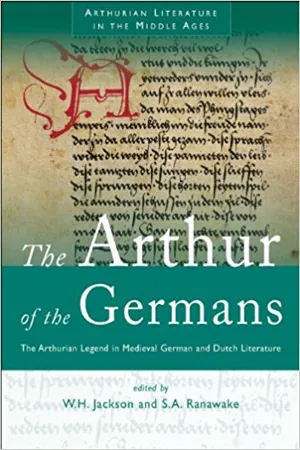
- 337 pages
- English
- ePUB (mobile friendly)
- Available on iOS & Android
eBook - ePub
About this book
Trusted by 375,005 students
Access to over 1.5 million titles for a fair monthly price.
Study more efficiently using our study tools.
Information
Part One
Reception and Appropriation: The German Verse Romances, Twelfth Century to 1300
1
THE WESTERN BACKGROUND
THE WESTERN BACKGROUND
Ingrid Kasten
Stories about the legendary King Arthur circulated not only in the British Isles but also in many parts of continental Europe in the Middle Ages. In Germany, as in other areas, these stories enjoyed great popularity, for they provided high-class entertainment and also acted as a framework for the presentation and discussion of new patterns of chivalric and courtly behaviour. The Arthurian material acquired its own history in Germany, but it also has a prehistory that is important both in its own right and for an understanding of the German developments. The stories of Arthur and his knights were transmitted northwards and eastwards through French or Anglo-Norman mediation. The great German Arthurian romances of Hartmann von Aue and Wolfram von Eschenbach arose as free adaptations of the works of the French poet Chrétien de Troyes, who himself had drawn on various written and oral sources. The aim of this opening chapter is to sketch the early history of the Arthurian legend, which preceded its reception in German literature.
Geoffrey of Monmouth and the Earliest References to Arthur
Although the figure of King Arthur was not, strictly speaking, invented by the British cleric Geoffrey of Monmouth, Geoffrey is none the less generally credited with having created the Arthurian myth and raised Arthur to the status of national hero among the Britons in his Historia Regum Britanniae, a legendary history of the kings of Britain probably completed at the end of 1138.
Earlier historians knew of only one Arthur, a military leader said to have distinguished himself in the fighting between the Britons and Saxons in the early sixth century: as dux bellorum, he first figures in Nennius’ early ninth-century Historia Brittonum. Nennius claims that this Arthur carried on his shoulders the image of the Virgin Mary in one of the twelve battles that he fought against the Saxons and that in his last battle alone, on the Mons Badonicus, he killed no fewer than 960 men in a single day. By contrast, Arthur is not mentioned either by Gildas, a contemporary chronicler of the Saxon wars, whose De excidio et conquestu Britanniae (c. 545) contains an account of the same battle, or by Bede in his Historia ecclesiastica gentis Anglorum (c. 730). One piece of evidence that does, however, appear to confirm Arthur’s early legendary fame is the Welsh elegy Gododdin ascribed to a bard by the name of Aneirin and believed to date from the late sixth century. (It survives only in a later linguistic form.) Here a hero’s valour is praised, ‘though he was not Arthur’.
It is clear from Nennius’ Historia Brittonum and the Mirabilia appended to that work that by the early ninth century a nexus of legends had already grown up around the figure of Arthur. Evidence of the increasing number of legends on the subject, which taken together paint an ambivalent picture of the king, is afforded not only by the anonymous Annales Cambriae of the second half of the tenth century but also by various saints’ lives dating from the years between 1070 and 1120. Following on from Nennius, the Annales Cambriae report that in the Battle of Badon in 516 Arthur carried Christ’s Cross on his shoulders for three days and three nights and that the Britons were finally victorious. Whereas Arthur appears here as a hero fired by religious zeal, he figures in the lives of the saints (texts in Faral 1929, I, 237–44 and Chambers 1927, 241–7; 262–4) as an overweening tyrant. In the Vita Cadoci (c. 1090) by Lifris of Llancarfan he is tempted to assault a young woman, and in the Vita Sancti Gildae (c. 1120/30) by Caradoc of Llancarfan, he is described as rex rebellis et tyrannus, a negative counterpart to the saintly Gildas. It is the Vita Sancti Gildae, finally, that first proposes a link between the Arthurian tradition and an older abduction myth, a link that was to have considerable repercussions for the later history of the legend: here St Gildas helps Arthur to win back his wife Guennuvar following her abduction by a foreign king (Chambers 1927, 263).
Even before embarking on his Historia Regum Britanniae, Geoffrey had already completed a Vita Merlini, telling of the life of the legendary magician Merlin (1135), and it is clear that in his later work he drew not only on the few written sources that were available to him but also on oral Celtic narrative tradition, a tradition which, precisely because of its oral nature, is virtually impossible to reconstruct with any degree of certainty. In its basic outline, his Historia is clearly influenced by traditional models of medieval soteriological historiography, and the suggestion that Geoffrey was not only influenced by Virgil’s Aeneid but that, in creating the figure of King Arthur, he sought to give the Britons a ruler who, like Charlemagne, would help to create a sense of national identity is entirely plausible, given the newly awakened interest in classical subjects in the twelfth century and the literary significance of the Continental legends surrounding the figure of Charlemagne.
Geoffrey took up the idea of the translatio imperii and combined it with the legend of Trojan ancestry, retelling the story of the Britons from the mythical foundation of their kingdom by Aeneas’ great-grandson, Brutus, to its downfall as the result of moral decline and, finally, to the rise of the Saxons. It is against this background that Arthur’s role must be seen. The victorious king is bold enough to challenge even the hegemony of the Roman empire, and he would have succeeded in achieving his aim of world dominion if he had not been prevented by treachery from within his own ranks in the person of his nephew, Mordred. His failure notwithstanding, Arthur appears not only as the representative of a glorious British past but as the embodiment of hope for the present.
It is the political aspect of the story which, in keeping with the work’s historiographic structure, is emphasized in the form of a series of power struggles, endless battles and intrigues among rival clans and tribes. There are, however, a number of fantastical episodes that depart from this pattern. One such episode is the account of Arthur’s conception, which results from an act of adultery arranged by the magician Merlin (the Amphitryon motif). Another is Arthur’s battle with a rapist giant on the Mont-Saint-Michel. Finally, there is the scene in which the king is spirited away to the faery isle of Avalon following his fatal wounding at the hands of the adulterous usurper Mordred. Thematically speaking, the work comes full circle, with Arthur’s birth and death both taking place against a background of adultery. In this way, two ideas that were to be of major importance in the later Arthurian tradition are already prefigured in Geoffrey’s Historia, namely, the image of Arthur as a courtly figure and the disintegration of his kingdom as the result of treachery and adultery.
It is clear from his various dedications to highly placed political figures at the English court that, in writing his Historia Regum Britanniae, Geoffrey was anxious to ingratiate himself with the Anglo-Norman rulers and, at the same time, to predispose them in favour of the Britons by depicting the latter as heirs to a glorious historical tradition reaching back to classical antiquity. Although contemporary scholars such as Giraldus Cambrensis were disinclined to regard Geoffrey’s historical distortions as serious historiography, it is evident from the Historia’s huge success (more than 200 manuscripts have survived) that it satisfied a sudden upsurge of interest in the mythical and aesthetic elaboration of history on the part of cultivated audiences.
Arthur in Vernacular Poetry: Wace and the Breton Lais
In the course of the twelfth century, the English court for which Geoffrey wrote his Historia developed into an important centre of political power and at the same time became a focus of the new courtly literature (Bezzola 1944–63, part III). It was here that the matière de Bretagne first found written expression. Geoffrey had already mediated between oral and written poetic traditions, but his Historia, written in Latin prose, inevitably reached only the litterati. However, the courtly society that was emerging at this time comprised not only clerics versed in Latin, but also the illiterate secular aristocracy, whose claims to cultural standing and a stake in literary discourse could be satisfied only by means of the vernacular. It was to the Jersey-born cleric Wace (c. 1110–after 1170) that this mediating role now fell: completed around 1155, his Roman de Brut is an Anglo-Norman reworking in verse of Geoffrey’s Historia and marks the decisive transition of the Arthurian tradition from Latin to the vernacular. Wace was for a long time connected to the English court and is known to have been active there as a clerc lisant (i.e. reader) between 1135 and 1170; between 1165 and 1169 he held a benefice at Bayeux, which he received from Henry II. His Roman de Brut was, in turn, the principal source of a rambling retelling of the material (c. 1200) by the English priest Layamon, according to whom Wace’s account was dedicated to Henry’s wife, Eleanor of Aquitaine, one of the leading patrons of courtly literature in the twelfth century.
Wace follows the basic outlines of his source, but stresses Arthur’s courtly characteristics, not only emphasizing the king’s open-handedness, his readiness to show pity, his courtly manners and his eloquence but also expatiating on the lengthy period of peace under Arthur and, in general, treating him as the paragon of a ‘good king’. Wace is also the first writer to describe the legendary Round Table (‘la Roünde Table’, v. 9751), which Arthur is said to have set up in order to prevent his knights from arguing over where they should sit. The Round Table thus figures as a symbol of equality, the prototype of an exclusive, feudal male society (though this symbol of equality was not fully realized in later romances, and did not completely eliminate hierarchical attitudes in the portrayal of Arthur’s court, see Schmolke-Hasselmann 1998, 59f.). And it is Wace, too, who is the first to mention the Britons’ belief that Arthur will one day return from Avalon (vv. 13275ff.).
Wace’s Roman de Brut marks the first stage in the great success story of the matière de Bretagne in the vernacular literatures of Europe. At about the same time as Wace’s work a number of lais arose, also in the environs of the English court. These lais were not written with any historiographical aim, but concentrate on individual episodes. Here the king of the Britons appears as a somewhat problematical or at least ambivalent figure. The earliest evidence of this tradition is the Anglo-Norman Lai du Cor by Robert Biket (or Bicket), which dates from the second third or third quarter of the twelfth century. Central to the narrative is a fantastical motif that takes the form of an ivory drinking horn hung with tiny bells. Given to Arthur as a present, it produces a whole series of unexpected consequences when used as a test of chastity. (This motif was to be taken up in a number of later Arthurian texts, including the First Continuation of Perceval and the Prose Tristan, with variants in Le manteau mautaillié and in Heinrich von dem Türlin’s Diu Crône.) Even the queen fails the test, and only a single knight succeeds in drinking from the horn without spilling any of its contents. Arthur is so enraged that he first thinks of killing the queen, but he finally regains his regal composure.
The figure of Arthur is also seen as problematical in Marie de France’s Lai de Lanval. Here, too, we find the motif of adultery, but on this occasion it is set in the new context of a faery background, thereby acquiring a new perspective. In this way, the theme of love acquires independent importance for the first time in the written Arthurian tradition. A Whitsun festival offers Arthur an opportunity to lavish lands and womenfolk on his knights. But one of them – a king’s son, Lanval – is undeservedly passed over. Saddened, he wanders away from the court and finds himself in a faery realm. Here a woman showers love and wealth on him, but on condition that he says nothing about their relationship. He returns to Arthur’s court, where the queen tries to seduce him. In an attempt to resist her, he reveals his secret and loses his lover. The queen for her part falsely accuses him of making improper advances, and he is haled before his judges. At the very last moment, his faery mistress appears and attests to his innocence. Lanval thereupon returns with her forever to the realm from which she has come – to Avalon.
In this work Arthur’s court presents a picture of troubled order: the king fails to distribute his gifts fairly, while the queen is anything but a faithful wife. The hero, too, is either unwilling or unable to assert himself, with the result that he sees his only solution in flight into an ‘other world’ the world of faery. The world of Arthur and the faery world are thus shown to be irreconcilable opposites.
Chrétien de Troyes and his Continuators
It is, however, Chrétien de Troyes who is undoubtedly the most important writer to have reshaped the Arthurian legends and introduced them to the Continent. We know little about the circumstances of his life. He clearly had a clerical training; and commentators are generally agreed that he was active as a writer between 1160 and 1191. It was during this period that he produced his five great Arthurian romances (not all of which were completed): Erec et Enide, Cligès, Yvain ou Le Chevalier au lion, Lancelot ou Le Chevalier de la charrette and Perceval ou Le Conte du Graal. It remains unclear whether Chrétien had any links with the English court and, if so, what form they may have taken. Lancelot, he states, was written at the behest of Marie of Champagne, the daughter of Eleanor of Aquitaine; and he was closely associated with Philip of Alsace, Count of Flanders, while he was working on Perceval.
Chrétien was surely familiar with Geoffrey’s Historia and Wace’s Roman de Brut, as well as with vernacular reworkings of classical themes. And it would appear from his polemical outburst at the ineptitude of professional storytellers (Erec et Enide vv. 20–26) that he also used other, oral sources: presumably he is alluding here to multilingual bards who, as representatives of the old oral poetic tradition, were spreading their tales about Arthur on the Continent. At all events, there are many parallels of motifs and other links between Chrétien’s romances and the Celtic tradition. Here, particular significance may be attached to the names that Chrétien uses (especially in Erec et Enide) and that can be traced back to Celtic origin.
The question of the relationship between Chrétien’s romances and the Mabinogion is a further bone of scholarly contention. The Celtic Mabinogion poems likewise tell of Erec ( = Gereint), Yvain ( = Owein) and Perceval ( = Peredur) but survive, essentially, in only two late manuscripts, the late thirteenth-century White Book of Rhydderch and The Red Book of Hergest of c. 1400. In recent years a scholarly consensus seems to have emerged to the effect that Gereint, Owein and Peredur do not derive from original Welsh tradition but that, in comparison to Chrétien’s versions, they must be regarded as secondary, owing their existence to the oral reception of the French romances and to cross-fertilization with autochthonous traditions. It has nevertheless been suggested that the Mabinogion stories ultimately derive, at least on the level of motif, from early Celtic or early European religion (Birkhan 1989).
Chrétien consciously distances himself from the narrative stance of the historiographer, while at the same time going well beyond the episodic structure of the lais. Battles and political power struggles are no longer central to his romances; Arthur no longer features as a great warrior and, although he still functions as a ‘good king’, there is now an ironic element to that portrayal; and he has ceased to be the main hero. As in Marie de France’s Lai de Lanval, it is individual knights who now figure as the protagonists. In contrast to the older narrative tradition, with its ‘monologic’ structures (Gaunt 1995), in which social relationships were conceived for the most part as involving only men, women now play a role in the way in which society and masculine identity are conceived, a development that reflects the cultural synthesis of amour and chevalerie already anticipated by the romans d’antiquité. At the same time, the importance of family structures is – at least initially – overshadowed by a chivalric ideal that transcends differences of rank within the nobility and incorporates elements of the Christian code of chivalry that arose in the context of the Crusades. But Chrétien also adopts a critical approach to the new, conceptualized attitude to love both as a form of service, such as we find in the lyric poetry of the trouvères, and as an example of the sort of passion found in the Tristan romances. Although the Tristan legend forms part of the matière de Bretagne it represents a different strand from the Arthurian tradition, and it is above all the Tristan story (perhaps in the version of Thomas) that provides the background for a complex series of often ironic intertextual references in Chrétien’s romances.
In Arthurian romance, as the genre was defined by Chrétien, the hero is torn between knighthood, love and marriage, and is bound to find himself wanting in consequence of his inability to meet the expectations of either society or of a woman, or to satisfy religious norms. As a result, he suffers a crisis, which he then has to overcome. These romances have a courtly setting – generally Arthur’s court – but also involve an ‘other world’, the world of aventure, where all seems alien, dangerous and evil, but it is also an imaginary world where marvels routinely occur. In this complex, Arthur’s court represents a normative model of feudal, courtly society, albeit one that is by no means beyond criticism. The hero achieves his goal not simply by confirming Arthurian norms: rather, there is a changing relationship between the h...
Table of contents
- Cover
- Title Page
- Copyright Page
- Contents
- Preface
- Acknowledgements
- The Contributors
- Abbreviations
- Introduction
- Part One: Reception and Appropriation: The German Verse Romances, Twelfth Century to 1300
- Part Two: Continuity and Change in the Later Middle Ages
- Part Three: The Medieval Dutch Arthurian Material
- Part Four: Other Literary, Pictorial and Social Manifestations of Arthurian Culture
- Part Five: The Legacy
- Notes
- General Bibliography
Frequently asked questions
Yes, you can cancel anytime from the Subscription tab in your account settings on the Perlego website. Your subscription will stay active until the end of your current billing period. Learn how to cancel your subscription
No, books cannot be downloaded as external files, such as PDFs, for use outside of Perlego. However, you can download books within the Perlego app for offline reading on mobile or tablet. Learn how to download books offline
Perlego offers two plans: Essential and Complete
- Essential is ideal for learners and professionals who enjoy exploring a wide range of subjects. Access the Essential Library with 800,000+ trusted titles and best-sellers across business, personal growth, and the humanities. Includes unlimited reading time and Standard Read Aloud voice.
- Complete: Perfect for advanced learners and researchers needing full, unrestricted access. Unlock 1.5M+ books across hundreds of subjects, including academic and specialized titles. The Complete Plan also includes advanced features like Premium Read Aloud and Research Assistant.
We are an online textbook subscription service, where you can get access to an entire online library for less than the price of a single book per month. With over 1.5 million books across 990+ topics, we’ve got you covered! Learn about our mission
Look out for the read-aloud symbol on your next book to see if you can listen to it. The read-aloud tool reads text aloud for you, highlighting the text as it is being read. You can pause it, speed it up and slow it down. Learn more about Read Aloud
Yes! You can use the Perlego app on both iOS and Android devices to read anytime, anywhere — even offline. Perfect for commutes or when you’re on the go.
Please note we cannot support devices running on iOS 13 and Android 7 or earlier. Learn more about using the app
Please note we cannot support devices running on iOS 13 and Android 7 or earlier. Learn more about using the app
Yes, you can access The Arthur of the Germans by in PDF and/or ePUB format, as well as other popular books in Literature & Medieval & Early Modern Literary Criticism. We have over 1.5 million books available in our catalogue for you to explore.