eBook - ePub
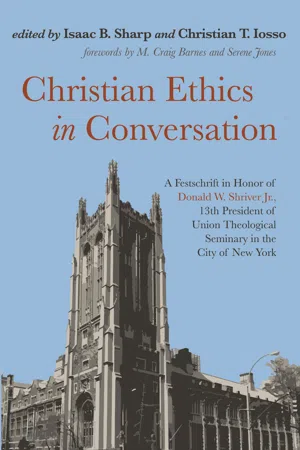
Christian Ethics in Conversation
A Festschrift in Honor of Donald W. Shriver Jr., 13th President of Union Theological Seminary in the City of New York
- 258 pages
- English
- ePUB (mobile friendly)
- Available on iOS & Android
eBook - ePub
Christian Ethics in Conversation
A Festschrift in Honor of Donald W. Shriver Jr., 13th President of Union Theological Seminary in the City of New York
About this book
Inspired by Donald W. Shriver Jr.'s leadership of Union Theological Seminary (New York City), Christian Ethics in Conversation brings together essays by members of a stellar faculty--including Gary Dorrien, Larry Rasmussen, Phyllis Trible, and Cornel West--and interdisciplinary colleagues, such as Columbia University biologist Robert Pollack, Chancellor Emeritus of the Jewish Theological Seminary Ismar Schorsch, and Pulitzer Prize-winning Yale historian David W. Blight. The challenges they describe of embracing diversity while facing financial pressure and encouraging social change speak to seminaries, churches, denominations, and faithful individuals facing similar challenges today.
The chapters model the kinds of interdisciplinary, interfaith, and inter-institutional conversations foundational to Shriver's approach to Christian public ethics. Shriver and Union Seminary addressed racial justice directly, and colleagues describe lessons learned from an activist-academic who was also a Southerner committed to reconciling and repairing the wounds of history. International conversation partners analyze the place of moral claims in successful social transformation, but those claims also had to be lived out in the seminary's institutional life. Gender justice, full inclusion, and liberation theologies became crucial to Union's identity, but not automatically. The changes required are described by a former dean, board member, worship leader, and several students. All the while, faculty and students of Union and its neighbors were engaged in ongoing debates about honest patriotism, friendship across division, and the dangers of uncritical nationalism, also captured by the book's contributors.
With contributions from:
M. Craig Barnes
Serene Jones
Dean K. Thompson
Donald W. Shriver, Jr.
Gary Dorrien
Milton McCormick Gatch, Jr.
Larry Rasmussen
Cornel West:
Janet R. Walton
James A. Forbes, Jr.
Phyllis Trible
Robert Pollack
Ismar Schorsch
Hays Rockwell
Thomas S. Johnson
Lionel Shriver
David Kwang-sun SUH
Roger Sharpe
Bill Crawford
Robert W. Snyder
Eric Mount
Joseph V. Montville
Helmut Reihlen and Erika Reihlen
David Blight
Ronald H. Stone
Steve Phelps
Information
Topic
Theology & ReligionSubtopic
Christian TheologyLater Work: Local, National, and International Conversations
17
Honest Patriot
On the morning of September 11, 2001, Don Shriver was at work in his country home in Chatham, New York, beginning to write a book about “moral assessments of the German, South African, and American past.”140 Then the jets struck and almost 3,000 people died. Soon, down in Manhattan, the air was thick with grief, anger, calls for war, cries for peace, and debates over dissent and patriotism. For the remainder of the fall, he said, he set aside writing to mourn the dead and ponder America’s response to the attack.
Don’s deliberations were informed by reading the New York Times (he’s a regular reader and frequently writes letters to the editor). The Times of December 31, 2001, contained two especially helpful pieces: an editorial arguing that the enormous events of September 11 made old concerns seem small and an op-ed by Joyce Carol Oates arguing that awful events eventually fade in public and personal memory.141
For Don, whose previous book warned against the danger of “leftover debris of national pasts that continue to clog the relationships of diverse groups of humans around the world,” certain forms of forgetting could be perilous.142 On the same day that he read Oates’ op-ed, he resumed writing his book, well aware that he faced a hard job. A point that Oates made stuck in his mind: “The future doesn’t belong to those who only mourn, but to those who celebrate.”143 But what, given the United States’ history of slavery and the conquest of Native Americans, is to be celebrated about the United States of America? And could criticism and celebration of a country ever be combined?
Four years later, Don delivered his answer in Honest Patriots: Loving a Country Enough to Remember Its Misdeeds, published by Oxford University Press. His answer was so important to him that he wrote it in italics. “What is celebratable about democracy in America? One answer is: Those public moments and events when we mourn some features of our national past with new present awareness that we must never repeat such events in our future.”144 The best patriots, he concluded, were “honest patriots,” people who have revisited shameful aspects of their national past “not in a spirit of moralism but with explicit intention to confront a past for the sake of ridding the present and future of its lingering effects.”145 In 2008, Honest Patriots won the distinguished Louisville Grawemeyer Award for “highly significant contributions to religious and spiritual understanding.”146
To read the book more than a decade after its publication is to encounter an engaging work on history, memory and public theology. In modest asides and acute first-hand observations, the book also illuminates defining trends in the author’s life.
Honest Patriots, Don’s fifteenth book, is something of an exercise in personal archaeology. In his introduction, he offers some autobiographical details and describes himself as “an American with a certain difference”—a Southerner, the inheritor of a history of regional hurt, healing, and racism.147 Honest Patriots begins with chapters on Don’s most visible international work, his examination of history and memory in Germany and South Africa. By starting his book overseas, he avoids any notion that he is an American going abroad to deliver answers from on high. Instead, he presents himself as an eager and searching student. He then moves on to two chapters about African Americans, whom he once described as “my teachers in matters of justice, forbearance, empathy, and the dream of a political order in America hospitable to all sorts and conditions of human beings.”148 The book ends with the memory and history of Native Americans, including the history of the Mohicans of the Hudson Valley near Don’s summer home in Chatham.149
Honest Patriots certainly explores “loving a country enough to remember its misdeeds,” but it also might have been titled Honest Patriot: The Education of Donald W. Shriver Jr. Born in 1927, he grew up in Norfolk, Virginia, in a middle-class family. His father, unlike his mother, was college educated and had earned a law degree at the University of Virginia. The family had no Confederate or slave-owning ancestors, and the myth of the Lost Cause was not a presence in his house. (Although his father accepted the legal logic of secession.) On family excursions to the historic sites of the American Revolution, Don gained some appreciation for history; he got a glimpse of the world beyond Virginia in a visit to the 1939–40 World’s Fair in New York City.
Family trips to Jamestown, where the Powhatans encountered the first English settlers, were reminders of the original inhabitants of his native state. But African Americans, defined by personal connections and great silences, were the largest presence in Don’s life outside of his family—which employed Mary Oakes, an African American, as a housekeeper who traveled five miles a day by bus to work in that suburban household. As he observes in Honest Patriots:
As I grew into adolescence, the unasked questions about our segregated city were legion: Why no black students in my high school when there was a black community directly across the street? Why an absence of blacks from the city council? From our large Methodist church? From homes in our neighborhood?150
Don’s journey outward from this world began when he was drafted in postwar 1946. Although he was opposed to conscription and considered applying for status as a conscientious objector, his pastor persuaded him that there was value in sharing in his generation’s broad experience of military service. In the Army, serving in the Signal Corps, he used his posting to Fort Monmouth, NJ, to make frequent weekend trips to New York City, where he enjoyed concerts and visits to art museums.
After a year in the military, Don enrolled in Davidson College and majored in history, which he savored for its ability to impart lessons about human beings, social change, and the forces that influence human understanding of good and evil. While there were no African American students at Davidson, he did encounter impressive Presbyterian ministers and undertook participation in the Presbyterian youth movement and the ecumenical United Christian Youth Movement where he made contacts with African Americans that would shape the course of his life.
By his sophomore year, Don was a national officer in the Presbyterian youth fellowship. At a conference in the North Carolina mountains, where many of the participants were African Americans, he took communion from an ...
Table of contents
- Title Page
- Forewords
- Editorial Preface
- Acknowledgments
- Early Work
- Union Presidency: Faculty Perspectives
- Union Presidency: Friends and Family, Neighbors and Colleagues
- Union Presidency: Student Perspectives
- Later Work: Local, National, and International Conversations
- Conclusion
- Contributors
Trusted by 375,005 students
Access to over 1.5 million titles for a fair monthly price.
Study more efficiently using our study tools.
Frequently asked questions
Yes, you can cancel anytime from the Subscription tab in your account settings on the Perlego website. Your subscription will stay active until the end of your current billing period. Learn how to cancel your subscription
No, books cannot be downloaded as external files, such as PDFs, for use outside of Perlego. However, you can download books within the Perlego app for offline reading on mobile or tablet. Learn how to download books offline
Perlego offers two plans: Essential and Complete
- Essential is ideal for learners and professionals who enjoy exploring a wide range of subjects. Access the Essential Library with 800,000+ trusted titles and best-sellers across business, personal growth, and the humanities. Includes unlimited reading time and Standard Read Aloud voice.
- Complete: Perfect for advanced learners and researchers needing full, unrestricted access. Unlock 1.5M+ books across hundreds of subjects, including academic and specialized titles. The Complete Plan also includes advanced features like Premium Read Aloud and Research Assistant.
We are an online textbook subscription service, where you can get access to an entire online library for less than the price of a single book per month. With over 1.5 million books across 990+ topics, we’ve got you covered! Learn about our mission
Look out for the read-aloud symbol on your next book to see if you can listen to it. The read-aloud tool reads text aloud for you, highlighting the text as it is being read. You can pause it, speed it up and slow it down. Learn more about Read Aloud
Yes! You can use the Perlego app on both iOS and Android devices to read anytime, anywhere — even offline. Perfect for commutes or when you’re on the go.
Please note we cannot support devices running on iOS 13 and Android 7 or earlier. Learn more about using the app
Please note we cannot support devices running on iOS 13 and Android 7 or earlier. Learn more about using the app
Yes, you can access Christian Ethics in Conversation by Isaac B. Sharp,Christian T. Iosso, Isaac B. Sharp, Christian T. Iosso in PDF and/or ePUB format, as well as other popular books in Theology & Religion & Christian Theology. We have over 1.5 million books available in our catalogue for you to explore.