- 190 pages
- English
- ePUB (mobile friendly)
- Available on iOS & Android
eBook - ePub
About this book
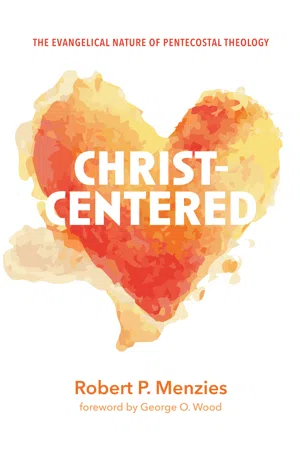
Pentecostals are often portrayed as emotional people who are driven largely by experience. In Christ-Centered, Menzies argues that this caricature misses the fact that Pentecostals are fundamentally "people of the book." Although Pentecostals encourage spiritual experience, they do so with a constant eye to Scripture. The Bible, and particularly the book of Acts, fosters and shapes pentecostal experience. Additionally, Pentecostals are defined by their emphasis on a personal relationship with Jesus Christ. At its heart, the pentecostal movement is not Spirit-centered, but rather Christ-centered. The work of the Spirit, as Pentecostals understand it, centers on exalting and bearing witness to the Lordship of Christ. Menzies develops these themes by examining the origins, biblical foundations, and missional orientation of the modern pentecostal movement. He concludes that, in spite of contradictory messages from some in fundamentalist pews and the pentecostal academy, Pentecostals are and have always been solidly evangelical.
Information
Topic
Theology & ReligionSubtopic
Biblical StudiesPart I
Pentecostal Theology
Its Evangelical Origins
Chapter 1
R. A. Torrey’s Enduring Theological Legacy
The Pentecostal Movement
An influential author and editor of numerous volumes of The Fundamentals (1910–15) and the superintendent of both the Moody Bible Institute and the Bible Institute of Los Angeles, R. A. Torrey (1856–1928) was without question one of the most significant leaders of what is now termed the Fundamentalist movement.1 Indeed, when it is also remembered that from 1902–6 Torrey circled the globe conducting huge, evangelistic meetings unrivaled in size at that time and that his many books and pamphlets remain wildly popular among conservative Evangelicals, R. A. Torrey might with good reason in Christian circles be called, the Father of Fundamentalism. Yet, in spite of his impressive pedigree and unparalleled influence, in this chapter I will argue that Torrey’s most lasting and significant legacy is not to be found in the Fundamentalist movement. In fact, as we shall see, the Fundamentalist movement rejected significant aspects of Torrey’s message and hermeneutic. Torrey’s true, enduring theological legacy is to be found in a movement that was just taking shape at the time of his death in 1928, the Pentecostal movement. Although Torrey himself largely misunderstood and, at least at first sight, rejected this movement, it is nonetheless his most faithful and significant theological heir.
My case for viewing Torrey as the Father of the Pentecostal rather than Fundamentalist movement will be presented in four parts: first, we shall review Torrey’s understanding of that cardinal Pentecostal doctrine, the baptism with the Holy Spirit; second, we will examine Torrey’s approach to Scripture, his hermeneutic; third, we will analyze Torrey’s response to the Azusa Street Revival (1906–9), the catalyst to “the most successful social movement of the past century;”2 and finally, we will highlight Torrey’s remarkable, if often unrecognized, impact on the Pentecostal movement, particularly in its formative stages.
Torrey’s Understanding of Baptism with the Holy Spirit
Several years ago while I was browsing through the books housed in the Alliance Bible Seminary’s library, located on Hong Kong’s beautiful Cheung Chau island, I ran across R. A. Torrey’s The Person and Work of the Holy Spirit (1910). As a Pentecostal, I was aware that Torrey and other Gilded Age Evangelicals, such as A. J. Gordon and A. B. Simpson, frequently spoke of the baptism with the Holy Spirit. However, I had never closely examined what Torrey actually said. So, when I saw the title of this volume, worn with age but still visible, it piqued my interest. I pulled the book off the shelf and began to read. The more I read, the more amazed I became. R. A. Torrey’s description of baptism with the Holy Spirit sounded eerily similar to my own assessment offered in various books and periodicals. I felt as if I was reading my own words, my own thoughts put to page. Clearly, I had found a kindred spirit.
Torrey’s perspective is perhaps most clearly presented in his short book, The Baptism with the Holy Spirit (1895), but similar descriptions appear in his later books, The Person and Work of the Holy Spirit (1910) and The Holy Spirit: Who He Is, and What He Does (1927), as well as his other writings. Torrey’s views on this matter did not change over the course of his life and ministry in spite of considerable pressure to modify them or change his language. The title of Torrey’s main biography, R. A. Torrey: Apostle of Certainty, captures well Torrey’s confident, unambiguous, and direct approach.3 Torrey is anything if not clear and his perspective is not difficult to summarize.
Torrey begins his discussion of baptism with the Holy Spirit by noting that “there are a number of designations in the Bible for this one experience.”4 Significantly, all of the terms and examples that he provides are found in Luke–Acts: “filled with the Holy Ghost” (Acts 2:4), “the promise of the Father” (Luke 24:49), “power from on high” (Luke 24:49), “the gift” (Acts 10:45), “to fall upon” (Acts 10:44), and “to receive” (Acts 10:47) “are all equivalent to ‘baptized with the Holy Ghost’” (Acts 1:5; 11:16).5
Torrey then moves to the heart of his description of baptism with the Holy Spirit by asserting three affirmations.
A Definite Experience
First, Torrey declares that “the baptism with the Holy Spirit is a definite experience which one may know whether he has received or not.”6 Again, Torrey draws upon stories from Luke–Acts to support this statement (Luke 24:49; Acts 19:2–6). Yet one cannot help but see that this judgment is also supported by his own experience and that of other influential leaders of his day. Charles Finney, D. L. Moody, and R. A. Torrey all spoke of powerful experiences of the Spirit, moments when they were “baptized with the Holy Spirit,” with the result that their lives and ministries were dramatically changed. Moody, keenly aware of his lack of power and challenged by the prayers and proddings of two Free Methodist ladies, was baptized with the Spirit in 1871. Moody told Torrey that this experience was so overwhelming that he “had to ask God to withhold His hand, lest he die on the very spot for joy.”7
Although as Marsden notes, Torrey was “known to distrust excessive emotion,”8 he did not shy away from speaking of his own experience. Torrey describes coming “to the place where I saw that I had no right to preach until I was definitely baptized with the Holy Ghost.”9 He declared to a friend that he would not enter the pulpit again “until I have been baptized with the Holy Spirit and know it.” Torrey then shut himself up in his study and on his knees prayed fervently, asking God to baptize him with the Holy Spirit. Several days passed and his prayers had not been answered. He was tempted to consider what might happen if Sunday came and he still had not received the promise. Yet he resolved not to preach until he had received power from on high. “But,” Torrey writes, “Sunday did not come before the blessing came.”10 It happened in a manner quite different from what he expected. “It was a very quiet moment, one of the most quiet moments I ever knew . . . . God simply said to me, not in any audible voice, but in my heart, ‘It’s yours. Now go and preach’ . . . . I went and preached, and I have been a new minister from that day to this.”11
Torrey would later have a more emotional, dramatic encounter. He was sitting in his office when, as he tells it, “I was struck from my chair on to the floor and I found myself shouting . . . ‘glory to God, glory to God, glory to God.’” Torrey states that he could not stop shouting. “I tried to stop, but it was just as if some other power than my own was moving my jaws.” Finally, after ...
Table of contents
- Title Page
- Foreword
- Acknowledgements
- Introduction
- Part I: Pentecostal Theology Its Evangelical Origins
- Chapter 1: R. A. Torrey’s Enduring Theological Legacy
- Part II: Pentecostal Theology: Its Evangelical Foundations
- Chapter 2: Baptism in the Holy Spirit
- Chapter 3: Glossolalia
- Chapter 4: Signs and Wonders
- Part III: Pentecostal Theology: Its Evangelical Trajectory
- Chapter 5: Jesus, Intimacy, and Language
- Chapter 6: Missional Spirituality
- Part IV: Pentecostal Theology: Its Evangelical Future
- Chapter 7: The Nature of Pentecostal Theology
- Conclusion
- Appendix
- Bibliography
Trusted by 375,005 students
Access to over 1.5 million titles for a fair monthly price.
Study more efficiently using our study tools.
Frequently asked questions
Yes, you can cancel anytime from the Subscription tab in your account settings on the Perlego website. Your subscription will stay active until the end of your current billing period. Learn how to cancel your subscription
No, books cannot be downloaded as external files, such as PDFs, for use outside of Perlego. However, you can download books within the Perlego app for offline reading on mobile or tablet. Learn how to download books offline
Perlego offers two plans: Essential and Complete
- Essential is ideal for learners and professionals who enjoy exploring a wide range of subjects. Access the Essential Library with 800,000+ trusted titles and best-sellers across business, personal growth, and the humanities. Includes unlimited reading time and Standard Read Aloud voice.
- Complete: Perfect for advanced learners and researchers needing full, unrestricted access. Unlock 1.5M+ books across hundreds of subjects, including academic and specialized titles. The Complete Plan also includes advanced features like Premium Read Aloud and Research Assistant.
We are an online textbook subscription service, where you can get access to an entire online library for less than the price of a single book per month. With over 1.5 million books across 990+ topics, we’ve got you covered! Learn about our mission
Look out for the read-aloud symbol on your next book to see if you can listen to it. The read-aloud tool reads text aloud for you, highlighting the text as it is being read. You can pause it, speed it up and slow it down. Learn more about Read Aloud
Yes! You can use the Perlego app on both iOS and Android devices to read anytime, anywhere — even offline. Perfect for commutes or when you’re on the go.
Please note we cannot support devices running on iOS 13 and Android 7 or earlier. Learn more about using the app
Please note we cannot support devices running on iOS 13 and Android 7 or earlier. Learn more about using the app
Yes, you can access Christ-Centered by Robert P. Menzies in PDF and/or ePUB format, as well as other popular books in Theology & Religion & Biblical Studies. We have over 1.5 million books available in our catalogue for you to explore.