- 208 pages
- English
- ePUB (mobile friendly)
- Available on iOS & Android
eBook - ePub
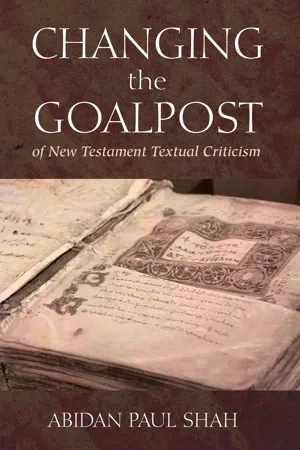
Changing the Goalpost of New Testament Textual Criticism
About this book
Before the 1960s, the goal of New Testament Textual Criticism was singular: to retrieve the "original text" of the New Testament. Since then, the goalpost has incrementally shifted away from the "original text" to retrieving "any text" or "many texts" of the NT. Some scholars have even concluded that the "original text" is hopelessly lost and cannot be retrieved with any confidence or accuracy. Other scholars have gone a step further to claim that the idea of an "original text" itself is a misconception that needs to be abandoned. If this new approach in NTTC is correct, then the authority of Scripture is weakened or no longer valid. It will be shown in this book that such is not the case. Furthermore, emphasis will be placed on the need to return to the traditional goalpost of NTTC, i.e., to retrieve the original text. Without a generally definitive text, the door will be left wide open to recreate any desired text of the NT. An unsettled original text will result in an unsettled biblical theology due to a lack of any authoritative and standard text. Consequently, it will lead to an unsettled Christian faith and practice.
Information
1
Introduction
Before the 1960s, the goal of New Testament Textual Criticism (NTTC) was singular: to retrieve the “original text” of the New Testament (NT). Since then, the goalpost has incrementally shifted away from the “original text” to retrieving “any text” or “many texts” of the NT. Under this new approach to the text, all variants are considered to be equally valuable, regardless of their external evidence in the history of transmission. Previously, variants were looked upon as a means to recover the original text, but now they are increasingly treated as windows into the various early Christian communities and their struggles with doctrines. Now it is considered far more profitable to gain insight into the various “Christianities”1 or “trajectories of faith”2 in the early church than to seek after an elusive and illusive “original text.” Some scholars have concluded the original text is hopelessly lost and cannot be retrieved with any confidence or accuracy.3 Other scholars have gone a step further to claim the idea of an original text itself is a misconception that needs to be abandoned.4 As a major representative of this movement, Eldon J. Epp contends that instead of a single, authoritative, “original text,” there were multiple originals in the beginning, and the concept of an original text is a later development that arose since the coming of the printing press. Some have also proposed creating a text or texts that suit the reader and his or her community.5 Such an understanding of the history of the NT text has serious implications for the study of the NT and the authority of Scripture. Historic Christianity is a faith that is built upon a first-century text. Without a generally determinable original text, there is no longer an authoritative text, and if there is no authoritative text, then there is no longer any distinct Christian faith and practice.6 It is imperative this new shift in NTTC be examined, evaluated, and refuted.
This new movement in NTTC has been spearheaded by five proponents and the recent use of a computer program. Leading the charge is Bart D. Ehrman, who popularized his view through his bestseller Misquoting Jesus: The Story Behind Who Changed the Bible and Why,7 but the bulk of his thesis is contained in his scholarly work The Orthodox Corruption of Scripture.8 Ehrman based the latter on Walter Bauer’s Orthodoxy and Heresy in Early Christianity.9 Prior to Bauer, the normative understanding of early church history was that orthodoxy came first and heresy followed later, but was rebutted successfully. Bauer challenged this traditional view and proposed heresy was on par with orthodoxy in the early church. In fact, in some regions, heresy was the original orthodoxy, and only after some bitter sociopolitical struggles did the orthodox group rise victorious. Since “winners write the history,” the orthodox party passed down a distorted view of the church’s origin to prove their precedence over the other parties. Ehrman extends Bauer’s thesis to allege the orthodox were not content with just sabotaging sees, bishoprics, and councils to advance their agenda; they even corrupted the NT text in order to prove their superiority and maintain their dominance.10
Unlike Bauer, who had sequestered the NT as being inconsequential due to widespread corruption, Ehrman deems it as Exhibit A for his thesis. He begins his argument with the following declaration:
Christianity in the second and third centuries was in a remarkable state of flux. To be sure, at no point in its history has the religion constituted a monolith. But the diverse manifestations of its first three hundred years—whether in terms of social structures, religious practices, or ideologies—have never been replicated.11
He claims this turbulence in early Christianity can be verified by examining the extant NT manuscripts, wherein many of the variants are simply traces of the orthodox attempt to gain control and root out other equally viable movements. He repeats the commonly accepted observation the orthodox scribes “occasionally altered the words of their sacred texts to make them more patently orthodox and to prevent their misuse by Christians who espoused aberrant views.”12 The previous statement is nothing new and has been repeatedly affirmed in standard text-critical works.13 The confounding twist is Ehrman extends his list of suspects from the “orthodox scribes” of the third and fourth centuries to the hypothetical “proto-orthodox” scribes of the first couple hundred years of early Christianity. He claims in the early years of “theological instability,” the scribes of the “proto-orthodox” party manipulated the text to fit their theological agenda and thus cemented the hold of their successors: the orthodox party. He uses some of the early christological controversies of the third and fourth centuries as a background to identify the motives behind the different variants created by the proto-orthodox scribes. Under his thesis, the text available to us can no longer be claimed as the original text because it has been altered by the orthodox coup in the earliest stages of the Christian movement. Simply stated, “the winners not only write the history, they also reproduce the texts.”14 It is important to note here, even though Bauer’s thesis has been repeatedly challenged through the years, Ehrman has continued to...
Table of contents
- Title Page
- Abstract
- Acknowledgments
- Chapter 1: Introduction
- Chapter 2: The Traditional Goals And Methods Of NTTC
- Chapter 3: Bart D. Ehrman
- Chapter 4: David C. Parker
- Chapter 5: Eldon J. Epp
- Chapter 6: J. Keith Elliott
- Chapter 7: The Coherence-Based Genealogical Method
- Chapter 8: Final Analysis and Critique
- Chapter 9: Conclusion
- Bibliography
Trusted by 375,005 students
Access to over 1.5 million titles for a fair monthly price.
Study more efficiently using our study tools.
Frequently asked questions
Yes, you can cancel anytime from the Subscription tab in your account settings on the Perlego website. Your subscription will stay active until the end of your current billing period. Learn how to cancel your subscription
No, books cannot be downloaded as external files, such as PDFs, for use outside of Perlego. However, you can download books within the Perlego app for offline reading on mobile or tablet. Learn how to download books offline
Perlego offers two plans: Essential and Complete
- Essential is ideal for learners and professionals who enjoy exploring a wide range of subjects. Access the Essential Library with 800,000+ trusted titles and best-sellers across business, personal growth, and the humanities. Includes unlimited reading time and Standard Read Aloud voice.
- Complete: Perfect for advanced learners and researchers needing full, unrestricted access. Unlock 1.5M+ books across hundreds of subjects, including academic and specialized titles. The Complete Plan also includes advanced features like Premium Read Aloud and Research Assistant.
We are an online textbook subscription service, where you can get access to an entire online library for less than the price of a single book per month. With over 1.5 million books across 990+ topics, we’ve got you covered! Learn about our mission
Look out for the read-aloud symbol on your next book to see if you can listen to it. The read-aloud tool reads text aloud for you, highlighting the text as it is being read. You can pause it, speed it up and slow it down. Learn more about Read Aloud
Yes! You can use the Perlego app on both iOS and Android devices to read anytime, anywhere — even offline. Perfect for commutes or when you’re on the go.
Please note we cannot support devices running on iOS 13 and Android 7 or earlier. Learn more about using the app
Please note we cannot support devices running on iOS 13 and Android 7 or earlier. Learn more about using the app
Yes, you can access Changing the Goalpost of New Testament Textual Criticism by Abidan Paul Shah in PDF and/or ePUB format, as well as other popular books in Theology & Religion & Biblical Criticism & Interpretation. We have over 1.5 million books available in our catalogue for you to explore.