eBook - ePub
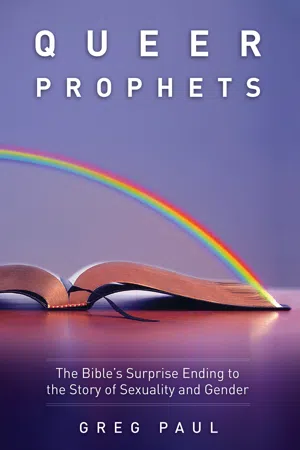
Queer Prophets
The Bible’s Surprise Ending to the Story of Sexuality and Gender
- 142 pages
- English
- ePUB (mobile friendly)
- Available on iOS & Android
eBook - ePub
About this book
This is the story of a spiritual journey, a theological quest to find better biblical answers (ones that work in real life) to the challenging questions that plague many of us surrounding gender and sexual identity. If God is love, why does he seemingly reject LGTBQ2+ people? How can Christians truly embrace them without abandoning their biblical convictions? How are queer Christians supposed to live? No story ends where it began. If we follow the story instead of treating the Bible as a document recording a set of precepts, we find that the angst, division, and abuse set in motion by the fall in the garden are reconciled and resolved in the city of the new Jerusalem. And just possibly, we may also find that "queer" people have a prophetic function for our age.
Information
Topic
Theology & ReligionSubtopic
Christian Church1
“Well, I Use You, Don’t I?”
By the time I met John over lunch, he had become both living legend and salacious rumor to me. That was in the spring of 1992, but I’d encountered him years before while still in my teens. He was the much-older boyfriend of a girl my older brothers used to hang out with up at the lake sometimes. The way I remember him, he’d had a mane of thick brown hair and a full beard, broad shoulders, and a deep tan. Jeremiah or Ezekiel in a swimsuit.
I probably talked to him a couple of times that summer, but I don’t recall. He was a striking figure though, and I know I spoke to my mother about him. He was the director of a well-known evangelical Christian camp at the time, and a leader of church young people in general. Through the fall and winter months, he led an all-city worship gathering for them in a downtown church—ironically, the very church building that would much later become home to the Sanctuary community, where I have lived and breathed and had my being for close to thirty years now. I was surprised to find out that my mother had taught him Sunday School as a child; she spoke fondly of him, and with compassion about the difficult situation in which he had grown up: his father had died when John was just fourteen years old.
I must have said something about a guy in his thirties dating a girl who was barely twenty. My mother smiled a secret smile, watching John and his girl trying to throw each other off the neighbor’s dock.
“Oh,” she said, “he’ll never marry her.”
If I asked why, she didn’t tell me.
But she was right. The relationship ended soon after that. I kept hearing about John now and then. I attended a few of those youth gatherings, and there was no denying that he had charisma by the boat load, but I was more interested in checking out the girls than I was in him, or anything he had to say. Through the next few years, the anecdotes about and references to John shifted from admiring, to concerned, to enigmatic. He was certainly all over the place, wasn’t he? He seemed to be struggling some. He’d needed to back away, a little. Uh oh, he’d had a breakdown. . . . And the trickle of information stopped. John slipped from view, landed in a well-we-don’t-talk-about-that limbo.
It was a long time until I next saw him, and he was on TV. It was a local talk show; John was savaging a conservative minister of some sort who was trying to articulate and defend what he considered to be biblical sexual values. John had lost much of his golden aura, and he’d gained a fiery anger. He was aggressively gay, razor sharp, and totally out there. Although he still identified as Christian, it wasn’t a version of the faith that I recognized. That poor minister never had a chance.
Several years later, I discovered that a friend of mine had shared a house with John and two or three other young men while he was going to university. At the time, none of them had known what was bothering John, but it shook them severely to watch the man they’d looked up to descend into anxiety, depression and, finally, a full-blown nervous breakdown. None of the church leaders who had built him up, my friend said, had ever come around to check on him. My guess is that they knew what John’s struggle was really about—he probably told them—and they had no idea how to deal with it. John had become untouchable.
The crazy, extreme behaviors of the ghettoized gay community in the 1980s were the kind of thing that Christians, and to be fair, many others, either whispered about in a horror that was tinted with no small measure of gleeful titillation or tried to describe soberly and clinically as a means of proving just how aberrant these debauched specimens of humanity were. Rumor had it that John had dived into it all head first. And, think of all those young boys and young men he had had access to! How many must he have interfered with? It may seem ridiculous and offensive to make that kind of leap now, but it didn’t then—not to straight folks. The common assumption, and not just in the church but in society at large, was that all queer folk had abandoned any sort of morality at all and were sexually insatiable.
Nobody ever came forward with an accusation. The friend of mine who had lived with him told me that, to his knowledge, John had never even confided the nature of his struggle to the young men who lived in his house, much less tried to seduce them. Not long after my lunch with John, I would begin to hear repeatedly from volunteers and staff of the AIDS Committee of Toronto—never from John himself—that he had been a hero in the gay community during the early years of the AIDS crisis in the mid- to late eighties. During that horrifying era, as a licensed funeral director, he prepared for burial all the bodies of the men who succumbed to the disease that was scything through the gay community in the city of Toronto, as it was around the world. No other undertaker would touch them.
Many years later, John would tell me that it was in fact his Christian faith that remained a singular light in the deep darkness of his journey toward accepting himself as a gay man. It was a Christian community in Boston that brought him back from the brink and stood him on his feet. And stand he did; in the maelstrom of death and despair that was the AIDS-afflicted gay community in Toronto of the eighties and early nineties, John’s faith anchored him as he not only prepared the bodies of gay men for burial, but often officiated at their funerals. He’d gone back to school and, in 1989, was ordained a minister in a mainline denomination.
When I met him for that first lunch, I hadn’t seen him for probably sixteen or seventeen years, not since that summer at the lake. I had just begun hanging out on the streets in the downtown core of Toronto—I called it “doing outreach” when pressed by church folks to give account for my activities; it was a practice that would soon give birth to a little foundling community of homeless people, addicts, prostitutes, street rounders, and a handful of earnest young Christians, which we would call Sanctuary. John had been an associate at a nearby church for a few years at that point. Apart from his normal liturgical and pastoral duties, he’d established a men’s hostel in the church (a sprawling old pile) and was on the cusp of founding a bereavement support center. There couldn’t have been many people better qualified for such an endeavor. He’d buried hundreds, many of them friends, during the AIDS epidemic which, in 1992, was still picking up speed.
Despite our tenuous connection, and knowing that I came from the same firmly fundamentalist tradition and convictions that had rejected him, John agreed readily to meet. The hair and beard had been trimmed and tamed, salt-and-peppered with the years. He was still lean and fit, and he wore a beautifully cut gray suit. Blue eyes danced beneath dark eyebrows. But for the black shirt and parson’s collar, he’d have looked at home sliding out of the driver’s seat of a Porsche, or behind the wheel of a yacht in one of those early retirement ads.
I remember little of what we discussed, although there must have been some catching up on the current circumstances of mutual acquaintances, and descriptions of what our own ministry lives looked like. I know he mentioned his partner of, I think, six or seven years. Interesting, that, since his denomination at the time did not affirm “practicing” gay or lesbian people in ministry, and had, in fact, defrocked another man who had, not long before, come out to his congregation and introduced his life partner. This was 1992, remember, when almost no churches or even secular social organizations were affirming same-gender relationships (I certainly wasn’t), and legal marriage was a distant, not very realistic dream for gay and lesbian couples.
John had a plummy, radio announcer’s voice, too, so he could afford to speak in a low, confidential tone. But it wasn’t his vocal quality or the cut of his suit that drew me to him. Something happened across that table, and I know it happened for John too, as we talked about it later.
It was as if the usual curtain of propriety and caution that hangs between mere acquaintances had been drawn swiftly aside. Both of us had sat down expecting to be superficially friendly, civil—and careful. We knew what each other represented, or so we thought, and imagined ourselves to be on opposite sides of a great divide. I’m not sure what motivated John to accept my invitation, but I had extended it because I realized that my newly adopted neighborhood included not only street people, but also one of the world’s largest gay and lesbian communities. (Kids, this was so long ago that the term LGBTQ had yet to be invented, let alone 2+.) In my naive enthusiasm to announce the gospel of Jesus Christ, I imagined that it was up to me to shine his light into a dark place. I suppose I expected to find in John a jaded, defensive soul with a cynical overlay of official but empty religion.
Instead, it felt like I was talking to someone I had known intimately all my life. John was possessed of a deep, obvious spirituality of the kind that has gone through the fire and come out refined, luminous. His compassion for struggling people of every stripe, not just queer folk, was clear. He loved God. His life was announcing the good news every day, in both word and deed. Jesus was his Savior, and his Lord. I knew these things about John, not just because he said them, but because everything about him carried the unmistakable, unfakeable whiff of eternity. I knew because something in my own soul confirmed it.
I saw John now and then over the next ten years, and although we maintained a good friendship, I never again felt that connection with quite the same intensity. It was as if, that day, the Spirit had sat at the table with us, sharpening our vision and hearing, opening our hearts, interpreting for us things that words alone can never truly communicate.
I left the restaurant badly rattled.
By the time my feet hit the sidewalk, the lovely sense of sitting before a crackling fire with God and a dear friend was gone. My mind reeled with question after question as I walked back to Sanctuary.
How could this be? John was homosexual, and not just by inclination, but by lifestyle. And yet, he was doing really good ministry, real Jesus stuff. I had been raised in a “closed” Brethren assembly, and while there are a number of points on which I would now disagree with the doctrine of such churches, they had at least one great characteristic: they produced an extraordinarily high level of biblical literacy among their congregants. The passages that prohibit or comment adversely on same-gender sexual activity raced through my mind, and beneath them rumbled the assumptions of my culture and training.
It was wrong, no question—wrong, wrong, wrong!—and yet God was nevertheless clearly “using” John. The very idea of being “used” by God, as if we are to him merely instruments to be picked up and put down according to need, is one I find demeaning to both God and humanity now. But that’s how I thought at the time, and it seemed clear to me that John was no fit vessel for God’s service.
Objection after objection plowed through my thoughts and shaped themselves into a stream-of-consciousness prayer of complaint and puzzlement. I felt betrayed, sucked in by a spiritual shell game.
“But-but-but . . .” I sputtered like an old one-lung motor. “How could you use him?”
Eventually I ran out of gas. Into my bewildered, disoriented mind slipped a thought, and it rang like the voice of God.
“Well, I ‘use’ you, don’t I?”
2
That Gently Diverging Course
Listen, I don’t think I was any more homophobic than was common at that time...
Table of contents
- Title Page
- Introduction
- Chapter 1: “Well, I Use You, Don’t I?”
- Chapter 2: That Gently Diverging Course
- Chapter 3: Disorientation
- Chapter 4: Even If It Leaves Me Limping
- Chapter 5: Certainty Is No Friend to Faith
- Chapter 6: Badly Broken and Buried Deep
- Chapter 7: Christ in Dark Places
- Chapter 8: Must Not All Love Derive from Him?
- Chapter 9: Love Has Kept Me Searching
- Chapter 10: A Little Sliver of an Opening
- Chapter 11: Somebody Has to Be Wrong
- Chapter 12: The Redemptive Arc
- Chapter 13: That Surprising Ending Gives Clarity
- Chapter 14: Bent to the Inclusion of Every Outsider
- Chapter 15: Jesus Knew What Was Going On
- Chapter 16: Room for “Those People”
- Chapter 17: Like the Angels
- Chapter 18: A Kind of Living Prophetic Utterance
- Final Words
- Acknowledgments
Trusted by 375,005 students
Access to over 1.5 million titles for a fair monthly price.
Study more efficiently using our study tools.
Frequently asked questions
Yes, you can cancel anytime from the Subscription tab in your account settings on the Perlego website. Your subscription will stay active until the end of your current billing period. Learn how to cancel your subscription
No, books cannot be downloaded as external files, such as PDFs, for use outside of Perlego. However, you can download books within the Perlego app for offline reading on mobile or tablet. Learn how to download books offline
Perlego offers two plans: Essential and Complete
- Essential is ideal for learners and professionals who enjoy exploring a wide range of subjects. Access the Essential Library with 800,000+ trusted titles and best-sellers across business, personal growth, and the humanities. Includes unlimited reading time and Standard Read Aloud voice.
- Complete: Perfect for advanced learners and researchers needing full, unrestricted access. Unlock 1.5M+ books across hundreds of subjects, including academic and specialized titles. The Complete Plan also includes advanced features like Premium Read Aloud and Research Assistant.
We are an online textbook subscription service, where you can get access to an entire online library for less than the price of a single book per month. With over 1.5 million books across 990+ topics, we’ve got you covered! Learn about our mission
Look out for the read-aloud symbol on your next book to see if you can listen to it. The read-aloud tool reads text aloud for you, highlighting the text as it is being read. You can pause it, speed it up and slow it down. Learn more about Read Aloud
Yes! You can use the Perlego app on both iOS and Android devices to read anytime, anywhere — even offline. Perfect for commutes or when you’re on the go.
Please note we cannot support devices running on iOS 13 and Android 7 or earlier. Learn more about using the app
Please note we cannot support devices running on iOS 13 and Android 7 or earlier. Learn more about using the app
Yes, you can access Queer Prophets by Greg Paul in PDF and/or ePUB format, as well as other popular books in Theology & Religion & Christian Church. We have over 1.5 million books available in our catalogue for you to explore.