eBook - ePub
Spiritual Life on a Burning Planet
A Christian Response to Climate Change
- 100 pages
- English
- ePUB (mobile friendly)
- Available on iOS & Android
eBook - ePub
About this book
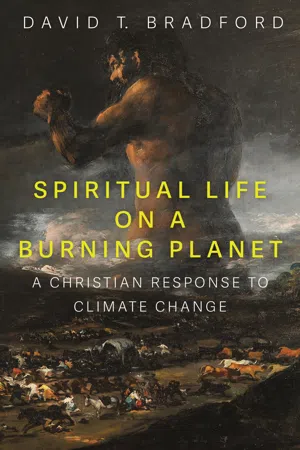
Spiritual Life on a Burning Planet draws on scientific research in developing religious perspectives on anthropogenic climate change. Its four chapters are entitled "Tolling Bells," "Burning Planet," "Eschatology in the Anthropocene," and "The Downward Passage." "Tolling Bells" introduces the topic of climate change and several of its emotional and biblical implications. "Burning Planet" provides an overview of the science of climate change and surveys the effects of global warming on human life later this century. The essays in "Eschatology in the Anthropocene" develop theological interpretations of climate change and examine its moral, spiritual, social, and psychological dimensions. "The Downward Passage" focuses on Christ's descent, the harrowing of hell, understood as a point of doctrine and an exemplary image of forthcoming challenges as we advance more deeply into the Anthropocene. A spiritual path suited to the Anthropocene is outlined. Its watchword is penthos, a traditional practice with sufficient power to convey a person through the grief and mourning that represent a true grasp of our having forced the earth into a new geological epoch.
Information
Topic
Theology & ReligionSubtopic
Christian Theology1
Tolling Bells
The future is now arriving, its rolling entry signaled in muffled bells and endless news cycles. It peered from Industrial Era dynamos and could be smelled, seen, and touched in the coal-grime streets of Victorian England. It shines from mile-long servers and beams sterile blue light into billions of faces. The eyes of the future are collapsing stars burning through the plasticized surface of political propaganda and media-driven fantasies. An inkling of the facts of climate change cauterizes hope and miniaturizes human aspirations. Those who cower before the facts have accurately gauged their magnitude. At present, the flywheel madness and seeping ingress of chaos is disguised by quotidian semblances of order. But the lord of masks, the loud-shouting god of the Anthropocene, guarantees fleeting crazes and festival routs, all moribund at their point of inception. The sane and safe alternative is to mourn.
The destruction of natural beauty is a grave experience whose poignancy can evolve into rending grief. Bees and tropical butterflies are becoming memento mori.1 The bodies of migratory birds are shrinking.2 Icecaps are disappearing, and boreal forests are burning. Extreme weather is disrupting the predictable continuity of outdoor time. Seasonal changes are becoming less clearly marked. An uncanny change is underway, its scope exceeding our power of imagination. Tides of anxiety and sadness can be expected, passing among individuals and saturating crowds. Bourgeois urbanites whose exposure to the natural world is limited to worms in organic tomatoes will be among the last to react. Confused and lonely, they will feel haunted by their devices and the muted clatter of their silver kitchen implements. Another predictable response is fear, of such intensity that it grades into nausea and progresses toward a palpable silence that tips into panic. Repeated episodes of panic will erode what hope and confidence remain, at which point the fear becomes despair. Fomented in large groups, the emotions aroused by the malign effects of climate change will reverse polarity and prompt outrage and upheavals of violence. Climate change is physical at base, but its psychological effects will prove pervasively disturbing. Many will seek solace in the virtual world, their minds fixed in chronic states of addictive hypnosis. A worldwide lament, paired with ubiquitous acts of penitence, would create a slim chance of mounting sufficient courage and moral imagination to alter our self-determined fate. Even then, the material processes that are already in motion would be impossible to stop.
Conclusive data are now arriving. The evolutionary experiment of human consciousness is drawing toward its completion. The imposing drama of human advance has proved itself a dumb tragedy of self-sacrifice in which the victors are destroying their homes. The drama did not begin with faulty moral judgement—“knowing what is good and what is bad”—nor with actions as mundane as sex—“they realized that they were naked” (Gen 3:5, 7). The actors’ gender difference is irrelevant; they were two-in-one, “the most cunning of all the animals” (Gen 3:1). Eve presented the fruit to Adam, but both received the message of warning. Adam’s self-incriminating pretense of ignorance is the tactic of blaming the victim: “she gave me the fruit—so I ate it” (Gen 3:12). The thematic axis of the drama runs vertically through the tree situated in the “middle of the garden” (Gen 3:3). Other trees were lush and unforbidden but not centrally located. The first act of the drama is the bent-heart action of idolatry—of oneself and one’s kind. What followed shows the cost of usurping the center in the effort to “be like gods” (Gen 3:5). The second act was the couple’s expulsion and exile: “What have you done! Listen: Cursed be the ground because of you!” (Gen 3:17). They were expelled and “banned,” their return prevented by a “fiery revolving sword” (Gen 3:14, 24). Life thereafter entailed “toiling” and “crawling” (Gen 3:14, 17). The third act of the drama was a murder: Cain killing Abel: “Your brother’s blood cries out to me from the soil” (Gen 4:10). So began our fitful travels in widening arcs from an imaginary home. We are “restless wanderers” and kin to Cain, a mongrel species since departing the African homeland (Gen 4:12).3 Now we are turning in circles as the earth becomes increasingly strange. We have made ourselves resident aliens on a burning planet.
The Christian narrative of salvation history deviates from today’s developing scenarios of global warming.4 The viability of its plan necessitates physical circumstances the world has known for millennia. But the earth is changing—to the extent that its future may not be habitable. We have put the plan into doubt. The tiered, supernaturally inflected world of ancient times may have folded into the empirical world of modern astronomy and physics; but the difference in cosmology hardly matters. High civilization and, possibly, humankind are precarious. Given these circumstances, shall we allow God a freedom that He permits His creatures: the freedom to withdraw from promises to which He previously adhered? Amos promoted this option more so than other prophets.5 He allowed God the freedom that God allows His creatures: the freedom to retreat, to cancel, to withdraw. Opportunities were offered, then encapsulated in the Incarnation, and now their material foundation—a habitable earth—is deteriorating at the hands of those to whom the opportunities were offered. The branches are being stripped, the rootstock is smoldering. Is there hope? For institutions and large social collectives as we now know them—no. For earth in the form that has served humans for millennia—no. For spiritually avid persons and their remnant bands—yes.6
1. Koh et al., “Co-Extinctions of Tropical Butterflies,” 272–74; Sánchez-Bayo and Wyckhuys, “Worldwide Decline,” 8–27.
2. Weeks et al., “Shared Morphological Consequences.”
3. The phrase “mongrel species” and the emphasis on migration are based on Reich, Who We Are.
4. Scholarly perspectives on salvation history (Heilsgeschichte) range from classic, biblically oriented formulations (as in Gerhard von Rad’s “fundamental conception of history as a continuum of events determined by Jahweh’s promise”) to recent post-modern views in which the constancy of religious meaning across historical time is denied (von Rad, Old Testament Theology, 426). In setting the Christian narrative of salvation history against the facts of climate change, the point is that all such perspectives come to nothing under certain scenarios of future warming. This is clearly the case in Hothouse Earth pathways, as discussed in later chapters, and it also applies to lesser threats in which warming-induced socioeconomic changes lead to the decay of civil society and the collapse of expansive, expensively maintained institutions. The church (since Constantine) is such an institution. For critical consideration of varied concepts of salvation history, see Hinze, “End of Salvation History.”
5. For Amos’s distinctiveness in this respect, see Hasel, Remnant.
6. For remnant theology in Jewish scripture, through Isaiah, see Hasel, Remnant. For the remnant in Zephaniah, see King, “Remnant in Zephaniah,” 414–27.
2
Burning Planet
The first of the following reviews is...
Table of contents
- Title Page
- Introduction
- Chapter 1: Tolling Bells
- Chapter 2: Burning Planet
- Chapter 3: Empirical Apocalyptic
- Chapter 4: The Downward Passage
- Bibliography
Trusted by 375,005 students
Access to over 1.5 million titles for a fair monthly price.
Study more efficiently using our study tools.
Frequently asked questions
Yes, you can cancel anytime from the Subscription tab in your account settings on the Perlego website. Your subscription will stay active until the end of your current billing period. Learn how to cancel your subscription
No, books cannot be downloaded as external files, such as PDFs, for use outside of Perlego. However, you can download books within the Perlego app for offline reading on mobile or tablet. Learn how to download books offline
Perlego offers two plans: Essential and Complete
- Essential is ideal for learners and professionals who enjoy exploring a wide range of subjects. Access the Essential Library with 800,000+ trusted titles and best-sellers across business, personal growth, and the humanities. Includes unlimited reading time and Standard Read Aloud voice.
- Complete: Perfect for advanced learners and researchers needing full, unrestricted access. Unlock 1.5M+ books across hundreds of subjects, including academic and specialized titles. The Complete Plan also includes advanced features like Premium Read Aloud and Research Assistant.
We are an online textbook subscription service, where you can get access to an entire online library for less than the price of a single book per month. With over 1.5 million books across 990+ topics, we’ve got you covered! Learn about our mission
Look out for the read-aloud symbol on your next book to see if you can listen to it. The read-aloud tool reads text aloud for you, highlighting the text as it is being read. You can pause it, speed it up and slow it down. Learn more about Read Aloud
Yes! You can use the Perlego app on both iOS and Android devices to read anytime, anywhere — even offline. Perfect for commutes or when you’re on the go.
Please note we cannot support devices running on iOS 13 and Android 7 or earlier. Learn more about using the app
Please note we cannot support devices running on iOS 13 and Android 7 or earlier. Learn more about using the app
Yes, you can access Spiritual Life on a Burning Planet by David T. Bradford in PDF and/or ePUB format, as well as other popular books in Theology & Religion & Christian Theology. We have over 1.5 million books available in our catalogue for you to explore.