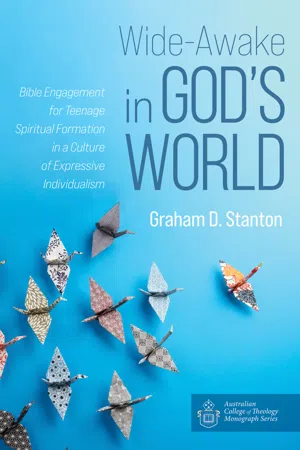
eBook - ePub
Wide-Awake in God’s World
Bible Engagement for Teenage Spiritual Formation in a Culture of Expressive Individualism
- 242 pages
- English
- ePUB (mobile friendly)
- Available on iOS & Android
eBook - ePub
Wide-Awake in God’s World
Bible Engagement for Teenage Spiritual Formation in a Culture of Expressive Individualism
About this book
In an expressivist culture, effective engagement must acknowledge teenagers' freedom to choose their own spiritual path. Yet, in an evangelical theology, faithful formation must hold on to biblical authority. As we seek to engage young people with the Bible, key questions need to be explored. Such questions include: how can pedagogical freedom be affirmed without undermining theological authority; and how can authority be asserted without diminishing personal freedom?
This study explores a freedom-authority dialectic in theological dialogue with the educational philosophy of Maxine Greene. Greene's reflection on the arts and the imagination are brought into conversation with insights from Charles Taylor, Garret Green, and Nicholas Wolterstorff.
As a work of practical theology, the book concludes with a framework to shape the purpose, content, and values for Bible engagement in contemporary youth ministry.
Information
Topic
Theology & ReligionSubtopic
Christian Ministry1
Expressive Individualism, Bible Engagement, and Maxine Greene
Suppose you are leading a discussion with a group of young people about Jesus’ parable of the two sons from Luke 15:11–31. While most of the group are not particularly engaged in the conversation, one young man is eagerly reporting how helpful this Bible passage has been in his own life. “My little brother and I fight a lot, mostly because I think he has got life easy and gets away with a whole lot more than I ever did. But this story is such a great reminder to me that older brothers should not be jealous of younger brothers.”1
How will you respond? Will you rejoice that a young person has not only read the Bible, but has even chosen to use the Bible to shape the way he lives? Here is a young man who has chosen to position himself under the “authority” of the biblical story. In some way he has allowed Jesus’ words to direct his experience. In a world of biblical illiteracy and wayward morality, surely this is a bright star in an otherwise darkened sky of teenage Bible engagement!
And yet, perhaps there is also the unsettling feeling (or maybe even the overwhelming conviction) that this young man’s personal concerns have overshadowed the voice of the text? Read in the context of the whole chapter, to conclude that the parable of the lost son is about how older brothers should relate to their younger siblings is so far wide of the mark that it is quite shocking to experienced readers of the Gospels. The story of the two sons does not stand alone but comes as the climax of one parable in three parts (the lost sheep, the lost coin, the lost son).2 This three-fold story is addressed to those who are grumbling at Jesus’ reception and dining with “sinners.” While it could be argued that this young person has made a choice to position himself under the “authority” of the biblical story, at least in the sense that the story is used to direct his experience, one could also argue that his personal concerns have overshadowed the voice of the text.
Meanwhile, the other members of the group remain disengaged. Perhaps it is because they have already heard “the answer” to what this story is about. Or maybe they know from experience that you are about to tell them the answer before the study is done. Either way, reading the parable of the good Samaritan again is not offering them any sense of personal risk or adventure. As a result, Christian faith holds little appeal “because the great truths have already been revealed, and it is simply a matter of devoting oneself to what is already known.”3
So, which will we choose? Must we give away commitment to objective authority and any sense of an orthodox reading of the biblical text in order to promote teenage engagement? Or do we sacrifice teenage engagement because of a commitment to theological truth?
The central concern of this book is to find a way to affirm both authority and freedom—to propose practices of Bible engagement in youth ministry that can effectively promote Christian spiritual formation in a culture of expressive individualism. In pursuit of that end, this study will correlate insights drawn from the aesthetic pedagogy of educational philosopher Maxine Greene with key themes of Christian theology in order to propose a practice framework for what I am calling a dialogical youth ministry (DYM). The chapters that follow will argue that DYM promotes the freedom of young people by inviting them to explore and construct meaning and to imagine how things could be otherwise for them and their world. DYM affirms the authority of Scripture by inviting Christian leaders to be present as people of conviction in dialogue with teenagers as together they think about the world, offering the gospel of Jesus as a possibility for meaning-making.
The journey towards DYM engages with three main areas of discourse. First, this study engages with literature that seeks to help the Christian church face the challenge of finding approaches to spiritual formation that engage appropriately with the contemporary culture of expressive individualism. Second, because of the specific focus on practices of transformative Bible engagement, the study engages with theological reflection on the relationship between the Bible and the imagination in light of a conservative evangelical theology of biblical authority. Third, the study engages with the critical analysis of the educational philosophy of Maxine Greene by educationalists and religious educators.
Spiritual Formation and Expressive Individualism
Expressive individualism is a highly significant—very likely the most significant—factor in the cultural milieu in which Australian young people engage with spirituality. First identified as the dominant culture of the United States of America in the twentieth century, expressive individualism has become a feature of modern secular culture across the Western world. Characterized by individual choice and the absence of external authorities,4 in expressive individualism each individual must discover their true self by looking inward to their own thoughts and feel...
Table of contents
- Title PAge
- Illustrations
- Preface
- Acknowledgements
- Abbreviations
- Chapter 1: Expressive Individualism, Bible Engagement, and Maxine Greene
- Chapter 2: Practical Theology, Correlative Conversation, and Practice Frameworks
- Part I: Maxine Greene’s Aesthetic Pedagogy
- Chapter 3: Education in and for Freedom
- Chapter 4: Engaging the Arts
- Chapter 5: Releasing the Imagination
- Part II: Dialogical Youth Ministry
- Chapter 6: Freedom, Authority, and the Martyr’s Gift
- Chapter 7: The Bible, Dialogue, and the Disciplined Imagination
- Chapter 8: Imagination, Bible Engagement, and Being Known by God
- Chapter 9: A Practice Framework for Dialogical Youth Ministry
- Bibliography
Trusted by 375,005 students
Access to over 1.5 million titles for a fair monthly price.
Study more efficiently using our study tools.
Frequently asked questions
Yes, you can cancel anytime from the Subscription tab in your account settings on the Perlego website. Your subscription will stay active until the end of your current billing period. Learn how to cancel your subscription
No, books cannot be downloaded as external files, such as PDFs, for use outside of Perlego. However, you can download books within the Perlego app for offline reading on mobile or tablet. Learn how to download books offline
Perlego offers two plans: Essential and Complete
- Essential is ideal for learners and professionals who enjoy exploring a wide range of subjects. Access the Essential Library with 800,000+ trusted titles and best-sellers across business, personal growth, and the humanities. Includes unlimited reading time and Standard Read Aloud voice.
- Complete: Perfect for advanced learners and researchers needing full, unrestricted access. Unlock 1.5M+ books across hundreds of subjects, including academic and specialized titles. The Complete Plan also includes advanced features like Premium Read Aloud and Research Assistant.
We are an online textbook subscription service, where you can get access to an entire online library for less than the price of a single book per month. With over 1.5 million books across 990+ topics, we’ve got you covered! Learn about our mission
Look out for the read-aloud symbol on your next book to see if you can listen to it. The read-aloud tool reads text aloud for you, highlighting the text as it is being read. You can pause it, speed it up and slow it down. Learn more about Read Aloud
Yes! You can use the Perlego app on both iOS and Android devices to read anytime, anywhere — even offline. Perfect for commutes or when you’re on the go.
Please note we cannot support devices running on iOS 13 and Android 7 or earlier. Learn more about using the app
Please note we cannot support devices running on iOS 13 and Android 7 or earlier. Learn more about using the app
Yes, you can access Wide-Awake in God’s World by Graham D. Stanton in PDF and/or ePUB format, as well as other popular books in Theology & Religion & Christian Ministry. We have over 1.5 million books available in our catalogue for you to explore.