- 150 pages
- English
- ePUB (mobile friendly)
- Available on iOS & Android
eBook - ePub
About this book
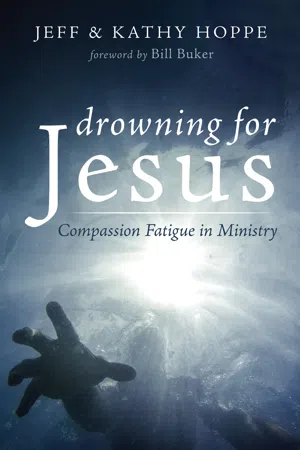
While there are many books that address burnout in ministry, there are few that speak to compassion fatigue. The book is divided into three parts. Part I, "The Beckoning Sea," explains the perils of ministry, the church as a family system, the difference between burnout and compassion fatigue, and risk factors for ministry leaders. In Part II, "Finding Your Stroke," the authors offer prevention advice for burnout, compassion fatigue, and managing church systems. Part III, "The Rescue," discusses the process of recovery beginning with rest and retreat, and the minister's renewed calling. The authors explain how intentionality, building resiliency, and finding connection bring healing. A chapter is dedicated to clergy families. Using the analogy of ocean swimming and the story of Jonah, a reluctant preacher, the authors weave a common theme through the narrative offering education, understanding, and hope while sharing the stories of ministry leaders who have survived the turbulent waters of pastoral caregiving.
Information
Topic
Theology & ReligionSubtopic
Christian ChurchPart I
The Beckoning Sea
The word of the Lord came to Jonah son of Amittai: “Go to the great city of Nineveh and preach against it, because its wickedness has come up before me.”
—Jonah 1:1–2
The ocean is enticing. I remember my first trip to Hawaii. I couldn’t wait to get in the water. I just wanted to touch and taste it and feel it envelop me. Water is a mystery that I can experience. I don’t understand it, but I’m drawn to it. Whether an ocean, a lake, a stream, or a waterfall, I cannot pass it without putting my hand or foot in it. Yet that’s not enough, I want to go deep into it until I am surrounded by the quiet. Water is hypnotizing; it draws me near. Imagine the thrill I felt on Hawaii’s north shore as the waves crashed against my body. The smells, the sounds, and the feel of the spray are as real to me now as they were at the time of my visit. Whenever I am stressed, I close my eyes and revisit the ocean to gain a sense of steadiness and calm. The water’s beckoning is inescapable for me.
Just like the thrill of ocean swimming, such is God’s calling on your life. Few other professions have that grip on an individual. A person typically opts for a career that fits his or her aptitude or interests. If a person is good at math throughout school, then likely he or she will pursue a career that uses those skills. For the person interested in humanities, a probable career choice might be in social services, teaching, or even the law. The person who loves science will enter the sciences, engineering, or medical field. Rarely do I hear people in other careers use the sense of mission as a minister uses it. At one point, someone asked me, “Why do you want to be a minister?” I hesitated and then replied, “Oh, I don’t want to be a minister. God called me. How can I choose otherwise?” No other career incorporates one’s entire soul such as ministry.
The call of God is powerful. It harbors both the possibility of great joy in serving God and the church, and yet ramifications, should you resist the invitation. The story of Jonah shows what happens when one disobeys God’s command to serve. When God decides to choose a person for ministry, the invitation is appealing. In his book Testing and Reclaiming Your Call, Robert Schnase writes, “The mystery we wrestle with is that God wishes to use any of us at all. Of all the strange ways for God to reveal unlimited love, God uses limited lives.”1 It seems odd that such an auspicious task is given to you, an ordinary being who is limited in knowledge and vulnerable to pride, discouragement, disillusionment, and exhaustion. At the same time, it’s appealing to consider that you are deemed worthy to serve the Almighty.
God demonstrates grace toward humanity by entrusting the gospel message to you. Your response to this call is unpredictable. How you react involves the tension between autonomy and surrender. If you rely on your own strength and desires, the path becomes draining, and eventually may lead to burnout or compassion fatigue. It is a career that requires a dependency upon God and a continual reevaluation of your theological belief system. The calling to ministry awakens, motivates, encourages, and strengthens you. It is this vocation that sustains you through difficult times. Eugene Peterson describes this assurance, “It suddenly struck me that my ordination vows had functioned for the past forty years as pitons, pegs driven firmly into the vertical rock face upon which Christian ministry is played out.”2
Yet God gives you freedom to respond. The personal responsibility that comes with the vow will remain with you and the commitment of that initiative becomes apparent amid trouble.3 Spiritual vocation demands a pledge that you may not always be ready to make. Consider the resistance of the biblical characters. In Exodus 3, God speaks to Moses. “I am sending you to Pharaoh to bring my people the Israelites out of Egypt.” What is Moses’s response? “Who am I that I should go to Pharaoh and bring the Israelites out of Egypt?”4 Moses argues with God and raises five objections to God’s request: I’m not a good enough, I don’t have the answers, the people won’t believe me, I’m not a good speaker, and I’m not a leader.5 Jeremiah’s story is similar. “The word of the Lord came to me, saying, ‘Before I formed you in the womb I knew you, before you were born I set you apart; I appointed you as a prophet to the nations.’ ‘Alas, Sovereign Lord,’ I said, ‘I do not know how to speak; I am too young.’”6
The response to God’s bid is one of awe and bewilderment that soon turns to excitement and wonder. Many enter the pastoral field with high hopes and large expectations of themselves. The clergy life holds both possibilities and challenges, opportunities for growth and moments of doubt, and intense satisfaction and great disappointment. Church leaders throughout history comment on the hard work of ministry. Gregory of Nazianzus left the profession because shepherding people was harder than guiding a flock of sheep.7 Chrysostom stated the task of ministry was overwhelming.8 Spurgeon remarked that pastoral caregiving was a great burden to bear.9
Ministry can be difficult, and the affirmation of a calling is imperative. In his book The Preach...
Table of contents
- Title page
- Foreword
- Preface
- Acknowledgments
- Introduction: Swim at Your Own Risk
- Part I: The Beckoning Sea
- Chapter 1: Diving without Looking
- Chapter 2: Barracudas in the Water
- Chapter 3: Man Overboard!
- Chapter 4: Sink or Swim
- Part II: Finding Your Stroke
- Chapter 5: Charting the Waters
- Chapter 6: Learning to Breathe
- Chapter 7: Using the Right Gear
- Chapter 8: Navigating the Swells
- Part III: The Rescue
- Chapter 9: Resuscitation
- Chapter 10: Saving Yourself
- Chapter 11: Share the Buoys
- Chapter 12: Swim with Friends
- Bibliography
Trusted by 375,005 students
Access to over 1.5 million titles for a fair monthly price.
Study more efficiently using our study tools.
Frequently asked questions
Yes, you can cancel anytime from the Subscription tab in your account settings on the Perlego website. Your subscription will stay active until the end of your current billing period. Learn how to cancel your subscription
No, books cannot be downloaded as external files, such as PDFs, for use outside of Perlego. However, you can download books within the Perlego app for offline reading on mobile or tablet. Learn how to download books offline
Perlego offers two plans: Essential and Complete
- Essential is ideal for learners and professionals who enjoy exploring a wide range of subjects. Access the Essential Library with 800,000+ trusted titles and best-sellers across business, personal growth, and the humanities. Includes unlimited reading time and Standard Read Aloud voice.
- Complete: Perfect for advanced learners and researchers needing full, unrestricted access. Unlock 1.5M+ books across hundreds of subjects, including academic and specialized titles. The Complete Plan also includes advanced features like Premium Read Aloud and Research Assistant.
We are an online textbook subscription service, where you can get access to an entire online library for less than the price of a single book per month. With over 1.5 million books across 990+ topics, we’ve got you covered! Learn about our mission
Look out for the read-aloud symbol on your next book to see if you can listen to it. The read-aloud tool reads text aloud for you, highlighting the text as it is being read. You can pause it, speed it up and slow it down. Learn more about Read Aloud
Yes! You can use the Perlego app on both iOS and Android devices to read anytime, anywhere — even offline. Perfect for commutes or when you’re on the go.
Please note we cannot support devices running on iOS 13 and Android 7 or earlier. Learn more about using the app
Please note we cannot support devices running on iOS 13 and Android 7 or earlier. Learn more about using the app
Yes, you can access Drowning for Jesus by Jeff Hoppe,Kathy Hoppe in PDF and/or ePUB format, as well as other popular books in Theology & Religion & Christian Church. We have over 1.5 million books available in our catalogue for you to explore.