Compared to armies and navies, which have existed as professional fighting services for centuries, the technology that makes air forces possible is much newer. As a result, these services have had to quickly develop methods of preparing aviators to operate in conditions ranging from peace or routine security to full-scale war. The first book to address the history and scope of air power professionalization through learning programs, Educating Air Forces offers valuable new insight into strategy and tactics worldwide.
Here, a group of international experts examine the philosophies, policies, and practices of air service educational efforts in the United States, France, Italy, Germany, Australia, Canada, and the UK. The contributors discuss the founding, successes, and failures of European air force learning programs between the Great War and World War II and explore how the tense Cold War political climate influenced the creation, curriculum, and results of various programs. They also consider how educational programs are adapting to soldiers' needs and the demands of modern warfare.
Featuring contributions from eminent scholars in the field, this volume surveys the learning approaches globally employed by air forces in the past century and evaluates their effectiveness. Educating Air Forces reveals how experiential learning and formal education are not only inextricably intertwined, but also necessary to cope with advances in modern warfare.
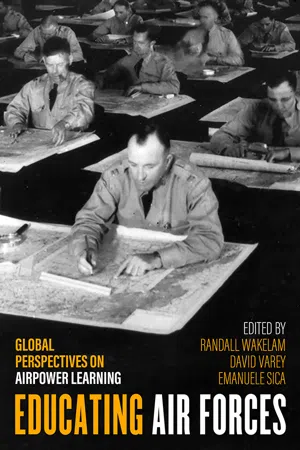
eBook - ePub
Educating Air Forces
Global Perspectives on Airpower Learning
- 254 pages
- English
- ePUB (mobile friendly)
- Available on iOS & Android
eBook - ePub
Educating Air Forces
Global Perspectives on Airpower Learning
About this book
Information
III
POST–COLD WAR EDUCATION
The Air Corps Tactical School and the School of Advanced Air and Space Studies
Educating America’s Air Force Then and Now
Harold R. Winton
Education in the present is the foundation of everything that happens in the future.
Congressman Ike Skelton, 1987
Military institutions serve their countries in two fundamental ways, both of which involve helping statesmen: they contribute to the preservation of peace by deterring potential opponents from threatening vital interests, and they provide the martial means with which to achieve desired political outcomes when deterrence fails. Both activities require broad knowledge and perspective combined with a high order of intelligence. Much of this depends on the warrior’s own efforts. But natural genius is rare, and autodidacts almost always have intellectual blind spots. Hence, institutional education is important and necessary. It is also, if properly constituted, economical, the costs of education being minuscule compared to the other requirements of maintaining effective fighting forces.
This chapter examines approaches to institutional education at two periods in the life of the US Air Force—one in its infancy, i.e., before it became a separate service, the other in its maturity as a full-fledged member of the American military establishment. The first embraces the period 1921 to 1940, the second 1990 to 2016. Both analyses address five issues concerning the educational institutions being discussed: origins and purpose, faculty, curriculum, students, and significance.1
THE AIR CORPS TACTICAL SCHOOL
The Air Corps Tactical School (ACTS) was indisputably the most important educational institution influencing America’s air arm between the world wars. This was true for two reasons: first, it was the only American educational institution devoted to the study of war in and from the air; and second, in the mid-late 1930s it became the intellectual incubator for the singularly contentious doctrine of high-altitude, precision, daylight bombing, a formulation that, in inevitable military fashion, became elided to a simple acronym—HAPDB.2 It was established at Langley Field, Virginia, in 1920 as the Air Service Field Officers School, later renamed the Air Service Tactical School. With the creation of the Army Air Corps in 1926, it received its final designation. In 1931 it moved to Maxwell Field, Alabama, where it remained until being suspended in 1940 due to the demands of mobilization for World War II.3 The vast majority of the school’s graduates, some 85 percent, came from the classes of 1931 to 1940. Furthermore, both the technological limitations of flight and the thinness of extant aeronautical literature limited the school’s curriculum during its first decade. Thus, this analysis will concentrate on the school during its years at Maxwell, 1931–1940.4
The intentions behind what became the Air Corps Tactical School changed perceptibly over time. In their original form they grew generally out of the US Army’s conviction developed during the late nineteenth and early twentieth centuries that military education was a necessary part of military professionalism, a belief reinforced by the experience of World War I. They also sprang particularly from the conviction among airmen that they had in their hands an instrument of significant—perhaps even revolutionary—importance to the future of war.5 Both the general and the particular were reflected in the adjutant general’s letter of 25 February 1920 authorizing establishment of the Air Service Field Officers School, which stated that instruction was to “fit the graduates for performance of duties that devolve upon officers of the Air Service” and thus to limit “the instruction in the tactics of other arms and in combined tactics” to that necessary to accomplish the first purpose.6 By the early 1930s, however, the school’s particular purpose, that of enhancing the place of the air weapon in future war, began to take on increasing significance, based not on official sanction from the War Department but in active opposition to its lack thereof.7
The school’s faculty were almost invariably men of noteworthy experience and high intelligence who went on to make significant contributions to national defense. The following list, with dates of faculty service indicated parenthetically, is illustrative. Joseph T. McNarney (1920–1924) commanded the 1st Corps Observation Group during the Chateau Thierry offensive of World War I; during World War II he served as George Marshall’s deputy chief of staff until being appointed deputy, and later, Supreme Allied Commander in the Mediterranean.8 William C. Sherman (1920–1923) set a new American record for flight endurance in 1913 and served as chief of staff of the Air Service in France during World War I. After publishing Air Warfare, one of the most sensible treatments of the subject of the interwar era, in 1926, he died prematurely a year later.9 George C. Kenney (1927–1931) accumulated extensive flying experience as an observation pilot during World War I while also gaining credit for two victories in air-to-air engagements with German aircraft. During the next war he commanded the American Air Forces in the Southwest Pacific, where he demonstrated flexibility and creativity in the development of new tactics, particularly the technique of skipping bombs along the water’s surface, which was used with significant success against Japanese transport ships.10 Kenneth N. Walker (1929–1933) was too young for service in World War I, but he made a name for himself from 1927 to 1928 as operations officer of the 2nd Bombardment Group, where he experimented with various formations to enhance bombers’ defensive posture and developed ideas for increasing the accuracy of bombing operations.11 During World War II he commanded the V Bomber Command under Kenney and was awarded the Medal of Honor after being killed while observing an attack on the Japanese stronghold of Rabaul.12 Laurence Kuter (1935–1937) entered the army in 1927 as a field artillery officer but transferred to the Air Corps in 1933 and graduated first in the ACTS Class of 1935.13 He later became one of the authors of Air War Plans Division Paper 1 (AWPD-1) of 1941, which detailed the expansion of the Army Air Forces for a possible war against both Germany and Japan. He was also instrumental in formulating the army’s 1943 doctrine for air-ground operations, which codified the principle that ground and air forces were co-equal and interdependent. Muir S. Fairchild (1937–1940) flew bombers in France during World War I, served as the Air Corps representative to Douglas Aircraft Company in the early 1930s, and was a graduate of both the Army War College and the Army Industrial College. During World War II he was a member of the Joint Strategic Survey Committee, the analytical arm of the Joint Chiefs of Staff.14 Toward the end of and after the war, he was instrumental in the formation and direction of the United States Strategic Bombing Survey (USSBS), a joint civilian-military effort to assess the effectiveness of American strategic bombing against Germany and Japan.15 In short, the ACTS faculty was composed of men who deftly combined thought with action.
These and other capable men devised a curriculum that served two purposes. The first was to expand the officers’ horizons and orient them on the characteristics and tactics of the army’s other arms and services, giving them knowledge that would not only make them more effective participants in combined-arms operations, but also equip them to perform well if selected to attend the Command and General Staff School.16 The second was to make them competent in the employment of the air instrument. The first objective was addressed in courses such as the history of World War I, military geography and strategy, infantry, artillery, ground logistics, and staff duties.17 The latter objective included, among other things, the study of large-scale air operations, balloons and aircraft, bombardment, pursuit (fighter) aviation, (ground) attack aviation, observation, navigation, and air logistics. Generally speaking, the former were taught in the first half of the academic year, the latter in the second. The air courses combined theory with practice.18 General precepts were articulated in lectures, which were followed by discussions of the content and practical problems to work out the details of execution.
But beginning in the early 1930s, and with increasing fervor thereafter, the curriculum took on the aura of an indoctrination into the efficacy of strategic bombing as a war-winning strategy, to the relative neglect of other air missions. Walker, Kuter, and Fairchild were among the more prominent members of the “Bomber Mafia,” but they were joined by several others, including Robert Olds, Harold George, and Haywood Hansel.19 David MacIsaac later provided a succinct summary of their argument, omitting only the original provision of the ACTS faculty that the bombers would not require fighter escorts:
the most efficient way to defeat an enemy is to destroy, by means of bombardment from the air, his war-making capacity; the means to this end is to identify by scientific analysis those particular elements of his war potential the elimination of which will cripple either his war machine or his will to continue the conflict; these elements having been identified, they should be attacked by large masses of bombardment aircraft flying at high altitude, in daylight, and equipped with precision bombsights that will make possible the positive identification and destruction of “pinpoint” targets; finally, such bombing missions having been carried out, the enemy, regardless of his strength in armies and navies, will lack the means to support continued military action.20
This dominant focus on the doctrine, some would later say dogma, of strategic bombing was the product of several impulses. The most basic was the general conviction among the faculty that the horrific bloodbath of World War I simply could not be repeated. This sentiment was complemented by a fervent belief that the power of the offense in aerial war significantly exceeded the efficacy of the defense. But there was also a widespread, firmly held realization that strategic bombing’s potential war-winning capacity constituted the single best argument for the creation of an independent American air service. Although there was resistance to the bombardment line of thinking by a small group of ACTS faculty, of whom Captain L. Claire Chennault was the most prominent, by the early 1930s the bomber advocates were clearly triumphant.21
From its inception until the four short courses of 1939 to 1940, the students who attended ACTS represented the upper crust of Air Corps officers, having been competitively selected based on official performance appraisals.22 This was reflected in their rates of promotion. The school graduated slightly fewer than 1,100 officers.23 By the end of 1947, 895 (86 percent) of the 1,036 graduates for whom data were available had attained at least the rank of colonel, and 275 (27 percent) had reached flag rank.24
But one must look more broadly to assess the school’s significance. The deficiencies of its strategic bombing doctrine have been widely noted. That construct underestimated the effectiveness of enemy air defenses, resulting in unsustainable casualties to bomber formations in the late summer of 1943.25 It overestimated the precision with which bombers could locate and strike their targets.26 It failed to account for what Clausewitz calls friction in war.27 It did not fully grasp the challenges of determining the vulnerabilities in an adversary’s economic system.28 The result was a pronounced divergence between aspiration and outcome.29 Nevertheless, the combined bomber offensive against Germany crippled that nation’s industrial system, and even as unbiased a historian as Richard Overy has concluded that “the air offensive was one of the decisive elements in Allied victory.”30 The American thinking behind that offensive, for better and for worse, was born at ACTS. And despite the school’s relative neglect of air-ground operations, it gave airmen such as Pete Quesada, whose IX Tactical Air Command supported the First US Army, and O. P. Weyland, whose XIX Tactical Air Command supported the Third US Army, a sufficiently broad knowledge of airpower’s capabilities to work out how to conduct such operations when they were called upon to do so.31 In sum, while far from perfect in its prognostications, ACTS made a net positive contribution to America and its air arm.
THE SCHOOL OF ADVANCED AIR AND SPACE STUDIES
During World War II, the Army Air Forces, like their land and sea equivalents, simply could not afford the luxury of an officer education system. Training in the technical and tactical aspects of aerial warfare was the closest thing to education the exigencies of active operations would permit. But when the US Air Force was established as an independent service in 1947, its leaders instantly grasped the imperative of educating its officers for the long haul. This need was particularly felt at a time when rapidly emerging technologies such as atomic weapons, jet engines, and ballistic missiles were pulling the service toward hitherto unanticipated modes of warfare. Thus, one of the air force’s first acts after its creation was to establish the Air University located at the recently redesignated Maxwell Air Force Base, Alabama, not coincidentally the site of the ACTS. The university’s major components consisted of: the Squadron Officer School, which educated captains; the Air Command and Staff College, which educated majors; and the Air War College, which educated senior lieutenant colonels and junior colonels.
The School o...
Table of contents
- Cover
- Half title
- Title
- Copyright
- Contents
- Foreword
- Introduction
- I. The Interwar Years
- II. The Cold War
- III. Post–Cold War Education
- Acknowledgments
- Contributors
- Index
Trusted by 375,005 students
Access to over 1.5 million titles for a fair monthly price.
Study more efficiently using our study tools.
Frequently asked questions
Yes, you can cancel anytime from the Subscription tab in your account settings on the Perlego website. Your subscription will stay active until the end of your current billing period. Learn how to cancel your subscription
No, books cannot be downloaded as external files, such as PDFs, for use outside of Perlego. However, you can download books within the Perlego app for offline reading on mobile or tablet. Learn how to download books offline
Perlego offers two plans: Essential and Complete
- Essential is ideal for learners and professionals who enjoy exploring a wide range of subjects. Access the Essential Library with 800,000+ trusted titles and best-sellers across business, personal growth, and the humanities. Includes unlimited reading time and Standard Read Aloud voice.
- Complete: Perfect for advanced learners and researchers needing full, unrestricted access. Unlock 1.5M+ books across hundreds of subjects, including academic and specialized titles. The Complete Plan also includes advanced features like Premium Read Aloud and Research Assistant.
We are an online textbook subscription service, where you can get access to an entire online library for less than the price of a single book per month. With over 1.5 million books across 990+ topics, we’ve got you covered! Learn about our mission
Look out for the read-aloud symbol on your next book to see if you can listen to it. The read-aloud tool reads text aloud for you, highlighting the text as it is being read. You can pause it, speed it up and slow it down. Learn more about Read Aloud
Yes! You can use the Perlego app on both iOS and Android devices to read anytime, anywhere — even offline. Perfect for commutes or when you’re on the go.
Please note we cannot support devices running on iOS 13 and Android 7 or earlier. Learn more about using the app
Please note we cannot support devices running on iOS 13 and Android 7 or earlier. Learn more about using the app
Yes, you can access Educating Air Forces by Randall Wakelam, David Varey, Randall Wakelam,David Varey,Emanuele Sica in PDF and/or ePUB format, as well as other popular books in History & Military & Maritime History. We have over 1.5 million books available in our catalogue for you to explore.