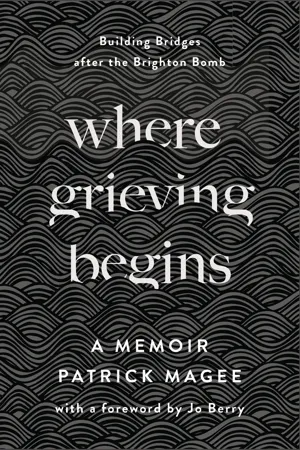
My given names are Patrick Joseph. Dad chose them in part to honour my great uncle, Patrick Joseph Magee, who had been killed on the Western Front in 1916. I say ‘in part’ because my baptism was the second occasion to do so; the first had a tragic outcome. My paternal grandparents, Joss and Susan Magee (née Steenson), wanted their firstborn son to be so named, but the child was stillborn. That was in 1923, while Joss was interned by the British for his part in the struggle against partition. Six years later, and after the birth of a daughter, Rose, Dad was born and was christened John, for baby Patrick was alive still in their hearts. The legacy skipped to me. My name therefore stands for both losses.
Dad’s line, the Magees and Steensons, and my maternal lineage, the Donegans and Robinsons, lived in pre-partition Ireland. My parents were of that first generation born within the six-county statelet. I was born in 1951, thirty years after its imposition. I therefore come from a blighted generation born into political impoverishment.
No one voted for partition. Actual violence and the threat of greater violence from the British and unionists created a gerrymandered political entity in which the Catholic/nationalist population (to use a convenient shorthand) was in a perpetual minority, bereft of the political muscle to counter the injustices facing us or to resolve our grievances through constitutional means.
Partition wept like an open wound through every decade of its imposition. The socialist republican leader James Connolly, writing in the Irish Worker (14 March 1914), had predicted that partition would cause ‘a carnival of reaction North and South … would destroy the oncoming unity of the Irish labour movement and paralyse all advanced movements’. Partition created two confessional, socially conservative political malformations. In the North, the bigotry, austerity and oppression of unionist misrule limited all and caused many to emigrate, thus offsetting the higher birth rate of the Catholic population. I was raised in England from the age of four after Dad crossed the water in search of work. This had later consequences. But I will start with those first remembered years of my Belfast infancy, for their influence on me and on my sense of self was a vital shaping factor in my development.
Mum was Philomena Donegan. She was pregnant when she married Dad, and they took a room in 29 Little May Street, where I was born in 1951. In those days, many young married couples had to lodge in neighbouring homes because of the overcrowding endemic to the poorest areas of the city, be they nationalist or unionist. Mum had grown up around the corner at 8 Catherine Street North, another small red-brick terrace on the edge of the Market district, beside the telephone exchange and close to the city hall. Due to the comparative grandeur of some Georgian features, a distinction was drawn between this side of the Market, the upper or city side, and the huddled backstreets behind Cromac Square, the lower or bridge side (given its proximity to the Albert Bridge). However, the houses in Little May Street were smaller than those in the once more fashionable Joy Street adjoining, where in the nineteenth century merchants and sea captains lodged, but still roomier, less pokey, than their counterparts across the square.
It was an area defined by and bustling with enterprise: the various markets, cattle yards, bakeries and the abattoir. Its huddle of streets housed some four thousand residents at that time. Although the housing conditions were grim, a constant refrain of locals was that nobody went hungry in the Market. A strong sense of community grew through an interdependence explicable in part by the common historical experience of existential threat. Memories of the anti-Catholic pogrom at the time of partition were a shared inheritance. Another tradition persisting to this day, despite much of the area now being unrecognisable due to the savagery of urban regeneration, is the insistence passed down that the district should be called the Market rather than pluralised, even though historically the area contained many distinct markets; for example, meat, poultry, cattle, variety and fish markets.
The Donegans originally hailed from the Mourne region of County Down, particularly from Castlewellan, Dundrum, Newcastle and surrounds. A previous generation had been farmers, but the land couldn’t support them all and they gravitated to Belfast, particularly to the Market and Ormeau Road, where they became dealers and small traders, barbers, tailors and shoemakers. Others emigrated and made good lives in New York and New Jersey. Great-Grandmother Donegan and family eventually settled in the Market, where other Donegans and Robinsons had already established a presence, after she and the family were burned out of Craigmore Street in the nearby Donegall Pass during the aforementioned anti-Catholic pogrom in, I reckon, August 1920.
My father, John Magee, was originally from Osman Street in the Falls, yet another red-brick terrace in the city’s nationalist heartland; identical in terms of the poor conditions they endured in subsequent moves the family made to nearby streets until they found a firmer foothold in Tyrone Street, Carrick Hill.
Magee is a common surname in the North and one shared by Protestants and Catholics – an advantage when a name might otherwise single you out for the other’s intolerance. Dad insisted we had an ancestor, a radical dissenter (that is ‘dissenter’ in the Protestant sense) who supported the United Irishmen, the original Irish republicans who had vowed up on McArt’s Fort, the giant basalt outcrop overlooking Belfast, to ‘break the connection with England, the never-failing source of all our political evils’. A booklet much prized by Dad called The Magees of Belfast and Dublin, Printers refers, he claimed, to this family branch. Recent interest stirred me to check whether Dad’s belief in this link held substance, but thus far it remains uncorroborated. However, its veracity is of less consequence than that he felt pride in believing it. This was a proud tradition – an identity – one I effortlessly assimilated.
I’ve only managed to verify the already known paternal line, from Belfast street directories and censuses going back to the turn of the 1900s, to addresses in what today is referred to as the Lower Falls: Steele Court, Baker Street, Theodore Street, Plevna Street, Lincoln Street and Servia Street, all in a quarter-mile westerly radius of Divis Street at the bottom of the Falls Road. That generation were Catholics and living in some of the poorest overcrowded tenements on the edge of the rapidly burgeoning industrial city. There were further moves: Bombay Street; Ardoyne; even a pre–World War II short residence in London. Both Mum and Dad were born in the old maternity hospital in Townsend Street.
Census returns reveal that women of the family worked in the nearby linen mills as flax spinners and reelers, the young men as flax dressers. In 1972, I briefly worked for a few nights as a cleaner in one of the surviving mills on the Falls, what is now the Conway Education Centre, and was struck by the dampness and cloying stench of the place and was moved at the thought of the poor women going back decades who had to endure those appalling conditions for lack of alternative employment, for little had changed. I knew neither of my grandmothers. They worked standing in water. Both died before I was born, of tuberculosis and of pneumonia.
When Dad sought work in England, Mum moved the fifty yards or so back to 8 Catherine Street North with me and her second born, my brother Sean, eighteen months younger than me. This is the point where my memory kicked in. My first datable memory is of Christmas 1953. I couldn’t then have known how old I was. But because I can recall two Christmases prior to our move to England, I know I was two and a half at the time. I can pinpoint an earlier memory: Sean, then nine months, bleeding after getting hold of a fork. Not a serious incident but certainly my first memory of blood – I would have been two years and three months old. I remember the moment when my sister, Susan, was brought home from the maternity hospital for the first time. Dad was home, in a suit. All very strange. I was three.
Dad became a somewhat distant figure to me. Mum struggled, I now realise, and Grandad (Henry) Donegan filled the void of his absence. Growing up, I always felt closer to the Donegans.
Grandad Donegan’s was one of four houses in that part of the street up to Hamilton Street. As a toddler I played on the polished red-and-cream patterned mosaic of our hallway stoop, which I’m told Henry tiled himself. On the corner of Hamilton Street was the Tyrone Cattle Yard. There was also a gated entrance to a big courtyard, accessible as well through each backyard, where an outside iron staircase led up to Jack Robinson’s boxing gym, the St George’s ABC. It had at one time been known as Robinson’s Gym. Jack would call in to Grandad’s daily. Known as Blind Jack, because of his poor eyesight, he was an uncle of my grandmother, Ellen (Lena). Jack had a son, Spike, a notable local boxer in the 1930s (and who, incidentally, later became a close friend of Joss). My uncle, Seamus Donegan, who at one time was himself an amateur boxer (although remembered to this day more for his prowess with the skipping rope), used to act as a guide for Jack. As a toddler I would scale the external cast-iron steps leading to the gym door only to be escorted back down as soon as my presence was noted by one of the hopeful contenders therein. Below the gym were stables for hire. I recall seeing circus ponies, still regaled in their fancy harnesses and plumage. Mum confirmed before her death a story she used to tell us as children that as a girl she had seen elephants being stabled there.
My maternal grandmother, Lena, is recorded as born in North Camp near Farnborough, England. Lena’s mother, my great-grandmother, Annie Heaphy, was from Fermoy in Cork. Prior to partition, at one time Fermoy was the main British Army garrison in Ireland. She married a British soldier stationed there, George Robinson. Census returns confirm that the Robinsons were a peripatetic family, following the various postings of a regular soldier, although they put down firm roots in County Down and Belfast.
Directly across the street from Grandad’s was the side of the Fiesta dance hall, a converted Nissen hut, which fronted Hamilton Street. I’ve heard that during World War II, American troops were billeted there. At weekends I would eventually fall asleep despite the music reverberating through its corrugated shell. Other sounds, and smells, came from the port and docks. The heavy odours of this busy dockland sprawl overwhelm any recall of the near-pastoral redolence of the place in England where Dad would later bring us to and where I was to spend most of my childhood, Norwich (which I will come to). Beside the Fiesta, to the corner of Little May Street, was a garage or tyre depot. There was straw in the street because cattle would frequently be driven through to one of the nearby stockyards. Front doors had to be closed to bar steers from entering. When one managed to slip the cordon, as it were, it had to be shooed through to the backyard of the house, for it was impossible to turn the beast in the narrow hall passage. Worse if the unfortunate critter mounted the stairs. I’ve a now faint vision of Aunt Bridget, Mum’s twin, feigning comic hysterics (or maybe for real) at the top of the stairs as a bullock clambered up towards her. At night, from the pantry window I could make out work shirts and dungarees flapping on the line in the small backyard, but my Uncle Harry, Mum’s younger brother, would point and convince me the bogeyman was outside. A large tin bath hung on the wall facing the door to the yard. There was an outside toilet. When dark, a candle was needed. Rats were a problem. There was a house in Hamilton Street, still standing, where Mum would buy milk, that had a pair of ‘Western’ longhorns on display in the hallway.
Grandad Donegan was a shoemaker and an amateur photographer, and he worked from a room at the back of the house on the first landing where the stairs turned, or the turn room, as I’ve heard it called. The smell of shoe leather takes me back there, a toddler dwarfed by strange shaping and cutting machines. Mum says that her granny, who was a dealer, used to buy old shoes from one of the markets nearby for Henry to either repair or use as base material for making recycled footwear. In photos she comes across as a stern, matriarchal figure with strong features topped by steely white hair. A woman not to be messed with. Grandad slept in the parlour, his domain. Evidently, he was a busy amateur, and I can still recall the mystery of the rolls of drying film hanging from lines above. On Saturday nights the parlour hosted ceilidh sessions, and two of his brothers, Hughie and Jack, with friends, would play reels on fiddle, mandolin and accordion. I’m told Grandad played the fiddle, as did Jack, but I have no memory of this. I do have a faint recall of songs they would sing in turn: ‘The Mountains of Mourne’ and ‘Courtin’ in the Kitchen’. Most were old IRA men, although I am older now than they were back then. I would be brought into the parlour to say goodnight, indulged for a minute then ushered out so that the men could play in peace.
For Down people moving to Belfast for work, the Market was a natural first port of call. But they were Down people first and always. These ceilidh weekends helped to bind them to their roots. I used to gather the coloured porter-bottle tin tops left in the wake of these sessions and would play with them on the tiled porch. There always seemed to be music. Grandad had a gramophone, the centrepiece in our pre-television scullery, and dozens of old 78 rpm records, of Jimmy Shand, light opera, the hits of the day. Mario Lanza’s recording of ‘Drinking Song’ from The Student Prince is the first song I can identify, a big hit following the release of the film in 1954.
These first memories, more a flurry of impressions, became indelibly set, strong to this day, and provided a rich seam to mine while growing up in England, where I often sought comfort in recollection of the harmony and warmth I missed and felt wrenched away from and which I associated with Belfast, more specifically Grandad’s. It was all to change when I was four, in July 1955, when Dad brought us across the water to Norwich, where he had found work. The family had no connections there. He had served an apprenticeship in the Harland and Wolff shipyards in Belfast as a steel plater, but at the end of his apprenticeship there was no job. After stints in the Barrow-in-Furness shipyards and on Humberside, he ventured south to Norwich and must have liked what he saw because, with his boss’s help, he put a down payment on a house for us in Armes Street, a two-up, two-down terrace. While Dad was away working, Mum would take me to a nearby phone box to receive arranged calls with him. Grandad Donegan was scathing with her before our departure: ‘Yer in for a quare gunk … You’ll never sit yer arse in England.’ She also remembered him admonishing her by telling Bridget, ‘Light a candle. She needs a prayer said for her.’
Mum was excited in the days before we left, which she tried to instil in me, but apparently I was resistant to the move, to the extent that I knew what was happening; and when Dad returned for us I had to be coaxed and consoled with promises of the new toys awaiting me in our new home. We left only days later. My last memory of leaving Belfast is of ships in the harbour; of seamen leaning along the entire length of the hull rail of a huge black ship.
Until I was six I assumed that the move to England was temporary. I would pester Mum about when we would be going home. I think she was in two minds and didn’t herself fully regard Norwich as permanent. In the course of the next few years relatives would visit us, and there were occasional trips to Belfast, reinforcing the attachment. I would rehearse the all-day train journey in my head, Mum, Dad, me, Sean and Susan scrambling to make the ‘boat train’ connection at Leeds, Mum in a perpetual flap, Dad calm, organised. We would arrive at the Heysham ferry when it was dark, then the all-night, often rough crossing. Passengers would openly throw up in the passageways, and the stench of vomit and salt water was heavy on the nostrils. From our cabin window I remember seeing strings of lights way off in the blackness as the ferry passed the Isle of Man. Then the early-morning docking in Belfast. Back in Norwich, the distant sound of a goods train brought the journey to mind. I even imagined the unseen local train to be destined for the ferry. I prized a postcard from Grandad which depicted Belfast City Hall in all its Victorian splendour, and because of it being situated in spitting distance from the Market, a familiar sight to me even as a toddler. Belfast had come to assume mythic proportions.
Mum was a great storyteller, and as we – Sean, Susan and I – sat around the hearth, she would recreate wonderful events from her own childhood in the Market, even finding humour in recounting incidents from the Belfast Blitz of 1941, reinforcing my own sense of displacement and longing to be back there. Mum, then eleven, had known the horror of the bombing but turned it into a tale suitable for our amusement. For Sean and Susan, being younger, the ties back were not as tangible. Susan had only been ten months old when we left.
World War II had ended ten years previously, but there were still indicators in Norwich. The bombed-out shell of Heigham Methodist Chapel stood at the corner of Armes and Nelson Street. We – I and neighbouring kids – played among the rubble, open to the heavens. There were many prefabs close by, built as emergency housing for returning servicemen and their families. It was common to see men wearing black army berets. One who lived nearby made a precarious living from selling locally cut props for washing lines. We were that close to woodland. A schoolmate’s father had a full German uniform, a war souvenir. Another, a service revolver. I found a gas mask in a collapsed air-raid shelter. But the post-war became the Cold War, and air-raid siren drills were quite common, a welcome disruption to the school routine. Another occasion for a day off was when the Canadian Mounties came to town, escorting the English queen’s cavalcade past our school – St John the Baptist, Junior.
One day, Mum gathered us around in the kitchen – I was six. We were no longer to call her Mammy, the Belfast practice, and instead use Mum, like the English kids. Sean and Susan had much less of a problem with this change than I did. To me it sounded daft. Mammy was Mammy. Years later, returning to Bel...