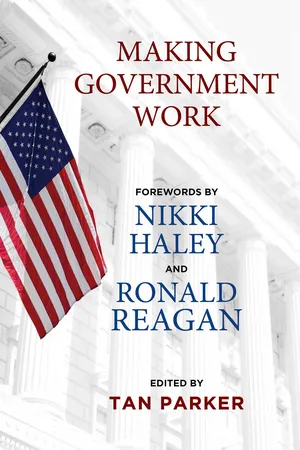
Making Government Work
eBook - ePub

Making Government Work

  1. 256 pages
  2. English
  3. ePUB (mobile friendly)
  4. Available on iOS & Android
eBook - ePub

Making Government Work

About this book

Making Government Work: A Conservative Agenda for the States is an updated version of the highly acclaimed 1994 original book. It serves as a modern-day guide for how as Americans we can move the states forward with common sense, conservative public policy initiatives to benefit the Nation as a whole. Making Government Work is a reminder that conservative reforms set the stage for unprecedented prosperity. The book contains a star-studded line up of some of today's most powerful voices, including Nikki Haley, Chuck Norris, Rick Perry, Kathy Ireland, Rick Santorum, Chad Hennings, Jeb Bush, Dr. Art Laffer and Bob Woodson along with many more. " Making Government Work is for state government what the Contract with America was for the federal government. It is a sensible, fact based plan to create a better future through the application of sound principles." –Newt Gingrich, former Speaker of the House The author's proceeds from the book will be donated to organizations that serve America's veterans.
Frequently asked questions

Yes, you can cancel anytime from the Subscription tab in your account settings on the Perlego website. Your subscription will stay active until the end of your current billing period. Learn how to cancel your subscription.
No, books cannot be downloaded as external files, such as PDFs, for use outside of Perlego. However, you can download books within the Perlego app for offline reading on mobile or tablet. Learn more here.
Perlego offers two plans: Essential and Complete
  • Essential is ideal for learners and professionals who enjoy exploring a wide range of subjects. Access the Essential Library with 800,000+ trusted titles and best-sellers across business, personal growth, and the humanities. Includes unlimited reading time and Standard Read Aloud voice.
  • Complete: Perfect for advanced learners and researchers needing full, unrestricted access. Unlock 1.4M+ books across hundreds of subjects, including academic and specialized titles. The Complete Plan also includes advanced features like Premium Read Aloud and Research Assistant.
Both plans are available with monthly, semester, or annual billing cycles.
We are an online textbook subscription service, where you can get access to an entire online library for less than the price of a single book per month. With over 1 million books across 1000+ topics, we’ve got you covered! Learn more here.
Look out for the read-aloud symbol on your next book to see if you can listen to it. The read-aloud tool reads text aloud for you, highlighting the text as it is being read. You can pause it, speed it up and slow it down. Learn more here.
Yes! You can use the Perlego app on both iOS or Android devices to read anytime, anywhere — even offline. Perfect for commutes or when you’re on the go.
Please note we cannot support devices running on iOS 13 and Android 7 or earlier. Learn more about using the app.
Yes, you can access Making Government Work by Tan Parker in PDF and/or ePUB format, as well as other popular books in Politique et relations internationales & Gouvernement américain. We have over one million books available in our catalogue for you to explore.

Federalism and the American Experiment: The Intention of the Constitution

by Professor Richard J. Dougherty
The drafting of the U.S. Constitution, which began on May 25, 1787, in the Pennsylvania State House and ended on September 17 of that year, is one of the greatest achievements in all of human history. The Constitutional Convention in Philadelphia created the framework for our nation. Once the ratification process was completed by each state, the Founders had created the most significant political document the world has ever known. The delegates to the convention in that summer of 1787 accomplished something unimaginable in just under four months. These Founders established the supreme law of the United States that has governed our nation beautifully for over 230 years. Our Founders established Federalism—the balance of power between the state governments and the federal government. The Founders also placed internal limits on government through the creation of the separation of powers and through the establishment of the Tenth Amendment, which guarantees states’ rights. No one better understands or is able to more clearly explain our extraordinary founding documents than Professor Richard J. Dougherty, who is one of the leading constitutional scholars in the United States today. Throughout his career he has focused on constitutionalism and the principles of American politics, the presidency, and America’s founding. He is the chairman of the Department of Politics and the director of the Center for Christianity and the Common Good at the University of Dallas (UD). I am very thankful to Dr. Dougherty for being such a wonderful teacher for me as a young man at UD and for accepting my invitation to write the historical context and framework for Making Government Work.
—Tan Parker
Contemporary debates about the proper scope and function of exercises of public power at the national level rightly often focus on issues such as the role of the federal bureaucracy, the separation of powers, executive overreach, and examples of judicial lawmaking from the bench. What these issues have in common is the way in which all the sectors of the federal government have undermined the legitimate role that state and local power were intended to play under our constitutional design.
Discussions of the proper role of state power regularly focus on distinctions between conservative and progressive views of policy and initiative, with conservatives typically being described as the more militant defenders of local power. But this is an outdated way of thinking of the question of federalism, as numerous policy issues have arisen that suggest a more robust interest in state and local power might in fact be used to forward more progressive causes, such as the legalization of marijuana and assisted suicide guidelines
For example, abortion, the most heavily debated of public policy and moral issues over the past half-century, is not so clearly understood along the older lines of thinking—there is certainly some concern among those favoring the right to abortion that a conservative Supreme Court might, for instance, simply ban the practice outright, perhaps by adopting the principle that the unborn child deserves protection as a person under the Fourteenth Amendment’s “due process” clause.1
The importance of federalism, then, is not that it serves a particular political agenda. Rather, the issue is one of the structure and meaning of the fundamental institutions and operations of American government, intended as they are to serve the protection of the interest of liberty and the rights of American citizens. Undermining the intended form of the constitutional design serves as a direct threat to the protection of those rights and interests, and it thus behooves all parties to be concerned about the intervention of the heavy hand of the federal government in the lives of its citizens.
The increased role of the federal government in policy-making and enforcement has resulted in the proliferation of federal programs and agencies, many of which have virtually no accountability to the American citizenry. The proper solution to much of what concerns our society today is not to turn to bodies of unaccountable “experts” whose decisions about policy concerns are unconnected to the real interests of constituents. As always, the real solution to our very real problems is always more politics, not less politics.

THE FOUNDERS ON FEDERALISM

General dissatisfaction with the Articles of Confederation at the time of the American founding led to the call in 1786 for a convention to correct or improve the Articles, eventually leading to the convening of the Constitutional Convention in May 1787. The delegates to the convention quickly recognized the need to start over in the construction of a new arrangement, which resulted in the drafting and ratification of the Constitution in 1787 and 1788. One of the central questions was the role that the states would play in this arrangement.
Surely Publius saw the efforts of the states under the Articles of Confederation as ineffective, and he suggests in the Federalist Papers the cause of that incapacity. He describes in Federalist No. 15 what he considers the “great and radical vice” of the Articles, which is to be found in “the principle of LEGISLATION for STATES or GOVERNMENTS, in their CORPORATE or COLLECTIVE CAPACITIES, and as contradistinguished from the INDIVIDUALS of which they consist.”2 In other words, the federal or general government, to be effective, must have some capacity to pass laws directly affecting individual citizens and not be beholden to the individual states to carry out national policies. The states under the Articles were seen as too often dragging their feet on implementing those policies, or even through their open hostility to the general government as simply disdainful of the ends it was promoting.3
But for advocates of the Constitution, the fact that the general government would have more power did not mean this power would be unlimited. There was no question, in other words, that the state and local governments would maintain a good degree of authority. Publius in the Federalist Papers attempts to persuade the defenders of state authority that the Constitution maintains substantial state power:
The proposed Constitution, so far from implying an abolition of the State governments, makes them constituent parts of the national sovereignty, by allowing them a direct representation in the Senate, and leaves in their possession certain exclusive and very important portions of sovereign power.4
One way in which Publius makes the point is to argue that the Constitution as proposed contains, in fact, a mixture of forms, such that it cannot be accurately described as simply national—meaning consolidating all power—nor simply federal, because it is both at the same time:
The proposed Constitution, therefore, is, in strictness, neither a national nor a federal Constitution, but a composition of both. In its foundation it is federal, not national; in the sources from which the ordinary powers of the government are drawn, it is partly federal and partly national; in the operation of these powers, it is national, not federal; in the extent of them, again, it is federal, not national; and, finally, in the authoritative mode of introducing amendments, it is neither wholly federal nor wholly national.5
The Founders did not envision a federal government with unlimited power and reach that could or would commandeer all power unto itself or supplant the power of states exercising their legitimate authority. Because the Constitution does not empower the new government to exercise unlimited or unrestricted power, in Publius’s view “the proposed Government cannot be deemed a national one; since its jurisdiction extends to certain enumerated objects only, and leaves to the several States a residuary and inviolable sovereignty over all other objects.”6 Understanding the limits of that crucial phrase, “certain enumerated objects,” is central to acknowledging the Framers’ design.
What are those enumerated objects? Publius gives us an account of what they would be in Federalist No. 56, rebutting the claim that the House of Representatives would be too small and that the members would thus not have sufficient knowledge of their constituents’ needs and interests. Publius notes that representatives do not have to be aware of every particular need of the constituents since the federal government is not entrusted with addressing these matters comprehensively. “What are to be the objects of federal legislation?” he asks. “Those which are of most importance, and which seem most to require local knowledge, are commerce, taxation, and the militia.”7
In other words, the government is not entrusted with care over the everyday activities of its citizens, and thus requires only limited local knowledge.8 There would be no doubt, then, that from the Founders’ point of view the individual states would continue to play a substantial role in the direction of public policy and enforcement of the law.
Indeed, in Publius’s understanding the states would maintain their prominence, given their role in “the ordinary administration of criminal and civil justice,” which activity he asserts is “of all others… the most powerful, most universal, and most attractive source of popular obedience and attachment.”9 There is a normal and natural attraction that people have for the bodies that are closer to them, especially when they see those bodies actively maintaining their liberty and security; it serves as the “great cement of society,” in Publius’s words.10

HISTORICAL DEVELOPMENTS

How, then, did the United States move from the founding-era conception of political liberty and federalism to the contemporary era, where the federal government’s influence is so far felt in so many areas of American life?11 There are numerous factors that contributed to that shift, including the political, economic, military, and social changes that have taken place over the course of the past centuries. But the crucial point to recognize is that they were almost all entirely a result of specific choices made at particular times in American history.
An examination of just one example among many such choices will be worthwhile—the regulation of interstate commerce as a mechanism for expanding federal influence.
Historically, there were two general principles that guided the regulation of commerce by the federal government. One principle was that Congress could only regulate matters that were directly connected to interstate commerce. The other was the recognition of the difference between manufacturing and trade.12
“Trade” was subject to federal regulation if it was trade across state lines, but “manufacturing” was generally understood to be by definition not interstate, and thus manufacturing could not be included in Congress’s powers to regulate “commerce” among the states. Yet, these distinctions came to be rejected by both Congress and the Supreme Court in the New Deal era, opening the door for vast expansions of interstate regulation.
An understanding of the process of the expansion of the conception of commerce can be found in comparing two cases from the first half of the twentieth century, Hammer v. Dagenhart, decided in 1918, and United States v. Darby Lumber Company, decided in 1941. Both cases dealt with the issue of child labor laws, but came out quite differently on the merits.
In Hammer, the Supreme Court struck down a federal labor law (the Keating-Owen Child Labor Act of 1916) that sought to impose a national age limit on child labor.13 Dagenhart sued on the grounds that Congress did not have the authority to regulate manufacturing, which was distinct from commerce, and the Court upheld his challenge to the law. Justice Day, writing for a divided Court, began by articulating a broad understanding of the American political order, specifically as it relates to the principle of federalism:
The maintenance of the authority of the states over matters purely local is as essential to the preservation of our institutions as is the conservation of the supremacy of the federal power in all matters entrusted to the nation by the federal Constitution.14
The legitimate authority of Congress to regulate commerce “among the several States,” granted in Article I, Section 8, of the Constitution, does not extend to regulating the manufacturing of goods; thus if there is going to be any such regulation it must be done by the states.15 As Justice Day notes, in the early and important 1824 Gibbons v. Ogden case Chief Justice Marshall, in defining the extent and nature of the commerce power, said, “It is the power to regulate; that is, to prescribe the rule by which commerce is to be governed.”16 Day reads this to mean that Congress does not have the authority to prohibit or eliminate commerce—he says to “destroy” it—but only to prescribe the means by which or through which the commerce can move. Thus, he argues, any further regulation that might be exercised is left to the hands of the states:
In interpreting the Constitution it must never be forgotten that the nation is made up of states to which are entrusted the powers of local government. And to them and to the people the powers not exp...

Table of contents

  1. Cover
  2. Title Page
  3. Dedication
  4. Foreword by Ronald Reagan
  5. Foreword by Nikki R. Haley
  6. Preface
  7. Acknowledgments
  8. 1. Federalism and the American Experiment: The Intention of the Constitution
  9. 2. Guidelines for Pro-Growth Tax Reform for the States
  10. 3. A Commonsense Guide for the States: The Texas Model
  11. 4. Making American Health Care Great: A Conservative Agenda for States to Create Innovative Health Care Markets
  12. 5. Religious Liberty and the Human Good
  13. 6. Three Cheers for the Electoral College
  14. 7. Labor Unions and the Public Sector
  15. 8. Our Energy Future
  16. 9. God’s Green Earth
  17. 10. Choosing the Best for Our Children
  18. 11. Restoring Public Universities as the Marketplace of Ideas
  19. 12. Getting Right on Crime
  20. 13. The Texas Model of Tort Reform
  21. 14. The U.S. Infrastructure Crisis: Enough Talk Already
  22. 15. The Conservative Path to Immigration and Border Security Reform
  23. 16. From Serving the Nation to Coming Home: How State and Local Governments Can Assist in Veteran Transition
  24. 17. Legislative Aftershock
  25. 18. Defending the Second Amendment
  26. 19. America’s Greatest Asset: The Family
  27. 20. Every Life Matters
  28. 21. Addressing the Social Fabric of Our Society
  29. 22. The Media: “Goodbye, Iphigene”
  30. 23. Revitalizing Low-Income Communities—from the Bottom Up and the Inside Out
  31. Contributor Biographies
  32. About the Editor
  33. Notes
  34. Copyright