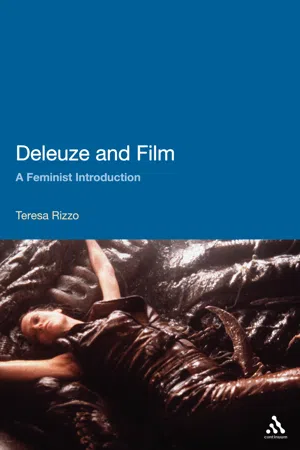
In the first book-length introduction to Deleuze's work
on film from a feminist perspective, Teresa Rizzo ranges across Deleuze's books
on Cinema, his other writings, and feminist re-workings of his philosophy to
re-think the film viewing experience. More than a commentary on Deleuze's books
on Cinema, Rizzo's work addresses a significant gap in film theory, building a
bridge between the spectatorship studies and apparatus theories of the 1970s,
and new theorisations of the cinematic experience. Developing a concept of a
'cinematic assemblage', the book focuses on affective
and intensive connections between film and viewer. Through a
careful analysis of a range of film texts and genres that have been important
to feminist film scholarship, such as the Alien
series and the modern horror film, Rizzo puts Deleuze's key concepts to
work in exciting new ways.
- 208 pages
- English
- ePUB (mobile friendly)
- Available on iOS & Android
eBook - ePub
About this book
Information
1
The cinematic apparatus and the transcendental subject
Psychoanalytic feminist film theory offers a detailed examination of film spectatorship and of its implication for sexual difference. The concept of the cinematic apparatus has been central to this work. However, this has brought with it certain difficulties. Mary Ann Doane speaks of an ‘exhaustion’ and ‘impasse’ for psychoanalytic film theory, closely linked to ‘its activation of the metaphor of the apparatus or dispositif’.1 The reasons why the concept of the cinematic apparatus might have caused an impasse are complex and they will be addressed presently. First, however, the main problems need to be briefly outlined. The manner in which film theorists such as Christian Metz and Jean-Louis Baudry theorized the cinematic apparatus as a spatial structure based on monocular perspective and the topography of Plato’s cave has been one of the primary causes of the impasse. By doing so they were able to argue that the cinematic apparatus is based on an identification with an all-seeing transcendental subject. The problem with this kind of identification is that the transcendental subject is ahistorical, atemporal and disembodied – causing cinema’s temporal qualities to be overlooked. Moreover, by privileging space over time, the cinematic apparatus produces only one mode of viewing, because the movement that is so central to cinema is ignored in favour of an identification with a point in space. Without movement and without temporality the cinematic apparatus not only produces the same mode of viewing but also the same kind of spectating position over and over.
Gilles Deleuze’s approach to cinema provides useful tools with which to explore previously under-examined dimensions of this apparatus. In contrast to the cinematic apparatus, Deleuze’s distinction between the movement-image and the time-image offers the potential to distinguish different kinds of viewing arrangements, not simply between the movement-image and the time-image, but also in relation to the many possibilities that emerge from his large taxonomy of images within the movement-image and the time-image. Interestingly, although his books on cinema were written at a time when theories of the cinematic apparatus were extremely influential in film theory generally, Deleuze makes no reference to them. In fact, the Cinema books say very little about spectatorship and the role of the spectator.
Nonetheless, although not addressed directly, forms of spectatorship are implied and Deleuze certainly discusses a cinematic subject. The perception-image, for example, produces a cinematographic consciousness that is able to articulate a subjective and objective perception simultaneously. For Deleuze this introduces the viewer to a non-human, specifically cinematographic, form of perception. While this is not a spectating position, as psychoanalytic film theory understands it, it is certainly a means of engaging the viewer. In addition, some of the types of images, such as the affection-image and the time-image, can readily be examined in terms of how they engage viewers. The final section of the chapter will examine in detail how Deleuze’s camera consciousness challenges some of the fundamental aspects of the cinematic apparatus and connects with the viewer in new ways.
Deleuze’s focus on cinema’s qualities of movement and temporality also offers a very different idea of transcendence and the transcendental subject from that proposed by theorists of the cinematic apparatus. His notion of transcendental empiricism is based on experimentation, on change, and is open to the new. It takes into account sensations and the materiality of life. A transcendental field, he writes, is ‘a pure stream of a-subjective consciousness, a pre-reflexive impersonal consciousness without a self’.2 Transcendental empiricism is beyond the conventional understanding of a straightforward sensation or ‘simple empiricism’, because it relates to the passage from one sensation to another. Through affective engagements cinema continually produces passages of sensations or becomings.
Furthermore, according to John Rachman, ‘[t]ranscendental empiricism may then be said to be the experimental relation we have to that element in sensation that precedes the self as well as any “we”, through which is attained, in the materiality of living, the powers of “a life”’.3 The ‘we’ and the type of ‘life’ Deleuze invokes are not ego-centred, but impersonal. Life is unique not because an ego-centred self experiences it, but because it relates to the moment of becoming or the moment different connections produce something new and singular. Cinema articulates Deleuze’s notion of transcendental empiricism because, unlike the cinematic apparatus, it is based on movement and temporality.
Re-thinking the cinematic experience through movement and temporality represents an important project for Deleuzian film theory. However, it also represents a crucial project for feminist film theory to get beyond the impasse created by the deployment of the cinematic apparatus. A critique of the cinematic apparatus and the means by which it produces a transcendental subject is a crucial step in this process. In order to work through some of the problems that have led to the decline in feminist engagement with spectatorship theory, the first section of this chapter undertakes a detailed analysis of the cinematic apparatus and feminist responses. The second section outlines the problems with the transcendental cinematic subject as understood by theories of the cinematic apparatus. This analysis is followed by a discussion of Deleuze’s concept of the perception-image as a means of confronting the problems inherent in the transcendental cinematic subject, in particular in relation to difference.
Section 1: The cinematic apparatus
Within theories of cinematic apparatus and psychoanalytic feminist film theory, an understanding of how cinematic identification operates varies from theorist to theorist, as well as within the work of the same theorist in different periods. For example, as Doane has pointed out, 4 there is a significant difference between Baudry’s theorization of looking, identification and spectatorship in his first essay on the cinematic apparatus, published in 1970,5 and his second, published a few years later.6 This shifting ground shows how dangerous it can be to generalize when discussing the problems inherited from theories of the cinematic apparatus. For all that, one thing remains constant: the difficulty these processes pose for difference. Theories of the cinematic apparatus tend to produce a generalized, universal subject, be it male or female. In order to understand why this occurs, we need to outline the main theoretical components that make up the framework of the cinematic apparatus.
The concept of the cinematic apparatus takes into account various mechanisms and processes that constitute the cinematic experience, including the narrative structure, the ideological nature of the apparatus, the technology involved, as well as the psychological aspects of the process. Theories of the cinematic apparatus do not see these various aspects as separate, but are interested in how they work together. Central to this argument is a process of identification that is activated by a system of looking, one that brings together the various components of the cinematic apparatus to produce both meaning and a cinematic subject. The link between looking and cinematic identification is a complex one, comprising a variety of theories and discourses: Sigmund Freud’s work on the development of the ego and his theory of voyeurism; Jacques Lacan’s theory of subject formation (in particular, his theory of the mirror stage); Louis Althusser’s theory of ideology, a powerful analogy between the cinema and the allegory of Plato’s cave; and, finally, the concept of monocular perspective, a geometrical arrangement of space inherited from Renaissance perspective.
Theorists of the cinematic apparatus argue that a film requires the unconscious work of the spectator in order to be able to generate meaning, and furthermore, that this unconscious work also produces a cinematic subject. Robert Stam, Robert Burgonyne and Sandy Flitterman-Lewis argue that a psychoanalytic approach understands film viewing and subject formation as reciprocal processes: that ‘something about our unconscious identity as subjects is reinforced in film viewing, and film viewing is effective because of our unconscious participation’.7 Crucial to this process is Lacan’s proposition that the subject exists in language.8 Lacan emphasizes the importance of certain structures of language in subject formation and meaning making. He argues that language is structured around certain subject positions that are waiting to be filled. By taking up these positions, an individual is constituted as a subject. More specifically, the personal pronouns ‘I’ and ‘you’ already exist in language and when an individual makes use of these pre-existing positions s/he is constituted as a subject. It is through the act of saying ‘I’ that one becomes a subject. Furthermore, language also positions us as ‘“he” or “she”; it constructs us even as we assert ourselves as subjects within it’.9
David N. Rodowick observes that Lacan’s work on subject formation was taken up primarily from Althusser’s ideological application of it. For Althusser, institutions contain similar structures of subject formation to those found in language. They contain pre-existing subject positions for individuals to take up, and, in the process of taking up these positions, individuals become subjects. By becoming subjects of the institution, however, they also become imbricated in its ideology. Althusser argues that ‘all ideology hails or interpellates concrete individuals as concrete subjects’.10 While Althusser’s work on subject formation may be useful in understanding cinema’s potential for producing ideological positions with which to identify, it does not explain exactly how the scopic system found in cinema participates in this process. For this purpose apparatus theorists deploy another aspect of Lacan’s theories of subject formation – the mirror stage.
For Lacan, while subjectivity is the result of language acquisition or entry into the Symbolic, the process of subject formation actually begins at a previous stage, which is dominated by the visual and which he calls the Imaginary. A central mechanism of the Imaginary is the mirror stage.11 It is a process that occurs in children between the ages of 6 and 18 months. The infant recognizes its image in the mirror and identifies with it. It also becomes aware of its separateness from the adult holding it and therefore also its separateness from all other people. This recognition of the self as a distinct entity marks the beginning of the formation of the ego. However, this process is complicated in two ways. First, the image of itself in the mirror, with which the child identifies, is an idealized image. This is because, at this stage of their development, the child’s visual capacities are far more developed than their motor capacities. While the infant still feels itself to be fragmented and uncoordinated, it perceives the image of itself in the mirror as more coordinated and unified. Lacan says of the image of the self in the mirror, ‘in relation to the still very profound lack of co-ordination of his own motility, it represents an ideal unity, a salutary imago’.12 Identification therefore is not based solely on recognition, but also on misrecognition. In addition, identification with the image in the mirror is also identification with the self as other, or with the self as elsewhere.13 As a result, the self that emerges from this process of recognition is split and alienated. If the emergence of a separate and unified identity is dependent on another, then the self also has the potential to be its own other.
For theorists of the cinematic apparatus such as Baudry and Metz, Lacan’s mirror stage forms the basis for a theory of cinematic identification. The cinema screen is likened to the mirror, except for one striking difference: as Metz has observed, unlike a mirror the film does not reflect back our own image for us to identify with.14 Who or what do we then identify with? According to Baudry and Metz, while we may identify with certain characters on the screen, this identification is only secondary. Our primary identification occurs with the camera and the act of looking itself. This is because the other on the screen cannot see us, yet, because the camera has looked and recorded for us, we are positioned in a way that invites us to look. Metz suggests that at ‘the cinema, it is always the other who is on the screen; as for me, I am there to look at him. I take no part in the perceived, on the contrary, I am all-perceiving’.15 This implies that there is a significant difference between the operation of identification in Lacan’s mirror phase and in Metz’s cinematic primary identification. In Lacan’s mirror phase a sense of a unified and separate identity is dependent on the other in the mirror, whereas for Metz a unified identity is the result of an identification with the camera and therefore with the act of seeing. It appears then that theorists of the cinematic apparatus ignore the role of the other in the mirror phase. Metz’s transition, from an identification with the self as other in the mirror to an identification with the self as pure perception, is quite radical. It is the view of both Doane and Joan Copjec that he achieves this by melding Lacan’s theory of the mirror stage with Renaissance monocular perspective, and in so doing distorts and misrepresents Lacan’s theory of the gaze. 16 This shift is central to cinematic identification’s creation of a transcendental subject that is both ahistorical and unchanging.
Metz also endows looking with mastery and control by connecting cinematic looking to Freud’s concept of scopophilia – the drive to look and the pleasures derived from it. He distinguishes between two kinds of look associated with scopophilia – active voyeurism and narcissistic identification. Active voyeurism coincides with primary identification, that is, with the camera and with the self as all-perceiving and associated with mastery. Narcissistic identification coincides with secondary identification, and as such with an identification with the protagonist as a more perfect self. According to Metz, this form of identification parallels the dynamic found in Lacan’s mirror stage, in which, by means of a process of misrecognition, the infant identifies with a more unified and perfect self.17
Metz argues that one of the major sources of cinematic pleasure is produced because the spectator is positioned at a distance from the images on the screen in two ways. First, s/he is physically distant. More importantly, however, s/he is temporally distant, as the events on the screen were recorded elsewhere and at an earlier time. Because of this double distancing, the spectator is able to indulge in the act of looking without fear of reprisal. According to Freud, scopophilia, the compulsion to look, relates to libidinal drives that operate through an oscillation of pleasure and unpleasure. This dynamic relies on a distancing or an absence of the desired object in order to produce pleasure. Annette Kuhn, for whom this is the key to understanding the pleasure we derive from film viewing, writes, ‘Given that in cinema the object of the spectator’s look is indeed both distant and absent – “primordial elsewhere,” as Metz says – the filmic state must be particularly prone to evoking the pleasurable aspects of looking’.18 Alfred Hitchcock’s Rear Window (1945) is an excellent example of a film that encourages pleasure through identification with the main character Jeff (James Stewart). Confined to his apartment because of a broken leg, Jeff spends his days compulsively looking out his window into the apartments of his neighbours. His pleasure from looking is fundamentally tied up with distance and anonymity. This is particularly the case when he sees his girlfriend in the apartment of one of his neighbours, a man whom he suspects is a murderer. As he watches her escape from danger, he might be watching a chara...
Table of contents
- Cover
- Half-Title
- Continuum Studies
- Title
- Copyright
- Contents
- Introduction
- Acknowledgements
- Chapter 1 The cinematic apparatus and the transcendental subject
- Chapter 2 Re-thinking representation: New lines of thought in feminist philosophy
- Chapter 3 Cinematic assemblages: An ethological approach to film viewing
- Chapter 4 The slasher film: A Deleuzian feminist analysis
- Chapter 5. The Alien series: Alien-becomings, human-becomings.
- Chapter 6. The molecular poetics of the assemblage: Before Night Falls
- Conclusion A feminist cinematic assemblage
- Notes
- Bibliography
- Index
Trusted by 375,005 students
Access to over 1.5 million titles for a fair monthly price.
Study more efficiently using our study tools.
Frequently asked questions
Yes, you can cancel anytime from the Subscription tab in your account settings on the Perlego website. Your subscription will stay active until the end of your current billing period. Learn how to cancel your subscription
No, books cannot be downloaded as external files, such as PDFs, for use outside of Perlego. However, you can download books within the Perlego app for offline reading on mobile or tablet. Learn how to download books offline
Perlego offers two plans: Essential and Complete
- Essential is ideal for learners and professionals who enjoy exploring a wide range of subjects. Access the Essential Library with 800,000+ trusted titles and best-sellers across business, personal growth, and the humanities. Includes unlimited reading time and Standard Read Aloud voice.
- Complete: Perfect for advanced learners and researchers needing full, unrestricted access. Unlock 1.5M+ books across hundreds of subjects, including academic and specialized titles. The Complete Plan also includes advanced features like Premium Read Aloud and Research Assistant.
We are an online textbook subscription service, where you can get access to an entire online library for less than the price of a single book per month. With over 1.5 million books across 990+ topics, we’ve got you covered! Learn about our mission
Look out for the read-aloud symbol on your next book to see if you can listen to it. The read-aloud tool reads text aloud for you, highlighting the text as it is being read. You can pause it, speed it up and slow it down. Learn more about Read Aloud
Yes! You can use the Perlego app on both iOS and Android devices to read anytime, anywhere — even offline. Perfect for commutes or when you’re on the go.
Please note we cannot support devices running on iOS 13 and Android 7 or earlier. Learn more about using the app
Please note we cannot support devices running on iOS 13 and Android 7 or earlier. Learn more about using the app
Yes, you can access Deleuze and Film by Teresa Rizzo in PDF and/or ePUB format, as well as other popular books in Philosophy & Film & Video. We have over 1.5 million books available in our catalogue for you to explore.