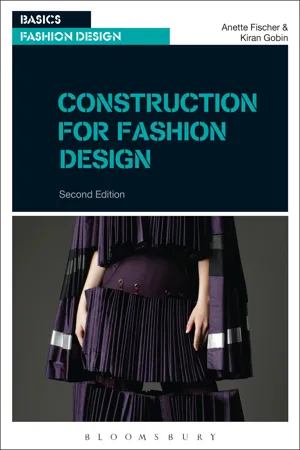
Construction is the foundation of fashion design; it takes passion and great skill to turn a two-dimensional drawing into a successful garment. Construction for Fashion Design guides readers through the process, teaching the theory, practical skills and techniques that they need to succeed. It leads readers through the essential stages of creating a garment, from pattern cutting and draping on the mannequin to sewing techniques and haberdashery. This fully revised and expanded second edition features insightful case studies with leading creative practitioners at the cutting edge of the fashion industry today, complete with detailed, step-by-step exercises that enable readers to contextualise their knowledge and put it into practise for the creation of their own successful projects.
- 208 pages
- English
- ePUB (mobile friendly)
- Available on iOS & Android
eBook - ePub
Construction for Fashion Design
About this book
Information

1.1 Roksanda Ilincic, AW15.
1
Getting Started
It is important for designers to understand the fundamentals of how a garment grows from a two-dimensional concept into a three-dimensional object. A pattern is a flat paper or card template from which the parts of the garment are transferred to fabric before being cut out and assembled.
A good understanding of body shape and how body measurements transfer to the pattern piece is essential. The pattern cutter must work accurately in order to ensure that, once constructed, the parts of the fabric fit together properly and precisely.
This chapter is an introduction to pattern cutting, starting with the tools and equipment needed. Then it takes a look at the processes involved: the importance of silhouettes and proportion; sizing and grading and how to take body measurements. Finally, it introduces the basic block and pattern shapes and how the body measurements relate to these.
Pattern cutting tools and equipment
Working with the right tools will make block and pattern construction easier. These are just some of the key pieces of equipment required.

Tailor’s chalk (1) Using tailor’s chalk is one way of marking lines or transferring a pattern on to cloth.
Set of three French curves (2) These are used for drawing narrower curves, such as those found on collars and pockets.
43 cm set square (3) This is a right-angled triangular plate used for drawing lines, particularly at 90 degrees and 45 degrees.
Wooden awl (4) This is used for marking any points within the pattern piece by punching through the pattern to leave a small mark on the fabric.
Pins (5) These are used to temporarily fix pieces of paper or cloth together.
Tape measure (6) An indispensable item, this is used for taking measurements of the body and its flexibility allows curved lines to be measured, too.
Pattern drill (7) This is used for marking things such as darts, pockets and any other marking points within the pattern piece. The pattern drill will punch a hole of 1⁄16–3⁄16 in (2–4 mm) into the pattern. The position of the punch hole can then be marked with chalk or thread on to the fabric.
Pattern notcher (8) This is used for marking the edge of the pattern pieces by taking out a small square for each balance point. This should only be used on pattern paper, thin sheets of plastic or card—not on fabric.
Paper scissors (9) These are—as their name suggests—only used for paper, in order to keep the blades sharp.
Tracing wheel (10) This is used to trace a line from one piece of paper or pattern on to another directly underneath it.
Pattern master (11) This is used to create lines and curves and to check angles.
Fabric Scissors/Shears (12) These scissors or shears are to be used when cutting fabric, again in order to keep the blades sharp.
Small Scissors/Snips (13) These are helpful when cutting threads whilst stitching and also can be used to help unpick mistakes. Especially good for very fine and intricate work.
Pencils (not shown) Your pencil can be a mechanical or traditional pencil, but should be no softer than HB. This is to ensure sharp and accurate lines.
Aluminium meter ruler (not shown) This is essential for drawing and connecting longer, straight lines.
Silhouettes
First impressions of an outfit are created by its silhouette—the overall shape created by a garment. Before qualities such as the detail, fabric or texture of the garment can be considered, the silhouette of the garment is an important initial decision in the design and construction process.
The importance of silhouette
Silhouette is fundamental to the preliminary stages of the design process in order to determine which parts of the body will be emphasized and why. Once these decisions are made, it is up to the pattern cutter and designer to start contemplating how the design can be physically constructed and, if necessary, supported and structured using underpinnings and foundations. Many materials and techniques can be used to shape a silhouette (see chapter seven: Support and structure). For example, using shoulder pads to widen the shoulder can create an illusion of a small waist and narrow hips.
Proportion and bodylines
Proportion refers to the comparative relations and dimensions of the various parts of a whole outfit. A combination of garments can look messy or can work in harmony. For example, the ways in which a jacket, a skirt and a pair of boots relate to one another will add to the sense of proportion and balance conveyed by the outfit as a whole.
Proportions can be changed fairly easily using various construction methods. For example, moving a hemline, waistline, pocket, seam or dart position can dramatically alter the balance of width and length on an individual body shape. Choice of fabric texture and color can also add to the overall effect conveyed by the cut and shape of a garment.

1.2 Sculptured ceramic mannequin by Helen Manley.
The change of silhouette over time
Throughout history, fashion has always reflected the wealth of the nation, the status of individuals and cultural representation over time. See here for a more detailed look at the history of supported and structured garments.

1.3 The chang...
Table of contents
- Cover
- Title Page
- Contents
- Introduction
- 1 Getting started
- 2 Pattern cutting
- 3 Garment construction
- 4 Surface-specific techniques
- 5 Haute couture and tailoring
- 6 Draping on the mannequin
- 7 Garment support and structure
- 8 Finishes
- Conclusion
- Glossary
- Bibliography
- Useful resources
- Index
- Acknowledgments and picture credits
- eCopyright
Trusted by 375,005 students
Access to over 1.5 million titles for a fair monthly price.
Study more efficiently using our study tools.
Frequently asked questions
Yes, you can cancel anytime from the Subscription tab in your account settings on the Perlego website. Your subscription will stay active until the end of your current billing period. Learn how to cancel your subscription
No, books cannot be downloaded as external files, such as PDFs, for use outside of Perlego. However, you can download books within the Perlego app for offline reading on mobile or tablet. Learn how to download books offline
We are an online textbook subscription service, where you can get access to an entire online library for less than the price of a single book per month. With over 1.5 million books across 990+ topics, we’ve got you covered! Learn about our mission
Look out for the read-aloud symbol on your next book to see if you can listen to it. The read-aloud tool reads text aloud for you, highlighting the text as it is being read. You can pause it, speed it up and slow it down. Learn more about Read Aloud
Yes! You can use the Perlego app on both iOS and Android devices to read anytime, anywhere — even offline. Perfect for commutes or when you’re on the go.
Please note we cannot support devices running on iOS 13 and Android 7 or earlier. Learn more about using the app
Please note we cannot support devices running on iOS 13 and Android 7 or earlier. Learn more about using the app
Yes, you can access Construction for Fashion Design by Anette Fischer,Kiran Gobin in PDF and/or ePUB format, as well as other popular books in Design & Fashion Design. We have over 1.5 million books available in our catalogue for you to explore.