When countries try to navigate through the aftermath of conflict, trust is the main focus and the catalyst for rebuilding societies, nations, economies and democracies. Trust is vital, not only at an individual level, but also at a community level: trust is important to sustain peace and also works as a trigger to end conflicts. But why are some divided societies more prone to the collapse of social trust than others?
This book uses empirical and case study research, including qualitative comparative analysis (QCA), statistical methods, observations and interviews, to compare which policies and institutions to build trust have a greater impact on divided societies in the Middle East. The book focuses on Lebanon, Palestine, and Syria, but analyses the results from these societies by also comparing other political and ethno-religiously divided societies beyond the MENA region.
The book does not want to forward a universal 'theory' that gives us the origin of trust and how it is destroyed. Rather, it aims to provide a comprehensive explanation of generalised trust in divided societies and answer the question: under which institutions is generalised trust in a divided society maintained or destroyed, and how does this happen? Of key importance to Abdalhadi Alijla is to highlight the formal and informal institutions that inspire an elevated level of trust to help make societies less vulnerable to internal conflict, and also to give voice to the real people who live and experience divided societies.
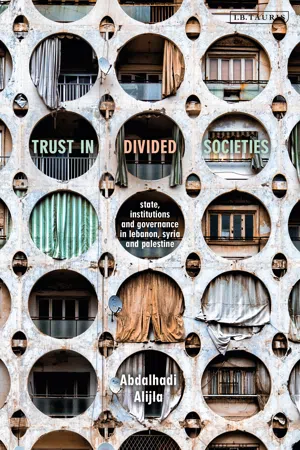
eBook - ePub
Trust in Divided Societies
State, Institutions and Governance in Lebanon, Syria and Palestine
- 256 pages
- English
- ePUB (mobile friendly)
- Available on iOS & Android
eBook - ePub
Trust in Divided Societies
State, Institutions and Governance in Lebanon, Syria and Palestine
About this book
Information
Chapter 1
Introduction
Why do certain divided societies lack trust between their composite members more than others? Why are divided societies more prone to the collapse of social trusts than others? Why do Lebanon, Syria, Palestine and many other Middle Eastern countries have low levels of generalized trust?
Return, a novel written by the Bosnian novelist Snježana Mulić, tells the story of five Bosnians from the three different ethnicities in Bosnia and Herzegovina who returned home after the end of the war. It provides a snapshot of hundreds of thousands of stories from people in divided societies and, in particular, those in post-conflict areas. Trapped in the heaviness of bureaucracy and lost in transition as they search for a reason to continue living, the five Bosnians struggle with the unfairness of political and bureaucratic institutions that leads to frustration, tension and hopelessness, forcing many of them to permanently leave their home country. Mulić ends her novel with the observation that ‘seventy per cent of households in Scandinavia and North America were using the internet daily, the rich were buying places in space . . . only our heroes are stuck in 1992’1. Here, she was referring to the inequality that was rampant in the country where the rich and elite live in luxury while the poor are stuck in the past; a society-wide, war-induced fragmentation. These stories are found in almost every divided society, whether that society is divided politically or ethno-religiously. Conflict and post-conflict issues (including the idea of ‘returning home’) are common throughout almost all societies that experience war and division.
Returning to the opening questions: Why do certain societies in a post-conflict state have low levels of trust? When societies try to navigate through the aftermath of a conflict, or during conflicts of the elite, trust is the main focus and the catalyst for rebuilding societies, nations, economies and democracies. Mulić’s novel focuses on trust in institutions; specifically, on the reconfiguration and reengineering of individuals’ lives by these institutions that result in frustration, distrust and hopelessness.
This book contributes to the debate around generalized trust and political institutions. The literature on generalized trust appears to be significantly dominated by the cultural theory and the social networks theory (or, the associational explanation). Many scholars have partially accepted that it is very difficult to assess sources of generalized trust in societies. It is particularly problematic when it comes to divided societies that have experienced ethnic conflict or deep political mobilization or polarization in recent decades. As divided societies, Lebanon, Palestine and Syria can be considered empirical case studies, which show how politics, ethnicity and violence have a severe impact on trust levels. As will be discussed thoroughly in the first chapters, the underlying assumptions and different theories (e.g. cultural, institutional and associational) show that there is a need for empirical or case study research on divided societies in order to examine the relationship between institutions and generalized trust. There is also a need for such studies for academics, policymakers and members of the international community who work in the areas of peace, conflict and development in war-torn or divided societies.
In this book, I focus on the impact of institutions on trust, analysing different aspects of political and societal institutions and institutional conditions. From a theoretical perspective, the focus is on the application of theoretical insights and empirical methods. Empirically, the focus is on using qualitative comparative analysis (QCA) to compare different policies and to determine which policy combinations have a greater impact on the level of generalized trust in the selected case studies. Moreover, statistical methods are used to measure the degree to which institutional conditions influence the level of generalized trust in Lebanon and Palestine. Research around the Syrian conflict and post-conflict partially benefits from QCA analysis, which provides a guide to selecting specific institutions to test and offers a more comprehensive context-based analysis.
Generalized trust and divided societies
Trust in divided societies is a sensitive yet intriguing topic that researchers have studied in an attempt to understand why one might trust strangers in a society in which multiple ethnicities and cultures exist, often in conflict with one another. The analysis of variations in the level of generalized trust in divided societies can provide a complex and detailed understanding of the possible connections between institutions, context and cultural factors, on the one hand, and generalized trust, on the other. The term ‘generalized trust’ is understood as trust given to strangers without the giver having a prior relationship with or experience of the recipient (Hardin, 2001). Despite its importance and the role it plays in various social contexts, there is no consensus among social scientists on the definition of generalized trust (Barber, 1983).
In divided societies, the discussion is much more complex when it come to generalized trust. Divided societies are challenged by history, culture, tradition, war, and social and political fragmentation, which create a low level of generalized trust and, consequently, a low level of social capital. The management of divided societies is characterized by complexities caused by the aspirations of the various ethnic groups to have their own political, cultural and societal institutions. Often, these aspirations are in conflict with each other and may lead to a decrease in trust under unequal, unfair institutions, and institutional outcomes, such as preferential public administration, biased public officers or particularistic public services. These institutional conditions favour specific ethnicities or groups of people, which leads to an inequality in services, opportunities and the provision of other public goods.
Trust is a key element not only at an individual level but also at a community level: trust is important to sustain peace and also works as a trigger to end conflicts. It facilitates social coordination and interaction between individuals who have had no previous social interaction (Gambetta, 1988). Despite the fact that this type of interaction is uncertain in that one cannot know its consequences, trust that leads to this kind of new interaction can effectively build bridges and be a catalyst for the acquisition of knowledge about the society and its surrounding. This kind of interaction is vital in post-conflict reconciliation processes where different ethnicities and groups need to interact in order to create a public sphere and debate as to which institutions and what kind of political syst ems are wanted. Generalized trust is also considered a coercive method of control over social behaviour (Coleman, 1990). Social capital, of which generalized trust is considered to form a significant portion, is believed to play a key role in the development of democratic institutions (Foley, Putnam, and Edwards, 2001). Additionally, social capital and trust contribute to peace-building as well as to the hindering of conflict in divided societies (Michaelene Cox, 2008).
Maintaining a constant level of generalized trust among people in divided societies throughout the reconciliation process becomes necessary. The reconciliation process, as a civil society activist from Lebanon told me, begins with the building of fair institutions – particularly that of a judicial system. When taking historical, cultural and societal factors into consideration, institutions (both formal and informal) become the focus of the reconciliation process in divided societies. Institutions become the source of power and resources for divided parties, and groups are mobilized to design and control these institutions in order to benefit from them. However, these institutions, despite being part of ‘the cake’ (a metaphor pertaining to resources and power) should be viable and built to function.
There is, therefore, a consensus among social scientists that institutions are crucial to state-building in the aftermath of civil war or internal violence (Schindler, 2010). Civil war and ethnic violence can destroy not only communities but also institutions, leaving whole societies in ruins. Once conflict ceases, there is always a need to establish and redesign institutions to accommodate new realities and meet the requirements of the conflicting parties, based on the conflict-ending agreements (e.g. the Ta’if agreement in Lebanon, the Dayton agreement in Bosnia and Herzegovina and the Mecca agreements in Palestine).2 Attention is often given to the crucial element of trust by advocating that these institutions are designed to work transparently and effectively, with the aim of boosting social trust between the different hostile groups (Bar-Siman-Tov, 2011). A large number of studies focus on institution-building as well as reconfigurations necessary to adapt to the new state of a war-torn and divided society.
There is evidence to suggest that institutions are crucial to the creation of generalized trust (Rothstein and Stolle, 2008). Generalized trust is positively associated with well-functioning institutions, public policies and the quality of governments (Knack and Keefer, 1997; La Porta et al., 1997; Peyrefitte, 1996; Putnam, 1993). The relevance of generalized trust to institutions is its capacity and ability to resolve problems of collective action, such as the provision of various forms of public goods, and to avoid a situation known as a ‘social trap’, in which short-term benefits for some groups of society have longer-term and often negative consequences for other groups or for the society as a whole (Kumlin and Rothstein, 2005). Moreover, the equality and fairness of formal institutions in divided societies can serve as a link between trust and institutions. Therefore, institutions are important mechanisms when it comes to influencing the creation or destruction of generalized trust.
Measuring generalized trust in relation to institutional–societal factors will guide policymakers and researchers towards a wider understanding of the mechanisms of maintaining or destroying generalized trust. I examine the impact of specific institutional and societal conditions (including informal institutions such as corruption) on generalized trust to help the purpose of this book very carefully. For example, common bureaucratic practices may have a greater effect on the level of generalized trust than power-sharing institutions or institutional factors in a divided society. This is because individuals recognize inequality and unfairness in their daily encounters with bureaucracy in local administrative procedures.
In comparison with the extensive attention that has been paid to studies on democratic mixed societies, there has been very little discussion around the applicability of these theories to non-democratic and/or divided societies. Furthermore, despite the extensive research on social capital and generalized trust undertaken in the last three decades, there are still some important gaps in understanding the sources of generalized trust, particularly the relationship between institutions and trust (Farrell, 2005). This requires a diversity of studies and work from different research fields and geographical areas. Although some comparative research on generalized trust in divided societies from an institutional perspective exists, it is still not common. Existing studies argue that there is a direct link between institutions and generalized trust, although few give empirical and comparative evidence to support their arguments (Levi, 1997; Rothstein and Stolle, 2008).
Over the course of previous conversations and academic work on this topic, two important unresolved issues were identified. First, there are few studies examining the link between generalized trust and institutions in divided societies. Second, although experts acknowledge, empirically and philosophically, the fact that institutions have an impact on generalized trust, very few attempts have been made to examine specific policies, informal institutions or institutional conditions, especially in divided societies and in the Middle East and North Africa (MENA).
In this book, I propose that a major source of generalized trust in divided societies can be found in state machinery; namely, in administrative and legal institutions of the state represented by public policies and practices, such as informal institutions. My intent is to fill the gap in the discourse of generalized trust and institutions, thereby providing empirical evidence that institutions do have various levels of influence on generalized trust.
In order to gain an insight into generalized trust in divided societies, I undertook a comparative cross-case study, using QCA and statistical methods. I then refined the data with single case studies that focus on Lebanon, Palestine and Syria. The primary findings on the effects of institutions on generalized trust were derived using a cross-case study analysis in eight societies – Lebanon, Bosnia and Herzegovina, Pakistan, Turkey, Macedonia, South Africa, Kyrgyzstan and Iraq – using QCA and Simultaneous Equation Modelling (SEM). I then undertook an examination of three case studies: Lebanon, Palestine and Syria.
In line with previous studies, my hypothesis is that institutions could be empirically modelled as determinants of generating or destroying generalized trust. In other words, trust is associated with three main factors. The first of these factors is institutional conditions (unbiased public administration, equality in providing public services, the universality of public goods, the feeling of safety and security, perception of corruption and policymaking decentralization). The second is that of societal institutional conditions (public deliberation, activation and the creation of a civil society, which includes freedom of expression). The last factor is that of governmental design (monopoly of power and the judicial system). These factors reflect how individual experiences are shaped when interacting with institutions.
To maintain a sharp focus on the question at hand, I concentrate on the issues of generalized trust within divided societies from the MENA. Throughout the book, I subject generalized trust theories to analysis in both politically and ethno-religiously divided societies in relation to the institutional theory of trust. Given the particularity of the topic, it is important that I use other cases studies from outside the MENA region, such as Bosnia and Herzegovina, Macedonia, South Africa and Kyrgyzstan. In this book, it is important not to assume that there is one universal ‘theory’ that gives us the origin of trust and how it is destroyed. My purpose is not simply to correct or propose a ‘theory’. Rather, my main aim is to serve traditional and classic academic goals, providing a comprehensive explanation of the specific phenomena being studied – which is, in this case, generalized trust in divided societies. I contribute to the ongoing conversations on the topic.
I address the following key question: Under which institutions is generalized trust in a divided society maintained or destroyed, and how does this happen? This question is important for several reasons. If they knew which institutions (formal and informal) influence generalized trust to a greater degree, policymakers would put more effort into those institutions and their design as policy tools. As a result, these institutions will inspire an elevated level of trust, making societies less vulnerable to internal conflict, which is costly in both the short and long term.
From Beirut to Gaza through Damascus: Division and distrust
Along the road from Rafic Hariri International Airport to Beirut, one can clearly see the deeply divided nature of Lebanese society. Flags, pictures of political and religious figures and military checkpoints colour the landscape between different neighbourhoods where various religious groups live, such as Trqiq Jdedia, Hadath and Achrafieh, Beka’a. This division can be seen further in the different shapes and level of modernity of the buildings on either side of the road – a demonstration of inequality, corruption and political/administrative arbitrariness in the country.
In October 2019, protests erupted in Lebanon as a result of the high levels of distrust and dissatisfaction in the political regime in power at the time. The Lebanese people adopted the slogan ‘All of them means all’, which means that they wanted all of the contemporary political elites removed – and that they wanted the regime removed even more (Azhari, 2019). One of the main demands of the protesters was that corruption, which has impacted every detail of the lives of the Lebanese and people living in Lebanon, be ended (Aljazeera, 2019). For many months, the economy of Lebanon had been decelerating, which affected millions of Lebanese people. They were unable to withdraw cash from their banks, which obliged the banks to enforce unprecedented measures, dividing the Lebanese people based...
Table of contents
- Cover
- Half-Title
- Title
- Dedication
- Contents
- Acknowledgements
- Illustrations
- Abbreviations
- Preface
- Chapter 1 INTRODUCTION
- Chapter 2 BETWEEN SOCIAL CAPITAL AND TRUST: INSTITUTIONS, HISTORY AND CULTURES
- Chapter 3 BROKEN WINDOWS: TRUST IN DIVIDED SOCIETIES
- Chapter 4 TRUST BEYOND MENA: DO INSTITUTIONS MATTER?
- Chapter 5 THE FAILURE: INSTITUTIONS, CORRUPTION AND TRUST
- Chapter 6 LEBANON GONE WRONG: INEQUALITY AND TRUST IN LEBANON
- Chapter 7 CREATING HYBRID SOCIETY: TRUST IN PALESTINE
- Chapter 8 DOOMED AFTER, DOOMED BEFORE: TRUST IN SYRIA
- Chapter 9 REFUGEES IN DIVIDED SOCIETIES: SYRIANS IN LEBANON
- Chapter 10 CONCLUSION: THE MISSING VIRTUE
- Appendices
- Notes
- Bibliography
- Index
- Copyright
Trusted by 375,005 students
Access to over 1.5 million titles for a fair monthly price.
Study more efficiently using our study tools.
Frequently asked questions
Yes, you can cancel anytime from the Subscription tab in your account settings on the Perlego website. Your subscription will stay active until the end of your current billing period. Learn how to cancel your subscription
No, books cannot be downloaded as external files, such as PDFs, for use outside of Perlego. However, you can download books within the Perlego app for offline reading on mobile or tablet. Learn how to download books offline
Perlego offers two plans: Essential and Complete
- Essential is ideal for learners and professionals who enjoy exploring a wide range of subjects. Access the Essential Library with 800,000+ trusted titles and best-sellers across business, personal growth, and the humanities. Includes unlimited reading time and Standard Read Aloud voice.
- Complete: Perfect for advanced learners and researchers needing full, unrestricted access. Unlock 1.5M+ books across hundreds of subjects, including academic and specialized titles. The Complete Plan also includes advanced features like Premium Read Aloud and Research Assistant.
We are an online textbook subscription service, where you can get access to an entire online library for less than the price of a single book per month. With over 1.5 million books across 990+ topics, we’ve got you covered! Learn about our mission
Look out for the read-aloud symbol on your next book to see if you can listen to it. The read-aloud tool reads text aloud for you, highlighting the text as it is being read. You can pause it, speed it up and slow it down. Learn more about Read Aloud
Yes! You can use the Perlego app on both iOS and Android devices to read anytime, anywhere — even offline. Perfect for commutes or when you’re on the go.
Please note we cannot support devices running on iOS 13 and Android 7 or earlier. Learn more about using the app
Please note we cannot support devices running on iOS 13 and Android 7 or earlier. Learn more about using the app
Yes, you can access Trust in Divided Societies by Abdalhadi M. Alijla in PDF and/or ePUB format, as well as other popular books in Politica e relazioni internazionali & Relazioni internazionali. We have over 1.5 million books available in our catalogue for you to explore.