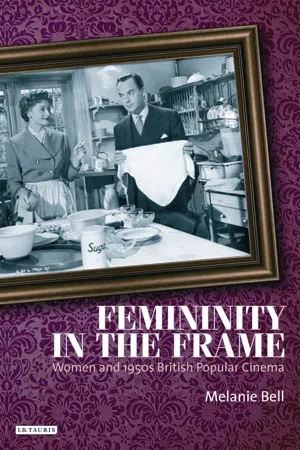
It's widely assumed that Britain in the 1950s experienced a return to traditional gender roles. Popular cinema has typically been seen to represent this era through the dominant image of the 'happy housewife'. "Femininity in the Frame" is a sharply observant account of how British cinema engaged with femininity and women's roles during this important period. Written in a lively and accessible manner, it challenges received understandings, arguing that the period was marked by social unease and anxiety about gender roles and femininity, with much British cinema producing ambiguous messages about feminine identities and the role of women. Through analysing marginalized figures, such as prostitutes, criminals and femmes fatales, and addressing central themes, notably sexuality, marriage and female friendship, Melanie Bell examines how British popular cinema imagined and constructed femininity in this era of rapid social and cultural change.
She draws together sources ranging from official reports to film reviews, with case studies of films across genres, including "The Perfect Woman", "Young Wives' Tale", "The Weak and the Wicked" and "A Town Like Alice", to show how new ideas and understandings of femininity were seeping into the cultural imagery at this time. She demonstrates how such films expressed proto-feminist ideas and how they ultimately explored new forms of femininity in a manner that has not until now been recognised.
- 240 pages
- English
- ePUB (mobile friendly)
- Available on iOS & Android
eBook - ePub
About this book
Information
1
Man-Made Women
In this chapter I discuss three films from the post-war period that explore the theme of the male scientist and his creation of ‘the perfect woman’. All three films dramatize the theme of male-controlled reproduction and the creation of females to satisfy the personal needs – either professional and/or emotional/sexual – of the male scientist. Each film uses a different reproductive strategy – creating a machine that resembles a human, surgical transformation of an existing human, creating an exact copy of a human – but difference in technique or reproductive strategy does not result in difference in outcome. In all cases the project fails because the man-made woman is not wholly biddable, the men have misread their own desires and at all times have failed to actualize them in a functional manner. In The Perfect Woman (d. Bernard Knowles 1949) an elderly professor creates a mechanized doll in the image of his niece. The niece subsequently substitutes herself for the doll, which leads to a series of chaotic misunderstandings before the doll self-destructs and harmony is restored. Stolen Face (d. Terence Fisher 1952) follows the misguided fortunes of a plastic surgeon who, unable to have the woman he loves, recreates her face on a disfigured female criminal, with tragic consequences. In Four Sided Triangle (d. Terence Fisher 1953) a young scientist suffering from unrequited love develops a replicating machine and uses his invention to produce an exact copy of his would-be love. The facsimile spurns him and both perish in an accidental fire. Although the primary focus of these films is men and the male project, they find a place in this study because they highlight dramatically the contradiction between male fantasies and idealizations of women and female reality. In this respect they illustrate Alison Light’s observation (discussed in the main Introduction) of the contradictory relations between the official prescriptions for women’s lives and women’s own experiences. That cultural constructions of science interacted with the representation of women in an era of rapid technological change, highlights something of the space occupied by the female fantasy figure in the male cultural imaginary of the 1950s.
Science
Science and technology were important themes in the post-war years. Robert Jones suggests that ‘the prestige of science was very high in 1945’, not least because of its role in securing the war-time victory of the Allies.1 The military needs of the war (often referred to as ‘the physicists’ war’) led to the refinement of scientific advances in areas such as nuclear capabilities, radar and chemical development, which in turn had profound implications for exploitation in peacetime. As Arthur Marwick observes, ‘there was great enthusiasm for, and much talk about, the importance of science and technology to Britain’s social regeneration’, although it was less clear exactly how these scientific and technological developments should be harnessed.2 Science was, for example, central to the 1951 Festival of Britain where the Science Exhibition sought to educate the general public about scientific concepts such as atoms, whilst the Festival more broadly was driven by a desire to integrate science with the arts.3 Scientists themselves had significant status in post-war society and were looked to as experts whose knowledge was of fundamental importance in shaping the future. Writing in 1945, George Orwell captured this belief in his wry observation that:
[a] scientist’s political opinions, it is assumed, his opinions on sociological questions, on morals, on philosophy, perhaps even on the arts, will be more valuable than those of a layman. The world, in other words, would be a better place if the scientists were in control of it … there are already millions of people who do believe this.4
Alongside prestige, however, was a certain amount of anxiety about the uses to which scientific inventions could be put. Ambivalent feelings about the creation of the atom bomb in 1945 were captured in the 1947 Mass Observation Report ‘Where is Science Taking Us?’ which described ‘widespread public anxiety about atomic bombs, a feeling that science was now out of control whereas it had formerly been a blessing’.5 Planning documents pertaining to the Festival of Britain likewise demonstrated an anxiety about the role of atomic weapons and a desire to use art to tame and balance the excesses of science.6 In an essay first published in the Tribune in 1945, Orwell again berated the intellectual community for failing to engage fully with the ramifications of atomic technology beyond the ‘reiteration of the useless statement that the bomb “ought to be put under international control”’.7
The contradictory discourses that shaped understandings of science and technology were very much in evidence in the realm of reproductive science. Whilst eugenics had been discredited by Fascist practices there remained a concern about the long-term decline in the birth-rate and the phenomenon of ‘differential breeding’; that is, the lower classes reproducing faster than the middle classes.8 Socially acceptable measures to incentivize the ‘right’ people to reproduce came in the form of improved state services and childcare allowances (discussed in the main Introduction), which were deemed the ‘democratic route to improving the nation’s stock’ after the war.9 Medical expertise in this area was far-reaching, ranging from state-funded child welfare clinics to the widely disseminated teachings of the child psychologist D. W. Winnicott. Although radical advances in reproductive technology did not emerge in Britain until the 1970s, the strategies intended to shape the reproduction of the nation (or more accurately a particular privileged section of it) demonstrate the extent to which reproductive science had the capacity to infiltrate everyday life in the 1950s. It is this link between science and reproduction which is played out to extremes in the post-war science fiction films where men strive to do away with the real woman in favour of creating the ‘right’ kind of (fantasy) woman.
British Science Fiction Cinema
Given the status of science it is not surprising that science and scientists were a recurring feature in films throughout the period, in both the burgeoning science fiction genre and also more mainstream genres such as comedy, where Ealing’s The Man in the White Suit (1951) provided an acerbic comment on the consequences of science and invention. Relaxations in film censorship (which allowed film producers to experiment with more ‘adult’ themes) and a contemporary concern with cold war politics meant that British science fiction films broadly engaged with the themes of ‘social instability, the false promises of science and cold war threats, much like their American postwar counterparts’.10 Seven Days to Noon (1950) is an early example of the fear of nuclear development and the theme of the ‘mad scientist’, whilst The Quatermass Experiment (1955, first broadcast on television in 1953) is one of the best-known examples of the popular ‘invasion’ narrative. Alongside the scientist as ‘boffin’, typified by Michael Redgrave’s performance as Barnes Wallis in The Dam Busters (1954), was the figure of the ‘comic scientist’. In films such as The Mouse that Roared (1959) the figure was an amalgam of common clichés (unable to explain his invention, forgetful about everyday matters, endearingly ‘batty’) and ultimately the narratives propose that the wildest excesses of science can be brought to heel, or rather, as Geraghty suggests, ‘modernity can be outflanked by the traditional’.11
In addition to the many cinematic depictions of cold war fears, British science fiction began to explore the threat that women were thought to represent to the post-war world. As Steve Chibnall illustrates, a number of British films from this period combine ‘female monstrosity and otherness with male erotic spectatorship … [suggesting] fear of female sexuality with excitement about its possibilities’.12 These ‘alien women’ (in Chibnall’s parlance) range from the male-produced doppelgänger in The Perfect Woman to the alien-invaders of Devil Girl from Mars (1954) who abduct earth-males to repopulate their matriarchal planet. Interestingly it is the lower-budget films where these types of representation are most readily found. By the early 1950s, pulp science fiction literature, as Chibnall demonstrates, was the ‘repository for male [sexual] imaginings’13 and a parallel can be drawn with domestic feature-film production. Films such as The Perfect Woman, Devil Girl from Mars, Stolen Face and Four Sided Triangle were all relatively minor features, modestly budgeted, and were certainly not intended or imagined at the time as prestige productions. Four Sided Triangle and Stolen Face were made by Hammer before their famous horror costume cycle got underway in 1957. Stolen Face is a Hammer-Lippert co-production, made in British studios with British personnel but drawing in secondary American stars and scriptwriters to produce a sharper product that would capture both the domestic and American market.14 A number of these films replay themes from American film noir, thus the plastic surgery theme in Stolen Face is a rehash of George Cukor’s 1941 MGM star vehicle for Joan Crawford, A Woman’s Face, which was itself reworked by Anthony Mann’s later, and much lowerbudgeted, Strange Impersonation (1946). Co-productions like Stolen Face enjoyed reasonable commercial success, in part because of tight budgeting, casting, and audience familiarity with thematic content. Four Sided Triangle comes after the Hammer-Lippert co-production deal had ended and by this time Hammer was producing science fiction/horror films, before later moving into the costume horror they became famous for. Both films were directed by Terence Fisher and have attracted (limited) critical interest which has primarily focused on the films as early examples of the director honing his craft before his later success as the quintessential Hammer horror director.15 The Perfect Woman is comparable in terms of budgeting. Made by Two Cities under the administrative umbrella of Independent Producers Limited (which gave producers a degree of artistic licence), the film is known to have been commercially profitable, not least because it was inexpensive to make.16 There is no case to be made for these films as lost or under-appreciated masterpieces; these are modest films with modest budgets that were moderately successful both commercially and artistically.17 But it is striking that the theme of the alien women – specifically the man-made woman – should emerge so sharply at this time and in films that occupied a similar position towards the sidelines of the cultural map. It is highly probable that it was this positioning which permitted a more imaginative and direct engagement with the extremes of male fantasies vis-à-vis desire for, and control of, women, than would have been readily permitted in films with larger production budgets and higher-profile directors and stars.
Men, Science and Reproduction
Whilst women as invaders from outer space is one example of what could be conjured up in the male imaginary, man-made doppelgängers more readily represent the threat from within. The focus of this chapter is the attempt by men to reproduce females through scientific means, and the films demonstrate a concern with how male scientists use science in the quest for the ideal woman and female perfection as defined by those men. Their quest points to the gendering of science and a recognition of the impact of male scientists in the arena of reproductive technology. Reproduction should here be understood in the broadest sense as creating a facsimile of life; a copy which is made by a man without recourse to either God or woman. This can occur in many different ways in the cultural imaginary; the revitalization of body parts, the transformation of an existing being, the cloning of a human, or the creation of an ‘artificial’ person; that is, a machine that resembles a human. In most cases an in-uterine birthing process or female womb is rendered redundant. All such strategies are fundamentally concerned with circumventing the ‘natural’ role of either the female or of God in the reproductive process, and are predicated on an implicit belief that science can improve on nature. Examples of ex-uterine reproduction are prolific in Western culture and include, within Christian mythology, the creation of Eve from Adam’s rib, and within Greek mythology the creation of Athena, who was born from the head of Zeus. The literary tradition of the theme of revitalizing human body parts is evident in Mary Shelley’s novel Frankenstein (1818), which dramatizes the creation of the male figure, whilst E. T. A. Hoffman’s short story The Sandman (1816) deals with the creation of a female figure in the form of a mechanized doll.18 The Frankenstein story has become a metaphor in Western cultures for any work or creation that becomes uncontrollable to its creator, who then typically rejects it. The fascination with male control over the reproduction of life readily translated first into theatrical adaptations of Frankenstein in the 1820s, and then moved into film. Versions of the Frankenstein story appeared in Hollywood as early as 1910, with Universal Studios’ later 1930s Frankenstein cycle being the best remembered. It was a favourite theme of German Expressionist cinema which produced The Golem (1915 and 1920), Lubitsch’s The Doll (1919), The Cabinet of Dr Caligari (1920) and most famously Metropolis (1926), where Fritz Lang’s robot Maria clearly functions, as Lyn Phelan suggests, as a ‘deathly seductress’ to the men around her whom she provokes into causing industrial chaos.19
Typically within Western mythologies, the creation of the female by the male is perceived to be a lesser form of creation, and it differs in important ways from the male. Whilst Mary Shelley’s male creation is an intelligent and articulate being with considerable agency who becomes monstrous in Frankenstein’s eyes, Hoffman’s doll-figure Olympia is physically beautiful but practically mute and functions primarily as a passive agent in a feud between her two male creators. As Phelan argues, the stakes change when men produce women rather than other men; ‘the additional layer of difference more easily secures the distinction between male maker and female machine – autonomous subject and automated object.’20 This additional difference makes it possible for the man-made woman to function also as ‘the explicit focus of eroticized fantasy and often of a special kind of sexualized disturbance’,21 thereby gendering the nature of uncontrollability. There is certainly a tradition in science fiction of seeing sex work as an ‘activity that can be conveniently mechanized’, leading, in more recent films, to the creation of ‘[h]umanoid sex toys’ which range from the techno-women in Bryan Forbes’ The Stepford Wives (1974) to the robotic ‘comfort woman’ Pris in Ridley Scott’s Blade Runner (1982).22 Whatever the male scientists’ stated intention for (and motivation behind) the creation of the women, which varies across the case studies offered here, her function as an object of male sexual desire underpins her creation. Like all Frankensteinian inventions, however, the women prove difficult to control and ultimately their male creators come to recognize the limits bot...
Table of contents
- Cover
- Halftitle Page
- Cinema and Society series
- Title Page
- Dedication
- Contents
- List of Illustrations
- Acknowledgements
- General Editor’s Introduction
- Introduction: Women and the 1950s
- 1. Man-Made Women
- 2. The British Femme Fatale
- 3. The Comedy-of-Marriage Film
- 4. The Female Group Film
- 5. The Figure of the Prostitute
- 6. Female Film Critics
- Conclusion: Reconfiguring 1950s Femininity
- Notes
- Bibliography
- Selective Filmography
- Index
- eCopyright
Trusted by 375,005 students
Access to over 1.5 million titles for a fair monthly price.
Study more efficiently using our study tools.
Frequently asked questions
Yes, you can cancel anytime from the Subscription tab in your account settings on the Perlego website. Your subscription will stay active until the end of your current billing period. Learn how to cancel your subscription
No, books cannot be downloaded as external files, such as PDFs, for use outside of Perlego. However, you can download books within the Perlego app for offline reading on mobile or tablet. Learn how to download books offline
Perlego offers two plans: Essential and Complete
- Essential is ideal for learners and professionals who enjoy exploring a wide range of subjects. Access the Essential Library with 800,000+ trusted titles and best-sellers across business, personal growth, and the humanities. Includes unlimited reading time and Standard Read Aloud voice.
- Complete: Perfect for advanced learners and researchers needing full, unrestricted access. Unlock 1.5M+ books across hundreds of subjects, including academic and specialized titles. The Complete Plan also includes advanced features like Premium Read Aloud and Research Assistant.
We are an online textbook subscription service, where you can get access to an entire online library for less than the price of a single book per month. With over 1.5 million books across 990+ topics, we’ve got you covered! Learn about our mission
Look out for the read-aloud symbol on your next book to see if you can listen to it. The read-aloud tool reads text aloud for you, highlighting the text as it is being read. You can pause it, speed it up and slow it down. Learn more about Read Aloud
Yes! You can use the Perlego app on both iOS and Android devices to read anytime, anywhere — even offline. Perfect for commutes or when you’re on the go.
Please note we cannot support devices running on iOS 13 and Android 7 or earlier. Learn more about using the app
Please note we cannot support devices running on iOS 13 and Android 7 or earlier. Learn more about using the app
Yes, you can access Femininity in the Frame by Melanie Bell in PDF and/or ePUB format, as well as other popular books in Media & Performing Arts & Performing Arts. We have over 1.5 million books available in our catalogue for you to explore.