eBook - ePub
The Third Man
About this book
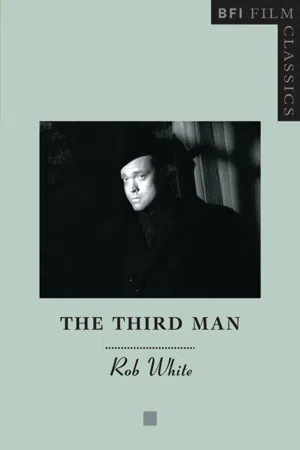
A window is thrown open and sudden light illuminates the face of Orson Welles. Harry Lime's return from the dead in 'The Third Man' (1949), Carol Reed's unique thriller set in occupied Vienna, is one of the most famous scenes in all cinema. But there is more besides: the zither score, the tilted shots, the cuckoo-clock speech, the desperate manhunt in the city sewers. A British-American co-production overseen by Alexander Korda and David O. Selznick, 'The Third Man' was written by Graham Greene, photographed by Robert Krasker and featured, along with Welles, Joseph Cotten, Alida Valli and Trevor Howard. All of the did superb work under Reed's subtle direction. After 'The Third Man', Carol Reed was hailed as one of the world's great directors. This title sets out to understand what kind of artist Reed was and whether he deserved such accolades. Rob White explores how the film came to be made and seeks to explain its fascination.
Information
‘THE THIRD MAN’
. . . . . . . . . . . . . . . . . . . . . . . . . . .
There is no sun without shadow and it is necessary to know the night.
Albert Camus, The Myth of Sisyphus (1942)
‘I never knew the old Vienna before the war, with its Strauss music, its glamour and easy charm.’1 The voice is English, the delivery laconic and brisk, the mood cosmopolitan but hard-bitten. ‘Constantinople suited me better.’ It is Carol Reed delivering the voiceover that sets the scene for The Third Man: ‘I really got to know it in the classic period of the Black Market – we’d run anything, if people wanted it enough and had the money to pay. Of course, a situation like that does tempt amateurs – but you know they can’t stay the course like a professional.’
The talk is of a new Vienna, after the war: an occupied city patrolled by soldiers from America, Britain, France and the Soviet Union, and a city partly in ruins, though, as the voice points out, ‘it doesn’t look any worse than a lot of other European cities – bombed about a bit’. There is, to listen to it, no lamentation here, nor any solemn reflection on the recent carnage – just unsentimental plain-speaking, clipped and fast.
But the shots in the mock-documentary opening sequence tell a slightly different story. There are racketeers selling boots, stockings and wristwatches. Deprivation shows in their stubbled faces. The body of an ‘amateur’ floats among hunks of cracked ice in grimy-looking water, the low sun glinting, the wreck of a ship partly visible at the left edge of the screen. These images, and the ones of structures reduced to rubble, sit uneasily with the shots showing an official world of order: Vienna’s classical façades and statues, occupying troops on patrol or parade. The damage done in war is evident in the sequence even though Reed’s voiceover and the fast cutting (twenty-eight different shots in sixty-six seconds) discourage the viewer from dwelling on it.


Vienna after the war
And there is the music, played on a zither over the opening credits. It is also ambiguous. Like the montage of post-war Vienna it goes at a jaunty pace but there are darker things underneath its good cheer. It is music for bourgeois leisure, but something else can be heard in it too – unease, tension, some middle-European density.
It might not have been as fluent as this. Graham Greene, who wrote the screenplay, imagined, to begin with, a scene at Frankfurt airport where the protagonist Holly Martins is mistaken for an eminent man of letters. And David O. Selznick, who put up much of the money for the production, persisted in demanding more explanation of the protocol and administrative practicalities of four-power occupation. So presumably it was Reed’s work to make the opening so quick and condensed. That would make sense. Reed was a pragmatic film-maker, ready to change style if necessary in order to keep things moving – a bit of a magpie, but one with clear goals in sight.
Selznick, though, undid much of the director’s work in setting the scene.2When he was finally able to release the film in the US he scratched Reed’s voiceover and had Joseph Cotten, who plays Holly, rerecord it. Out went ‘we’d run anything’, to be replaced by ‘they could get anything if people wanted it enough’. Selznick tried to dispel the air of moral uncertainty that adds an edge to the way Reed’s narrator introduces the film’s éminence grise:

Graham Greene

David O. Selznick
Oh wait, I was going to tell you – I was going to tell you about Holly Martins from America. He came here to visit a friend. The name was Lime, Harry Lime. Now Martins was broke and Lime had offered him – I don’t know – some sort of a job. Anyway, there he was, poor chap, happy as a lark and without a cent.
I was dead broke when I got to Vienna. Aclose pal of mine had wired me offering me a job doing publicity work for some kind of a charity he was running. I’m a writer, name’s Martins, Holly Martins. Anyway, down I came all the way to old Vienna, happy as a lark and without a dime.
Harry Lime’s name has gone in Selznick’s version. And gone too is that bittersweet, paradoxical ‘poor’. Poor chap, happy as a lark. Greene ended the novella, which was the basis for his screenplay, with the same sentiment: ‘Poor Crabbin. Poor all of us, come to think of it.’3
There is the lamentation after all, a sideways glance at the misery of things, the misery you do not see, for better or worse, when you are ‘happy as a lark’.
. . . . . . . . . . . . . . . . . . . . . . . . . . .
As well as changing the voiceover, Selznick made cuts in the American version, dispensing with some unsubtitled German speech and abbreviating the ending. It took fifty years for the British release version of The Third Man to be shown widely in the US, and by then Selznick’s cut had featured in the American Film Institute’s 100 Greatest American Films poll at number fifty-seven. One critic thought its inclusion there a ‘colonialist fantasy’,4 but it would be just as misleading to call it simply a British film, given the central involvement of Selznick, Cotten and Orson Welles. However, there is no question that Reed’s film has far greater status in British film culture. When, in 2000, the British Film Institute decided to emulate the AFI and poll a host of critics and industry figures to find ‘the favourite British films of the 20th Century’, The Third Man emerged at the top of the list.
It fought off Brief Encounter (David Lean, 1945, at number two), Great Expectations (Lean, 1946, five), Kind Hearts and Coronets (Robert Hamer, 1949, six), The Red Shoes (Michael Powell and Emeric Pressburger, 1948, nine), Brighton Rock (John Boulting, 1947, fifteen), Henry V (Laurence Olivier, 1944, eighteen) and A Matter of Life and Death (Powell and Pressburger, 1946, twenty) – that is eight films from a five-year period.
The period from the end of war in Europe in 1944 to, say, 1950 saw an unprecedented flowering of the British film industry and of British film art. Thiswas the Golden Age–if there ever was one.There would be other revivals but none would match the achievements of the immediate postwar years, when Powell and Pressburger were making one outstanding picture after another, kept company by Lean, Olivier and Hamer (to name just the most prominent), and when Reed was being lauded by no less a critic than André Bazin, founder of Cahiers du Cinéma, as ‘the most brilliant of English directors and one of the foremost in the world’.5
. . . . . . . . . . . . . . . . . . . . . . . . . . .
With his production company London Films’ Austrian currency reserves in mind, Korda first had the idea to make a film set in four-power Vienna. ‘We want to make a picture in Austria,’ Korda told the screenwriter Paul Tabori in 1946.6 ‘It’ll be a comedy … and the basic idea is “invisible frontiers”. I want you to do a treatment as quickly as possible.’ Nothing came of Tabori’s involvement: Korda’s thinking took a different turn.
Following the successful development of The Fallen Idol (1948), his first film with Greene and Reed, which was then being shot, Korda took the idea to the novelist and pestered him about it until Greene came back with the germ of a story in a single sentence: ‘I had paid my last farewell to Harry a week ago, when his coffin was lowered into the frozen February ground, so that it was with incredulity that I saw him pass by, without a sign of recognition, among the host of strangers in the Strand.’7 Korda was hooked but Greene had trouble moving on. Then, at the end of September 1947, the elaboration of his ‘Risen-from-the-dead story’ (as he called it8) became clearer.
The following February Greene went to Vienna to do research. He was struck by the debris that still littered the city years after the end of Allied bombing and by the cavernous sewer system. A reporter from The Times, Peter Smollett, told him about the black market trade in watered-down penicillin, adding another piece to the emerging whole. Greene stayed at Sacher’s, the hotel mostly reserved for British officers, and visited various bars and nightclubs (often in the company of Elizabeth Montagu, a German-speaking London Films factotum, and once with fellow novelist Elizabeth Bowen), all of which would find their way into The Third Man.
After two weeks he travelled via Prague to Rome where he met his lover Catherine Walston. With the £9,000 Korda had paid him he bought a yacht, the Nausikaa, and a villa in Anacapri that was to be a haven for the rest of his life. There he finished the novella that was to be the basis of the new film. He handed it over to Korda in early March.
In April, with The Fallen Idol safely out of the way, Korda took Reed to visit Selznick in Bermuda. By the middle of May a deal had been signed for four films. In return for the right to release London Films productions in the US, Selznick would provide finance and access to his rostrum of contracted stars. The Third Man, the first film to come under the terms of the deal (Powell and Pressburger’s Gone to Earth would follow in 1950 before the deal ended acrimoniously in the courts), was green-lit.
Reed and Greene took a further trip to Vienna. They toured the city, then paced out scenes in Reed’s hotel room, working out the storyline and continuity. By the time they returned to England a draft script was finished. Selznick had insisted on a provision in his contract with Korda that he be consulted on the script (though he had no right of veto). Reed and Greene duly went to California in August for intensive discussions. Pages and pages of notes were composed, drawing on memos from Selznick and another draft of the script. But the final script barely reflected the American’s input.
. . . . . . . . . . . . . . . . . . . . . . . . . . .
Selznick and Korda wanted Cary Grant to play Holly and Noël Coward t...
Table of contents
- Title Page
- Contents
- Acknowledgments
- ‘The Third Man’
- Notes
- Credits
- Select Bibliography
- eCopyright
Trusted by 375,005 students
Access to over 1.5 million titles for a fair monthly price.
Study more efficiently using our study tools.
Frequently asked questions
Yes, you can cancel anytime from the Subscription tab in your account settings on the Perlego website. Your subscription will stay active until the end of your current billing period. Learn how to cancel your subscription
No, books cannot be downloaded as external files, such as PDFs, for use outside of Perlego. However, you can download books within the Perlego app for offline reading on mobile or tablet. Learn how to download books offline
Perlego offers two plans: Essential and Complete
- Essential is ideal for learners and professionals who enjoy exploring a wide range of subjects. Access the Essential Library with 800,000+ trusted titles and best-sellers across business, personal growth, and the humanities. Includes unlimited reading time and Standard Read Aloud voice.
- Complete: Perfect for advanced learners and researchers needing full, unrestricted access. Unlock 1.5M+ books across hundreds of subjects, including academic and specialized titles. The Complete Plan also includes advanced features like Premium Read Aloud and Research Assistant.
We are an online textbook subscription service, where you can get access to an entire online library for less than the price of a single book per month. With over 1.5 million books across 990+ topics, we’ve got you covered! Learn about our mission
Look out for the read-aloud symbol on your next book to see if you can listen to it. The read-aloud tool reads text aloud for you, highlighting the text as it is being read. You can pause it, speed it up and slow it down. Learn more about Read Aloud
Yes! You can use the Perlego app on both iOS and Android devices to read anytime, anywhere — even offline. Perfect for commutes or when you’re on the go.
Please note we cannot support devices running on iOS 13 and Android 7 or earlier. Learn more about using the app
Please note we cannot support devices running on iOS 13 and Android 7 or earlier. Learn more about using the app
Yes, you can access The Third Man by Rob White in PDF and/or ePUB format, as well as other popular books in Media & Performing Arts & Film & Video. We have over 1.5 million books available in our catalogue for you to explore.