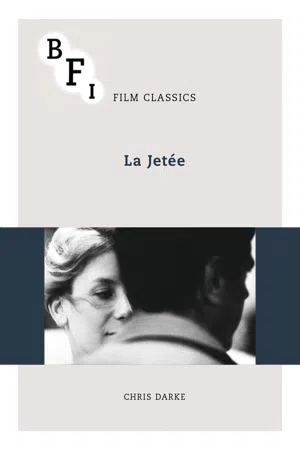
Chris Marker's La Jetée is 28 minutes long and almost entirely made up of black-and-white still images. Since its release in 1964, the film – which Marker described as a 'photo-novel' – has haunted generations of viewers and inspired writers, artists and film-makers. Its spiralling narrative of post-nuclear war time-travel narrative has influenced many other films, including the Terminator series and Terry Gilliam's Hollywood 'remake' Twelve Monkeys (1995).
But as Marker rarely gave interviews, little is really known about the origins of La Jetée or the ideas behind it. In this groundbreaking study, Chris Darke draws on rare archival material, including previously unpublished correspondence and production documents, to examine the making of the film. He explores how Marker's only fiction film was influenced both by his early work as a writer and by Alfred Hitchcock's Vertigo (1958), and considers how La Jetée's imagery can be seen to 'echo' throughout Marker's extraordinarily diverse oeuvre.
eBook - ePub
La Jetée
About this book
Information
1 La Jetée … Still
I don’t remember when I first saw La Jetée (1963) or where. It might have been in a repertory fleapit or a university seminar room. Or did I discover it, this mysterious jewel of a film, dumped on a VHS tape among half-recorded TV shows and out-of-date ads? Imagine: tumbling on fast-forward through colourful junk when, suddenly, this. Press play. Monochrome images – cool, spare, static – which seem to unfold out of each other. Whispering. Sudden heart-swelling gusts of music. Then – did that just happen? How? Rewind. Watch again. Wait for that moment when the film itself looks straight back at you.
The ‘where’ and ‘when’ don’t really matter now. The film has been a part of my life for so long that it seems always to have been there and over the years it has acquired the status of a work apart, and not only for me. When asked to contribute to the decennial Sight & Sound poll of the ‘Greatest Films of All Time’ in 2012, I had no trouble deciding which title would occupy prime position in my list and, in its first appearance, La Jetée came in at number fifty out of a hundred films, tying with Mizoguchi’s Ugetsu Monogatori (1953) – curiously, another film about ghosts and wartime – but was kept from the top slot by Hitchcock’s ‘pre-make’, Vertigo (1958). If such polls amount to anything, then La Jetée can no longer be considered merely a ‘cult classic’, as it has often been called, and should now be recognised as a bona fide master-work, a classic fully fledged and with no need of qualification.
Not that there isn’t something eminently cult-like about the admiration it inspires, the best expression of which must be the tiny one-room bar named in its honour in the Shinjuku district of Tokyo, where people come to drink beneath images from the film and which Marker stated was worth more to him than ‘any number of Oscars’.1 Other tributes are better known: from Terry Gilliam’s 1995 Hollywood ‘remake’ Twelve Monkeys and Mark Romanek’s video for David Bowie’s 1993 single Jump They Say, to the many science-fiction films that have drawn on La Jetée’s spiralling time-travel narrative, among them the Back to the Future series (1985–90), the Terminator films (1984–) and more recently Primer (2004) and Looper (2012), not to mention the 2014 US television series 12 Monkeys (which, if we accept Marker’s claim that La Jetée was itself a remake of Vertigo, makes the TV series a remake of a remake of a …).
In a well-known essay on cult films, Umberto Eco distinguishes between ‘unhinged’ and ‘perfect’ works. The ‘unhinged’ film is easily reduced to quotable fragments ripe for semiotic recycling and cult appreciation. The ‘perfect’ film, on the other hand, resists such intertextual overhauling because it remains in our minds as a whole, ‘in the form of a central idea or emotion’.2 But what about films that are both ‘unhinged’ and ‘perfect’, emotionally and intellectually complete as well as seemingly easy to disassemble? La Jetée is just such a work. ‘Unhinged’ in its highly unconventional and already fragmented form, it is also peculiarly ‘perfect’ for the same reason. I’d go further. La Jetée is perfect enough in its unhinged-ness to be exhibited in a gallery.
It is one thing to write a book about La Jetée, quite another to dedicate a room to it (and not a bar this time). The room in question was at the Whitechapel Gallery in London where an exhibition of Marker’s work was on show and I found myself returning to it repeatedly between April and June 2014. The challenge of how best to fit a black box into a white cube, of reconciling the viewing conditions of cinema with those of a gallery, found an answer in the room’s layout. Rows of benches facing a screen approximated the experience of being at the movies. The lighting levels, dimmed but not quite dark, and the space left for people to circulate around one side of the seating, allowed gallery-goers to pause, watch for a moment and then move on. I realised I could do something in that room I’d never done before, something that wouldn’t normally be possible among the darkened rows of a cinema or the brightly lit distractions of home viewing. I could watch people watching La Jetée.

Watching the watchers (installation view of Chris Marker: A Grin Without a Cat, exhibition held at Whitechapel Gallery, 16 April–22 June 2014. Courtesy Whitechapel Gallery, Whitechapel Gallery Archive)
Whether I was standing at the entrance or sitting on the benches alongside other viewers, my attention invariably shifted away from the film to the audience. And while there was something slightly recursive to the act of watching people watch a film about a man who watches the mental images projected in his mind’s eye, what did I see in those faces? Rapt attention, no doubt, and the signs of moment-by-moment immersion in the unique experience that the film offers. If my avid observation of the audience sounds a bit odd, I should explain that, as one of the curators of the show, I was bound to be intrigued by the way people reacted. Walking through the other two rooms, among the photographs and multimedia installations, books and collages, I was impressed by the absorbed looks of the visitors. Each room also included a looped projection of a film shown in its entirety: in the first, Marker’s early collaboration with Alain Resnais, Les Statues meurent aussi (Statues Also Die, 1953), and in the third, a restored print of Le Fond de l’air est rouge (A Grin Without a Cat, 1977), Marker’s three-and-a-half-hour documentary fresco about the leftist movements of the 1960s.
But it was in the room between the other two where I did most of my audience-watching. Though the smallest by far, it provided a focus to the show, being the only room dedicated solely to a single film. A little under thirty minutes long, shot in black and white, made up almost entirely of still images and with an evocative combination of voiceover narration, sound effects and music, La Jetée is cinematically hard to classify; something alluded to in the title credits where it is described as ‘un photo-roman’, or ‘a photo-novel’. With haunting economy, it tells the story of a soldier (Davos Hanich), who is held captive in an underground prison camp in post-apocalypse Paris and used as a guinea pig in time-travel experiments. He retains a mental image from his childhood of the face of a woman (Hélène Chatelain) and the death of a man witnessed on the observation pier (‘la jetée’) of Orly airport in Paris. His captors exploit the strength of this image, first to send him back to the past, where he meets the woman again, then into the future to secure the fate of humanity’s survivors. His mission accomplished, the time traveller flees back in time to Orly, where he hopes to be reunited with the woman, but he has been pursued by a guard from the camp who executes him in front of her. The time traveller’s final realisation is that his childhood image was of his own death.
Even though it was made over fifty years ago, La Jetée seems to have escaped the ravages of time, which explains something of its enduring fascination. Film-makers have played extensive variations on its story; artists have lingered over its exploration of the photographic image; and critics have analysed it as a meditation on loss, memory and the nature of cinema. However, in curating the Whitechapel show we found proof that La Jetée did not, in fact, fall fully formed from the sky as an inimitable cinematic masterpiece, but that it had its phases of production, its first drafts and rough sketches and even, as we discovered, its ‘twin’. To unearth such material was significant for two reasons. First, because Marker was deeply averse to giving interviews and rarely spoke about his work, next to nothing is known about the film’s origins or the ideas behind it. Such reticence adds greatly to its enduring mystique as a work that speaks for itself and as a seeming anomaly, the only fiction film in Marker’s extensive cinematic oeuvre. Second, because there is almost nothing in Marker’s own words, the material we assembled afforded a rare insight into the work that went into shaping the film.
I had read in an essay by the film scholar Philippe Dubois that the Royal Belgian Film Archive holds a trove of material relating to La Jetée, including a copy of a different version of the film, an exercise book containing an editing plan and a collection of correspondence between Marker and Jacques Ledoux, the former director of the Film Archive. Ledoux had assisted Marker with his research for La Jetée by arranging screenings of science-fiction films for him, and Marker had in turn donated materials to the Archive, as well as giving his friend an enigmatic credit on the film for the so-called ‘Ledoux Process’ (‘Procédé Ledoux’) and casting him in the role of the Chief Experimenter. So, in April 2013 I travelled to Brussels where, in the Archive’s gabled library, I examined these items with a sense of anticipation that was only heightened by the discovery that the Marker–Ledoux correspondence had mysteriously gone missing. (Dubois treats his readers to some extracts. Marker to Ledoux in early 1962: ‘a role as experimental-doctor-in-a-World-War-Three-underground-concentration-camp awaits you, which will fit you like a glove’).3 The copy of the film held by the Archive – La Jetée’s ‘twin’ – was distinguished from its definitive sibling by only the slightest difference in appearance; but when it comes to stillness and movement a difference, however small, can be decisive. What was striking was how and where Marker had chosen not to tell the story in still images. In this version, the opening pre-credits sequence set on the main pier at Orly airport is filmed in motion. The camera pans from left to right in a high-angle shot following the time traveller as he runs towards the woman, the image of whose face haunts him, and so towards the death which, through some quirk of time, he will have seen – and foreseen – as a child. This moving shot lasts only ten seconds but it alters the balance of the film completely.

Jacques Ledoux as Chief Experimenter
If this version of the film raised questions about the beginning (and beginnings) of La Jetée, the other archival item I had to examine took me even further back in time to its prehistory. Slipping on a pair of white gloves, I opened a large manila envelope and extracted a spiral-bound A4 exercise book with a blue cover and the word ‘Sciences’ embossed in gold. Turning to the inside front page, I saw the film’s title scrawled in thick strokes. The handwriting was familiar. Marker had made his mark with the pen he took his penname from. Over the following twenty-eight pages the structure of the film is arranged in a series of fourteen sequences listed alphabetically from A to Q. Each sequence is laid out across facing pages, with the left-hand page containing images and the right handwritten (though not by Marker) editing instructions. (The exceptions being sequences B, J and K, which are missing from the document but acknowledged in the overall alphabetical sequence.) The images had been cut from contact sheets, pasted vertically onto the page, and each one numbered, their order relating to an early version of the film’s narrative sequence. This ‘workbook’, as we curators came to call it, was like a secret manual of the film, a unique and fragile assembly (some images falling ungummed from its pages) of the elements that make up the completed work. Particularly interesting is the comparative exchange it sets up with the film, for there are things in the workbook not in the film and things in the film not in the workbook.

The workbook title page
These two archival treasures, La Jetée’s ‘twin’ and the workbook, were the principal displays in the Whitechapel room dedicated to the film. The Archive’s print was only available in the French-language version, with Jean Négroni’s narration translated in English subtitles, and it happened to be the most luminous copy of the film I’d ever seen. Probably because it had rarely, if ever, been projected as a celluloid print, the high-definition digital transfer was pristine, with monochrome tones that glowed like silk. From the workbook, we had facsimiles made of the title page and six sequences (A, M, N, O, P and Q) selected to illustrate either how close they are to the final version of the film or how they differ from it. In an adjoining vitrine, two other printed versions of the film’s images and text were shown, one published in 1964 by the French magazine L’Avant-Scène Cinéma, the other being the 1992 hardback ‘ciné-roman’ designed by Bruce Mau.

The workbook: vitrine display (installation view of Chris Marker: A Grin Without a Cat, exhibition held at Whitechapel Gallery, 16 April–22 June 2014. Courtesy Whitechapel Gallery, Whitechapel Gallery Archive); layout for Sequence A
One day, as we arranged the pages with our white gloves, preparing them for their vitrines, I said to a colleague, ‘We’re going to be accused of being fetishists.’ (Fetishism: the act of sanctifying fragments. See Eco’s definition of ‘cult’.) And with good reason. Two good reasons, in fact, the first being strictly curatorial. These different paper versions of the film – workbook, magazine layout and ‘ciné-roman’ – together proposed a way of taking seriously its descripti...
Table of contents
- Title Page
- Contents
- Acknowledgments
- 1 La Jetée … Still
- 2 In the Beginning
- 3 Window Shopping in 1962
- 4 Chris Marker Takes the Stairs
- 5 This Is the Story …
- 6 The Life and Death of Images
- Notes
- Credits
- Select Bibliography
- eCopyright
Trusted by 375,005 students
Access to over 1.5 million titles for a fair monthly price.
Study more efficiently using our study tools.
Frequently asked questions
Yes, you can cancel anytime from the Subscription tab in your account settings on the Perlego website. Your subscription will stay active until the end of your current billing period. Learn how to cancel your subscription
No, books cannot be downloaded as external files, such as PDFs, for use outside of Perlego. However, you can download books within the Perlego app for offline reading on mobile or tablet. Learn how to download books offline
Perlego offers two plans: Essential and Complete
- Essential is ideal for learners and professionals who enjoy exploring a wide range of subjects. Access the Essential Library with 800,000+ trusted titles and best-sellers across business, personal growth, and the humanities. Includes unlimited reading time and Standard Read Aloud voice.
- Complete: Perfect for advanced learners and researchers needing full, unrestricted access. Unlock 1.5M+ books across hundreds of subjects, including academic and specialized titles. The Complete Plan also includes advanced features like Premium Read Aloud and Research Assistant.
We are an online textbook subscription service, where you can get access to an entire online library for less than the price of a single book per month. With over 1.5 million books across 990+ topics, we’ve got you covered! Learn about our mission
Look out for the read-aloud symbol on your next book to see if you can listen to it. The read-aloud tool reads text aloud for you, highlighting the text as it is being read. You can pause it, speed it up and slow it down. Learn more about Read Aloud
Yes! You can use the Perlego app on both iOS and Android devices to read anytime, anywhere — even offline. Perfect for commutes or when you’re on the go.
Please note we cannot support devices running on iOS 13 and Android 7 or earlier. Learn more about using the app
Please note we cannot support devices running on iOS 13 and Android 7 or earlier. Learn more about using the app
Yes, you can access La Jetée by Chris Darke in PDF and/or ePUB format, as well as other popular books in Media & Performing Arts & Film & Video. We have over 1.5 million books available in our catalogue for you to explore.