eBook - ePub
Rio Bravo
About this book
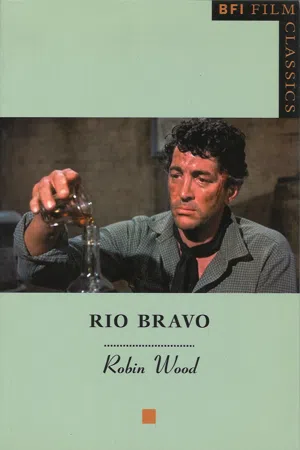
This volume is a study of the classic western film 'Rio Bravo', which, according to the author, remains 'beyond politics, as an argument as to why we should all want to go on living'.
Information
1
. . . . . . . . . . . . . . . . . . . . . . . . . . .
QUESTIONS OF VALUE AND POLITICS
The Author Resurrected
When Roland Barthes announced ‘the death of the Author’ perhaps he did not realise how simply and literally this phrase would be understood by his enthusiastic followers. Somewhere in the course of S/Z,1 if I remember correctly, he pronounces Sarrasine ‘incomparable’, a clear value judgment – and wherein can this value, this incomparability, lie but in Balzac’s individual authorship, the novella not having been produced accidentally by a monkey with a typewriter? Unfortunately, ‘the death of the Author’ has led to the implicit dismissal of ‘value’ as a criterion. We have been taught to look for ‘the rules of classical narrative’, for generic patterns, motifs, recurring iconography, to study works ‘scientifically’ as cultural products (which of course they are). This discipline has been of great importance: it has greatly increased our awareness of the basic raw materials upon which a genre defines itself and out of which individual films are built. But beyond it remains, or should remain – must remain if we are to retain any belief in human creativity and if works are to mean more to us than mere specimens for dissection – the question of value, and that question hinges inevitably on notions of personal authorship. It has not vanished altogether, but today it is seldom seriously discussed, as if there were something rather shameful about raising it. Yet most of us continue to value the Westerns of Ford and Hawks above those of, say, John Sturges, however interesting the latter may be as examples of generic conventions and variants.
I doubt whether you could find a dozen Westerns in which a woman throws a flowerpot through a window or an alcoholic deputy pours a glass of whisky back into the bottle without spilling a drop, but let us suppose for a moment that you can. And one might concede immediately that those two moments in Rio Bravo have a certain resonance in themselves, in isolation, divorced from their realisation in the film. Yet it is the realisation that ultimately matters, the precisions of staging, acting, editing, framing, the timing of their shot-by-shot moments within the context of an organically developing whole, in which what is past is still present for the spectator and what is to come a matter for excited moment-to-moment conjecture. And that realisation inevitably presupposes the existence of a guiding, controlling, creating imagination – in short an author.
I shall attempt some demonstration of this in the book that follows, with this forewarning: the film critic is at a distinct disadvantage relative to the literary critic. When F. R. Leavis proposed his famous definition of the ideal critical exchange (‘This is so, isn’t it?’/‘Yes, but…’), he could quote: the words offered as support for the judgment were there on the page before the reader, who could then decide whether s/ he was convinced. Short of supplying a video of extracts to accompany this book, I cannot do this: even the most elaborate montage of stills cannot communicate the movement of a scene any more than can a verbal description, and it is not for nothing that we define cinema as ‘moving pictures’. I can only send readers back to the film, for confirmation or disagreement.
There is another reason why, today, the question of value is seldom raised in ‘serious’ discourse on film – is abandoned, in effect, to the slick ‘entertainment’ provided by the popular press with its snap judgments, its mere ‘opinions’. The age in which we live is dominated by science and technology, hence by the assumption that everything worth saying can and must be susceptible to ‘proof’: you can prove that a certain motif recurs through a dozen films noirs; you cannot prove, in any fixed, definitive way, that Out of the Past is superior to Double Indemnity, or why. A value judgment cannot, by its very nature, be proven. But that is its strength, not a weakness: a value judgment is there precisely to stimulate thought, debate, argument, to be discussed, modified, rejected; it leads to dialogue, not to the sense that ‘Well, we know that now, let’s pass on to the next’. And what we are discussing, modifying, challenging are at once personal values and the values available in our culture at a given time, their debate leading to refinement, correction, development, change. That is why certain films are called ‘classics’: they continue to resonate, to offer different readings (within reason) to different generations, different individuals… or to the same individual at different periods in her/ his development.
Hawks and Politics
In 1968 the BFI published my book on Howard Hawks, or rather on his films.2 When most of it was written I had a brief meeting with the director in a London hotel (he was here, I think, to promote El Dorado) . It was not a noticeable success, but what interviews with famous people are? He was kind (I was half-petrified and stammered a lot), and he told me at the end that I was ‘good enough’. (Actually, he said that at least I had my questions prepared, unlike most interviewers, and he seemed to recognise that I had seen some of his movies.) I didn’t know how to conduct an interview with a famous person, having never undertaken such a thing before. I still don’t know, thirty-five years later. (It is perhaps complicated when you venerate the person’s achievements.) How can you make – or presume to make – any kind of intimate contact within that unnerving fifteen or so minutes? It is no use saying ‘I love your movies’, because every reporter (who may not have seen even one of the films, or remembered their titles) has already said the same thing, even though it doesn’t mean the same thing.
Hawks allowed the interview to continue for ten minutes longer than the twenty I had been told I was permitted, which was rather surprising because twice I made him somewhat angry. In the minor instance, I suggested that the end of His Girl Friday was unsatisfactory because Rosalind Russell should have walked out on Cary Grant (not, of course, to patch up her relationship with Ralph Bellamy). Grant was too monstrous, too irresponsible on every level, and he would only continue to manipulate and dominate her. Hawks told me, rather touchily, that it was what she really wanted.
The second question almost (I thought at the time) ended the interview, though now I also think that Hawks (although angry and offended) felt a certain respect for my courage in asking it: I don’t think he was used to being challenged, at that stage of his career. I shall have to admit here that I was, in fact, ‘set up’. I had at that time about as much political awareness as the average chimpanzee, but I had brought with me, from Welwyn Garden City Grammar School where I taught English, one of my two most brilliant pupils, David Moran, who can’t have been more than sixteen. David and I had become quite close because of our common interest in film. Having managed to persuade a somewhat bewildered headmaster who had never heard of Howard Hawks to give me a day off for the interview, I daringly pressed further to get permission for David to accompany me, partly for the educational experience, partly for the menial task of monitoring the tape recorder. The offending question was David’s, suggested on the train up to London, but I had promised him that I would raise it. In Hawks’s films foreigners always had minor, and in some ways ignominious, roles and never progressed beyond comic support: ‘Dutchy’ in Only Angels Have Wings, ‘Frenchy’ in To Have and Have Not, Carlos in Rio Bravo. Did Hawks not see that this was a question of racism?
He was plainly upset: it was clear that such an idea had never consciously occurred to him. He glared, he was indignant, but mostly he was visibly hurt. I wanted to disappear through a convenient trapdoor. Then he gave me what still seems tome, for its period, a good, intelligent (if arguably unenlightened) answer. It went something like this: ‘They were performers who came to my films with already developed personas. I helped and encouraged them to develop them further.’ And of course he did: Sig Rumann, Marcel Dalio and Pedro Gonzalez-Gonzalez never gave richer or more rounded characterisations (or less demeaning ones) in any other Hollywood films that I have seen.
The interview was supposed to appear in my book on Hawks, but I was told there wasn’t room for it (I also had to cut the book fairly drastically, not omitting any sections or ideas but shortening and simplifying sentences, omitting any words that were not strictly necessary; it may well have benefited from this in directness and clarity but I think it lost something in nuance). I delivered my typescript and the tape David had recorded, not thinking to keep a copy (this in the old days before computers were dreamed of ).When, after the book’s publication, I asked to have one or the other returned, I was told neither could be found. The interview, then, exists only in my distant memory, but I believe the above account is reasonably correct. What it does, essentially, is suggest Hawks’s (and so many Hollywood film-makers’) innocence of politics, both racial and sexual, and it is this I want to talk about first.
The Answer to ‘High Noon’?
Hawks himself linked Rio Bravo to High Noon in interviews; it has become almost obligatory today to refer to it as ‘the right wing answer to High Noon’. I shall return to Hawks’s own version of the relationship later. Here, I want to challenge a use of the term ‘right wing’ that strikes me as both glib and seriously misleading.
If Rio Bravo is ‘the right wing answer’, then High Noon is presumably left wing. Its chief claim to this (tome) desirable title seems to be that it was widely considered (andbyitsmakers,whoperhaps spread the word) a bold attack on McCarthyism. When it came out in 1953 it was extremely popular, but I cannot recall anyone making this connection (this was of course in England – the situation may have been different in the United States). But then, the connection is not exactly obvious. If we are to think of it in terms of allegory, then what exactly is supposed to be the match between film and actuality? Do Frank Miller, his brother Ben and their two sidekicks represent the UnAmerican Activities Committee?Are the townspeople, who prefer not to get killed or who would rather booze it up with the bad guys, the general public who failed to protest openly?Does Will Kane stand for an unidentified someone who denounced and (metaphorically) shot down McCarthy and his followers? Or is it sufficient that the film is simply telling us that we should stand up and be counted (in whatever connection)? But that scarcely makes it left wing, and it appears quite untainted by socialism, expressing above all a contempt for ‘the people’ (its most striking characteristic), while celebrating the charismatic hero who ‘goes it alone’ (with a little belated help from his wife). In one respect, indeed, it is clearly right wing, namely the issue of capital punishment: the whole plot (and Will Kane’s dilemma) hinges on the fact that the jury failed to hang Frank Miller.
It should, I think, be applauded for its handling of sexual and racial politics (which, curiously, I have never seen it credited for, though I may have missed this): its treatment of the Mexican widow, Helen Ramirez (Katy Jurado), is quite remarkable for the period and would still appear progressive today. Not only is she permitted dignity, intelligence and a conscience, she has also been the mistress (‘friend’ in the dialogue, but we are left in no doubt of the euphemism) of, in turn, Frank Miller, Will Kane and Kane’s deputy Harve (Lloyd Bridges). The film records these facts without flinching, implying that she has never lost her integrity, allowing Helen herself a speech about the difficulty of being a Mexican within white culture. Finally, she is permitted to befriend the heroine on equal terms and ride to the station with her side by side. I wish the film had taken the obvious step further. Were I shooting a remake today I would have her, rather than Amy (Grace Kelly), be the one to run back from the train and save Kane’s life, after which they would have gone off together, leaving Amy’s Quaker principles intact. (Any takers? I’ll write the screenplay.)
If High Noon is not (aside from this solitary lapse) a discernibly leftist movie, is Rio Bravo a rightist one? The question has worried me somewhat, as (ever since I ceased to think of politics in terms of ‘Which of these candidates would I vote for if I bothered to vote? Which seems the nicest person?’) I have continued to love Rio Bravo; in fact, I recently placed it first in the Sight and Sound ‘Ten Best Films’ poll. But the relationship between one’s political position and one’s sense of artistic value is an extremely complex, at times bewildering, one. I am still far from resolving it. For many years now Hawks has been at the centre of this dilemma, and perhaps I have undertaken this book as a way of resolving it.
Hawks’s own account of the relationship between the two films is totally apolitical and characteristically practical:
Gary Cooper ran around trying to get help and no one would give him any. And that’s rather a silly thing for a man to do, especially since at the end of the picture he is able to do the job by himself. So I said, we ’ll do just the opposite, and take a real professional viewpoint: as Wayne says when he’s offered help, ‘If they’re really good I’ll take them; if not, I’ll just have to take care of them.’ We did everything that way, the exact opposite…
That’s fair enough, as far as it goes, but it contains one inaccuracy (Cooper does need help at the end) and one omission: Hawks might have mentioned that Wayne needs help at every critical moment, and gets it, in most cases, quite unexpectedly, from a number of diverse supporters: an alcoholic, a teenager, a woman and an aged cripple… This is, after all, a major component of the film’s thematic structure.
It is true that Rio Bravo shows no more respect for ‘the people’ (the town’s inhabitants) than does High Noon. But neither does it express contempt for them: typically, Hawks simply regards them as irrelevant. As they can be of little help against the heavily armed and powerful Burdettes, they are of no use to the heroes and thus of no interest to Hawks, the only exceptions being Carlos and his wife Consuela, who stand apart somewhat as keepers of the solitary hotel and suppliers of additional ‘comic relief’ (though few scenes in the film are devoid of comedy). Hawks has never shown any positive interest in ‘civilised’ or settled domestic life. His nearest approach to a ‘family’ film is The Ransom of Red Chief, his contribution to the O. Henry omnibus movie Full House, in which the child’s parents show little concern when he is kidnapped (‘He ’ll be back’), and eventually make his kidnappers pay to return him. Hawks’s only film centred on a married couple (Monkey Business) is primarily concerned with the repression on which the marriage is built and the chaos and disruption resulting from its release. The adventure films never end in marriage (neither do the comedies) – only in the provisional acceptance of a relationship, with no guarantee of permanence (‘How little we know’, as Lauren Bacall sings in To Have and Have Not, the tune accompanying the couple’s final exit). The solitary exception is Gentlemen Prefer Blondes, which ends with a double wedding, instantly undercut by a track-in on Marilyn Monroe and Jane Russell, excluding their inadequate spouses from the image, implying in their exchange of triumphant smiles that the two women are in fact marrying each other. The citizens of Rio Bravo (which I assume is the name of the town as well as the river, of which we never see any sign but which the brief snatch of song at the end assures us ‘rolls along’) are never more than undifferentiated background figures, at most a pretext for the heroes’ actions. The heroes themselves form a quasi-democratic group: if Chance is the leader, it is by force of personality, integrity and ability, his position accepted voluntarily by the others (who are free to opt out whenever they wish). Dictatorship is represented by Nathan Burdette, who rules by force with his paid stormtroopers. While I shall not be claiming Rio Bravo as some kind of crypto-Marxist movie, if I had to choose which film leaned more to the left I would favour it (possibly to Hawks’s horror, precisely for that reason) over High Noon. Today, indeed, it is easy to read the Burdette empire as an embryonic form of corporate capitalism erected upon values of wealth, greed and power, and the film’s political interest becomes more clearly defined.
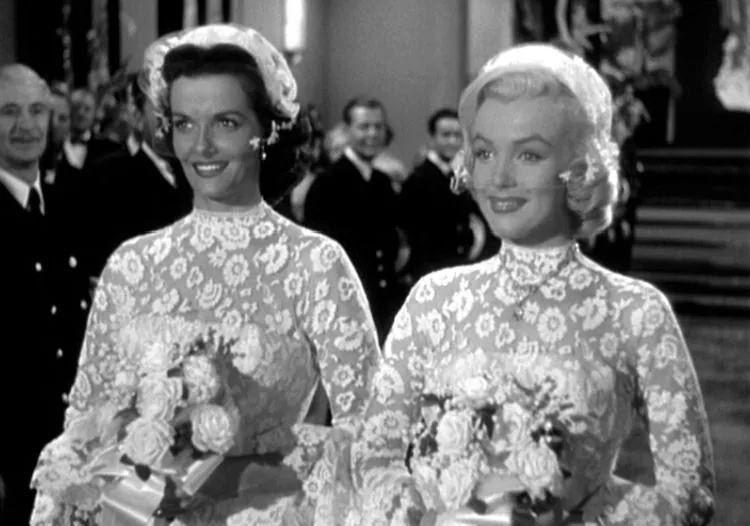
The wedding of Dorothy and Lorelei
Hawks (in his films) comes across as something of a political innocent (he appears, in private life, to have voted Republican, perhaps merely as a habit inherited from his background of wealth and privilege). His films are at their worst when the narrative develops explicitly political implications, the worst example being the ending of Red River, which I have come, over the years, to find quite unacceptable. Dunson (John Wayne) has degenerated into a figure equivalent to Nathan B...
Table of contents
- Title Page
- Contents
- A Personal Note
- 1 Questions of Value and Politics
- 2 A Hawks Triology
- 3‘Rio Bravo’
- Notes
- Credits
- eCopyright
Trusted by 375,005 students
Access to over 1.5 million titles for a fair monthly price.
Study more efficiently using our study tools.
Frequently asked questions
Yes, you can cancel anytime from the Subscription tab in your account settings on the Perlego website. Your subscription will stay active until the end of your current billing period. Learn how to cancel your subscription
No, books cannot be downloaded as external files, such as PDFs, for use outside of Perlego. However, you can download books within the Perlego app for offline reading on mobile or tablet. Learn how to download books offline
We are an online textbook subscription service, where you can get access to an entire online library for less than the price of a single book per month. With over 1.5 million books across 990+ topics, we’ve got you covered! Learn about our mission
Look out for the read-aloud symbol on your next book to see if you can listen to it. The read-aloud tool reads text aloud for you, highlighting the text as it is being read. You can pause it, speed it up and slow it down. Learn more about Read Aloud
Yes! You can use the Perlego app on both iOS and Android devices to read anytime, anywhere — even offline. Perfect for commutes or when you’re on the go.
Please note we cannot support devices running on iOS 13 and Android 7 or earlier. Learn more about using the app
Please note we cannot support devices running on iOS 13 and Android 7 or earlier. Learn more about using the app
Yes, you can access Rio Bravo by Robin Wood in PDF and/or ePUB format, as well as other popular books in Media & Performing Arts & Film & Video. We have over 1.5 million books available in our catalogue for you to explore.