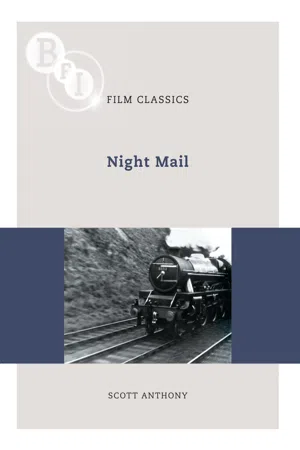
Night Mail (1936) is one of the best-loved and best-known films in the canon of British documentary cinema. Bringing together the creative talents of Harry Watt, Basil Wright, W. H. Auden and Benjamin Britten, the film gave John Grierson's documentary school its first popular success. Its collectivist politics and its peculiarly modest brand of modernism is as redolent of the inter-war age as Agatha Christie, Penguin Books or The Shell Guides. But it was also a corporate promo, part of a publicity campaign initiated by Clement Attlee to stave off Post Office part-privatisation and to improve the morale of postal workers.
Scott Anthony's study provides a lively appreciation of this vivid, witty and often just plain eccentric masterpiece. In doing so he uncovers the remarkable stories of civic-minded idealism, creative intrigue and political trickery that underpin this classic documentary.
eBook - ePub
Night Mail
About this book
Information
1 A Man Called Tallents
Sir Stephen Tallents’ interest touched life at many points – variously and sometimes oddly – all the way to thistledown pillow and ratskin prayer books … documentary cinema is his monument.
John Grierson1
A very nice gentle creature who was Empire Marketing Board and started Grierson’s film unit.
Graham Greene2
Night Mail’s genius has been variously ascribed to John Grierson’s documentary ethos, the avant-garde nous of GPO film-maker Alberto Cavalcanti, the popular stirrings of W. H. Auden’s poetry and the beginnings of Benjamin Britten’s brilliant composing career. As exceptional as those men’s abilities were, this seems sloppy and slightly unjust. Formally, Night Mail’s greatness rests on its skilful blending of word, sound and image. Critical appreciation has often reduced it to the extraordinary number of interwar era ‘names’ that can be shoehorned into an account of the film’s production. This is deeply unfair on the two men credited with producing the film, Basil Wright and (the even more frequently forgotten) Harry Watt. It also shamefully neglects the man primarily responsible for creating a public-sector film unit, staffing it with such remarkable people and tenaciously supporting its efforts, the aptly named Sir Stephen Tallents.
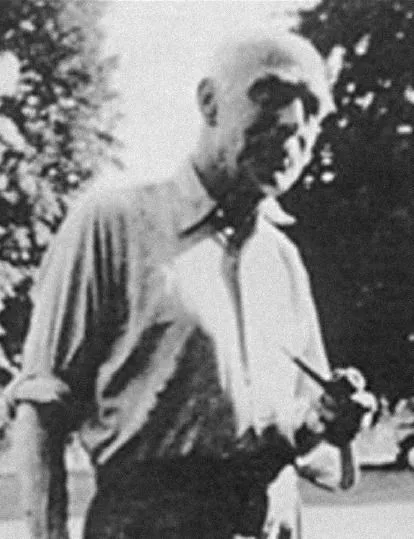
Sir Stephen Tallents
Tallents, an unusually inventive civil servant, had established the principle of a government film unit while working at the Empire Marketing Board (EMB). The EMB (1926–33) was a pioneering governmental venture in peacetime propaganda, a loose, experimental organisation whose uneven output reflected Tallents’s personal idiosyncrasies. As an EMB colleague described him:
Outwardly he was a shy man whose aloofness and reserve of manner discouraged intimacy and made many people find him cold and awe inspiring … this outward reticence hid, however, a highly romantic side to his complex nature, which had found expression in writing over-stylized prose articles for the back page of The Manchester Guardian.3
On the one hand, Tallents was the writer of Chekhovian short-story collections who had attracted News of the World infamy by attempting to elope with a wealthy heiress. On the other hand, Tallents was a senior civil servant whose distinguished career in public service had been defined by an unorthodox scientism.
Under Tallents’s direction the EMB sought to encourage new scientific, commercial and cultural relationships between Britain and an increasingly independent-minded Empire. It sought to sidestep tricky political issues by funding collaborations and exchange programmes, by subsidising publications and donating to research projects. It supported the growing of pineapples in Zanzibar, the cultivation of grapes in Palestine and the planting of rice fields in Harwich and Southend. During its seven years of existence the Board attempted to convince and cajole producers, distributors and consumers to change their behaviour for the benefit of all the Empire’s peoples. Indeed, it is not too fanciful to suggest that the work of modern non-governmental organisations (NGOs} and ‘fair trade’ campaigners have some roots in the scientific and economic development schemes sponsored by the EMB. Hence, at one level, the EMB published studies such as The Behaviour and Diseases of the Banana in Storage and Transport, while at the other it organised massive shopping exhibitions whose scope ranged from the distribution of aloo gobi recipes to mass-participation yoga classes.
The EMB was brought to popular notice by an array of conspicuously successful cultural interventions. Tallents hired artists, writers and eventually film-makers to ‘bring the Empire alive’ by celebrating the ‘forms of life not often discussed in speeches’. Tallents believed that the extension of the franchise and the end of World War I had opened up a new era of democratic internationalism in which the Commonwealth should play a key part. He spoke of:
Henry the Navigator and the School of Navigation by which he opened up the New World, and he would point to film, radio, poster and exhibition as the sextant and compass which would manoeuvre citizenship over the new distances.4
Tallents’s enthusiasm for film was unusual for a man of his position in the civil service. Although, by the mid-1920s, the cultural and economic challenge posed by American domination of the British film market was creating widespread political unease, this unease had crystallised in the Cinematograph Films Act of 1927, a piece of protectionist legislation which required cinemas to show a minimum quota of British films. Tallents considered this response inadequate, preferring instead to promote the production of distinctively British titles rather than limit the import of foreign films. The recruitment of John Grierson and the terrible impact of the Wall Street Crash served to harden Tallents’s conviction.
John Grierson was to become one of the defining personalities of British film. He both informed, and was a product of, a wider strand of interwar middle-class thought which attempted to fuse the emerging media technologies with an educational mission. His conception of documentary film bears obvious comparison with, for example, John Reith’s direction of ‘public-service’ broadcasting at the BBC. However, the aims and integrity of the documentary school Grierson created, and the quality and reach of the films this school produced, remain fiercely contested. It can be argued that Grierson played a key role in embedding a certain kind of realist aesthetic – a mode of social enquiry that tends to romanticise the everyday, ordinary or working class – into the fabric of British film culture. It could just as easily be said that his vision was so limited and particular that his only positive legacy is the striking public safety films that hit our screens every year around Christmas time.5 For the purposes of this monograph, we need only explain that this strange mixture of sombre schoolmaster and egocentric showman was crucial to organising and then orientating, Night Mail.
Grierson joined the EMB after a spell at Chicago’s famed school of social sciences. While in the US, Grierson had become convinced that the future of participative democracy depended on the development of new methods of civic education that were better able to capture the imagination and critical attention of the mass populace. Grierson believed film would be crucial to this development, coining the term ‘documentary’ to define a new kind of realistic feature dedicated to explaining, and interrogating, contemporary conditions.6 Ensconced in film research under Tallents’s wing at the EMB, Grierson waited for an opportunity to turn democratic theory into effective film-making practice. He soon got the opportunity he craved. The EMB’s first film, One Family (1930), was a delirious high-budget romp that centred on a little boy’s quest to gather the ingredients necessary to bake an Empire Christmas pudding. It was also an unmitigated disaster. Despite the popularity of the actual puddings (and the giant seven-foot pudding the EMB baked to promote it), One Family sunk with the public and bombed with the critics.7 The door was at last ajar for Grierson’s serious, and more sensibly budgeted, brand of cinema to take centre stage at the EMB. To his eternal credit, Grierson managed to produce two documentaries, the self-directed Drifters (1929), and Robert Flaherty’s Industrial Britain (1933), of lasting interest and imaginative power. The contentious portrayal of ‘dignified labour’ in these slump-era pictures created a critical sensation that appeared to bear out Grierson’s convictions. The impact of these two films convinced Tallents of the Unit’s potential. He almost apologetically explained:
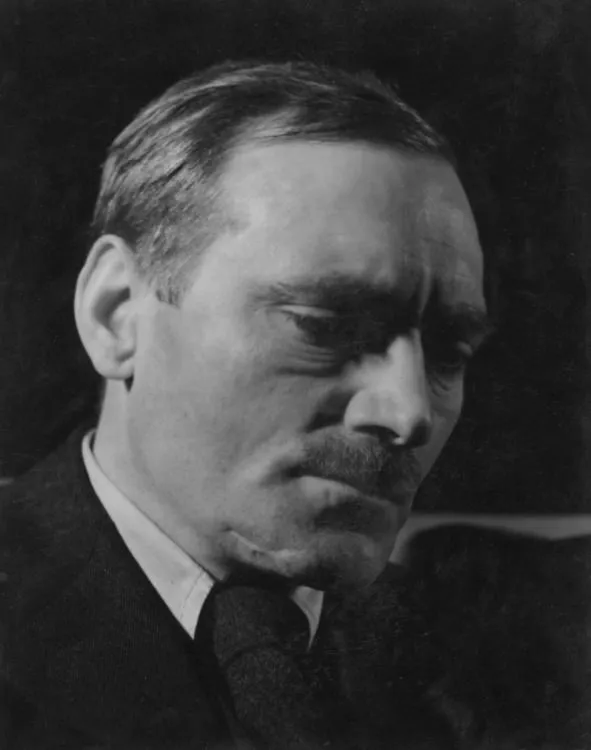
John Grierson
I write in this airy fashion, believing you will not confuse, any more than I confuse in my own mind, limited actual achievements with actual possibilities. We ourselves are conscious of many more defects in the specimen films than anyone looking at them for the first time is likely to notice. But I believe that there is a nucleus of remarkable promise in this EMB Unit, and this is recognised outside the EMB.8
Tallents’s pleading not only saved the Film Unit when the EMB was disbanded in 1933, but saw it transferred with him to the General Post Office (GPO). Tallents had long claimed that the documentary unit had been conceived along similar lines to Michel St Denis’s multitasking theatre group Compagnie de Quinze. The GPO’s financial backing enabled him to realise this vision and allowed Grierson to begin developing a documentary ‘school’. In the first instance Alberto Cavalcanti was recruited from the commercial world, brought in to ‘leaven with a more human touch the slightly inhuman austerity, which had tended to mar the unit’s work in the past’. The fêted director of Rien que les heures (1926) was soon followed to the GPO Film Unit’s new Blackheath studio by an incredible flock of artists, poets, painters and personalities. As Night Mail director Harry Watt remembered:
We had done some films for the Post Office, and they were pretty uninspiring … What we rank-and-filers did not realise was that we were being taken over to the PO by Sir Stephen Tallents, that most understanding of men, and that we would find, amongst the faceless little squares we imagined were hidden away in the bowels of the administration, some of the most easy going and sympathetic persons an experimental unit could wish for.9
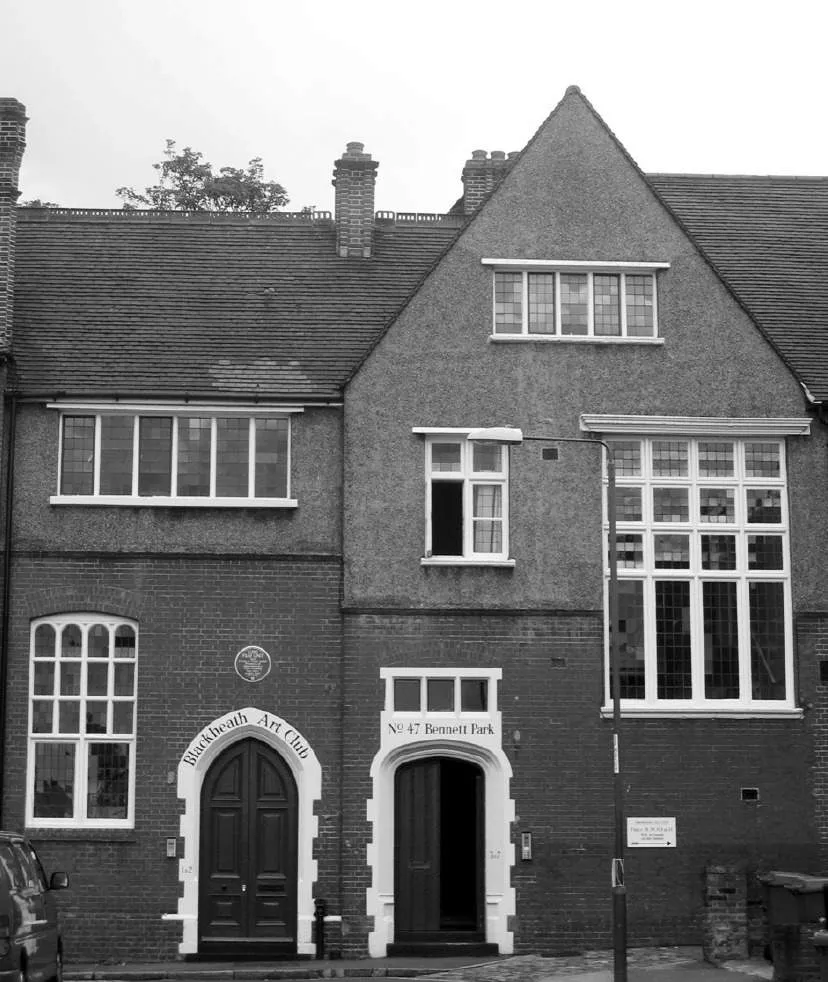
The GPO Film Unit’s Blackheath studio
Experimental was an apt description of the Film Unit. As well as taking aesthetic risks, the GPO Film Unit operated completely outside of the norms of the commercial mainstream. Its films were more likely to be distributed through film clubs, trade exhibitions and in schools, than seen in cinemas. For more than a decade, at least, the documentary film circuit operated at the margins of the film business. Its films rarely reached the spectacular new cinemas of the age; instead they found their way to audiences through the GPO’s mass media events and consumer exhibitions.10 Additionally, the EMB/GPO film directors were self-taught and, as anyone who has sat through an afternoon of their early efforts will attest, they struggled to master a steep learning curve. The unusually generous support afforded to Tallents’s amateur organisation belied the fact that he had been appointed to the GPO board in 1933 as part of a desperate last-ditch effort to stave off privatisation.
In the first instance, Tallents’s work at the GPO involved little more than devising ingenious ways to increase revenue by selling more telephones. New customer-focused services – such as directory enquiries, the speaking clock, ‘999’ and telephone chess – were to be unveiled with exquisite showmanship. For example, as part of 1934’s ‘Telephone Week’ the cable ship HTMS Monarch was sailed down the Thames and opened up to an enthusiastic public. Speakers were erected in Trafalgar Square to blare out a concert performed by Jack Hylton’s jazz band as it was flown over London in an Imperial Airways plane. The extraordinary team of modernist musicians collected at the GPO Film Unit produced an avant-garde selection of ‘novel GPO sounds’ for broadcast by the BBC. Most relevantly, the GPO Film Unit took advantage of its new studio’s facilities to produce its first full-scale sound venture, Pett and Pott (1934). Cavalcanti’s enjoyably whimsical short (arguably Pett and Pott is little more than an extended advert) contrasted the sensible phone-owning Petts, wi...
Table of contents
- Title Page
- Contents
- Acknowledgments
- 1 A Man Called Tallents
- 2 The Making and Meaning of Night Mail
- 3 Harry Watt vs Basil Wright
- 4 Alberto Cavalcanti, Benjamin Britten and the Sound Direction of Night Mail
- 5 Letters for the Poor: The Influence of W. H. Auden
- 6 The GPO and Night Mail
- 7 Critical Reputation
- ‘Night Mail’ by W. H. Auden
- ‘Night Mail’ by Blake Morrison
- Notes
- Credits
- eCopyright
Trusted by 375,005 students
Access to over 1.5 million titles for a fair monthly price.
Study more efficiently using our study tools.
Frequently asked questions
Yes, you can cancel anytime from the Subscription tab in your account settings on the Perlego website. Your subscription will stay active until the end of your current billing period. Learn how to cancel your subscription
No, books cannot be downloaded as external files, such as PDFs, for use outside of Perlego. However, you can download books within the Perlego app for offline reading on mobile or tablet. Learn how to download books offline
Perlego offers two plans: Essential and Complete
- Essential is ideal for learners and professionals who enjoy exploring a wide range of subjects. Access the Essential Library with 800,000+ trusted titles and best-sellers across business, personal growth, and the humanities. Includes unlimited reading time and Standard Read Aloud voice.
- Complete: Perfect for advanced learners and researchers needing full, unrestricted access. Unlock 1.5M+ books across hundreds of subjects, including academic and specialized titles. The Complete Plan also includes advanced features like Premium Read Aloud and Research Assistant.
We are an online textbook subscription service, where you can get access to an entire online library for less than the price of a single book per month. With over 1.5 million books across 990+ topics, we’ve got you covered! Learn about our mission
Look out for the read-aloud symbol on your next book to see if you can listen to it. The read-aloud tool reads text aloud for you, highlighting the text as it is being read. You can pause it, speed it up and slow it down. Learn more about Read Aloud
Yes! You can use the Perlego app on both iOS and Android devices to read anytime, anywhere — even offline. Perfect for commutes or when you’re on the go.
Please note we cannot support devices running on iOS 13 and Android 7 or earlier. Learn more about using the app
Please note we cannot support devices running on iOS 13 and Android 7 or earlier. Learn more about using the app
Yes, you can access Night Mail by Scott Anthony in PDF and/or ePUB format, as well as other popular books in Media & Performing Arts & Film History & Criticism. We have over 1.5 million books available in our catalogue for you to explore.