- 96 pages
- English
- ePUB (mobile friendly)
- Available on iOS & Android
eBook - ePub
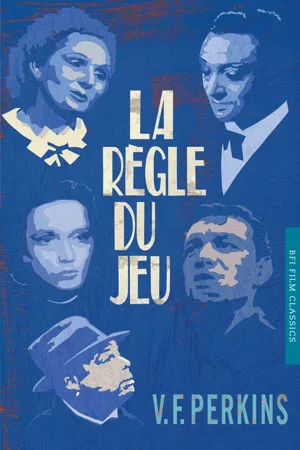
La Regle du jeu
About this book
Renoir's famous and controversial comedy of manners has a troubled history. Victor Perkins presents here a sensitive socio-historical study of Renoir's revised edition of the film, released 20 years after its premiere; shaped by the profundity and originality of its form.
Information
1 Making Unmaking Remaking
| CAHIERS | To get back to The Rules of the Game: Weren’t you surprised by the poor reception it got? |
| RENOIR | Well, I wasn’t expecting it. I never expect it, and for a very simple reason: I always imagine that the film I’m going to make will be an extremely marketable film, which will delight all the distributors and will be considered rather ordinary.1 |
Nowadays La Règle du jeu starts with an announcement. Before we get to the film itself we are told that we are to see a reconstruction. ‘Jean Gaborit and Jacques Durand have reassembled the original version of this film with the approval and guidance of Jean Renoir, who dedicates this resurrection to the memory of André Bazin.’ Implied here is a deal of significant context, much of it to do with the startling history of the film’s production.
The Gaborit/Durand version is the one presented in triumph at the 1959 Venice Film Festival, twenty years after the calamitous Paris premiere of July 1939. In his memoirs, Renoir looked back from the 1970s on a failure that had so depressed him that he made up his mind either to turn his back on cinema or to leave France. He had been stunned to discover that the film rubbed most of the audience up the wrong way. ‘It was a tremendous blow. The film was received with something like hatred … and the public regarded it as a personal insult.’2
It was the public, more than the journalistic, response that floored Renoir. He acknowledged that a number of reviewers wrote in praise of the picture. The historian Claude Gauteur assembled a dossier of forty-one contemporary responses and was able to weigh seven completely favourable reviews against twice as many that were unqualified in their hostility.3 Some revisionist historians wish us to believe that the film’s misfortunes were exaggerated, by Renoir among others, to support the legend of the martyred masterpiece. Gauteur, for instance, warns against supposing that the censors made it a special target before and after the outbreak of war. ‘La Règle du jeu was banned from September 1939 to February 1940 on account of the conditions of the time, as were a number of other French films. No more, no less.’4 Renoir recorded its withdrawal as demoralising.5 No memorable comfort came from knowing, if he did, that others suffered the same misfortune.
A notion of mastery is proclaimed in much writing about film. It pictures the author of a great work as from the outset certain of the intention, steadfast and confident in its execution. In this respect, forgetfulness worked to foster the image of pure victimhood for Renoir and La Règle du jeu. Accounts of the film’s reception have tended to overlook the director’s own misgivings as it was prepared for release, and to ignore his part in its undoing. It was because of the misgivings, perhaps, that he gave in to the demands of the film’s backers. ‘Commerce has spoken,’ he told his colleagues. ‘We are going to make cuts.’6 As a result, the premiere version of the film had lost 13 minutes from Renoir’s first cut; the losses affected a number of scenes and moments that would now be thought indispensable, and they may well have brought additional confusion to what was always an unorthodox storyline.
Panic cutting foresaw, tried to forestall, difficulties at the box office. Anxiety was inevitable when a major triumph was required for the film to realise the hopes, and return the money, invested in it. Since a mere moderate success would be accounted a failure, how terrible it must have been when it was received with worse than indifference. There is little room for doubt that La Règle du jeu was widely scorned and hated. Too many people who were there at the time – among others, the actors Marcel Dalio7 and Paulette Dubost8, the set designer Eugène Lourié9 and Henri Cartier-Bresson10, an assistant director on the film – left testimony that supports Renoir’s memory of a painful rejection. In its wake, further cuts were made as the director attempted to get rid of incidents that seemed particularly to rile the spectators, only to find that hostility erupted elsewhere in what remained. The picture shrank from the 113 minutes of its preview version to end up as a range of truncated prints of less than 90. The work of suppression was extended and apparently completed in 1942 by an Allied air raid that demolished the laboratories housing the negative. La Règle du jeu had become something beyond a film maudit.
If it was France that doomed the film, it was France too that rescued it. After the war, its reputation gathered. More voices joined those that had been raised in 1939 to defend or acclaim it. There came to light an 80-minute version in good condition. At that length, gaps in the continuity must have been evident and tantalising. But the version established itself in the ciné-clubs and specialised houses.
We have two key witnesses to the impact even of the mutilated versions. Alain Resnais, speaking to Sight & Sound as the director of Hiroshima mon amour (1959) and La Guerre est finie (1966), recalled a 1944 screening as the single most overwhelming experience he had ever had in the cinema:
When I came out of the theatre, I remember, I just had to sit down on the edge of the pavement; I sat there for a good five minutes, and then I walked the streets of Paris for a couple of hours. For me, everything had been turned upside down. All my ideas about the cinema had been challenged … Since then, of course, I’ve seen it at least fifteen times – like most film-makers of my generation.11
François Truffaut echoes this theme in a letter to Renoir:
I saw La Règle du jeu over and over again between the ages of thirteen and fourteen, when everything in my life was going so badly. [It] helped me to keep going, to understand the motives of the people around me, and to get through those awful years of my adolescence … I will always feel that my life is connected to the film you made.12
If we can rely on Truffaut’s memory, his immersion in La Règle du jeu must have occurred in the immediate aftermath of World War II.
Then and later, Renoir’s cause was championed by major figures in French film culture who nurtured and disciplined the growth of young cinéphilia. At the Paris Cinémathèque, Henri Langlois lost no opportunity to screen Renoir’s films and to set them among cinema’s greatest and most educative achievements. The critic André Bazin, through his zeal and intellectual passion, spread the conviction that Renoir was the most vital figure in the French contribution to world cinema. His impact was all the greater because he was at the same time fostering the development of the new generation of critics – among them Truffaut – who were to gather round the monthly Cahiers du cinéma and quite soon to form the core of the New Wave of film-makers.
To acclaim Renoir’s achievement was also necessarily to defend it against attack, since he had enemies on the left as well as on the right. His standing in many French eyes was compromised by his failure to return from America – from Hollywood! – after the German surrender. It was ten years before he made another film in the French studios, and in fact California remained his home until his death in 1979. His choice worried even his friends; it was open to a range of interpretations, many of them offensive to French sensibilities. The heat of cultural warfare did its bit to inflame the fervour of Renoir’s admirers.
In that context, the absence of an authentic version of La Règle du jeu must have become, by 1956, worse than teasing. The directors of a Paris ciné-club set out to establish a more complete edition. They formed La Société des Grands Films Classiques, acquired the rights and assembled every scrap of film or negative they could lay hands on. Buoyed by their discovery of salvaged material in another laboratory – more than two hundred cans of it – Jean Gaborit and Jacques Maréchal worked with the editor Jacques Durand to reconstitute Renoir’s movie. They went beyond restoration of the first premiere version to achieve something close to the 113 minutes that Renoir had initially sanctioned. Although the term did not exist in 1959, their edition of La Règle du jeu was surely the first and still the most glorious instance in cinema history of a Director’s Cut.

Alain Renoir, an assistant, on set with his father
By eloquent coincidence the restored film had its festival screening in the season that found the French New Wave in glory at Cannes. As he was at Venice in 1959 to present his new film, Le Testament du Docteur Cordelier, Renoir was able to savour the rediscovery. ‘Quite a triumph,’ he wrote to his son Alain.13 In Sight & Sound, Penelope Houston reported that ‘on the day these two productions … were shown, the festival was unmistakably Renoir’s’.14
André Bazin did not live to see this vindication. He died at forty in November 1958 before he could complete his book on Renoir. (In homage, Truffaut undertook to organise the manuscript and fill it out for publication.) One of the last acts of his life as a critic must have been to cast his votes, alongside those of Chabrol, Godard, Rivette, Rohmer and Truffaut among others, in the selection of Cahiers du cinéma’s Twelve Best Films of All Time. La Règle du jeu was placed at the head, second only to Murnau’s Sunrise (1927). The list was published in the issue for December 1958, which carried the announcement of Bazin’s death.
Like the Cahiers vote, all Bazin’s writing on La Règle du jeu must have been based on truncated prints. Yet he acclaimed the picture’s brilliant construction and provided understandings of its achievement that have proved doubly seminal. Bazin illuminated La Règle du jeu in ways to which all subsequent criticism is indebted; he was also the first to insist on its centrality for our assessment of the cinema as a whole. Since then, everyone who presents a significant argument on the aesthetics of film has been obliged to take account of Renoir’s work and to engage with Bazin’s view of it.
The dedication to Bazin’s memory was indeed a fitting tribute. But the opening announcement was not the only addition that Gaborit and Durand made to the resurrected movie. La Règle du jeu had always carried in its titles a disclaimer offering the picture as a divertissement and denying any ambitions as social criticism. In 1959, assuredly with Renoir’s approval and most likely at his suggestion, the disclaimer was modified and subtly transformed by an addition that gave the film the character of a prophetic period piece. It now reads – italics mark the insert – as follows: ‘This entertainment, whose action occurs on the eve of the 1939 war, makes no claim to be a study of manners. Its characters are pure make-believe.’
The inserted words were not put in to explain anything about the film’s plot for an audience that would now be offered it under the rubric of Les Grands Films Classiques. They were there to alert the spectator to the purpose of La Règle du jeu, and to insist on the relevance of the eve-of-war context even though – or especially because – the process of national and international events would not intrude upon the action and would be absent from the concerns of the characters. Evoking the brink of war gave the author’s approval to interpretations that emphasised social criticism. These new words asked that the film be seen in the light of the events that followed 1939. Thereby they...
Table of contents
- Title Page
- Contents
- Acknowledgments
- 1 Making Unmaking Remaking
- 2 André Jurieu (Roland Toutain)
- 3 Robert de La Chesnaye (Marcel Dalio)
- 4 Christine (Nora Gregor)
- 5 Octave (Jean Renoir)
- Notes
- Credits
- Select Bibliography
- eCopyright
Trusted by 375,005 students
Access to over 1.5 million titles for a fair monthly price.
Study more efficiently using our study tools.
Frequently asked questions
Yes, you can cancel anytime from the Subscription tab in your account settings on the Perlego website. Your subscription will stay active until the end of your current billing period. Learn how to cancel your subscription
No, books cannot be downloaded as external files, such as PDFs, for use outside of Perlego. However, you can download books within the Perlego app for offline reading on mobile or tablet. Learn how to download books offline
Perlego offers two plans: Essential and Complete
- Essential is ideal for learners and professionals who enjoy exploring a wide range of subjects. Access the Essential Library with 800,000+ trusted titles and best-sellers across business, personal growth, and the humanities. Includes unlimited reading time and Standard Read Aloud voice.
- Complete: Perfect for advanced learners and researchers needing full, unrestricted access. Unlock 1.5M+ books across hundreds of subjects, including academic and specialized titles. The Complete Plan also includes advanced features like Premium Read Aloud and Research Assistant.
We are an online textbook subscription service, where you can get access to an entire online library for less than the price of a single book per month. With over 1.5 million books across 990+ topics, we’ve got you covered! Learn about our mission
Look out for the read-aloud symbol on your next book to see if you can listen to it. The read-aloud tool reads text aloud for you, highlighting the text as it is being read. You can pause it, speed it up and slow it down. Learn more about Read Aloud
Yes! You can use the Perlego app on both iOS and Android devices to read anytime, anywhere — even offline. Perfect for commutes or when you’re on the go.
Please note we cannot support devices running on iOS 13 and Android 7 or earlier. Learn more about using the app
Please note we cannot support devices running on iOS 13 and Android 7 or earlier. Learn more about using the app
Yes, you can access La Regle du jeu by V.F. Perkins in PDF and/or ePUB format, as well as other popular books in Media & Performing Arts & Film & Video. We have over 1.5 million books available in our catalogue for you to explore.