eBook - ePub
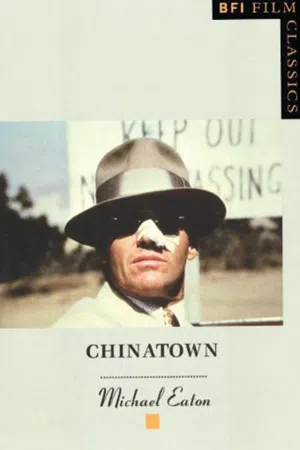
Chinatown
About this book
This study analyzes 'Chinatown' in the context of the figure of the detective in literature and film from Sophocles to Edgar Allan Poe and Alfred Hitchcock. In the account of 'Chinatown''s narrative development Michael Eaton seeks to uncover both its relationship to the pessimism of American cinema in the 1970s and its veritably mythical structure.
Information
'CHINATOWN'

Chinatown is the last, so it is often said, 'studio picture', a film which was made in a time when it was still possible for a Hollywood major to produce a complex work which, though it ultimately crashes against the rocks of despair, is never sucked into the maelstrom of cynicism. To approach it yet one more time, imagining that all its pleasures have been exhausted, that all its meanings have been disclosed, is to evoke a nostalgic memory of entering a cinema twenty years ago with an expectation so rarely experienced today.
Every film, even (perhaps especially) those that never see the light of day or the dark of night, is the result of an accident. Sometimes that contingency leads to the serendipitous discovery of a fragrant isle hitherto only alluded to in unreliable travellers' tales. More often it resembles a multi-vehicle pile-up on a rush-hour freeway. The fact that any film ever gets made at all seems more a demonstration of the operation of chaos theory than the result of rational, industrial planning. But for once the magic worked: so, Chinatown. It will take a while to get there.
It is too much of a temptation to resist the cliché 'wunderkind' when talking of Robert Evans, or to fail to evoke the shade of Irving G. Thalberg, and not only because Evans had portrayed the legendary producer in the Lon Chaney bio-pic, The Man with a Thousand Faces (1957). A radio actor as a child, a successful entrepreneur in the rag trade, a short-lived Hollywood juve (he had also portrayed, perhaps somewhat improbably for the son of a Jewish New York dentist, Pedro the bull-fighter in The Sun Also Rises, also in 1957), he had moved into independent production in the early 1960s and, by 1966, had been hired by Charles Bluhdorn of Gulf and Western as the Vice-President in Charge of Production at Paramount Studios. As he says of himself, with characteristic forbearance: 'It takes guts to be a producer, and I have guts.'1
The oil company was thinking of shutting down the ailing mountain and selling off the real estate to the adjoining Hollywood Cemetery before Evans turned its fortunes around with a string of box-office smashes such as Rosemary's Baby (1968), Love Story (1970) and The Godfather (1972), making it the number one studio in town.
In the early 70s Evans tried to negotiate a deal which would give him a percentage of the profits on every Paramount film but instead Bluhdorn proposed an unheard of offer. As Evans himself tells it, Bluhdorn said:
'I want Bob to make history ... He can make one picture a year, for five years, under his own banner, Robert Evans Productions, and still remain head of Paramount ...' [L]ike Simple Simon I fell for it ... I ended up with a kiss but no cigar.
So, for his first picture, he went to see Robert Towne: '[A] script doctor who didn't have enough money to get soles for his shoes.'2
An alumnus of Roger Corman's movie academy, Towne had accrued a screen credit for Tomb of Ligeia (1965) and had shared the card with Sam Peckinpah for Villa Rides (1968). By the early 70s his star was firmly in the ascendancy, not just because of his reputation as a script doctor (for Evans he had helped to fix The Great Gatsby in 1974 and added texture to The Godfather) but also because of the success of The Last Detail (1973). Directed by Hal Ashby, this starred Towne's old buddy, Jack Nicholson, as a sailor who, together with a black colleague, has the miserable duty of escorting a young no-hoper back to face a court-martial and a long prison sentence for a trivial offence. Made towards the end of the Vietnam war Towne's script not only pushed the envelope as far as vernacular language was concerned ('forty-seven motherfuckers' is the phrase ritualistically used) but it also depicted America, service life, masculinity and inter-racial relationships with a complexity and compassion which proved that popular American movies did not have to either ignore, condemn, patronise or pander to a young, hip, anti-authoritarian audience, but could be made from the epicentre of that very sensibility. It was a great script but it caused its writer not a little grief. He came to think that perhaps something more generic might guarantee an easier ride: 'What if I write a detective story?'3
Though the part was specially penned to be non-conformist icon Nicholson's crossover film as his first romantic hero, nobody at Paramount could understand the script – maybe because its sub-text concerned a theme too close to home: greed. The last time Hollywood had allowed a rogue insider to make a picture about that deadly sin, the negative had been melted down to retrieve the silver from the emulsion.
Nevertheless, Evans stuck by Chinatown as his choice for his first production. He was confident that Nicholson could appeal to a wider audience than the Easy Rider (1969) pot-heads: 'The devilish wink of his eye lit up the screen. His devastating smile shook not only the rafters but the limbs of most every woman I knew. His cracked voice did the rest.'4 Forget his current status, in the mid-1970s Jack Nicholson was anathema to the boardrooms of conservative, corporate Paramount. But eventually Nicholson's deal was to net him $500,000 plus a percentage of the gross, an indication of his new standing in the industry as a mainstream leading man. And the producer had a director in mind – one whose name would have been guaranteed to have his fellow executives calling their stress counsellors – Roman Polanski.
Taken together, Polanski's films seem to constitute something of a test-case for what Raymond Chandler called 'the trained seals of the critical fraternity',5 particularly those with a marked determination to balance an auteurist ball on the end of their hooters. The macabre events of this extraordinary life reveal the comfortable academic search for either consistent visual tropes or underlying thematic coherence in his work as not only a redundant but somehow also a discreditable exercise. Suddenly the critics' dictum that the work should be divorced from the life of the person who made it is exposed as a self-serving platitude.
From Polanski's childhood on the run as a renegade Jew in occupied Poland (considered as a surrealistic horror-show of European Realpolitik),6 through the savage dismemberment of his pregnant wife in 60s Hollywood (considered as a twisted morality tale for a society fashionably toying with the release of its demonic genies from their repressed bottles), to his continued exile from America on an accusation of sex with a minor (considered as a long-overdue revenge drama on the Playboy generation), Polanski's life and work on both sides of the Berlin Wall and in the Old and the New Worlds seems to cohere into nothing more or less than a demented imago of the latter half of the 20th century.
The fact that somewhere along the way this man has made some films seems to beggar the question. Perhaps the only surprise is that he has never been asked to helm his own auto-bio-pic. So, whatever the vicissitudes of a weird and patchy directorial career in which existential art-house fare like Knife in the Water (1962) had preceded a British gore-fest classic like Repulsion (1965) and an inexplicable stinker like Dance of the Vampires (1967) had followed a great theatre-of-the-absurd comedy like Cul-de-Sac (1966), none of his critics can doubt that he has seen more of life than they ever could, far more than they would ever want to.

The man with the knife
Suffice it to say that it was Evans who had brought this 'really offbeat' helmer of 'the drama of life ' to Hollywood for Rosemary's Baby six years before and since that time Polanski had had two gargantuan floperoos with Macbeth (1971) and What? (1973).
These days Robert Towne graciously acknowledges Polanski's contribution to the script that was eventually filmed, even going so far as to call him the best collaborator he ever worked with. At the time of rewriting, though, things were rather different, with Towne evidently and understandably threatened by an outsider's lack of respect for the script he considered his best work heretofore.
From today's perspective, however, the clash of Towne and Polanski seems a marriage if not Heavenly then at least Beverley (Hills, that is). It seems that it was not just the director's insistence on streamlining and simplifying the epic narrative that turned out to be so significant but the insistence on a specific point of view that structures the way the story is told that made Chinatown such a classically composed work.
It is an industry maxim that there are always a million reasons to turn down a movie and it is an industry truism that it is only the obsessive drive of one individual that can get a picture off the launch pad. That individual is (and I say this with some reluctance) very rarely the writer. But neither is it all that often (for those critics in the auditorium and theorists in the academy who still, for the most part, seem more settled if they can name and nail a fons et origino to celebrate or castigate) the director, either. In the case of Chinatown it seems evident that the individual who quite simply made this film happen, even if he cannot be credited with weaving its complex web of meanings, was the producer.
Before any image, the music: 'eerie, haunting, mysterious ... a lonely horn ... a solo trumpet played against strings'7 – but even that became the subject of argument, rancour and lasting ill-feeling between the producer and the director. After, according to Evans, a disastrous audience preview out in the sticks at San Luis Obispo, where real people apparently must live, he made the unilateral decision to junk the original soundtrack composed by Polanski's 'rinkydink friend' and hire the ever-dependable Jerry Goldsmith to save the picture: 'his theme was so erotic and eerie that magically Chinatown became mesmerising'. Then, over a sepia-tinted monochromatic Art Deco design which evokes early sound cinema, that enigmatic title – the first puzzle we have to solve, perhaps the last we will. Evans to Towne:
'...What's it called?'
'Chinatown'.
'What's that got to do with it. You mean it's set in Chinatown?'
'No. "Chinatown" is a state of mind – Jake Gittes's fucked-up state of mind.'
'I see,' I said, not seeing it at all.8
It's amazing that the title stayed. Towne got the idea from a Hungarian vice-cop who had once worked the Chinatown beat and whom the writer met when he bought a dog from him – his sheepdog, Hira, who would, as it happens, later be immortalised in the screenplay credit for Greystoke when Towne, axiomatically disappointed with the distance between his mental fantasy and the cinematic reality as only a screenwriter can be, took his own name off the picture.
'You don't know who's a crook and who isn't a crook,' said the cop. 'So in Chinatown they say: just don't do a goddamned thing.'9 For Towne 'Chinatown' became a synecdoche for the entire City of Los Angeles, a place where you have no idea what's going on10 and where it's best to let it alone for good or ill. So the film's title is a metaphor for a city which itself often seems more metaphorical than actual. Mike Davis has made the point well:
Los Angeles ... is ... a stand-in for capitalism in general. The ultimate world significance – and oddity – of Los Angeles is that it has come to play the double role of utopia and dystopia for advanced capitalism.11
This was a metaphor Roman Polanski had trouble coming to terms with when Evans first gave him the script:
Called Chinatown despite its total absence of oriental location or characters, it simply couldn't have been filmed as it stood, though buried somewhere in its 180-plus pages was a marvellous movie ... Chinatown was a great title, but unless we set at least one scene in L.A.'s real-life Chinatown, we'd be cheating – pulling in the public under false pretences.12
The writer, the producer, the director – all at each other's throats before the picture was even in pre-production. 'Chinatown' – that place where no one ever knows what's going on – might rather be a metaphor for movie-making.
The first images are of black and white still photographs flipped over like a 'What the Butler Saw' peep-show': pictures of a man and a woman engaging in passionate, but furtive intercourse – their clothes are rumpled, the man still wears his hat – coupling outside of the social world, in the woods. From the very first moments of the film two of its orchestrating themes are introduced: illicit sexuality and voyeurism. Even though the clothes in the st...
Table of contents
- Title Page
- Contents
- 'CHINATOWN'
- Notes
- Credits
- Bibliography
- eCopyright
Trusted by 375,005 students
Access to over 1.5 million titles for a fair monthly price.
Study more efficiently using our study tools.
Frequently asked questions
Yes, you can cancel anytime from the Subscription tab in your account settings on the Perlego website. Your subscription will stay active until the end of your current billing period. Learn how to cancel your subscription
No, books cannot be downloaded as external files, such as PDFs, for use outside of Perlego. However, you can download books within the Perlego app for offline reading on mobile or tablet. Learn how to download books offline
We are an online textbook subscription service, where you can get access to an entire online library for less than the price of a single book per month. With over 1.5 million books across 990+ topics, we’ve got you covered! Learn about our mission
Look out for the read-aloud symbol on your next book to see if you can listen to it. The read-aloud tool reads text aloud for you, highlighting the text as it is being read. You can pause it, speed it up and slow it down. Learn more about Read Aloud
Yes! You can use the Perlego app on both iOS and Android devices to read anytime, anywhere — even offline. Perfect for commutes or when you’re on the go.
Please note we cannot support devices running on iOS 13 and Android 7 or earlier. Learn more about using the app
Please note we cannot support devices running on iOS 13 and Android 7 or earlier. Learn more about using the app
Yes, you can access Chinatown by Michael Eaton in PDF and/or ePUB format, as well as other popular books in Media & Performing Arts & Film & Video. We have over 1.5 million books available in our catalogue for you to explore.