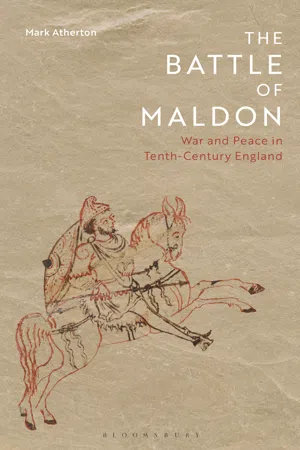
Depicting one of the defining conflicts of tenth-century England, The Battle of Maldon immortalises the bloody fight that took place along the banks of the tidal river Blackwater in 991, poignantly expressing the lore and language of a determined nation faced with the advance of a ruthless and relentless enemy. But, as Mark Atherton reveals, The Battle of Maldon is more than a heroic tale designed to inspire courage and unity in a time of crisis: rather, it celebrates ideals of loyalty and friendship and commemorates an event which changed the face of English culture.
Using Atherton's own vivid and illuminating translations from Old English, The Battle of Maldon: War and Peace in Tenth-Century England evokes the chaotic ebb and flow of the battle while also placing 'Maldon' in the context of its age. Seeking to reconstruct the way of life, the spirituality and the worldview of the original audience, Atherton examines how and why the poem encouraged its readers to relive the visceral experience of battle for themselves.
With this exciting study, Atherton provides an authoritative treatment of this iconic text, its history and its legacy. As such, this important book will be a vital resource for all readers of Old English literature and early medieval history.
- 256 pages
- English
- ePUB (mobile friendly)
- Available on iOS & Android
eBook - ePub
About this book
Information
PART 1
Approaches to The Battle of Maldon
Chapter 1
The grounds of Maldon
Het þa bord beran beornas gangan
þæt hi on þam easteðe ealle stodon
ne mihte þær for wætere, werod to þam oðrum
þær com flowende flod æfter ebban
lucon lagustreamas to lang hit him þuhte
hwænne hi togædere garas beron.
THE BATTLE OF MALDON (62–7)
[He ordered shields to be carried, men to advance,
until they all stood on the riverbank.
Because of the water the one army could not reach the other.
Then came flowing the flood-tide after the ebb,
ocean-streams locked together. Too long, it seemed to them,
before they would bear their spears together.]
Maldon the port
The long stretch of the coastline of south-eastern England, from the corner of Kent up to Suffolk, is remarkable for a number of similarly situated large river estuaries, all basically flowing down parallel lines from west to east, and all providing suitable sites for sheltered ports and trading stations. In the south of this area is the Medway, with the town of Rochester at its head, and then the Thames, by far the largest of these tidal estuaries and the reason for the growth and importance of the port of London – a process that probably began in the Roman period. In the north of this area, and already in East Anglia, you will find a confluence of three rivers where the estuaries of the Stour and the Orwell and then the narrow winding inlet of the Deben all reach the sea near present-day Harwich and Felixstowe. At the head of the Deben is Woodbridge, possibly the place where long ago in the seventh century the East Angles beached a sailing ship and dragged it uphill and overland to Sutton Hoo, to make it the centre of a magnificent showpiece royal ship burial.1 At the head of the Orwell is the town of Ipswich, an important trading centre throughout the early medieval period.

Figure 4 The Orwell estuary. © Mark Atherton.
In the middle of this stretch of coastline between the Thames and the Stour is the large estuary of the Blackwater, and at its head stands the town and port of Maldon, between the former administrative districts of Chelmsford Hundred and Wibertherne Hundred, now called the Dengie Peninsula. The original settlement of Maldon looks down from the hilltop over the Blackwater estuary and the surrounding territory. To the north, as we have seen, there is a crossing of the rivers Chelmer and Blackwater at Heybridge. To the west and south are three villages aptly named Woodham, in each case with a by-name derived from later Norman families who owned them: Woodham Walter, Woodham Mortimer, Woodham Farrers. The woodland implied in these place-names still survives in patches. In his literary travelogue The Wild Places the writer Robert Macfarlane begins a walk through a strip of ancient woodland near Woodham Walter then east along the Chelmer river to Maldon, and east of Maldon the Dengie:
The Dengie is a blunt-nosed peninsula in eastern Essex, just under a hundred square miles in area and bordered on three sides by water – the Blackwater estuary to its north, the North Sea to its east, the Crouch estuary to its south. Most of it is reclaimed land, below sea-level, saved from the tides by a network of sea-walls: grassed-over linear earthworks, fifteen feet high or more. It is provisional land, borrowed land. Stepping onto it you are stepping into a ghost of water.2
This is a mysterious, fog-bound world, celebrated by recent writers for its unpredictable salt-marsh terrain, which draws individuals on quests for a rare wild bird in the ‘beyond-world’ of The Peregrine, for the ‘beast in the Blackwater’ of The Essex Serpent.3 The low-lying Dengie is liable to flooding, and has been for centuries, as Macfarlane points out. The last great flood was in January 1953, but an entry for the year 1099 in the Peterborough manuscript of the Anglo-Saxon Chronicle describes a similar ‘great sea-flood’ (OE swiðe sæflod) on the east coast, which swa mycel to hearme gedyde swa nan man ne gemunet þet hit æfre æror dyde ‘did so much damage as no one remembers that it ever did before’.4
Historical records point to the existence of a number of prominent churches in the region. As the Northumbrian historian Bede reported in his Ecclesiastical History of the English Nation (completed in the year 731), the missionary and first bishop of the East Saxons was a man called Cedd (pronounced, strictly speaking, like ‘chedd’ in cheddar). Sent in the year 654 to the region by Oswy, king of the Northumbrians, to assist Sigbert, king of Essex, Cedd set about preaching to the East Saxons (Eccelesiastical History, bk III, ch. 22). According to Bede, Cedd built churches ‘in various places’, including especially in civitate quae lingua Saxonum Ythancaestir appellatur, ‘in the city called Ythancaestir in the Saxon tongue’.5 There are grounds for thinking that Ythancaestir is the location of the ancient chapel of St Peter-on-the-Wall, today a place of pilgrimage for Christians inspired by the so-called Celtic past, at a striking location at the end of the Dengie near Bradwell-on-Sea. With a touch of symmetry there is another early church dedicated to St Peter on the opposite side of the Blackwater estuary on the island of Mersea, as though together the two churches of St Peter would guard the mouth of the estuary.6
Maldon is basically a port. Before the characteristic Dengie landscape sets in, immediately to the east of Maldon itself is the harbour of Hythe Quay (hythe, Old English hyð, ‘landing-place’), to which small ships that have sailed up the channel of the Blackwater estuary can dock securely. There is a church on this site, dedicated to St Mary, which has been a place of Christian worship for about 1,400 years. One might also speculate that Cedd built this church of St Mary at Hythe too, amid the old ruins of a Roman temple or sanctuary, although this cannot be proved. By the tenth century, a wooden church stood next to the hythe, serving the needs of sailors and traders who berthed there. Over the centuries, it became the ‘Fishermen’s Church’. The oldest part of the present building is from the Norman period, but it has been rebuilt and augmented over the centuries. In early modern times, its famous lantern served as a landmark and aid to navigation, and the present building contains memorabilia of its location and function as a mariners’ church over many centuries.

Figure 5 The harbour at the Hythe, Maldon. © Dreamstime/Dianamower.
Because of its location, then, the town of Maldon can be seen as one of several gateways into southern England, as part of a pattern of important trading ports each situated at the head of a long estuary and providing a safe haven for ships. Like London or Colchester, which are both walled Roman cities, Maldon is defensible, situated as it is on the site of a hill fort, and this was necessary, for not all would-be users of this landing site have had friendly intentions. The point is well illustrated by an incident during the eighteenth-century hostilities with France, a relatively recent example by the chronology of this book. In 1744, in the run-up to the 1745 Jacobite rebellion under Bonnie Prince Charlie, England was on the alert for French invasions. With good reason, for there was in fact a planned invasion by the French, whose king, Louis XV, had recently declared war, and there were rumours of support from English Jacobite sympathizers.7
History was repeating itself: the fear of treachery at home – from Anglo-Danish families in the Danelaw – lies behind the account of The Battle of Maldon too.8 For their part, the French were aware of the potential Jacobite support for their planned invasion. A large army was assembled under Marshall Saxe, and a fleet of transports gathered, all at Dunkirk. Apparently, Maldon was the chosen destination for this D-day landing in reverse, for it was seen as the inroad to London, only forty-two miles away.9 But the winter weather proved treacherous, at least for the French. As Norman Longmate tells the story in his book Island Fortress, Vice-Admiral Jacques de Roquefeuil sailed out of the Breton harbour of Brest in February 1744, with orders to cover the invasion out of Dunkirk and lure away the English fleet towards the Isle of Wight. Finding the Isle of Wight empty of English ships, Roquefeuil sent messages to Saxe to begin the invasion from Dunkirk. But meanwhile, as Roquefeuil sailed along the coast of Kent towards Essex, he ran into the superior English fleet under Admiral John Norris at Dungeness, off Romney Marsh. It seemed inevitable that a sea-battle would take place, but the French ships slipped away as night fell. At around midnight, a great northeast gale blew up and vented all its fury on the retreating French warfleet; the ships fled before it, hurrying back to safety in Britanny. Meanwhile, the French transports had begun to set out, but twelve were sunk by the storm, and the rest retreated to Dunkirk. On this occasion, unlike their tenth-century Viking precursors, the invaders neve...
Table of contents
- Cover
- Half-Title
- Dedication
- Title
- Contents
- List of illustrations
- Acknowledgements
- Introduction
- Part I Approaches to The Battle of Maldon
- Part II After the battle
- Part III Appendices
- Notes
- Select bibliography
- Index
- Copyright
Trusted by 375,005 students
Access to over 1.5 million titles for a fair monthly price.
Study more efficiently using our study tools.
Frequently asked questions
Yes, you can cancel anytime from the Subscription tab in your account settings on the Perlego website. Your subscription will stay active until the end of your current billing period. Learn how to cancel your subscription
No, books cannot be downloaded as external files, such as PDFs, for use outside of Perlego. However, you can download books within the Perlego app for offline reading on mobile or tablet. Learn how to download books offline
Perlego offers two plans: Essential and Complete
- Essential is ideal for learners and professionals who enjoy exploring a wide range of subjects. Access the Essential Library with 800,000+ trusted titles and best-sellers across business, personal growth, and the humanities. Includes unlimited reading time and Standard Read Aloud voice.
- Complete: Perfect for advanced learners and researchers needing full, unrestricted access. Unlock 1.5M+ books across hundreds of subjects, including academic and specialized titles. The Complete Plan also includes advanced features like Premium Read Aloud and Research Assistant.
We are an online textbook subscription service, where you can get access to an entire online library for less than the price of a single book per month. With over 1.5 million books across 990+ topics, we’ve got you covered! Learn about our mission
Look out for the read-aloud symbol on your next book to see if you can listen to it. The read-aloud tool reads text aloud for you, highlighting the text as it is being read. You can pause it, speed it up and slow it down. Learn more about Read Aloud
Yes! You can use the Perlego app on both iOS and Android devices to read anytime, anywhere — even offline. Perfect for commutes or when you’re on the go.
Please note we cannot support devices running on iOS 13 and Android 7 or earlier. Learn more about using the app
Please note we cannot support devices running on iOS 13 and Android 7 or earlier. Learn more about using the app
Yes, you can access The Battle of Maldon by Mark Atherton in PDF and/or ePUB format, as well as other popular books in History & British History. We have over 1.5 million books available in our catalogue for you to explore.