One of the main challenges students face upon entering design school is little knowledge of the field, its terminology and best practices. Unsurprisingly, most new students have never fully developed a concept or visual idea, been in a critique, or have been asked to explain their work to others.
This book demystifies what design school is really like and explains what will be experienced at each stage, with particular focus on practical advice on topics like responding to design briefs and developing ideas, building up confidence and understanding what is expected.
· Student work is critiqued to show how projects are really assessed
· Profiles highlight how professional designers themselves address client briefs
· Tips for real-life problems are outlined, like getting stuck and dealing with critical feedback
Written by experienced instructors, this is the perfect guide for those starting their design education.
eBook - ePub
The Graphic Design Process
How to be successful in design school
- 200 pages
- English
- ePUB (mobile friendly)
- Available on iOS & Android
eBook - ePub
About this book
Information

An open sketchbook, a designer’s most essential tool.
Part One
ABOUT THE DESIGN PROCESS
DESIGN THINKING
Being a graphic designer means that you need to be ‘creative on demand’, generating visual and conceptual ideas consistently and to schedule. In both school and practice, you will need to generate ideas and good design, even when you feel tired, overworked or uninspired. To do so you will need to develop a design process that fosters and supports creative thinking. An effective design process that you can rely on to help you focus, and to open paths to your creativity, is one of the major things you are learning in design school. Part One of this book explains how most design processes share common ideas and methods. We begin by explaining the way designers think and how they learn to be creative, and why a design process is necessary to success. We finish with an explanation of the ‘4Ds’: a framework for the design process that helps us to produce creative projects. In Part Two we explain how the 4D framework can be employed in your own graphic design projects in school and beyond.
THINKING LIKE A DESIGNER
The term ‘design thinking’ is often used to describe the way designers in any discipline (product, service, fashion, industrial, etc.) work through a design problem. ‘Design thinking’ breaks the designer’s process down into a series of steps as follows:
Design process steps
1.Define the problem: This usually involves some sort of research.
2.Create many different ideas and options: This is called ‘divergent thinking’.
3.Refine the best ideas: This is called ‘convergent thinking’.
4.Steps 2 and 3 may be repeated.
5.Pick the best idea: Make prototypes and sometimes test them on users (user-testing) to refine the final design.
6.Steps 2, 3 and 4 may be repeated until the final design solution is completed.
Design thinking has been visualised and presented as a creative process, much like in the diagram below. You will find many kinds of designers, including graphic designers, saying they use a ‘design thinking process’, or ‘design thinking methodology’. If you hear this, it means that a designer solves problems by generating lots of ideas, refining and user-testing, before choosing and producing a final.
| 1 Discovery | 2 Interpretation | 3 Ideation | 4 Experimentation | 5 Evolution |
| Understand the challenge Prepare research gather inspiration | Tell stories and search for meaning, frame opportunities | Generate ideas and refine ideas | Make prototypes and get feedback | Track learnings Move forward |

This diagram is based on the IDEO’s visualisation of the design thinking process. Many point to IDEO as the origin of design-thinking in graphic design. Certainly through their books, talks, tools and online courses, IDEO are the most visible proponent of design thinking as a creative process method.
‘Design thinking’ is currently accepted as a process applicable to solving all kinds of problems, but it is a contested idea in the graphic design community because it somewhat glosses over exactly how to do the ‘creative’ part of the design process. Some doubt that a series of steps adequately explains the way graphic designers work – so we will explore this idea further in a moment. However, the simplicity of design thinking does demystify the design process and makes it easier to understand the way we learn to design, so it’s a good place to start.
LEARNING TO BE CREATIVE
Designers have to be creative to do their job. There are two ways of thinking about being creative. The first, and most commonly held idea is that there is something unique about designers: that they are just ‘creative people’ born with a special talent that design school nurtures. The other idea is represented by ‘design thinking’: design is not a unique ability, rather it is a process and a tool, which can be learned and used by designers and non-designers alike.
Some design theorists1 have broken down the design process into a series of ‘easily repeatable’ steps, which implies the creativity of the individual designer is not important. As long as you follow the steps, design will result. Other theorists2 have argued that designers have special abilities, something they call a ‘designer’s intuition’ or a ‘design eye’, which means that the designer as a person is essential to the design process. In this view, without the designer’s creative abilities there can be no design.
We agree with both views. Designing is a series of steps that can be learned, but it is the way a designer applies their intuition to the steps that makes the ‘magic’ happen. However, intuition isn’t a natural inborn talent that some possess, and others do not. A designer’s intuition is also a series of steps that can be learned. A design idea does not come into our minds like a lightning bolt of inspiration, even if it sometimes feels that way. An idea is the result of a series of small thinking ‘leaps’ or ‘creative connections’, which design theorist Nigel Cross calls a creative bridge. Designers mentally ‘walk’ across the creative bridge to an idea, rather than making a big mental leap across nothing to an idea. Designers often cross the bridge in a subconscious way, and this is why it looks like ‘talent’. Some people are naturally ‘more creative’ because they can more easily make creative connections before they start training. This is why we say that graphic design is not a ‘mysterious, ineffable art’3 that only a talented few can master. A designer’s intuition is just a special way of thinking that must be learned and honed through practise. The most compelling evidence that we may be right is of course that all sorts of people learn to be graphic designers all the time. Some people just more effortlessly walk over the creative bridge without much practise, while others might have to crawl across it, at least at first. As is so often the case though, the harder you work, the more ‘talented’ you become.
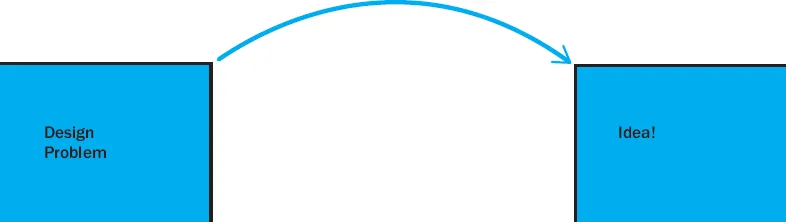
How we think designers get ideas — by ‘leaping’ from the problem straight to a design idea
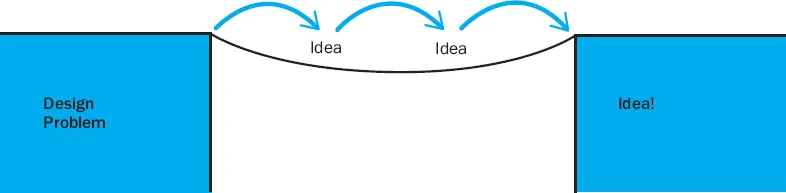
How designers actually get their ideas — by stepping from idea to idea to ‘cross’ the ‘creative bridge’
The Creative Bridge as described by Nigel Cross.
THE TROUBLE WITH ‘DESIGN THINKING’ IN GRAPHIC DESIGN
When broadly applied to the graphic design process, ‘design thinking’ might look as follows:
Design thinking steps
1.Define the problem: A project brief is given to, created (or modified) by the designer, who may conduct and/or be supplied with research to help them understand the problem.
2.Create many different ideas and options: The designer generates multiple rough initial ideas and drafts.
3.Refine the best ideas: The designer creates multiple iterations and prototypes of a number of ideas to find the best one.
4.Steps 2 and 3 may be repeated.
5.Pick the best idea and produce: Craft and produce the work to the required specifications. The designer may or may not test the final design on users.
It must be noted however, there is no prescribed or exact way of working that all graphic designers follow – only generally held and commonly shared ideas. Although this process broadly applies, not all graphic designers follow the steps in the order we presented here. Other visualisations of the graphic design process have five or seven steps rather than four, and the steps can often overlap or be repeated. All graphic design teachers teach a design process4 of some kind.
While design thinking maps to the general graphic design process we outline here, it has been criticised for several practical reasons. While some graphic design projects benefit from extensive research and user testing, others do not. Testing on audiences has a patchy track record in predicting success. Some designers argue that user research stifles innovation because the audience is not an expert in good design,5 and usability is not always the only concern in graphic design.
Most criticism of design thinking surrounds its focus on process over aesthetics: It is possible for a designer to follow the design thinking process steps exactly, all the while making poor visual and conceptual decisions, and end up with a bad design. This point is important because aesthetics matter in graphic design. As Pentagram Designer, Natasha Jen, notes: ‘Beauty is precision and intelligenc – not decoration, aesthetics is essential to the success of a design, not an optional add-on.’
Effective graphic design must catch the audience’s attention and then compel them to keep looking so that they take in the message and (hopefully) take the desired action. It is...
Table of contents
- Cover
- Title Page
- Contents
- Glossary of key terms
- Introduction
- PART 1 ABOUT THE DESIGN PROCESS
- PART 2 USING A DESIGN PROCESS
- Glossary of key terms
- Annotated further reading
- Index
- Acknowledgements
- eCopyright
Trusted by 375,005 students
Access to over 1.5 million titles for a fair monthly price.
Study more efficiently using our study tools.
Frequently asked questions
Yes, you can cancel anytime from the Subscription tab in your account settings on the Perlego website. Your subscription will stay active until the end of your current billing period. Learn how to cancel your subscription
No, books cannot be downloaded as external files, such as PDFs, for use outside of Perlego. However, you can download books within the Perlego app for offline reading on mobile or tablet. Learn how to download books offline
Perlego offers two plans: Essential and Complete
- Essential is ideal for learners and professionals who enjoy exploring a wide range of subjects. Access the Essential Library with 800,000+ trusted titles and best-sellers across business, personal growth, and the humanities. Includes unlimited reading time and Standard Read Aloud voice.
- Complete: Perfect for advanced learners and researchers needing full, unrestricted access. Unlock 1.5M+ books across hundreds of subjects, including academic and specialized titles. The Complete Plan also includes advanced features like Premium Read Aloud and Research Assistant.
We are an online textbook subscription service, where you can get access to an entire online library for less than the price of a single book per month. With over 1.5 million books across 990+ topics, we’ve got you covered! Learn about our mission
Look out for the read-aloud symbol on your next book to see if you can listen to it. The read-aloud tool reads text aloud for you, highlighting the text as it is being read. You can pause it, speed it up and slow it down. Learn more about Read Aloud
Yes! You can use the Perlego app on both iOS and Android devices to read anytime, anywhere — even offline. Perfect for commutes or when you’re on the go.
Please note we cannot support devices running on iOS 13 and Android 7 or earlier. Learn more about using the app
Please note we cannot support devices running on iOS 13 and Android 7 or earlier. Learn more about using the app
Yes, you can access The Graphic Design Process by Anitra Nottingham,Jeremy Stout in PDF and/or ePUB format, as well as other popular books in Design & Graphic Design. We have over 1.5 million books available in our catalogue for you to explore.