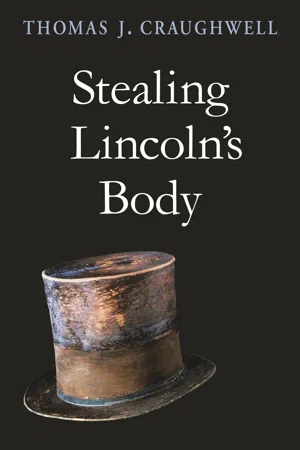
On the night of the presidential election in 1876, a gang of counterfeiters out of Chicago attempted to steal the entombed embalmed body of Abraham Lincoln and hold it for ransom. The custodian of the tomb was so shaken by the incident that he willingly dedicated the rest of his life to protecting the president's corpse.
In a lively and dramatic narrative, Thomas J. Craughwell returns to this bizarre, and largely forgotten, event with the first book to place the grave robbery in historical context. He takes us through the planning and execution of the crime and the outcome of the investigation. He describes the reactions of Mary Todd Lincoln and Robert Todd Lincoln to the theft—and the peculiar silence of a nation. He follows the unlikely tale of what happened to Lincoln's remains after the attempted robbery, and details the plan devised by the Lincoln Guard of Honor to prevent a similar abominable recurrence.
Along the way, Craughwell offers entertaining sidelights on the rise of counterfeiting in America and the establishment of the Secret Service to combat it; the prevalence of grave robberies; the art of nineteenth-century embalming; and the emergence among Irish immigrants of an ambitious middle class—and a criminal underclass.
This rousing story of hapless con men, intrepid federal agents, and ordinary Springfield citizens who honored their native son by keeping a valuable, burdensome secret for decades offers a riveting glimpse into late-nineteenth-century America, and underscores that truth really is sometimes stranger than fiction.
- 250 pages
- English
- ePUB (mobile friendly)
- Available on iOS & Android
eBook - ePub
Stealing Lincoln’s Body
About this book
Information
1
The World of the Counterfeiters

In 1647 the General Court of Rhode Island ordered the confiscation of all counterfeit wampum. The counterfeiters were Indians, members of the Algonquian nation, a large group of tribes that dominated what is now the northeastern United States. Their currency was wampum, strings of beads made from white whelk shells and purple-black quahog shells. In the Indian economy, the quahog shells were worth about twice as much as the whelk. It was an unfamiliar form of money to Europeans; but since the gold and silver coins of the Old Country were scarce in the New World, the English colonists of Rhode Island and the Dutch colonists of New Netherlands agreed among themselves to adopt wampum as legal tender. It wasn’t long before the Indians realized that here was an opportunity to take advantage of the newcomers. They hoarded the valuable quahog shells for themselves, dyed the cheaper white shells a dark purplish black, then passed them off as the real thing to the undiscerning Europeans. (The record is sketchy, but it is probable that Europeans also manufactured counterfeit wampum.) It took some time, but eventually the white men discovered that they had been had. Soon thereafter, the colonists went off the “wampum standard” and returned to conducting their business with gold and silver coins.1
But hard money was still in short supply, so in 1652 the government of Massachusetts authorized the first mint in British North America. The Massachusetts mint issued a series of silver coins, some stamped simply “NE,” for “New England,” others engraved with images of oak, pine, or willow trees. Today, collectors covet these coins as the first examples of American-made money. But coins from Massachusetts bear another distinction—among them were the first coins counterfeited in America, beginning around 1674, when John du Plessis was found guilty of turning out pewter imitations.2 Alas, the du Plessis case was not an isolated incident. Very quickly, counterfeiting became rife in the colonies.
In 1682 William Penn complained that he could not bring his “holy experiment” in Pennsylvania to fruition when half the coinage in his colony was phony. Counterfeit shillings were so common in Connecticut in 1721 that the colonial government despaired of ever getting them out of circulation. Delegates from the lower house of the Connecticut legislature suggested they accept the bogus coins as legitimate currency and assign them an actual value of two pence. In 1735 the governing council of South Carolina conceded that the colony’s paper money was so debased by counterfeits that the colony had no choice but to recall all the fifteen-, ten-, four-, and three-pound notes. Making the matter worse was the English custom of transporting felons to America. In 1770 the convict ship Trotman docked in Maryland. Among the exiles were a number of counterfeiters, who within days of coming ashore were back in business.3
Poverty and illiteracy allowed counterfeiting to flourish. Since few colonists had ever seen a gold coin, they would accept any shiny, circular, gold-colored piece of metal as the genuine article. In the case of paper currency, so few colonists could read that sloppily printed counterfeit currency bearing such absurd spelling errors as “Instice” for “Justice,” or “Two Crowes” for “Two Crowns,” passed undetected through the hands of the unlettered. Consequently, colonists who were barely scraping by suffered the most from bad money, while the literate and well-to-do spotted these crude jobs at once and refused to accept them.4
Initially, the courts treated counterfeiting as a misdemeanor. A New York silversmith caught producing false coins in 1703 was punished with a small fine. But as counterfeit money took a greater toll on America’s economy, the judges’ sentences became harsher. In 1720 a Philadelphia counterfeiter was hanged, and in Newport, Rhode Island, a counterfeiter had his ears sliced off as a prelude to being sold into indentured servitude. To show that it meant business, New Jersey’s colonial government adopted a motto for its three-shilling note: “To Counterfeit is Death.”5
In spite of the shoddy coins and paper money in circulation, some ambitious counterfeiters understood that they would realize greater profits by turning out a superior product. In the early part of the eighteenth century two of the most successful counterfeiters in America were women. In 1712 Freelove Lippencott, the wife of a Rhode Island sailor, traveled to England, where she had plates engraved, patterned on the paper money of Rhode Island, Massachusetts, and Connecticut. Back home she recruited a gang of men known as shovers to put her false currency into circulation.6
The most ingenious of the eighteenth-century American counterfeiters was Mary Butterworth, the wife of a prosperous house builder in Rehoboth, Massachusetts. She was thirty years old and the mother of seven children in 1716, when she started making paper currency in her kitchen. Butterworth’s method was breathtakingly original. First, she placed a piece of damp muslin over the bill she planned to counterfeit, then ran over it with a hot iron—the one she used to press clothes. The heat, by causing some of the ink to adhere to the muslin, created a pattern. Next, Butterworth laid the pattern on a blank piece of paper and ran the iron over the muslin again, a process that transferred the ink to the paper. With a fine pen she filled in the rest of the details of the bill, then burned the muslin pattern, thereby eliminating the evidence. It was a brilliant method, one that worked so well that Mary Butterworth turned her counterfeiting into a cottage industry employing three of her brothers, Israel, Steven, and Nicholas Peck, as well as Nicholas’s wife Hannah, to help her produce high-quality forgeries of Massachusetts, Rhode Island, and Connecticut currency. Mary Butterworth sold her product (she never used her bogus money herself) at half its face value to her shovers, among whom were a neighborhood innkeeper, some of the carpenters who worked for her husband, and the local deputy sheriff.
For seven years Mary churned out her bad money without attracting the attention of the law. Then, in 1723, she came under suspicion of counterfeiting. The authorities searched her house, but they found not a scrap of evidence against her. After all, there is nothing incriminating about a clothes iron and a fine pen. Nonetheless, the episode unnerved Mary; she gave up counterfeiting and lived quietly until her death in 1775 at eighty-nine years of age.7
The undisputed king of eighteenth-century American counterfeiters was a Morristown, New Jersey, engraver named Samuel Ford. In the 1760s and 1770s he produced imitations of New Jersey, New York, and Pennsylvania currency so good that even the provincial treasurers of those colonies could not tell the difference between a forgery by Ford and the real thing. Small wonder that he was never caught.8
With the outbreak of the American Revolution, the Continental Congress authorized a national paper currency—popularly known as continentals—backed by the credit of the United States. This was a problematic claim, for no European power had recognized that the American rebellion marked the birth of a legitimate new nation, let alone that the rebels possessed the type of credit international bankers would respect. There was also the matter of the American treasury—in essence, none existed. The thirteen states collected customs duties and taxes, and precious little of what they took in made its way to the congressional coffers in Philadelphia. Realizing that the new American currency had an unstable foundation, the British concluded that it would not take much to depreciate it. So around January 1776 a printing press was hauled out to the warship HMS Phoenix in New York harbor; the ship became a British-sanctioned counterfeiting workshop. The British counterfeits of continentals were excellent—so good, in fact, that in April 1777 the king’s counterfeiters ran an ad in a New York newspaper offering to sell their false currency to loyal subjects of the Crown at a rock-bottom price—the cost of the paper it was printed on. The counterfeiters boasted about their bills: “[They] are so neatly and exactly executed that there is no Risque … it being almost impossible to discover, that they are not genuine.”9
The British found an indigenous distribution network for their phony money among the Tories, Americans who remained loyal to King George. One such loyalist, Colonel Stephen Holland, operated a network of shovers that extended from his home in New Hampshire down to the colonies in the South. Two other distributors, David Farnsworth and John Blair, were arrested by supporters of the American cause in Danbury, Connecticut, with ten thousand dollars’ worth of false continentals on their persons. They tried to excuse themselves, saying that they were petty criminals compared with other members of their gang, who had passed forty thousand or fifty thousand dollars in bad currency elsewhere.10
The British lost the war, but they won the campaign to undermine America’s finances. By 1779, less than three years after it was first issued, the continental currency was so debased that Congress declined to print any more. Fortunately for the new United States, its finances were rescued by the timely arrival of loans from France and the creative accounting of Robert Morris, the financial wizard of the Revolution.11
After the continental currency debacle, the general trend after the Revolution was toward establishing a monetary system based on gold and silver coins, a movement that gained momentum in 1792 when Congress authorized the establishment of the U.S. Mint. This did not stop the counterfeiters, however: they simply acquired new equipment to manufacture coins. A story has come down to us of an English counterfeiter named Peach who set up shop in the basement of a house on James Street on Manhattan’s East Side, in what is now Chinatown. Peach manufactured “gold” Spanish doubloons, which had been esteemed good money in America since colonial times and were still in circulation in the 1820s. He was a man who took pride in his work; his false doubloons were of exactly the same weight and stamped with precisely the same design as authentic doubloons. Peach even took the trouble to “age” his coins. He churned his finished product in a barrel of sawdust, which rubbed the shine off the new coins and gave them a much-handled appearance. Next, he scattered the coins on a sheet of iron, then held the iron over a fire until the doubloons were slightly tarnished around the edges. This was a nice, authentic touch, because genuine doubloons really were tarnished, as a result of the coins’ soaking in bilgewater in the hold of the Spanish treasure ships that distributed doubloons to Spain’s colonies in the New World.12
Although the United States shied away from instituting a national paper currency, individual banks issued their own paper money known as banknotes. Unlike a national currency, the banknotes had no uniform design—bankers adopted whatever style they found appealing. This absence of a single, universally accepted banknote proved a bonanza for counterfeiters. By 1859, the eve of the Civil War, nearly four thousand different types of counterfeit bills were in circulation. Some were authentic banknotes whose denomination had been tampered with—a one-dollar bill became a ten; a five-dollar bill became a fifty. Others were outright counterfeits, ostensibly drawn against real or imaginary banks.13
Like all criminal professions, counterfeiting had its own vocabulary. Coney and queer were terms for counterfeit currency. The person who manufactured the false money was a coney man or a koniacker. Boodle meant bundles of counterfeit bills. A boodle carrier sold the counterfeit currency to distributors known as shovers. To shove meant to pass counterfeits in public as real money. As for real currency itself, that was rhino, nails, putty, or spondulics.14
In the years before the Civil War, counterfeiters began to congregate in carefully selected urban areas. Before 1820 counterfeiters had set up shop in any place that suited them; some were in small towns, others out in rural areas. Some even operated out of Canada. After 1820 almost all counterfeiters relocated to cities—especially cities that had a substantial printing industry and were major transportation hubs. Since there were more printing and engraving businesses in the lower Manhattan neighborhood bounded by Broadway, the Bowery, Houston, and Chatham Streets than anywhere else in the country, this area became the unofficial capital of American counterfeiting. St. Louis did not have many printing businesses, but it enjoyed two other assets that counterfeiters prized. First, its location on the Mississippi River and its proximity to the Ohio and Missouri Rivers made it a natural distribution center for channeling the queer into the Midwest and the Far West. Second, Missourians hated banks. Time and again voters had rejected proposals to charter a state bank. As a result, the only paper currency in Missouri was banknotes from out-of-state banks, a situation that made the citizens of St. Louis and the rest of the state especially easy marks for counterfeiters.15
Yet in the years before the Civil War, as counterfeiting spread across the United States, it met with only haphazard resistance from local law enforcement. Certainly arrests were made: nineteen counterfeiters were arrested in New York City in 1830; thirty-one were picked up in 1840. Arrests dropped, inexplicably, to thirteen in 1850, then skyrocketed to ninety in 1860. In spite of these statistics, neither New York nor any other American metropolis ever launched an all-out campaign to eliminate counterfeiting from its jurisdiction. City police forces of the pre-Civil War era were not designed to fight counterfeiters. City cops were not trained as detectives. They were patrolmen who walked an assigned area of the city, the rationale being that the presence of a uniformed officer on the streets would make the criminals of the neighborhood think twice. A different type of lawman was required to track down counterfeiters, someone who had informants among the criminal underclass, who perhaps could work effectively undercover, and whose duties permitted him to spend months closing in on a suspect. No such crime-fighting organization existed in the United States of the 1860s. I...
Table of contents
- Cover
- Title
- Copyright
- Dedication
- Acknowledgments
- Contents
- Prologue: “Lay My Remains in Some Quiet Place”
- 1 The World of the Counterfeiters
- 2 Big Jim’s Kennally’s Big Idea
- 3 The Boss Body Snatchers of Chicago
- 4 “The Devils Are Up Here”
- 5 The Body in the Basement
- 6 “The Tools of Smarter Men”
- 7 The Lincoln Guard of Honor
- 8 A Pullman-Style Burial
- Epilogue: Safe and Secure at Last
- Notes
- Bibliography
- Index
Trusted by 375,005 students
Access to over 1.5 million titles for a fair monthly price.
Study more efficiently using our study tools.
Frequently asked questions
Yes, you can cancel anytime from the Subscription tab in your account settings on the Perlego website. Your subscription will stay active until the end of your current billing period. Learn how to cancel your subscription
No, books cannot be downloaded as external files, such as PDFs, for use outside of Perlego. However, you can download books within the Perlego app for offline reading on mobile or tablet. Learn how to download books offline
Perlego offers two plans: Essential and Complete
- Essential is ideal for learners and professionals who enjoy exploring a wide range of subjects. Access the Essential Library with 800,000+ trusted titles and best-sellers across business, personal growth, and the humanities. Includes unlimited reading time and Standard Read Aloud voice.
- Complete: Perfect for advanced learners and researchers needing full, unrestricted access. Unlock 1.5M+ books across hundreds of subjects, including academic and specialized titles. The Complete Plan also includes advanced features like Premium Read Aloud and Research Assistant.
We are an online textbook subscription service, where you can get access to an entire online library for less than the price of a single book per month. With over 1.5 million books across 990+ topics, we’ve got you covered! Learn about our mission
Look out for the read-aloud symbol on your next book to see if you can listen to it. The read-aloud tool reads text aloud for you, highlighting the text as it is being read. You can pause it, speed it up and slow it down. Learn more about Read Aloud
Yes! You can use the Perlego app on both iOS and Android devices to read anytime, anywhere — even offline. Perfect for commutes or when you’re on the go.
Please note we cannot support devices running on iOS 13 and Android 7 or earlier. Learn more about using the app
Please note we cannot support devices running on iOS 13 and Android 7 or earlier. Learn more about using the app
Yes, you can access Stealing Lincoln’s Body by Thomas J. Craughwell,Thomas J. CRAUGHWELL in PDF and/or ePUB format, as well as other popular books in History & Political Biographies. We have over 1.5 million books available in our catalogue for you to explore.