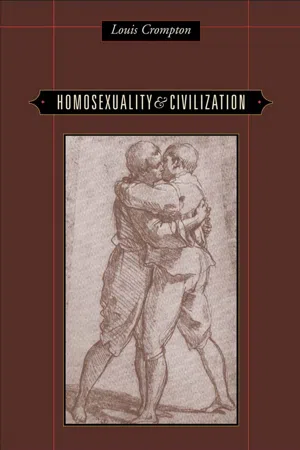
How have major civilizations of the last two millennia treated people who were attracted to their own sex? In a narrative tour de force, Louis Crompton chronicles the lives and achievements of homosexual men and women alongside a darker history of persecution, as he compares the Christian West with the cultures of ancient Greece and Rome, Arab Spain, imperial China, and pre-Meiji Japan.
Ancient Greek culture celebrated same-sex love in history, literature, and art, making high claims for its moral influence. By contrast, Jewish religious leaders in the sixth century BCE branded male homosexuality as a capital offense and, later, blamed it for the destruction of the biblical city of Sodom. When these two traditions collided in Christian Rome during the late empire, the tragic repercussions were felt throughout Europe and the New World.
Louis Crompton traces Church-inspired mutilation, torture, and burning of "sodomites" in sixth-century Byzantium, medieval France, Renaissance Italy, and in Spain under the Inquisition. But Protestant authorities were equally committed to the execution of homosexuals in the Netherlands, Calvin's Geneva, and Georgian England. The root cause was religious superstition, abetted by political ambition and sheer greed. Yet from this cauldron of fears and desires, homoerotic themes surfaced in the art of the Renaissance masters—Donatello, Leonardo, Michelangelo, Sodoma, Cellini, and Caravaggio—often intertwined with Christian motifs. Homosexuality also flourished in the court intrigues of Henry III of France, Queen Christina of Sweden, James I and William III of England, Queen Anne, and Frederick the Great.
Anti-homosexual atrocities committed in the West contrast starkly with the more tolerant traditions of premodern China and Japan, as revealed in poetry, fiction, and art and in the lives of emperors, shoguns, Buddhist priests, scholars, and actors. In the samurai tradition of Japan, Crompton makes clear, the celebration of same-sex love rivaled that of ancient Greece.
Sweeping in scope, elegantly crafted, and lavishly illustrated, Homosexuality and Civilization is a stunning exploration of a rich and terrible past.
- 621 pages
- English
- ePUB (mobile friendly)
- Available on iOS & Android
eBook - ePub
Homosexuality and Civilization
About this book
Information
CHAPTER ONE
EARLY GREECE
776 – 480 BCE
• A Millennium of Greek Love •
In all history, no society has aroused the same enthusiasm as ancient Greece. This is a truism, yet the fact remains incontestable. Greek achievements in literature, art, and architecture set norms for the Western world for two thousand years. When we think, we still employ the intellectual categories its philosophers and scientists devised. By resisting Persian might, Greece made Europe possible. In politics, democracy was a Greek invention. Though women and slaves failed to share the benefits of freedom and equality, it was these ideals that ultimately called into question their own exclusions. Above all, the Greeks charm us by their sociability, their lively openness to ideas, and their liberality of spirit. Civilization, already millennia old in Egypt, Sumer, India, and China, took a vast leap forward under the stimulus of the Greek experiment.
Yet there was one aspect of Greek life that students of antiquity long chose to consign to the category of the “unmentionable.” In E. M. Forster’s novel Maurice, the Cambridge translation class is routinely cautioned, “Omit: a reference to the unspeakable vice of the Greeks.”1 The novel is set in 1910, but four decades later a scholar of repute could still remark, “This aspect of Greek morals is an extraordinary one, into which, for the sake of our equanimity, it is unprofitable to pry too closely.”2 And indeed, despite the importance of the subject, no book on Greek homosexuality was circulated openly in English until 1978. Christian Europe, from the fourth century onward, regarded same-sex relations as anathema, and its nations competed in devising punishments for “unnatural” crimes. Homosexuality became the peccatum non nominandum inter Christianos, “the sin not even to be mentioned among Christians.” Such references as did appear were mainly confined to legal treatises, where penalties were spelled out, or to works of moral theology, where it was necessary for completeness’ sake to list the worst human vices.
In Greek history and literature, on the other hand, the abundance of accounts of homosexual love overwhelms the investigator. Homer’s intentions in the Iliad (c. 800 BCE) have been the subject of much debate. There is ample evidence, however, that by the beginning of the classical era (480 BCE) his archaic heroes Achilles and Patroclus had become exemplars of male love. Greek lyric poets sing of male love from almost the earliest fragments down to the end of classical times. Five brilliant philosophical dialogues debate its ethics with a wealth of illustrations, from Plato and Xenophon to Plutarch and the pseudo-Lucian of the third century CE. In the public arena of the theater we know that tragedies on this theme were popular, and Aristophanes’ bawdy humor is quite as likely to be inspired by sex between males as by intercourse between men and women. Vase-painters portray scores of homoerotic scenes, hundreds of inscriptions celebrate the love of boys, and such affairs enter into the lives of a long catalogue of famous Greek statesmen, warriors, artists, and authors. Though it has often been assumed that the love of males was a fashion confined to a small intellectual elite during the age of Plato, in fact it was pervasive throughout all levels of Greek society and held a honored place in Greek culture for more than a thousand years, that is, from before 600 BCE to about 400 CE.
Greek religion, too, testifies to the hold pederasty had upon the Greek imagination. Mythology provides more than fifty examples of youths beloved of deities.3 Poetry and popular traditions ascribe such affairs to Zeus, Poseidon, Apollo, Hercules, Dionysus, Hermes, and Pan—that is, to nearly all the principal male gods of the Olympian pantheon. Only the war god Ares is (surprisingly) missing. Among the poets, Sappho, Alcaeus, Ibycus, Anacreon, Theognis, Pindar, and a host of contributors to the Greek Anthology sang of same-sex love. Aeschylus, Sophocles, and Euripides produced important plays, now lost, on the subject. The lives of Greek political leaders in a host of cities record episodes, crucial or trivial, of homoerotic passion. These include Solon, Peisistratus, Hippias, Hipparchus, Themistocles, Aristides, Critias, Demosthenes, and Aeschines in sophisticated Athens; Pausanias, Lysander, and Agesilaus in militaristic Sparta; Polycrates in his cultivated court on Samos; Hieron and Agathocles in Sicilian Syracuse; Epaminondas and Pelopidas in bucolic Thebes; and Archelaus, Philip II, and Alexander in semi-barbarous Macedon. Socrates spoke, and Plato and Xenophon wrote, of the inspirational powers of love between men, though they decried its physical expression. After Plato’s death the presidency of his Academy passed from lover to lover. Among the Stoics, Zeno, Cleanthes, and Chrysippus extolled the love of boys. We know much less of the lives of Greek artists, but Phidias’s love for Pantarces was memorialized in marble. In the later Hellenistic age (332 BCE–400 CE) Plutarch, Athenaeus, and Aelian recorded the history of Greek love from its earliest times, while poets from Theocritus to Nonnus celebrated pederastic affairs in idylls, epigrams, and epics. This is an astounding record, including as it does most of the greatest names of ancient Greece during the greatest period of Greek culture.
Throughout these accounts, male attachments are presented in an honorific light, though there were always some skeptics. But for many biographers, for a man not to have had a male lover seems to have bespoken a lack of character or a deficiency in sensibility. It is this enthusiastic note, marked by a kind of spirited élan, that so clearly distinguishes the Greek view of homosexuality. We hear it sounded clearly and strongly in what is probably the most notable defense of male love in Greek literature, the speech that Plato puts in the mouth of Phaedrus at the beginning of the Symposium. Here is how the idealistic Athenian praises the male eros:
For I know not any greater blessing to a young man who is beginning life than a virtuous lover, or to a lover than a beloved youth. For the principle that ought to be the guide of men who would nobly live—that principle, I say, neither kindred, nor honor, nor wealth, nor any other motive is able to implant so well as love. Of what am I speaking? Of the sense of honor and dishonor, without which neither states nor individuals ever do any good or great work . . . And if there were only some way of contriving that a state or an army should be made up of lovers and their loves, they would be the very best governors of their own city, abstaining from all dishonor and emulating one another in honor; and it is scarcely an exaggeration to say that when fighting at each other’s side, although a mere handful, they would overcome the world.4
Phaedrus believes that no man would run away in battle if his lover’s eyes were upon him: this would be too ignominious to imagine. We shall consider Plato’s reservations more generally in a later chapter. But Phaedrus is giving voice to what was probably the typical view of an educated Greek of his time. Nor was this view restricted to intellectual circles. Its peculiar note of exaltation echoes repeatedly through all levels of Greek society. Like the rest of humanity, the ancient Greek was susceptible to various erotic moods—heroic, tender, frivolous, ribald, even, on occasion, brutal. But the notion of the potential ennobling effect of such love remained common currency from almost the earliest days of recorded Greek history down to the triumph of Christianity. It cast over the idea of paiderastia a strong aura of glamor. On public occasions it might be respectfully saluted before an audience made up of all classes, as in the case of Aeschines’ speech to the jurors of Athens. Belief in its edifying possibilities was one of the pieties of the tribe, not just for an elite but for the average citizen.
• Homer’s Iliad •
The ancient Greeks had no word that corresponded to our word “homosexual.” Paiderastia, the closest they came to it, meant literally “boy love,” that is, a relation between an older male and someone younger, usually a youth between the ages of fourteen and twenty. The older man was called the erastes or lover. Ideally, it was his duty to be the boy’s teacher and protector and serve as a model of courage, virtue, and wisdom to his beloved, or eromenos, whose attraction lay in his beauty, his youth, and his promise of future moral, intellectual, and physical excellence. In the Symposium, Phaedrus and the other speakers are always careful to use one term or the other as the occasion requires.
This is especially striking in Phaedrus’ discussion of the Iliad. Here he finds his ideal lovers, for Achilles determines to revenge the death of his comrade-in-arms Patroclus, even though he has been warned by the gods that this will cost him his life. But Phaedrus is puzzled as to which role to assign to which man. He notes that Aeschylus, in one of his most famous tragedies, the Myrmidons, had made Achilles the protector, the erastes. But Phaedrus thinks this is at odds with Homer, since the Iliad emphasizes the remarkable beauty of Achilles, which in Phaedrus’ view, qualifies him rather for the role of the eromenos.
Plato wrote the Symposium about 385 BCE. By that time a well-established Greek tradition saw Achilles and Patroclus not just as comrades in battle but as lovers in the full physical sense. But did Homer himself mean us to perceive Achilles and Patroclus as lovers? At least since Plato’s day, the question has been a matter of debate. Aeschylus, writing a century earlier, clearly regarded their relation as sexual. We know his Myrmidons was an extremely popular tragedy, though only fragments have come down to us. These fragments, however, make the erotic nature of their love quite explicit. In them Achilles reproaches his dead friend for letting himself be killed, and in the agony of his grief speaks over Patroclus’ naked corpse—in language whose directness must have startled even the Athenians—of the “devout union of the thighs.”5 Aeschylus’ sexual reading of the relation was shared by many (though, as we shall see, not all) Greeks a...
Table of contents
- Cover
- Title
- Copyright
- Contents
- Preface
- 1 • Early Greece 776 – 480 BCE
- 2 • Judea 900 BCE – 600 CE
- 3 • Classical Greece 480 – 323 BCE
- 4 • Rome and Greece 323 BCE – 138 CE
- 5 • Christians and Pagans 1 – 565 CE
- 6 • Darkness Descends 476 – 1049
- 7 • The Medieval World 1050 – 1321
- 8 • Imperial China 500 BCE – 1849
- 9 • Italy in the Renaissance 1321 – 1609
- 10 • Spain and the Inquisition 1497 – 1700
- 11 • France from Calvin to Louis XIV 1517 – 1715
- 12 • England from the Reformation to William III 1533 – 1702
- 13 • Pre-Meiji Japan 800 – 1868
- 14 • Patterns of Persecution 1700 – 1730
- 15 • Sapphic Lovers 1700 – 1793
- 16 • The Enlightenment 1730 – 1810
- Conclusion
- Notes
- Bibliography
- Acknowledgments
- Illustration Credits
- Index
Trusted by 375,005 students
Access to over 1.5 million titles for a fair monthly price.
Study more efficiently using our study tools.
Frequently asked questions
Yes, you can cancel anytime from the Subscription tab in your account settings on the Perlego website. Your subscription will stay active until the end of your current billing period. Learn how to cancel your subscription
No, books cannot be downloaded as external files, such as PDFs, for use outside of Perlego. However, you can download books within the Perlego app for offline reading on mobile or tablet. Learn how to download books offline
Perlego offers two plans: Essential and Complete
- Essential is ideal for learners and professionals who enjoy exploring a wide range of subjects. Access the Essential Library with 800,000+ trusted titles and best-sellers across business, personal growth, and the humanities. Includes unlimited reading time and Standard Read Aloud voice.
- Complete: Perfect for advanced learners and researchers needing full, unrestricted access. Unlock 1.5M+ books across hundreds of subjects, including academic and specialized titles. The Complete Plan also includes advanced features like Premium Read Aloud and Research Assistant.
We are an online textbook subscription service, where you can get access to an entire online library for less than the price of a single book per month. With over 1.5 million books across 990+ topics, we’ve got you covered! Learn about our mission
Look out for the read-aloud symbol on your next book to see if you can listen to it. The read-aloud tool reads text aloud for you, highlighting the text as it is being read. You can pause it, speed it up and slow it down. Learn more about Read Aloud
Yes! You can use the Perlego app on both iOS and Android devices to read anytime, anywhere — even offline. Perfect for commutes or when you’re on the go.
Please note we cannot support devices running on iOS 13 and Android 7 or earlier. Learn more about using the app
Please note we cannot support devices running on iOS 13 and Android 7 or earlier. Learn more about using the app
Yes, you can access Homosexuality and Civilization by Louis Crompton in PDF and/or ePUB format, as well as other popular books in History & World History. We have over 1.5 million books available in our catalogue for you to explore.